 Add to Chrome
 Add to Firefox
 Add to Edge
ConstructCIE: A Dataset for Extracting Causal Information from Construction Accident Narratives
Aug 06, 2026
Construction accident narratives contain rich causal information, but the evidence is often implicit, long-span, and distributed. We introduce ConstructCIE, a manually annotated dataset for Causal Information Extraction from OSHA construction accident reports. The dataset uses a hierarchical schema for accident types, causal factors, sub-causal factors, and supporting evidence spans. We evaluate supervised sequence taggers and instruction-tuned LLMs in an end-to-end hierarchical extraction setting. Results show that most evaluated models achieve strong accident-type prediction and recover broad causal meaning but remain limited in precise span-level extraction. JHE generally achieves stronger exact and soft matching, while IHE sometimes achieves higher keyword F1. Error distributions vary by extraction strategy, but evidence-selection and span-boundary errors remain common. These findings show that reliable Causal Information Extraction for construction accidents requires stronger domain grounding and more accurate evidence extraction.

Speech2Grasp: Data-Efficient Transfer of Text-Conditioned Grasp Detection to Speech in Humanoid Robots
Jul 29, 2026Humanoid robots increasingly require multi-modal understanding for natural interaction with humans. Despite the prominence of vision-language models, they generally assume textual rather than the more natural speech inputs. In this paper, we investigate whether a well-established text-conditioned model can be transferred to speech in a data-efficient manner. Using ALBEF as a case study, we conduct diagnostic analyses showing that a lightweight MLP-based projector effectively adapts it to speech, while preserving semantic discrimination and robustness. Motivated by these findings, we introduce Speech2Grasp, a framework for data-efficient transfer of text-conditioned grasp detection to speech. Real-world humanoid robot experiments show that Speech2Grasp outperforms cascaded ASR-based pipeline, while reducing inference latency. Our findings suggest a practical paradigm for extending established text-conditioned systems to speech.
AI-accelerated End-to-End Framework for Rapid Professional Upskilling
Jul 15, 2026By 2030, 59 of every 100 workers will need reskilling or upskilling, yet the average time to close an enterprise skills gap grew from roughly 3 days in 2014 to 36 days in 2018. Most current frameworks accelerate single stages of upskilling programs and generally lack industry validation. We present an end-to-end framework that applies AI acceleration across five stages of knowledge acquisition, content development, content review and verification, teaching, and assessment development; with a strong focus on both production and learning efficiency. Three strong external signals validates the framework: the US National Association of State Boards of Accountancy reviewed and approved an upskilling program built on the framework for continuing-professional-education credits; 3 learners followed the program and passed the NVIDIA Certified Professional in Agentic AI exam in a significantly short amount of time, with 14 more in progress; the program's knowledge base supports complex downstream analysis such as the production of a robust 1,267 risk item dataset for managing multi-agent AI system risks.
3D Point World Models: Point Completion Enables More Accurate Dynamics Learning
Jun 30, 2026Learning predictive models of the world enables robotic control through planning, potentially allowing robots to improvise solutions on new tasks. However, large video-based dynamics models lack explicit 3D spatial structure and suffer from geometrically inconsistent long-term rollouts with compounding errors. Emerging 3D dynamics models based on partial point clouds improve geometric consistency but remain sensitive to occlusions and accumulated prediction drift. To address these challenges, we present 3D Point World Models (3DPWM) - a task-agnostic world model that operates entirely in 3D space by first completing partial point clouds and then learning action-conditioned dynamics in this completed 3D scene. By operating on completed geometry, 3DPWM enables reliable long-horizon rollouts and more accurate cost evaluation for model-based planning while supporting adaptation to new tasks. Experiments across different robotic embodiments and tabletop manipulation benchmarks demonstrate that 3DPWM achieves significantly more reliable long-horizon rollouts (100-300+ steps), supports both open-loop and closed-loop planning, and enables successful sim-to-real transfer.
Emotion-Aware Classroom Quality Assessment Leveraging IoT-Based Real-Time Student Monitoring
Mar 17, 2026This study presents high-throughput, real-time multi-agent affective computing framework designed to enhance classroom learning through emotional state monitoring. As large classroom sizes and limited teacher student interaction increasingly challenge educators, there is a growing need for scalable, data-driven tools capable of capturing students' emotional and engagement patterns in real time. The system was evaluated using the Classroom Emotion Dataset, consisting of 1,500 labeled images and 300 classroom detection videos. Tailored for IoT devices, the system addresses load balancing and latency challenges through efficient real-time processing. Field testing was conducted across three educational institutions in a large metropolitan area: a primary school (hereafter school A), a secondary school (school B), and a high school (school C). The system demonstrated robust performance, detecting up to 50 faces at 25 FPS and achieving 88% overall accuracy in classifying classroom engagement states. Implementation results showed positive outcomes, with favorable feedback from students, teachers, and parents regarding improved classroom interaction and teaching adaptation. Key contributions of this research include establishing a practical, IoT-based framework for emotion-aware learning environments and introducing the 'Classroom Emotion Dataset' to facilitate further validation and research.
Boltzmann-based Exploration for Robust Decentralized Multi-Agent Planning
Mar 02, 2026Decentralized Monte Carlo Tree Search (Dec-MCTS) is widely used for cooperative multi-agent planning but struggles in sparse or skewed reward environments. We introduce Coordinated Boltzmann MCTS (CB-MCTS), which replaces deterministic UCT with a stochastic Boltzmann policy and a decaying entropy bonus for sustained yet focused exploration. While Boltzmann exploration has been studied in single-agent MCTS, applying it in multi-agent systems poses unique challenges. CB-MCTS is the first to address this. We analyze CB-MCTS in the simple-regret setting and show in simulations that it outperforms Dec-MCTS in deceptive scenarios and remains competitive on standard benchmarks, providing a robust solution for multi-agent planning.
Acceleration-Based Control of Fixed-Wing UAVs for Guidance Applications
Feb 27, 2026Acceleration-commanded guidance laws (e.g., proportional navigation) are attractive for high-level decision making, but their direct deployment on fixed-wing UAVs is challenging because accelerations are not directly actuated and must be realized through attitude and thrust under flight-envelope constraints. This paper presents an acceleration-level outer-loop control framework that converts commanded tangential and normal accelerations into executable body-rate and normalized thrust commands compatible with mainstream autopilots (e.g., PX4/APM). For the normal channel, we derive an engineering mapping from the desired normal acceleration to roll- and pitch-rate commands that regulate the direction and magnitude of the lift vector under small-angle assumptions. For the tangential channel, we introduce an energy-based formulation inspired by total energy control and identify an empirical thrust-energy acceleration relationship directly from flight data, avoiding explicit propulsion modeling or thrust bench calibration. We further discuss priority handling between normal and tangential accelerations under saturation and non-level maneuvers. Extensive real-flight experiments on a VTOL fixed-wing platform demonstrate accurate acceleration tracking and enable practical implementation of proportional navigation using only body-rate and normalized thrust interfaces.
Learnable Multi-level Discrete Wavelet Transforms for 3D Gaussian Splatting Frequency Modulation
Feb 15, 20263D Gaussian Splatting (3DGS) has emerged as a powerful approach for novel view synthesis. However, the number of Gaussian primitives often grows substantially during training as finer scene details are reconstructed, leading to increased memory and storage costs. Recent coarse-to-fine strategies regulate Gaussian growth by modulating the frequency content of the ground-truth images. In particular, AutoOpti3DGS employs the learnable Discrete Wavelet Transform (DWT) to enable data-adaptive frequency modulation. Nevertheless, its modulation depth is limited by the 1-level DWT, and jointly optimizing wavelet regularization with 3D reconstruction introduces gradient competition that promotes excessive Gaussian densification. In this paper, we propose a multi-level DWT-based frequency modulation framework for 3DGS. By recursively decomposing the low-frequency subband, we construct a deeper curriculum that provides progressively coarser supervision during early training, consistently reducing Gaussian counts. Furthermore, we show that the modulation can be performed using only a single scaling parameter, rather than learning the full 2-tap high-pass filter. Experimental results on standard benchmarks demonstrate that our method further reduces Gaussian counts while maintaining competitive rendering quality.
Heart2Mind: Human-Centered Contestable Psychiatric Disorder Diagnosis System using Wearable ECG Monitors
May 16, 2025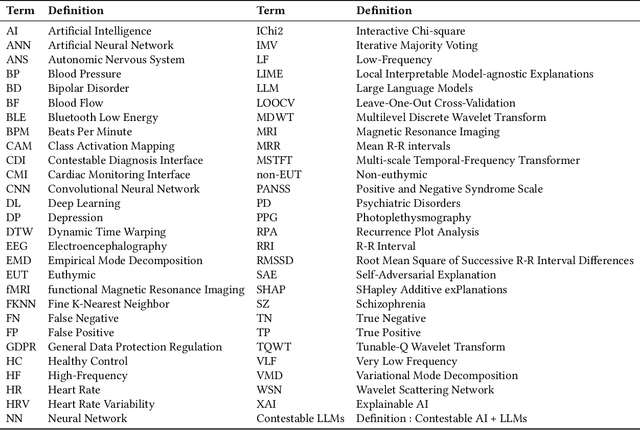
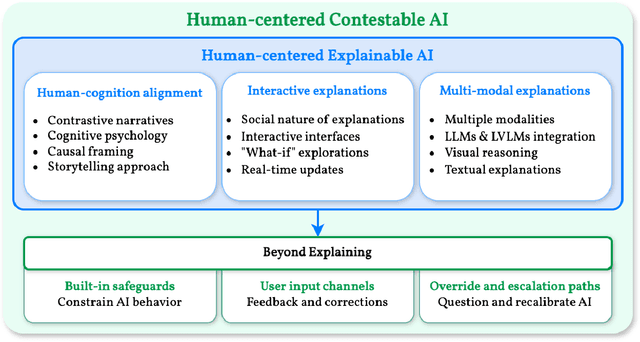
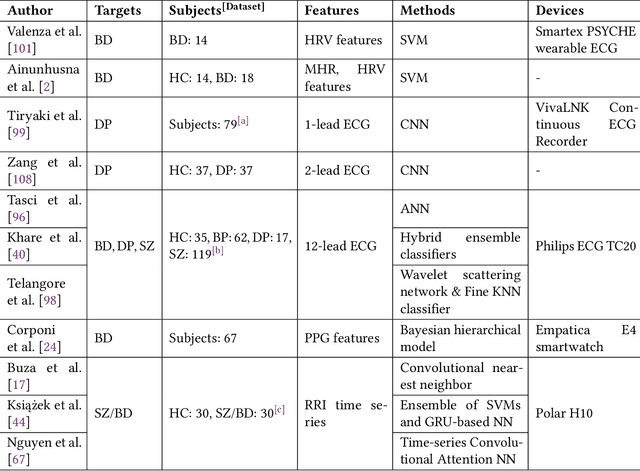
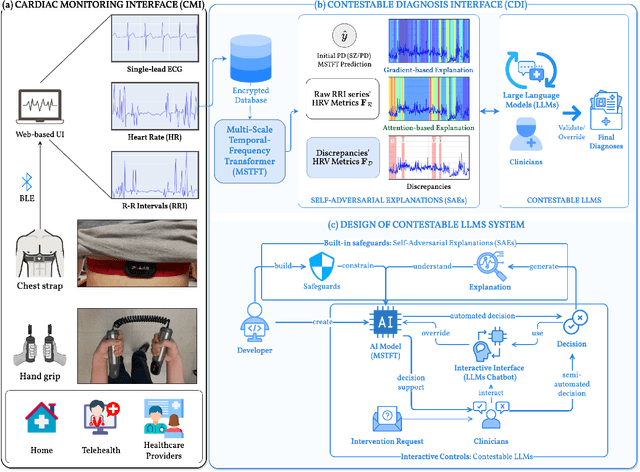
Psychiatric disorders affect millions globally, yet their diagnosis faces significant challenges in clinical practice due to subjective assessments and accessibility concerns, leading to potential delays in treatment. To help address this issue, we present Heart2Mind, a human-centered contestable psychiatric disorder diagnosis system using wearable electrocardiogram (ECG) monitors. Our approach leverages cardiac biomarkers, particularly heart rate variability (HRV) and R-R intervals (RRI) time series, as objective indicators of autonomic dysfunction in psychiatric conditions. The system comprises three key components: (1) a Cardiac Monitoring Interface (CMI) for real-time data acquisition from Polar H9/H10 devices; (2) a Multi-Scale Temporal-Frequency Transformer (MSTFT) that processes RRI time series through integrated time-frequency domain analysis; (3) a Contestable Diagnosis Interface (CDI) combining Self-Adversarial Explanations (SAEs) with contestable Large Language Models (LLMs). Our MSTFT achieves 91.7% accuracy on the HRV-ACC dataset using leave-one-out cross-validation, outperforming state-of-the-art methods. SAEs successfully detect inconsistencies in model predictions by comparing attention-based and gradient-based explanations, while LLMs enable clinicians to validate correct predictions and contest erroneous ones. This work demonstrates the feasibility of combining wearable technology with Explainable Artificial Intelligence (XAI) and contestable LLMs to create a transparent, contestable system for psychiatric diagnosis that maintains clinical oversight while leveraging advanced AI capabilities. Our implementation is publicly available at: https://github.com/Analytics-Everywhere-Lab/heart2mind.
Adaptive Wizard for Removing Cross-Tier Misconfigurations in Active Directory
May 02, 2025Security vulnerabilities in Windows Active Directory (AD) systems are typically modeled using an attack graph and hardening AD systems involves an iterative workflow: security teams propose an edge to remove, and IT operations teams manually review these fixes before implementing the removal. As verification requires significant manual effort, we formulate an Adaptive Path Removal Problem to minimize the number of steps in this iterative removal process. In our model, a wizard proposes an attack path in each step and presents it as a set of multiple-choice options to the IT admin. The IT admin then selects one edge from the proposed set to remove. This process continues until the target $t$ is disconnected from source $s$ or the number of proposed paths reaches $B$. The model aims to optimize the human effort by minimizing the expected number of interactions between the IT admin and the security wizard. We first prove that the problem is $\mathcal{\#P}$-hard. We then propose a set of solutions including an exact algorithm, an approximate algorithm, and several scalable heuristics. Our best heuristic, called DPR, can operate effectively on larger-scale graphs compared to the exact algorithm and consistently outperforms the approximate algorithm across all graphs. We verify the effectiveness of our algorithms on several synthetic AD graphs and an AD attack graph collected from a real organization.