 Add to Chrome
 Add to Firefox
 Add to Edge
3D Point World Models: Point Completion Enables More Accurate Dynamics Learning
Jun 30, 2026
Learning predictive models of the world enables robotic control through planning, potentially allowing robots to improvise solutions on new tasks. However, large video-based dynamics models lack explicit 3D spatial structure and suffer from geometrically inconsistent long-term rollouts with compounding errors. Emerging 3D dynamics models based on partial point clouds improve geometric consistency but remain sensitive to occlusions and accumulated prediction drift. To address these challenges, we present 3D Point World Models (3DPWM) - a task-agnostic world model that operates entirely in 3D space by first completing partial point clouds and then learning action-conditioned dynamics in this completed 3D scene. By operating on completed geometry, 3DPWM enables reliable long-horizon rollouts and more accurate cost evaluation for model-based planning while supporting adaptation to new tasks. Experiments across different robotic embodiments and tabletop manipulation benchmarks demonstrate that 3DPWM achieves significantly more reliable long-horizon rollouts (100-300+ steps), supports both open-loop and closed-loop planning, and enables successful sim-to-real transfer.

Learning Adversarial Augmentation Policies for Robust Garlic Seedling Detection
Jun 25, 2026Accurate seedling detection during early growth stages is essential for timely replanting and effective crop management in precision agriculture. However, existing studies are mostly evaluated under relatively stable imaging conditions, such as UAV imagery or greenhouse environments, leaving robust detection under severe and spatially heterogeneous illumination in ground-based outdoor monitoring insufficiently explored. In addition, many illumination-robust detection methods rely on additional enhancement or feature-extraction modules, which increase inference-time overhead and are not tailored to seedling detection and downstream missing seedling localization. To address these gaps, we construct a new garlic seedling dataset captured using a ground-based monitoring platform under real outdoor field conditions with highly variable illumination. We further propose an illumination-robust seedling detection framework based on adversarial augmentation policy learning. The proposed method jointly optimizes a stochastic augmentation policy agent and an object detector, enabling the detector to learn robust representations under challenging visual conditions. A structural penalty is introduced to prevent unrealistic distortions while encouraging challenging augmentations during training. Extensive experiments show that the proposed approach achieves an AP$_{50}$ of 91.6%, improving the baseline by 0.9 percentage points and outperforming the previous best-performing method by 0.2 percentage points. For downstream missing seedling localization, it achieves 75.0% precision and a 67.0% F1-score, improving the baseline by 4.8 and 2.0 percentage points, respectively. These results demonstrate the effectiveness of the proposed framework for practical ground-based agricultural monitoring under complex outdoor lighting conditions without additional inference-time computational overhead.
* 16 pages
Learning a Particle Dynamics Model with Real-world Videos
May 22, 2026Data-driven learning approaches for physics simulation, sometimes referred to as world models, have emerged as promising alternatives to traditional physics simulators due to their differentiable nature. Prior work has demonstrated impressive results in predicting the motions of rigid and non-rigid objects in complex scenes involving multiple interacting bodies. However, these models are typically trained in simulated environments because obtaining perfect state information such as complete scene point clouds and point correspondences over time is challenging in real-world settings. This reliance on synthetic data can limit their applicability when the sim-to-real gap is large. In this work, we aim to overcome these limitations by introducing a novel framework for training neural object dynamics models directly from unlabeled real-world videos. Specifically, we propose to learn a particle-based dynamics model compatible with a Gaussian splatting framework, which operates on dense particles derived from Gaussians (i.e., particles with scales and rotations) and predicts their position and rotation changes over time. The model is trained via rendering supervision, enabling learning from real-world videos without requiring particle-level labeled states. Our model operates directly on dense Gaussians without relying on heuristic subsampling anchor points. To enable this study, we also present a real-world dataset consisting of about 500 videos capturing diverse object interactions.
GS4: Generalizable Sparse Splatting Semantic SLAM
Jun 06, 2025Traditional SLAM algorithms are excellent at camera tracking but might generate lower resolution and incomplete 3D maps. Recently, Gaussian Splatting (GS) approaches have emerged as an option for SLAM with accurate, dense 3D map building. However, existing GS-based SLAM methods rely on per-scene optimization which is time-consuming and does not generalize to diverse scenes well. In this work, we introduce the first generalizable GS-based semantic SLAM algorithm that incrementally builds and updates a 3D scene representation from an RGB-D video stream using a learned generalizable network. Our approach starts from an RGB-D image recognition backbone to predict the Gaussian parameters from every downsampled and backprojected image location. Additionally, we seamlessly integrate 3D semantic segmentation into our GS framework, bridging 3D mapping and recognition through a shared backbone. To correct localization drifting and floaters, we propose to optimize the GS for only 1 iteration following global localization. We demonstrate state-of-the-art semantic SLAM performance on the real-world benchmark ScanNet with an order of magnitude fewer Gaussians compared to other recent GS-based methods, and showcase our model's generalization capability through zero-shot transfer to the NYUv2 and TUM RGB-D datasets.
Long-Term 3D Point Tracking By Cost Volume Fusion
Jul 18, 2024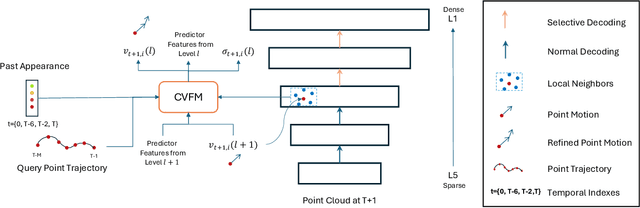
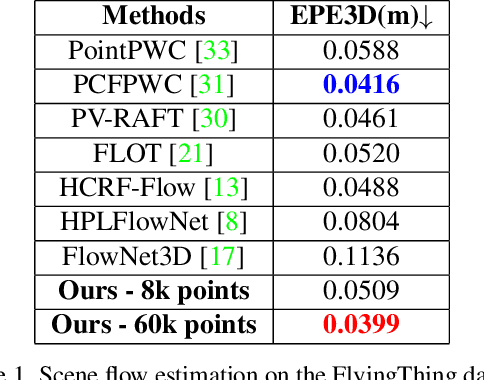
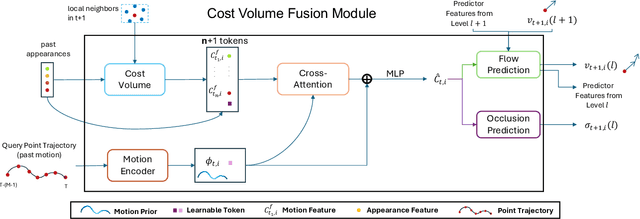
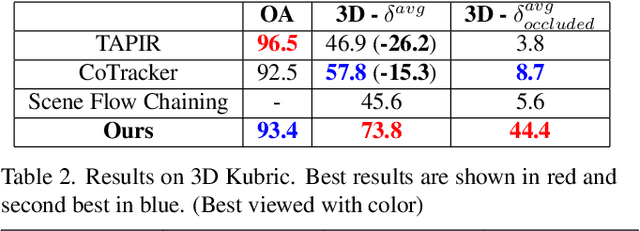
Long-term point tracking is essential to understand non-rigid motion in the physical world better. Deep learning approaches have recently been incorporated into long-term point tracking, but most prior work predominantly functions in 2D. Although these methods benefit from the well-established backbones and matching frameworks, the motions they produce do not always make sense in the 3D physical world. In this paper, we propose the first deep learning framework for long-term point tracking in 3D that generalizes to new points and videos without requiring test-time fine-tuning. Our model contains a cost volume fusion module that effectively integrates multiple past appearances and motion information via a transformer architecture, significantly enhancing overall tracking performance. In terms of 3D tracking performance, our model significantly outperforms simple scene flow chaining and previous 2D point tracking methods, even if one uses ground truth depth and camera pose to backproject 2D point tracks in a synthetic scenario.
Point Cloud Models Improve Visual Robustness in Robotic Learners
Apr 29, 2024
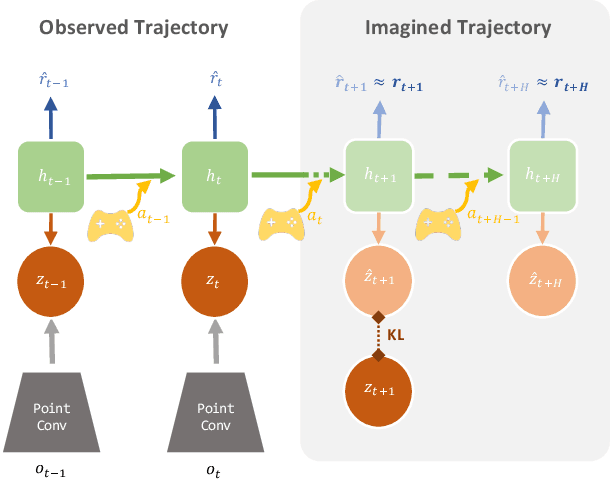


Visual control policies can encounter significant performance degradation when visual conditions like lighting or camera position differ from those seen during training -- often exhibiting sharp declines in capability even for minor differences. In this work, we examine robustness to a suite of these types of visual changes for RGB-D and point cloud based visual control policies. To perform these experiments on both model-free and model-based reinforcement learners, we introduce a novel Point Cloud World Model (PCWM) and point cloud based control policies. Our experiments show that policies that explicitly encode point clouds are significantly more robust than their RGB-D counterparts. Further, we find our proposed PCWM significantly outperforms prior works in terms of sample efficiency during training. Taken together, these results suggest reasoning about the 3D scene through point clouds can improve performance, reduce learning time, and increase robustness for robotic learners. Project Webpage: https://pvskand.github.io/projects/PCWM
Object Dynamics Modeling with Hierarchical Point Cloud-based Representations
Apr 09, 2024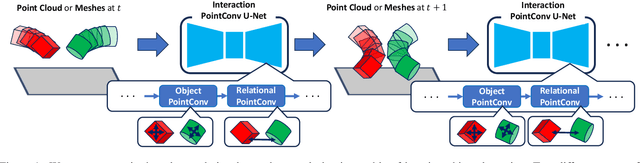



Modeling object dynamics with a neural network is an important problem with numerous applications. Most recent work has been based on graph neural networks. However, physics happens in 3D space, where geometric information potentially plays an important role in modeling physical phenomena. In this work, we propose a novel U-net architecture based on continuous point convolution which naturally embeds information from 3D coordinates and allows for multi-scale feature representations with established downsampling and upsampling procedures. Bottleneck layers in the downsampled point clouds lead to better long-range interaction modeling. Besides, the flexibility of point convolutions allows our approach to generalize to sparsely sampled points from mesh vertices and dynamically generate features on important interaction points on mesh faces. Experimental results demonstrate that our approach significantly improves the state-of-the-art, especially in scenarios that require accurate gravity or collision reasoning.
Out of Sight, Still in Mind: Reasoning and Planning about Unobserved Objects with Video Tracking Enabled Memory Models
Sep 26, 2023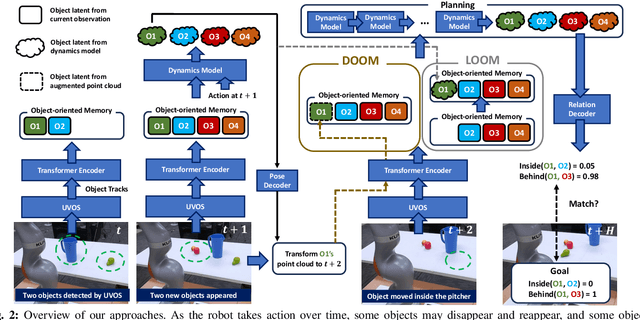
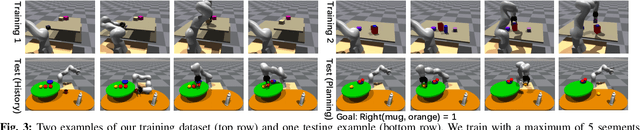
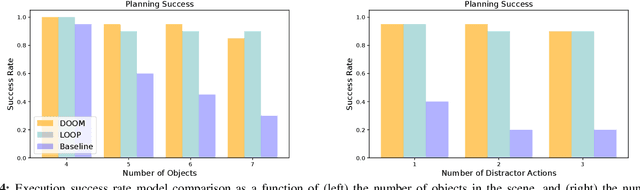
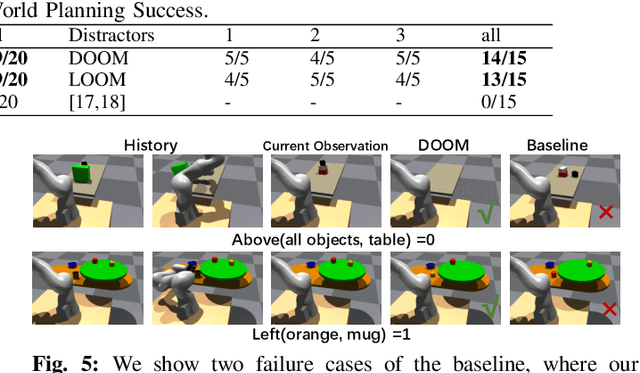
Robots need to have a memory of previously observed, but currently occluded objects to work reliably in realistic environments. We investigate the problem of encoding object-oriented memory into a multi-object manipulation reasoning and planning framework. We propose DOOM and LOOM, which leverage transformer relational dynamics to encode the history of trajectories given partial-view point clouds and an object discovery and tracking engine. Our approaches can perform multiple challenging tasks including reasoning with occluded objects, novel objects appearance, and object reappearance. Throughout our extensive simulation and real-world experiments, we find that our approaches perform well in terms of different numbers of objects and different numbers of distractor actions. Furthermore, we show our approaches outperform an implicit memory baseline.
Learning Vision-Based Bipedal Locomotion for Challenging Terrain
Sep 26, 2023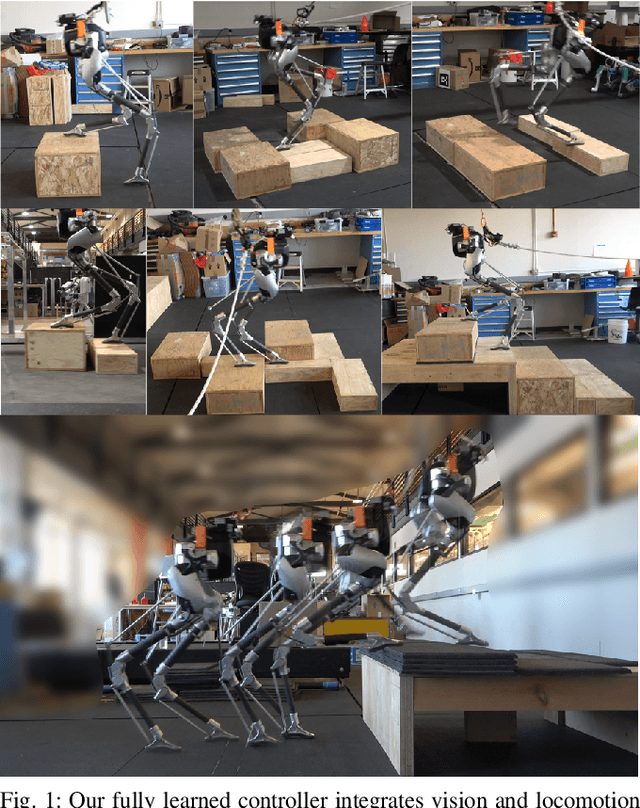
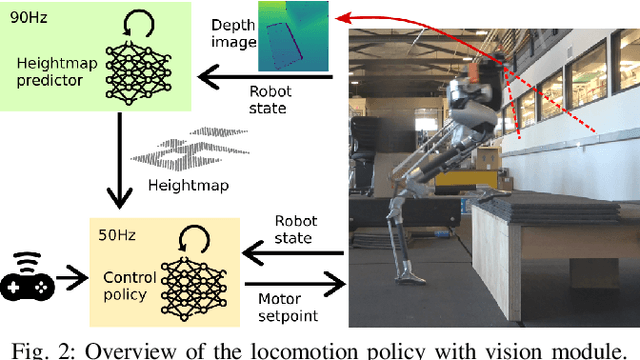
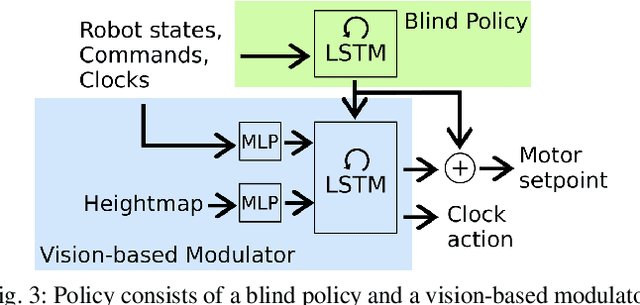
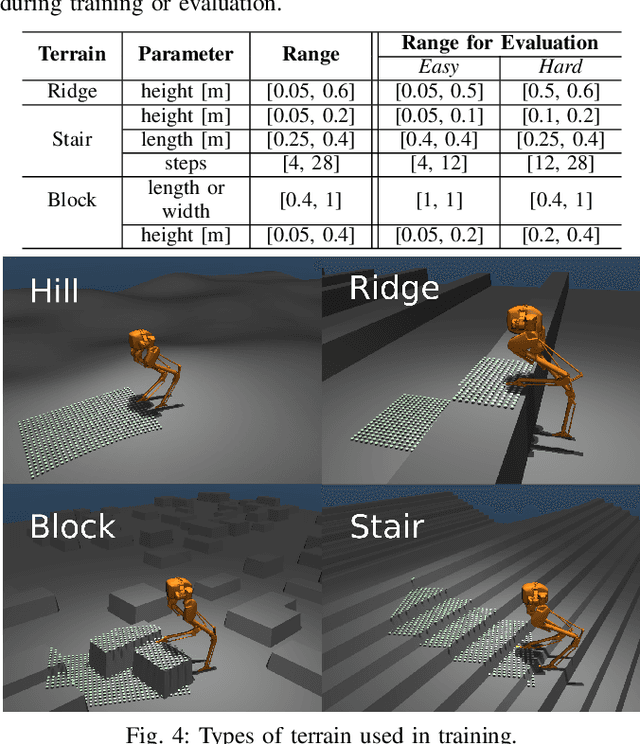
Reinforcement learning (RL) for bipedal locomotion has recently demonstrated robust gaits over moderate terrains using only proprioceptive sensing. However, such blind controllers will fail in environments where robots must anticipate and adapt to local terrain, which requires visual perception. In this paper, we propose a fully-learned system that allows bipedal robots to react to local terrain while maintaining commanded travel speed and direction. Our approach first trains a controller in simulation using a heightmap expressed in the robot's local frame. Next, data is collected in simulation to train a heightmap predictor, whose input is the history of depth images and robot states. We demonstrate that with appropriate domain randomization, this approach allows for successful sim-to-real transfer with no explicit pose estimation and no fine-tuning using real-world data. To the best of our knowledge, this is the first example of sim-to-real learning for vision-based bipedal locomotion over challenging terrains.
Maximal Cliques on Multi-Frame Proposal Graph for Unsupervised Video Object Segmentation
Jan 29, 2023
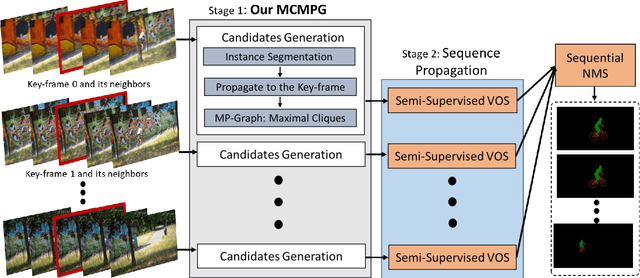
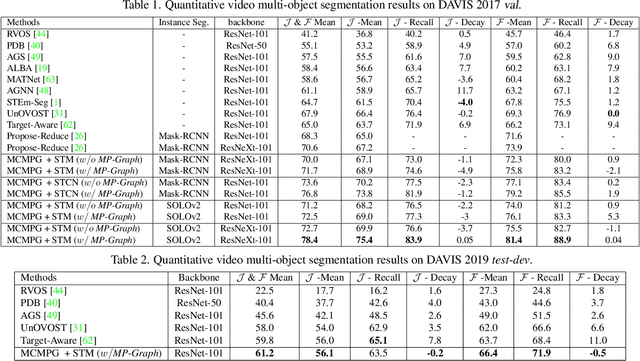
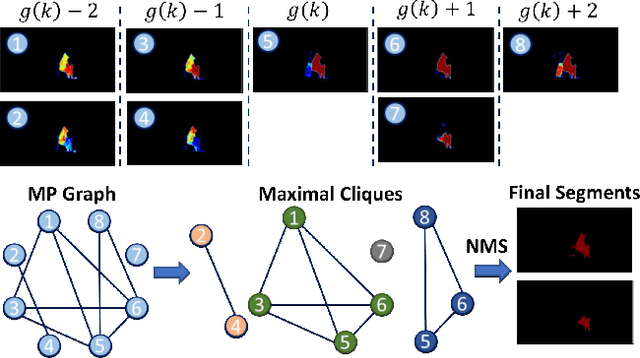
Unsupervised Video Object Segmentation (UVOS) aims at discovering objects and tracking them through videos. For accurate UVOS, we observe if one can locate precise segment proposals on key frames, subsequent processes are much simpler. Hence, we propose to reason about key frame proposals using a graph built with the object probability masks initially generated from multiple frames around the key frame and then propagated to the key frame. On this graph, we compute maximal cliques, with each clique representing one candidate object. By making multiple proposals in the clique to vote for the key frame proposal, we obtain refined key frame proposals that could be better than any of the single-frame proposals. A semi-supervised VOS algorithm subsequently tracks these key frame proposals to the entire video. Our algorithm is modular and hence can be used with any instance segmentation and semi-supervised VOS algorithm. We achieve state-of-the-art performance on the DAVIS-2017 validation and test-dev dataset. On the related problem of video instance segmentation, our method shows competitive performance with the previous best algorithm that requires joint training with the VOS algorithm.