 Add to Chrome
 Add to Firefox
 Add to Edge
Self-Evolving Human-Centered Framework for Explainable Depression Symptom Annotation
Jul 16, 2026
Annotation quality is a major bottleneck in building reliable and explainable artificial intelligence (XAI) systems for mental health research. In depression-related datasets, labels are often assigned without structured evidence, symptom-level justification, or traceable alignment with the criteria of the Diagnostic and Statistical Manual of Mental Disorders, Fifth Edition, Text Revision (DSM-5-TR), limiting both transparency and downstream model interpretability. We propose a self-evolving, expert-in-the-loop annotation framework for Major Depressive Disorder (MDD) that combines large language model (LLM)-assisted labeling with expert verification. The framework is intended to support the construction of explainable, DSM-5-TR-aligned datasets rather than to perform clinical diagnosis. It operates in three stages: candidate evidence selection from textual records, criterion-level DSM-5-TR analysis, and case-level synthesis that produces label-level diagnostic and severity annotations. A dual-memory architecture, composed of Example Memory and Reflection Memory, is designed to internalize expert feedback and iteratively improve future annotations without retraining. We describe this mechanism and leave its evaluation across multiple feedback cycles to future work. In addition to final labels, the framework exports clinical evidence, reasoning traces, and edit histories, enabling comprehensive auditability. In a pilot study using expert-reviewed samples, the proposed approach improves annotation consistency and explainability while reducing manual revision effort.

Heart2Mind: Human-Centered Contestable Psychiatric Disorder Diagnosis System using Wearable ECG Monitors
May 16, 2025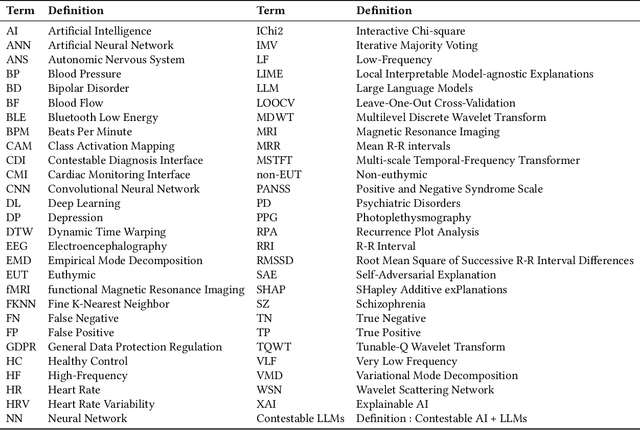
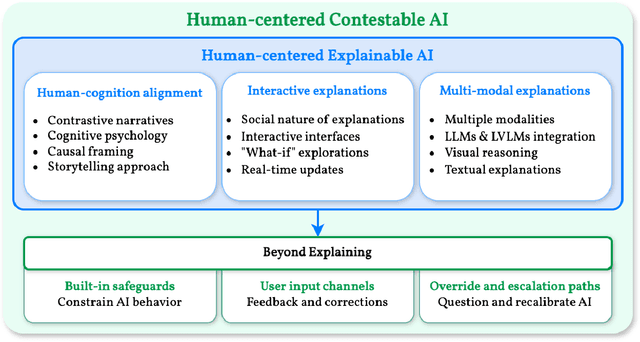
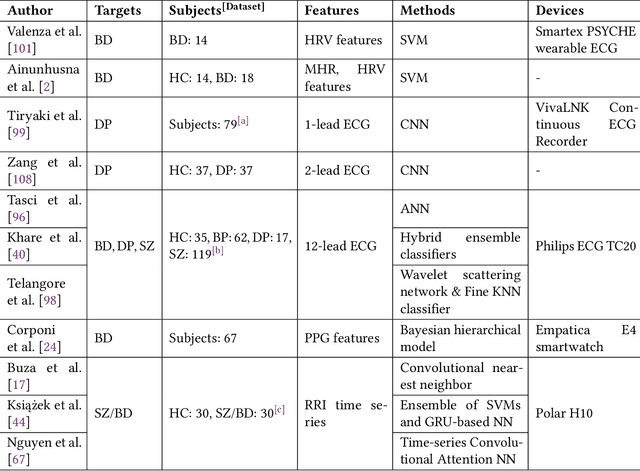
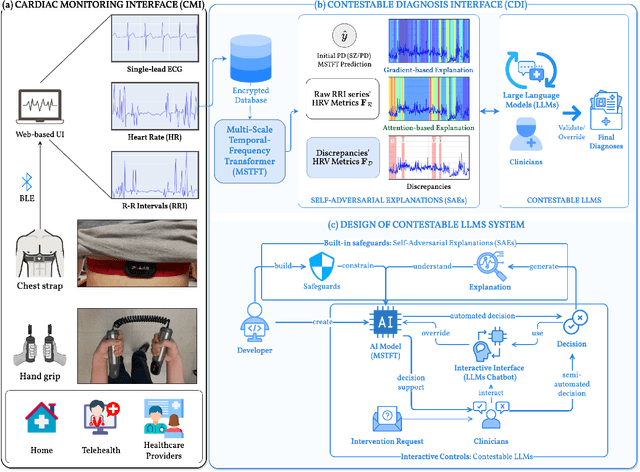
Psychiatric disorders affect millions globally, yet their diagnosis faces significant challenges in clinical practice due to subjective assessments and accessibility concerns, leading to potential delays in treatment. To help address this issue, we present Heart2Mind, a human-centered contestable psychiatric disorder diagnosis system using wearable electrocardiogram (ECG) monitors. Our approach leverages cardiac biomarkers, particularly heart rate variability (HRV) and R-R intervals (RRI) time series, as objective indicators of autonomic dysfunction in psychiatric conditions. The system comprises three key components: (1) a Cardiac Monitoring Interface (CMI) for real-time data acquisition from Polar H9/H10 devices; (2) a Multi-Scale Temporal-Frequency Transformer (MSTFT) that processes RRI time series through integrated time-frequency domain analysis; (3) a Contestable Diagnosis Interface (CDI) combining Self-Adversarial Explanations (SAEs) with contestable Large Language Models (LLMs). Our MSTFT achieves 91.7% accuracy on the HRV-ACC dataset using leave-one-out cross-validation, outperforming state-of-the-art methods. SAEs successfully detect inconsistencies in model predictions by comparing attention-based and gradient-based explanations, while LLMs enable clinicians to validate correct predictions and contest erroneous ones. This work demonstrates the feasibility of combining wearable technology with Explainable Artificial Intelligence (XAI) and contestable LLMs to create a transparent, contestable system for psychiatric diagnosis that maintains clinical oversight while leveraging advanced AI capabilities. Our implementation is publicly available at: https://github.com/Analytics-Everywhere-Lab/heart2mind.