 Add to Chrome
 Add to Firefox
 Add to Edge
Adaptive Arena-based Contestable Argumentative Network-of-Experts for Open-Ended Care Plan Coordination
Aug 05, 2026
Care plan coordination demands synthesizing heterogeneous clinical, functional, and psychosocial information across multiple professional disciplines, where monolithic LLM pipelines cannot perform in a transparent or safe manner. We present CANOE (Contestable Argumentative Network-of-Experts), a multi-agent neuro-symbolic framework that addresses these limitations through five modules: complexity assessment, adaptive team recruitment, role-based argumentative computation via an Arena-based Quantitative Bipolar Argumentation Framework (A-QBAF), human-in-the-loop contestation, and care-plan synthesis. Role-specialized agents generate supporting and attacking arguments for candidate interventions; conflicts are resolved through arena-based clash resolution before acceptability scores propagate across the argumentation graph. Care planners may accept, reject, edit, or add arguments, and the framework will deterministically recompute the final plan. Evaluation on Discharge Me! and MedicalRAG using ROUGE-L, AlignScore, MEDCON F1, FKGL, and LLM-as-a-judge shows that medically fine-tuned models achieve the strongest clinical correctness and safety, while CANOE's argumentative structure provides faithful explanation and human contestability.

Does Mixture-of-Experts Actually Help Inference on Consumer and Edge Hardware? An Empirical Study
Jun 23, 2026Mixture-of-Experts (MoE) language models are often described as ideal for resource-constrained inference. Each token activates only a small subset of experts, so the per-token compute cost, in floating-point operations (FLOPs), resembles that of a much smaller dense model. Whether that FLOP advantage survives in practice is far less clear. We ask whether MoE models actually run faster and cheaper than comparable dense models on consumer-grade and edge hardware. We benchmark OLMoE-1B-7B (1.3 B active of 6.9 B total) against three dense baselines on an Apple M2 Pro and an NVIDIA Jetson Orin Nano 8 GB through \texttt{llama.cpp}, measuring throughput, memory, and on-device energy. The answer is device-dependent: OLMoE's active-parameter advantage is only partly realised on the laptop (~10% behind the same-active Llama-3.2-1B) and erodes on the edge device (~31% behind, at 2.1$\times$ the energy per token, with peak memory at the 8 GB ceiling). Patching \texttt{llama.cpp} to time the decode graph node-by-node shows routing accounts for under 9% of MoE-block compute on the cleaner edge backend, so the gap reflects total-parameter memory footprint, expert dispatch, and KV-cache pressure rather than routing. The implication is that on bandwidth-bound edge hardware, inference cost tracks total parameters, not active ones, and sparse activation does not buy back what the device is constrained on. These findings are bounded to one MoE model at this parameter scale and two devices, and we release the full measurement harness and per-run data.
Heart2Mind: Human-Centered Contestable Psychiatric Disorder Diagnosis System using Wearable ECG Monitors
May 16, 2025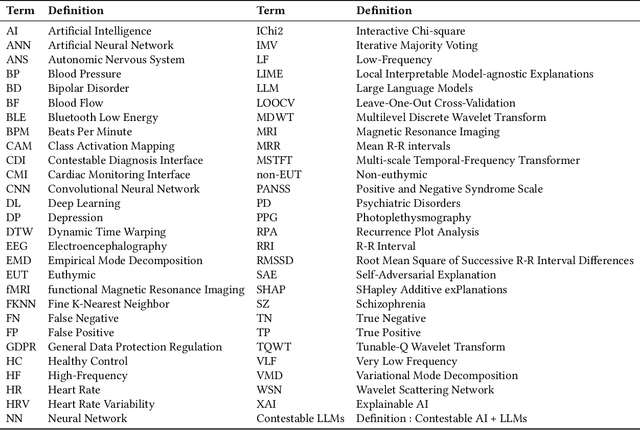
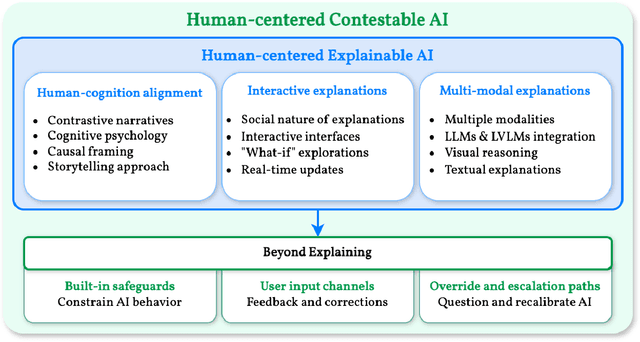
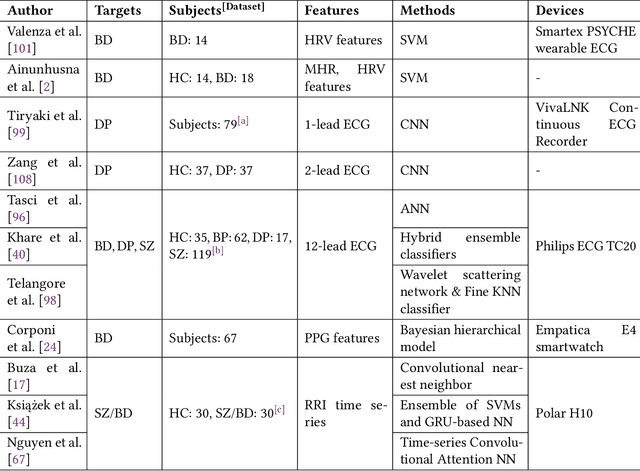
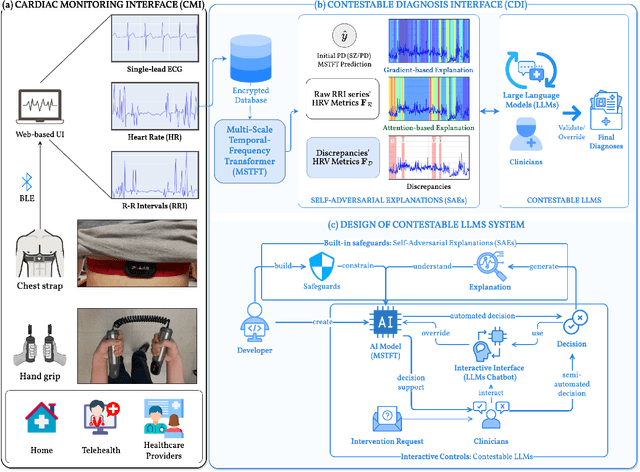
Psychiatric disorders affect millions globally, yet their diagnosis faces significant challenges in clinical practice due to subjective assessments and accessibility concerns, leading to potential delays in treatment. To help address this issue, we present Heart2Mind, a human-centered contestable psychiatric disorder diagnosis system using wearable electrocardiogram (ECG) monitors. Our approach leverages cardiac biomarkers, particularly heart rate variability (HRV) and R-R intervals (RRI) time series, as objective indicators of autonomic dysfunction in psychiatric conditions. The system comprises three key components: (1) a Cardiac Monitoring Interface (CMI) for real-time data acquisition from Polar H9/H10 devices; (2) a Multi-Scale Temporal-Frequency Transformer (MSTFT) that processes RRI time series through integrated time-frequency domain analysis; (3) a Contestable Diagnosis Interface (CDI) combining Self-Adversarial Explanations (SAEs) with contestable Large Language Models (LLMs). Our MSTFT achieves 91.7% accuracy on the HRV-ACC dataset using leave-one-out cross-validation, outperforming state-of-the-art methods. SAEs successfully detect inconsistencies in model predictions by comparing attention-based and gradient-based explanations, while LLMs enable clinicians to validate correct predictions and contest erroneous ones. This work demonstrates the feasibility of combining wearable technology with Explainable Artificial Intelligence (XAI) and contestable LLMs to create a transparent, contestable system for psychiatric diagnosis that maintains clinical oversight while leveraging advanced AI capabilities. Our implementation is publicly available at: https://github.com/Analytics-Everywhere-Lab/heart2mind.