 Add to Chrome
 Add to Firefox
 Add to Edge
Position: Multi-Agent Algorithmic Care Systems Demand Contestability for Trustworthy AI
Mar 21, 2026
Multi-agent systems (MAS) are increasingly used in healthcare to support complex decision-making through collaboration among specialized agents. Because these systems act as collective decision-makers, they raise challenges for trust, accountability, and human oversight. Existing approaches to trustworthy AI largely rely on explainability, but explainability alone is insufficient in multi-agent settings, as it does not enable care partners to challenge or correct system outputs. To address this limitation, Contestable AI (CAI) characterizes systems that support effective human challenge throughout the decision-making lifecycle by providing transparency, structured opportunities for intervention, and mechanisms for review, correction, or override. This position paper argues that contestability is a necessary design requirement for trustworthy multi-agent algorithmic care systems. We identify key limitations in current MAS and Explainable AI (XAI) research and present a human-in-the-loop framework that integrates structured argumentation and role-based contestation to preserve human agency, clinical responsibility, and trust in high-stakes care contexts.

Heart2Mind: Human-Centered Contestable Psychiatric Disorder Diagnosis System using Wearable ECG Monitors
May 16, 2025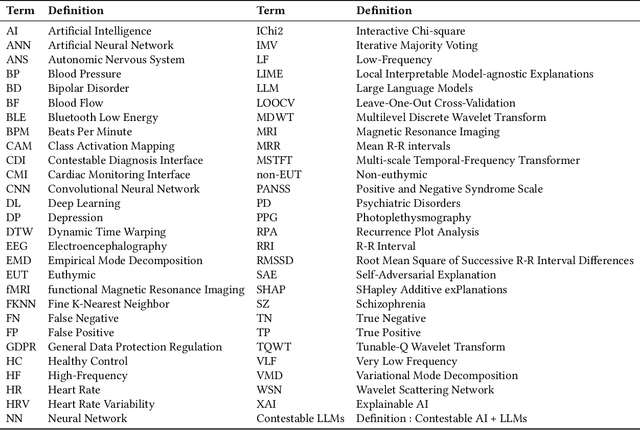
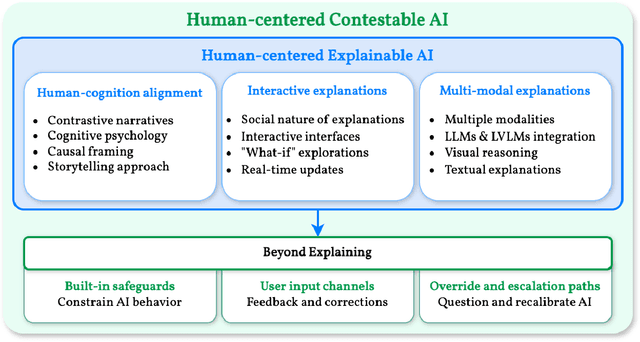
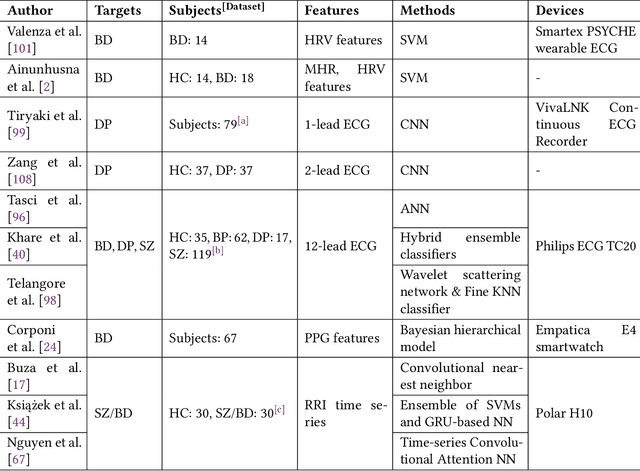
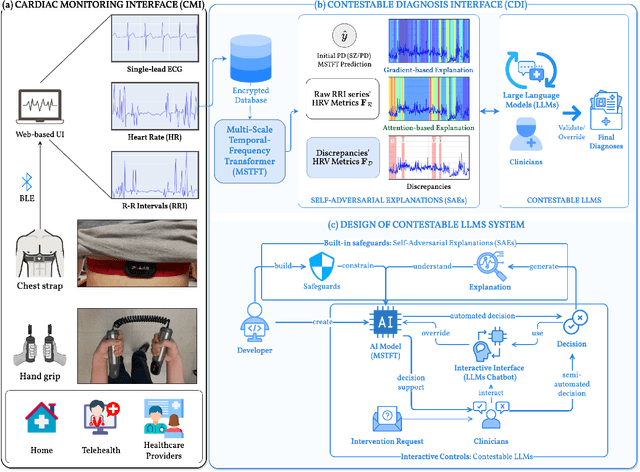
Psychiatric disorders affect millions globally, yet their diagnosis faces significant challenges in clinical practice due to subjective assessments and accessibility concerns, leading to potential delays in treatment. To help address this issue, we present Heart2Mind, a human-centered contestable psychiatric disorder diagnosis system using wearable electrocardiogram (ECG) monitors. Our approach leverages cardiac biomarkers, particularly heart rate variability (HRV) and R-R intervals (RRI) time series, as objective indicators of autonomic dysfunction in psychiatric conditions. The system comprises three key components: (1) a Cardiac Monitoring Interface (CMI) for real-time data acquisition from Polar H9/H10 devices; (2) a Multi-Scale Temporal-Frequency Transformer (MSTFT) that processes RRI time series through integrated time-frequency domain analysis; (3) a Contestable Diagnosis Interface (CDI) combining Self-Adversarial Explanations (SAEs) with contestable Large Language Models (LLMs). Our MSTFT achieves 91.7% accuracy on the HRV-ACC dataset using leave-one-out cross-validation, outperforming state-of-the-art methods. SAEs successfully detect inconsistencies in model predictions by comparing attention-based and gradient-based explanations, while LLMs enable clinicians to validate correct predictions and contest erroneous ones. This work demonstrates the feasibility of combining wearable technology with Explainable Artificial Intelligence (XAI) and contestable LLMs to create a transparent, contestable system for psychiatric diagnosis that maintains clinical oversight while leveraging advanced AI capabilities. Our implementation is publicly available at: https://github.com/Analytics-Everywhere-Lab/heart2mind.