 Add to Chrome
 Add to Firefox
 Add to Edge
Home Health System Deployment Experience for Geriatric Care Remote Monitoring
Jan 24, 2026
To support aging-in-place, adult children often provide care to their aging parents from a distance. These informal caregivers desire plug-and-play remote care solutions for privacy-preserving continuous monitoring that enabling real-time activity monitoring and intuitive, actionable information. This short paper presents insights from three iterations of deployment experience for remote monitoring system and the iterative improvement in hardware, modeling, and user interface guided by the Geriatric 4Ms framework (matters most, mentation, mobility, and medication). An LLM-assisted solution is developed to balance user experience (privacy-preserving, plug-and-play) and system performance.

RARR : Robust Real-World Activity Recognition with Vibration by Scavenging Near-Surface Audio Online
Aug 28, 2025
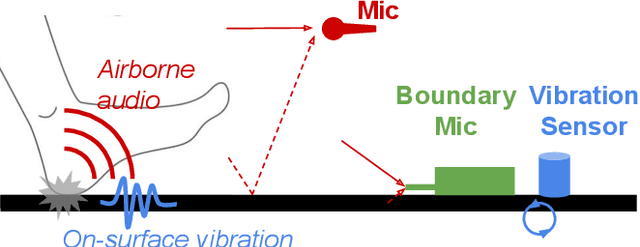

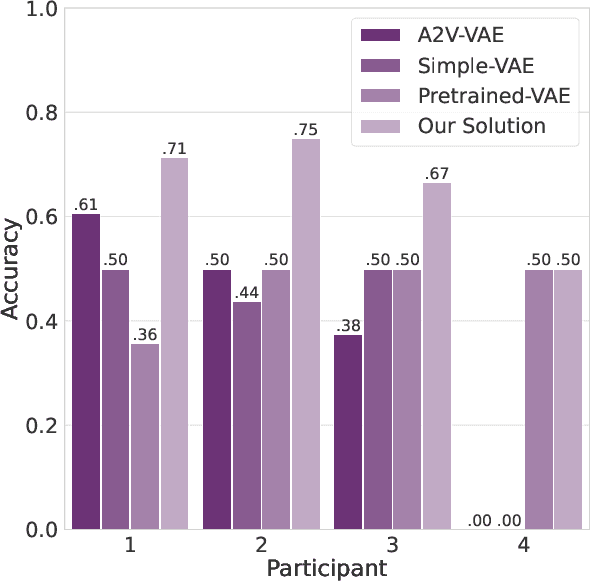
One in four people dementia live alone, leading family members to take on caregiving roles from a distance. Many researchers have developed remote monitoring solutions to lessen caregiving needs; however, limitations remain including privacy preserving solutions, activity recognition, and model generalizability to new users and environments. Structural vibration sensor systems are unobtrusive solutions that have been proven to accurately monitor human information, such as identification and activity recognition, in controlled settings by sensing surface vibrations generated by activities. However, when deploying in an end user's home, current solutions require a substantial amount of labeled data for accurate activity recognition. Our scalable solution adapts synthesized data from near-surface acoustic audio to pretrain a model and allows fine tuning with very limited data in order to create a robust framework for daily routine tracking.