 Add to Chrome
 Add to Firefox
 Add to Edge
IE as Cache: Information Extraction Enhanced Agentic Reasoning
Apr 16, 2026
Information Extraction aims to distill structured, decision-relevant information from unstructured text, serving as a foundation for downstream understanding and reasoning. However, it is traditionally treated merely as a terminal objective: once extracted, the resulting structure is often consumed in isolation rather than maintained and reused during multi-step inference. Moving beyond this, we propose \textit{IE-as-Cache}, a framework that repurposes IE as a cognitive cache to enhance agentic reasoning. Drawing inspiration from hierarchical computer memory, our approach combines query-driven extraction with cache-aware reasoning to dynamically maintain compact intermediate information and filter noise. Experiments on challenging benchmarks across diverse LLMs demonstrate significant improvements in reasoning accuracy, indicating that IE can be effectively repurposed as a reusable cognitive resource and offering a promising direction for future research on downstream uses of IE.

Learning from Emptiness: De-biasing Listwise Rerankers with Content-Agnostic Probability Calibration
Apr 11, 2026Generative listwise reranking leverages global context for superior retrieval but is plagued by intrinsic position bias, where models exhibit structural sensitivity to input order independent of relevance. Existing mitigations present a dilemma: inference-time aggregation incurs prohibitive latency, while training-based methods often fail to eradicate ingrained priors, particularly in compact models. To resolve this dilemma, we propose CapCal (Content-Agnostic Probability Calibration), a training-free framework that mechanically decouples positional bias from ranking decisions. By estimating the bias distribution via content-free placeholders, CapCal rectifies output logits through an entropy-adaptive contrastive mechanism. Evaluations across 10 benchmarks confirm that CapCal achieves superior performance among training-free methods while preserving single-pass efficiency. Notably, it unlocks the latent potential of lightweight models (e.g., 0.6B), delivering absolute NDCG gains exceeding 10 points and outperforming both permutation-based aggregation and data-augmentation baselines.
SPARD: Self-Paced Curriculum for RL Alignment via Integrating Reward Dynamics and Data Utility
Apr 09, 2026The evolution of Large Language Models (LLMs) is shifting the focus from single, verifiable tasks toward complex, open-ended real-world scenarios, imposing significant challenges on the post-training phase. In these settings, the scale and complexity of reward systems have grown significantly, transitioning toward multi-objective formulations that encompass a comprehensive spectrum of model capabilities and application contexts. However, traditional methods typically rely on fixed reward weights, ignoring non-stationary learning dynamics and struggling with data heterogeneity across dimensions. To address these issues, we propose SPARD, a framework that establishes an automated, self-paced curriculum by perceiving learning progress to dynamically adjust multi-objective reward weights and data importance, thereby synchronizing learning intent with data utility for optimal performance. Extensive experiments across multiple benchmarks demonstrate that SPARD significantly enhances model capabilities across all domains.
SpecSteer: Synergizing Local Context and Global Reasoning for Efficient Personalized Generation
Mar 17, 2026Realizing personalized intelligence faces a core dilemma: sending user history to centralized large language models raises privacy concerns, while on-device small language models lack the reasoning capacity required for high-quality generation. Our pilot study shows that purely local enhancements remain insufficient to reliably bridge this gap. We therefore propose SpecSteer, an asymmetric collaborative inference framework that synergizes private on-device context with cloud-scale reasoning. SpecSteer casts collaboration as Bayesian knowledge fusion and repurposes speculative decoding as a distributed alignment protocol, yielding a Draft--Verify--Recover pipeline: the on-device model drafts personalized sequences; the cloud validates via a ratio-based mechanism that decouples reasoning verification from private context, filtering logical flaws without accessing raw user context; upon rejection, a steering recovery injects local intent during correction. Experiments demonstrate that SpecSteer successfully closes the reasoning gap and achieves superior personalized generation performance, while delivering a 2.36x speedup over standard baselines.
A Survey on Large Language Models for Recommendation
Jun 01, 2023


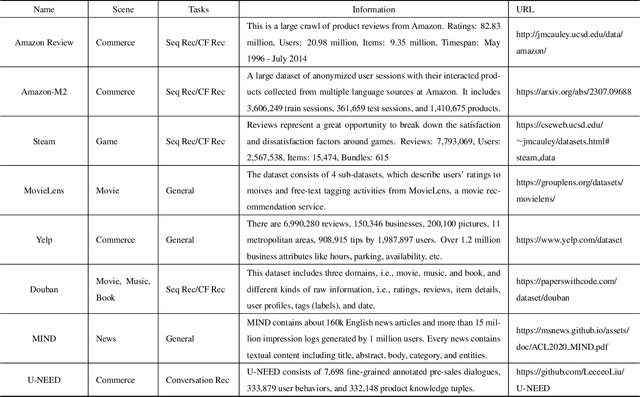
Large Language Models (LLMs) have emerged as powerful tools in the field of Natural Language Processing (NLP) and have recently gained significant attention in the domain of Recommendation Systems (RS). These models, trained on massive amounts of data using self-supervised learning, have demonstrated remarkable success in learning universal representations and have the potential to enhance various aspects of recommendation systems by some effective transfer techniques such as fine-tuning and prompt tuning, and so on. The crucial aspect of harnessing the power of language models in enhancing recommendation quality is the utilization of their high-quality representations of textual features and their extensive coverage of external knowledge to establish correlations between items and users. To provide a comprehensive understanding of the existing LLM-based recommendation systems, this survey presents a taxonomy that categorizes these models into two major paradigms, respectively Discriminative LLM for Recommendation (DLLM4Rec) and Generative LLM for Recommendation (GLLM4Rec), with the latter being systematically sorted out for the first time. Furthermore, we systematically review and analyze existing LLM-based recommendation systems within each paradigm, providing insights into their methodologies, techniques, and performance. Additionally, we identify key challenges and several valuable findings to provide researchers and practitioners with inspiration. We have also created a GitHub repository to index relevant papers on LLMs for recommendation, https://github.com/WLiK/LLM4Rec.