 Add to Chrome
 Add to Firefox
 Add to Edge
ARMFlow: AutoRegressive MeanFlow for Online 3D Human Reaction Generation
Dec 18, 2025
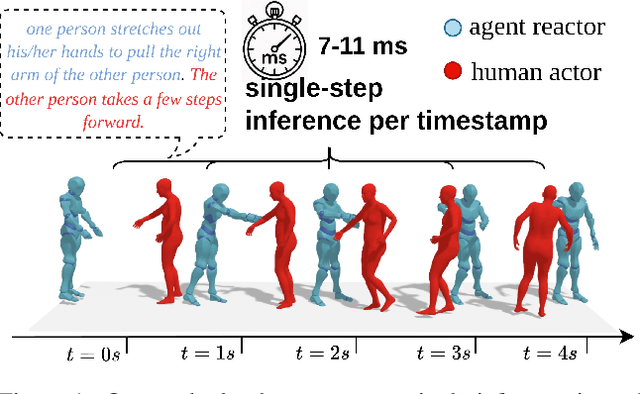

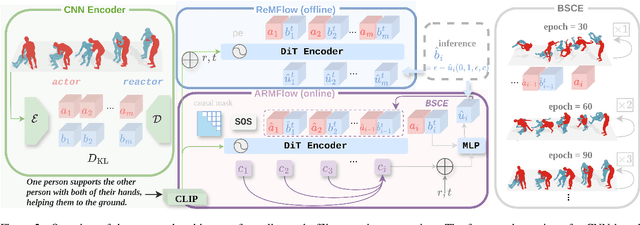

3D human reaction generation faces three main challenges:(1) high motion fidelity, (2) real-time inference, and (3) autoregressive adaptability for online scenarios. Existing methods fail to meet all three simultaneously. We propose ARMFlow, a MeanFlow-based autoregressive framework that models temporal dependencies between actor and reactor motions. It consists of a causal context encoder and an MLP-based velocity predictor. We introduce Bootstrap Contextual Encoding (BSCE) in training, encoding generated history instead of the ground-truth ones, to alleviate error accumulation in autoregressive generation. We further introduce the offline variant ReMFlow, achieving state-of-the-art performance with the fastest inference among offline methods. Our ARMFlow addresses key limitations of online settings by: (1) enhancing semantic alignment via a global contextual encoder; (2) achieving high accuracy and low latency in a single-step inference; and (3) reducing accumulated errors through BSCE. Our single-step online generation surpasses existing online methods on InterHuman and InterX by over 40% in FID, while matching offline state-of-the-art performance despite using only partial sequence conditions.

D$^2$GSLAM: 4D Dynamic Gaussian Splatting SLAM
Dec 10, 2025Recent advances in Dense Simultaneous Localization and Mapping (SLAM) have demonstrated remarkable performance in static environments. However, dense SLAM in dynamic environments remains challenging. Most methods directly remove dynamic objects and focus solely on static scene reconstruction, which ignores the motion information contained in these dynamic objects. In this paper, we present D$^2$GSLAM, a novel dynamic SLAM system utilizing Gaussian representation, which simultaneously performs accurate dynamic reconstruction and robust tracking within dynamic environments. Our system is composed of four key components: (i) We propose a geometric-prompt dynamic separation method to distinguish between static and dynamic elements of the scene. This approach leverages the geometric consistency of Gaussian representation and scene geometry to obtain coarse dynamic regions. The regions then serve as prompts to guide the refinement of the coarse mask for achieving accurate motion mask. (ii) To facilitate accurate and efficient mapping of the dynamic scene, we introduce dynamic-static composite representation that integrates static 3D Gaussians with dynamic 4D Gaussians. This representation allows for modeling the transitions between static and dynamic states of objects in the scene for composite mapping and optimization. (iii) We employ a progressive pose refinement strategy that leverages both the multi-view consistency of static scene geometry and motion information from dynamic objects to achieve accurate camera tracking. (iv) We introduce a motion consistency loss, which leverages the temporal continuity in object motions for accurate dynamic modeling. Our D$^2$GSLAM demonstrates superior performance on dynamic scenes in terms of mapping and tracking accuracy, while also showing capability in accurate dynamic modeling.
Ergodic Trajectory Planning with Dynamic Sensor Footprints
Dec 09, 2025This paper addresses the problem of trajectory planning for information gathering with a dynamic and resolution-varying sensor footprint. Ergodic planning offers a principled framework that balances exploration (visiting all areas) and exploitation (focusing on high-information regions) by planning trajectories such that the time spent in a region is proportional to the amount of information in that region. Existing ergodic planning often oversimplifies the sensing model by assuming a point sensor or a footprint with constant shape and resolution. In practice, the sensor footprint can drastically change over time as the robot moves, such as aerial robots equipped with downward-facing cameras, whose field of view depends on the orientation and altitude. To overcome this limitation, we propose a new metric that accounts for dynamic sensor footprints, analyze the theoretic local optimality conditions, and propose numerical trajectory optimization algorithms. Experimental results show that the proposed approach can simultaneously optimize both the trajectories and sensor footprints, with up to an order of magnitude better ergodicity than conventional methods. We also deploy our approach in a multi-drone system to ergodically cover an object in 3D space.
Uni-Hand: Universal Hand Motion Forecasting in Egocentric Views
Nov 18, 2025Forecasting how human hands move in egocentric views is critical for applications like augmented reality and human-robot policy transfer. Recently, several hand trajectory prediction (HTP) methods have been developed to generate future possible hand waypoints, which still suffer from insufficient prediction targets, inherent modality gaps, entangled hand-head motion, and limited validation in downstream tasks. To address these limitations, we present a universal hand motion forecasting framework considering multi-modal input, multi-dimensional and multi-target prediction patterns, and multi-task affordances for downstream applications. We harmonize multiple modalities by vision-language fusion, global context incorporation, and task-aware text embedding injection, to forecast hand waypoints in both 2D and 3D spaces. A novel dual-branch diffusion is proposed to concurrently predict human head and hand movements, capturing their motion synergy in egocentric vision. By introducing target indicators, the prediction model can forecast the specific joint waypoints of the wrist or the fingers, besides the widely studied hand center points. In addition, we enable Uni-Hand to additionally predict hand-object interaction states (contact/separation) to facilitate downstream tasks better. As the first work to incorporate downstream task evaluation in the literature, we build novel benchmarks to assess the real-world applicability of hand motion forecasting algorithms. The experimental results on multiple publicly available datasets and our newly proposed benchmarks demonstrate that Uni-Hand achieves the state-of-the-art performance in multi-dimensional and multi-target hand motion forecasting. Extensive validation in multiple downstream tasks also presents its impressive human-robot policy transfer to enable robotic manipulation, and effective feature enhancement for action anticipation/recognition.
A Shared Control Framework for Mobile Robots with Planning-Level Intention Prediction
Nov 12, 2025In mobile robot shared control, effectively understanding human motion intention is critical for seamless human-robot collaboration. This paper presents a novel shared control framework featuring planning-level intention prediction. A path replanning algorithm is designed to adjust the robot's desired trajectory according to inferred human intentions. To represent future motion intentions, we introduce the concept of an intention domain, which serves as a constraint for path replanning. The intention-domain prediction and path replanning problems are jointly formulated as a Markov Decision Process and solved through deep reinforcement learning. In addition, a Voronoi-based human trajectory generation algorithm is developed, allowing the model to be trained entirely in simulation without human participation or demonstration data. Extensive simulations and real-world user studies demonstrate that the proposed method significantly reduces operator workload and enhances safety, without compromising task efficiency compared with existing assistive teleoperation approaches.
DIAL-GS: Dynamic Instance Aware Reconstruction for Label-free Street Scenes with 4D Gaussian Splatting
Nov 10, 2025Urban scene reconstruction is critical for autonomous driving, enabling structured 3D representations for data synthesis and closed-loop testing. Supervised approaches rely on costly human annotations and lack scalability, while current self-supervised methods often confuse static and dynamic elements and fail to distinguish individual dynamic objects, limiting fine-grained editing. We propose DIAL-GS, a novel dynamic instance-aware reconstruction method for label-free street scenes with 4D Gaussian Splatting. We first accurately identify dynamic instances by exploiting appearance-position inconsistency between warped rendering and actual observation. Guided by instance-level dynamic perception, we employ instance-aware 4D Gaussians as the unified volumetric representation, realizing dynamic-adaptive and instance-aware reconstruction. Furthermore, we introduce a reciprocal mechanism through which identity and dynamics reinforce each other, enhancing both integrity and consistency. Experiments on urban driving scenarios show that DIAL-GS surpasses existing self-supervised baselines in reconstruction quality and instance-level editing, offering a concise yet powerful solution for urban scene modeling.
EgoLoc: A Generalizable Solution for Temporal Interaction Localization in Egocentric Videos
Aug 17, 2025Analyzing hand-object interaction in egocentric vision facilitates VR/AR applications and human-robot policy transfer. Existing research has mostly focused on modeling the behavior paradigm of interactive actions (i.e., ``how to interact''). However, the more challenging and fine-grained problem of capturing the critical moments of contact and separation between the hand and the target object (i.e., ``when to interact'') is still underexplored, which is crucial for immersive interactive experiences in mixed reality and robotic motion planning. Therefore, we formulate this problem as temporal interaction localization (TIL). Some recent works extract semantic masks as TIL references, but suffer from inaccurate object grounding and cluttered scenarios. Although current temporal action localization (TAL) methods perform well in detecting verb-noun action segments, they rely on category annotations during training and exhibit limited precision in localizing hand-object contact/separation moments. To address these issues, we propose a novel zero-shot approach dubbed EgoLoc to localize hand-object contact and separation timestamps in egocentric videos. EgoLoc introduces hand-dynamics-guided sampling to generate high-quality visual prompts. It exploits the vision-language model to identify contact/separation attributes, localize specific timestamps, and provide closed-loop feedback for further refinement. EgoLoc eliminates the need for object masks and verb-noun taxonomies, leading to generalizable zero-shot implementation. Comprehensive experiments on the public dataset and our novel benchmarks demonstrate that EgoLoc achieves plausible TIL for egocentric videos. It is also validated to effectively facilitate multiple downstream applications in egocentric vision and robotic manipulation tasks. Code and relevant data will be released at https://github.com/IRMVLab/EgoLoc.
TopoLiDM: Topology-Aware LiDAR Diffusion Models for Interpretable and Realistic LiDAR Point Cloud Generation
Jul 30, 2025LiDAR scene generation is critical for mitigating real-world LiDAR data collection costs and enhancing the robustness of downstream perception tasks in autonomous driving. However, existing methods commonly struggle to capture geometric realism and global topological consistency. Recent LiDAR Diffusion Models (LiDMs) predominantly embed LiDAR points into the latent space for improved generation efficiency, which limits their interpretable ability to model detailed geometric structures and preserve global topological consistency. To address these challenges, we propose TopoLiDM, a novel framework that integrates graph neural networks (GNNs) with diffusion models under topological regularization for high-fidelity LiDAR generation. Our approach first trains a topological-preserving VAE to extract latent graph representations by graph construction and multiple graph convolutional layers. Then we freeze the VAE and generate novel latent topological graphs through the latent diffusion models. We also introduce 0-dimensional persistent homology (PH) constraints, ensuring the generated LiDAR scenes adhere to real-world global topological structures. Extensive experiments on the KITTI-360 dataset demonstrate TopoLiDM's superiority over state-of-the-art methods, achieving improvements of 22.6% lower Frechet Range Image Distance (FRID) and 9.2% lower Minimum Matching Distance (MMD). Notably, our model also enables fast generation speed with an average inference time of 1.68 samples/s, showcasing its scalability for real-world applications. We will release the related codes at https://github.com/IRMVLab/TopoLiDM.
ERMV: Editing 4D Robotic Multi-view images to enhance embodied agents
Jul 23, 2025Robot imitation learning relies on 4D multi-view sequential images. However, the high cost of data collection and the scarcity of high-quality data severely constrain the generalization and application of embodied intelligence policies like Vision-Language-Action (VLA) models. Data augmentation is a powerful strategy to overcome data scarcity, but methods for editing 4D multi-view sequential images for manipulation tasks are currently lacking. Thus, we propose ERMV (Editing Robotic Multi-View 4D data), a novel data augmentation framework that efficiently edits an entire multi-view sequence based on single-frame editing and robot state conditions. This task presents three core challenges: (1) maintaining geometric and appearance consistency across dynamic views and long time horizons; (2) expanding the working window with low computational costs; and (3) ensuring the semantic integrity of critical objects like the robot arm. ERMV addresses these challenges through a series of innovations. First, to ensure spatio-temporal consistency in motion blur, we introduce a novel Epipolar Motion-Aware Attention (EMA-Attn) mechanism that learns pixel shift caused by movement before applying geometric constraints. Second, to maximize the editing working window, ERMV pioneers a Sparse Spatio-Temporal (STT) module, which decouples the temporal and spatial views and remodels a single-frame multi-view problem through sparse sampling of the views to reduce computational demands. Third, to alleviate error accumulation, we incorporate a feedback intervention Mechanism, which uses a Multimodal Large Language Model (MLLM) to check editing inconsistencies and request targeted expert guidance only when necessary. Extensive experiments demonstrate that ERMV-augmented data significantly boosts the robustness and generalization of VLA models in both simulated and real-world environments.
SGLoc: Semantic Localization System for Camera Pose Estimation from 3D Gaussian Splatting Representation
Jul 16, 2025We propose SGLoc, a novel localization system that directly regresses camera poses from 3D Gaussian Splatting (3DGS) representation by leveraging semantic information. Our method utilizes the semantic relationship between 2D image and 3D scene representation to estimate the 6DoF pose without prior pose information. In this system, we introduce a multi-level pose regression strategy that progressively estimates and refines the pose of query image from the global 3DGS map, without requiring initial pose priors. Moreover, we introduce a semantic-based global retrieval algorithm that establishes correspondences between 2D (image) and 3D (3DGS map). By matching the extracted scene semantic descriptors of 2D query image and 3DGS semantic representation, we align the image with the local region of the global 3DGS map, thereby obtaining a coarse pose estimation. Subsequently, we refine the coarse pose by iteratively optimizing the difference between the query image and the rendered image from 3DGS. Our SGLoc demonstrates superior performance over baselines on 12scenes and 7scenes datasets, showing excellent capabilities in global localization without initial pose prior. Code will be available at https://github.com/IRMVLab/SGLoc.