 Add to Chrome
 Add to Firefox
 Add to Edge
DinoLink: A Token-Centric Representation Compression Framework for Bandwidth-Constrained Collaborative V2X Perception
Jun 24, 2026
High-precision remote perception is often hindered by the severe bandwidth constraints of Vehicle-to-Everything (V2X) networks. We propose \textit{DinoLink}, a token-centric compression framework that replaces raw pixel streaming with discrete semantic communication for vehicle-cloud collaborative inference. DinoLink employs a dual-sparsity architecture: a saliency-aware selector prunes redundant background tokens, while a Residual Vector Quantization (RVQ) module collapses features into compact codebook indices. By transmitting only lightweight indices and positional priors, DinoLink achieves a $139\times$ bitrate reduction compared to uncompressed transmission while maintaining a competitive 32.8\% mAP on the nuScenes dataset. Deployment simulations further demonstrate a $34.5\times$ acceleration in narrow-band environments, such as LoRa. Our results substantiate DinoLink as a robust, bandwidth-efficient frontend for high-fidelity remote perception in constrained V2X scenarios. The code is publicly available at https://github.com/UGA-MOBILITY-LAB/dino_link.

ACEsplat: Accelerated 3D Gaussian Scene Regression via RGB and Poses Only
Jun 20, 2026Per-scene 3D Gaussian Splatting (3DGS) enables high-fidelity rendering, but practical robotic and AR scene capture pipelines often depend on external geometric initialization (e.g., SfM point clouds or depth estimates), which can be slow and brittle in on-site deployment. We present ACEsplat, a fast per-scene optimization framework that reconstructs 3D Gaussian representations from RGB images and camera poses only, without requiring external 3D priors (e.g., precomputed SfM models or supervised depth maps). ACEsplat uses a two-stage pipeline: (1) a self-supervised scene coordinate regression (SCR) module builds an internal geometry prior within 4--5 minutes; (2) SCR features and coordinate priors are fused by a lightweight Gaussian initialization head, followed by per-scene 3DGS optimization. On static-view rendering, ACEsplat achieves 29.11 dB PSNR on Wayspots with real-time SLAM poses and 33.20 dB on Cambridge Landmarks with SfM-refined poses. On RealEstate10K sparse-view novel view synthesis, it achieves competitive image fidelity under a challenging 2-view setting. ACEsplat completes scene-specific SCR mapping and 3DGS reconstruction within 15--25 minutes on a single GPU, making it a practical RGB+pose-only solution for rapid scene setup in robotics and mixed-reality applications.
CABLE: Cloud-Assisted Bandwidth-efficient LMM-based Encoding for V2X Systems
Jun 17, 2026Cloud-hosted large multimodal models (LMMs) can provide strong open-vocabulary perception for Vehicle-to-Everything systems, but naively transmitting full-resolution frames from edge to cloud causes severe communication overhead and high cloud-side prefill latency. We present CABLE, a cloud-assisted bandwidth-efficient LMM-based encoding framework for edge-cloud perception. CABLE propagates the previous cloud segmentation mask on the edge using ego-motion compensation, refines it with residual-motion cues, and consolidates disconnected regions via a corridor envelope to form a robust region of interest (ROI). Only ROI-masked images are uploaded, while the cloud segmentation output is fed back as the prior for the next frame, forming a mask-to-ROI-to-LMM feedback loop. Experiments on five datasets (nuScenes, WOD-ZB, Waymo, KITTI, and CADC) show consistent communication savings while largely preserving perception, achieving $73$--$87\%$ ROI pixel-coverage reduction with $5$--$8\times$ estimated LMM prefill speedup at a modest detection-quality trade-off relative to full-frame inference.
MotiMem: Motion-Aware Approximate Memory for Energy-Efficient Neural Perception in Autonomous Vehicles
Mar 28, 2026High-resolution sensors are critical for robust autonomous perception but impose a severe memory wall on battery-constrained electric vehicles. In these systems, data movement energy often outweighs computation. Traditional image compression is ill-suited as it is semantically blind and optimizes for storage rather than bus switching activity. We propose MotiMem, a hardware-software co-designed interface. Exploiting temporal coherence,MotiMem uses lightweight 2D Motion Propagation to dynamically identify Regions of Interest (RoI). Complementing this, a Hybrid Sparsity-Aware Coding scheme leverages adaptive inversion and truncation to induce bitlevel sparsity. Extensive experiments across nuScenes, Waymo, and KITTI with 16 detection models demonstrate that MotiMem reduces memory-interface dynamic energy by approximately 43 percent while retaining approximately 93 percent of the object detection accuracy, establishing a new Pareto frontier significantly superior to standard codecs like JPEG and WebP.
MACE: Mixture-of-Experts Accelerated Coordinate Encoding for Large-Scale Scene Localization and Rendering
Oct 16, 2025Efficient localization and high-quality rendering in large-scale scenes remain a significant challenge due to the computational cost involved. While Scene Coordinate Regression (SCR) methods perform well in small-scale localization, they are limited by the capacity of a single network when extended to large-scale scenes. To address these challenges, we propose the Mixed Expert-based Accelerated Coordinate Encoding method (MACE), which enables efficient localization and high-quality rendering in large-scale scenes. Inspired by the remarkable capabilities of MOE in large model domains, we introduce a gating network to implicitly classify and select sub-networks, ensuring that only a single sub-network is activated during each inference. Furtheremore, we present Auxiliary-Loss-Free Load Balancing(ALF-LB) strategy to enhance the localization accuracy on large-scale scene. Our framework provides a significant reduction in costs while maintaining higher precision, offering an efficient solution for large-scale scene applications. Additional experiments on the Cambridge test set demonstrate that our method achieves high-quality rendering results with merely 10 minutes of training.
Deep Representation Learning for Multi-functional Degradation Modeling of Community-dwelling Aging Population
Apr 08, 2024
As the aging population grows, particularly for the baby boomer generation, the United States is witnessing a significant increase in the elderly population experiencing multifunctional disabilities. These disabilities, stemming from a variety of chronic diseases, injuries, and impairments, present a complex challenge due to their multidimensional nature, encompassing both physical and cognitive aspects. Traditional methods often use univariate regression-based methods to model and predict single degradation conditions and assume population homogeneity, which is inadequate to address the complexity and diversity of aging-related degradation. This study introduces a novel framework for multi-functional degradation modeling that captures the multidimensional (e.g., physical and cognitive) and heterogeneous nature of elderly disabilities. Utilizing deep learning, our approach predicts health degradation scores and uncovers latent heterogeneity from elderly health histories, offering both efficient estimation and explainable insights into the diverse effects and causes of aging-related degradation. A real-case study demonstrates the effectiveness and marks a pivotal contribution to accurately modeling the intricate dynamics of elderly degradation, and addresses the healthcare challenges in the aging population.
ReConTab: Regularized Contrastive Representation Learning for Tabular Data
Oct 28, 2023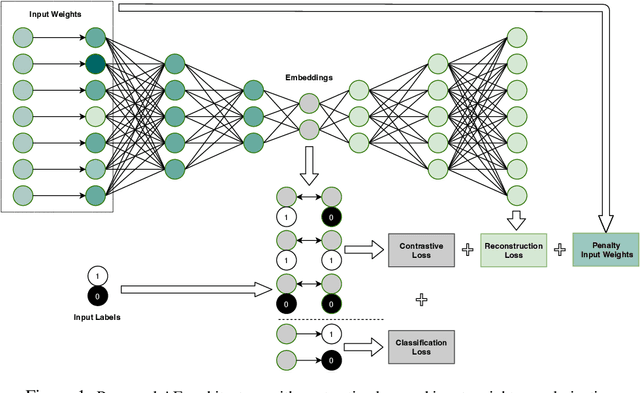
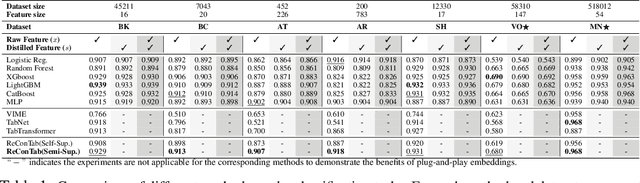
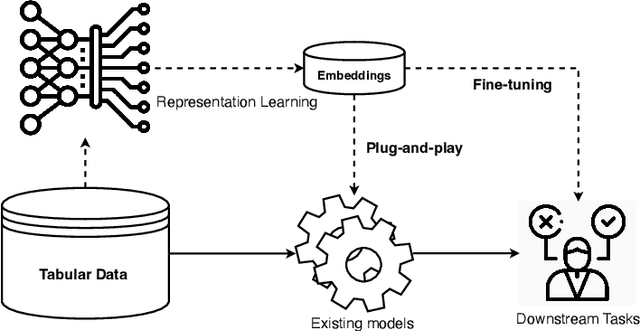
Representation learning stands as one of the critical machine learning techniques across various domains. Through the acquisition of high-quality features, pre-trained embeddings significantly reduce input space redundancy, benefiting downstream pattern recognition tasks such as classification, regression, or detection. Nonetheless, in the domain of tabular data, feature engineering and selection still heavily rely on manual intervention, leading to time-consuming processes and necessitating domain expertise. In response to this challenge, we introduce ReConTab, a deep automatic representation learning framework with regularized contrastive learning. Agnostic to any type of modeling task, ReConTab constructs an asymmetric autoencoder based on the same raw features from model inputs, producing low-dimensional representative embeddings. Specifically, regularization techniques are applied for raw feature selection. Meanwhile, ReConTab leverages contrastive learning to distill the most pertinent information for downstream tasks. Experiments conducted on extensive real-world datasets substantiate the framework's capacity to yield substantial and robust performance improvements. Furthermore, we empirically demonstrate that pre-trained embeddings can seamlessly integrate as easily adaptable features, enhancing the performance of various traditional methods such as XGBoost and Random Forest.