 Add to Chrome
 Add to Firefox
 Add to Edge
Differentiable Sparse Identification of Lagrangian Dynamics
Nov 13, 2025
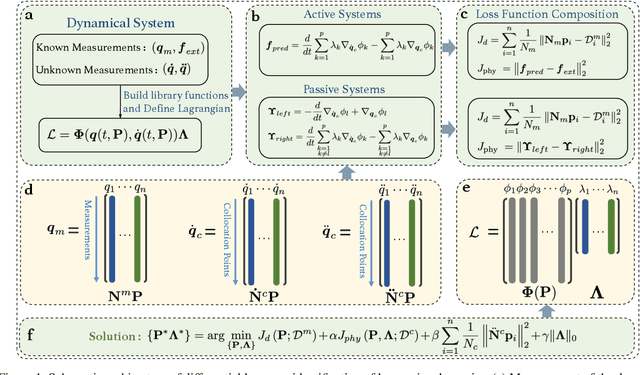
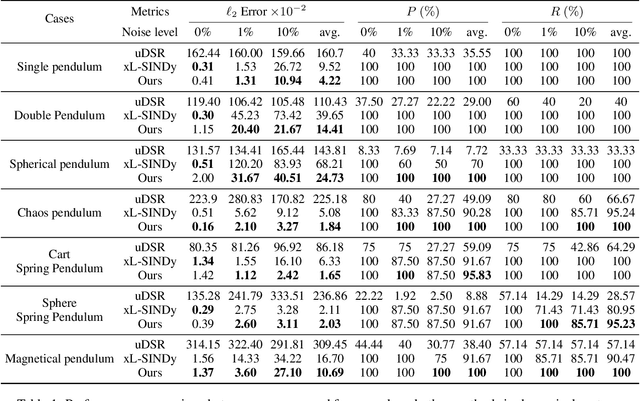
Data-driven discovery of governing equations from data remains a fundamental challenge in nonlinear dynamics. Although sparse regression techniques have advanced system identification, they struggle with rational functions and noise sensitivity in complex mechanical systems. The Lagrangian formalism offers a promising alternative, as it typically avoids rational expressions and provides a more concise representation of system dynamics. However, existing Lagrangian identification methods are significantly affected by measurement noise and limited data availability. This paper presents a novel differentiable sparse identification framework that addresses these limitations through three key contributions: (1) the first integration of cubic B-Spline approximation into Lagrangian system identification, enabling accurate representation of complex nonlinearities, (2) a robust equation discovery mechanism that effectively utilizes measurements while incorporating known physical constraints, (3) a recursive derivative computation scheme based on B-spline basis functions, effectively constraining higher-order derivatives and reducing noise sensitivity on second-order dynamical systems. The proposed method demonstrates superior performance and enables more accurate and reliable extraction of physical laws from noisy data, particularly in complex mechanical systems compared to baseline methods.

Structure-Aware Near-Field Radio Map Recovery via RBF-Assisted Matrix Completion
Nov 10, 2025This paper proposes a novel structure-aware matrix completion framework assisted by radial basis function (RBF) interpolation for near-field radio map construction in extremely large multiple-input multiple-output (XL-MIMO) systems. Unlike the far-field scenario, near-field wavefronts exhibit strong dependencies on both angle and distance due to spherical wave propagation, leading to complicated variations in received signal strength (RSS). To effectively capture the intricate spatial variations structure inherent in near-field environments, a regularized RBF interpolation method is developed to enhance radio map reconstruction accuracy. Leveraging theoretical insights from interpolation error analysis of RBF, an inverse μ-law-inspired nonuniform sampling strategy is introduced to allocate measurements adaptively, emphasizing regions with rapid RSS variations near the transmitter. To further exploit the global low-rank structure in the near-field radio map, we integrate RBF interpolation with nuclear norm minimization (NNM)-based matrix completion. A robust Huberized leave-one-out cross-validation (LOOCV) scheme is then proposed for adaptive selection of the tolerance parameter, facilitating optimal fusion between RBF interpolation and matrix completion. The integration of local variation structure modeling via RBF interpolation and global low-rank structure exploitation via matrix completion yields a structure-aware framework that substantially improves the accuracy of near-field radio map reconstruction. Extensive simulations demonstrate that the proposed approach achieves over 10% improvement in normalized mean squared error (NMSE) compared to standard interpolation and matrix completion methods under varying sampling densities and shadowing conditions.
Nowcast3D: Reliable precipitation nowcasting via gray-box learning
Nov 06, 2025Extreme precipitation nowcasting demands high spatiotemporal fidelity and extended lead times, yet existing approaches remain limited. Numerical Weather Prediction (NWP) and its deep-learning emulations are too slow and coarse for rapidly evolving convection, while extrapolation and purely data-driven models suffer from error accumulation and excessive smoothing. Hybrid 2D radar-based methods discard crucial vertical information, preventing accurate reconstruction of height-dependent dynamics. We introduce a gray-box, fully three-dimensional nowcasting framework that directly processes volumetric radar reflectivity and couples physically constrained neural operators with datadriven learning. The model learns vertically varying 3D advection fields under a conservative advection operator, parameterizes spatially varying diffusion, and introduces a Brownian-motion--inspired stochastic term to represent unresolved motions. A residual branch captures small-scale convective initiation and microphysical variability, while a diffusion-based stochastic module estimates uncertainty. The framework achieves more accurate forecasts up to three-hour lead time across precipitation regimes and ranked first in 57\% of cases in a blind evaluation by 160 meteorologists. By restoring full 3D dynamics with physical consistency, it offers a scalable and robust pathway for skillful and reliable nowcasting of extreme precipitation.
MARS: Optimizing Dual-System Deep Research via Multi-Agent Reinforcement Learning
Oct 06, 2025Large Reasoning Models (LRMs) often exhibit a tendency for overanalysis in simple tasks, where the models excessively utilize System 2-type, deliberate reasoning, leading to inefficient token generation. Furthermore, these models face challenges in adapting their reasoning capabilities to rapidly changing environments due to the static nature of their pretraining data. To address these issues, advancing Large Language Models (LLMs) for complex reasoning tasks requires innovative approaches that bridge intuitive and deliberate cognitive processes, akin to human cognition's dual-system dynamic. This paper introduces a Multi-Agent System for Deep ReSearch (MARS) enabling seamless integration of System 1's fast, intuitive thinking with System 2's deliberate reasoning within LLMs. MARS strategically integrates multiple external tools, such as Google Search, Google Scholar, and Python Interpreter, to access up-to-date information and execute complex computations, while creating a specialized division of labor where System 1 efficiently processes and summarizes high-volume external information, providing distilled insights that expand System 2's reasoning context without overwhelming its capacity. Furthermore, we propose a multi-agent reinforcement learning framework extending Group Relative Policy Optimization to simultaneously optimize both systems with multi-turn tool interactions, bin-packing optimization, and sample balancing strategies that enhance collaborative efficiency. Extensive experiments demonstrate MARS achieves substantial improvements of 3.86% on the challenging Humanity's Last Exam (HLE) benchmark and an average gain of 8.9% across 7 knowledge-intensive tasks, validating the effectiveness of our dual-system paradigm for complex reasoning in dynamic information environments.
RPG: A Repository Planning Graph for Unified and Scalable Codebase Generation
Sep 19, 2025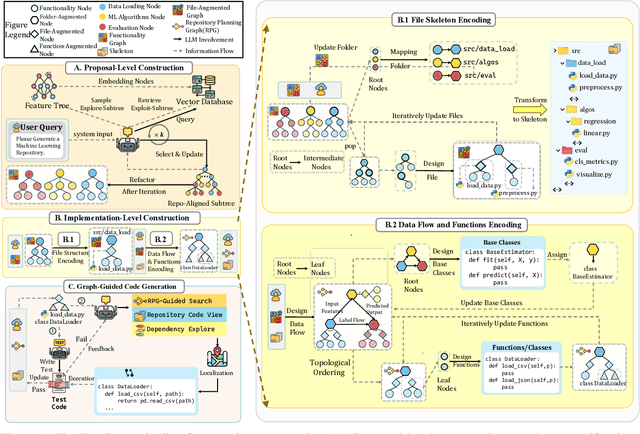
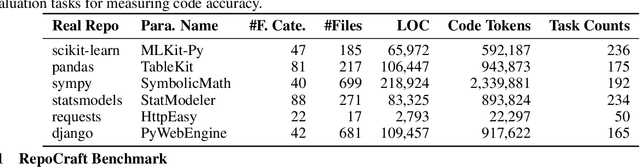
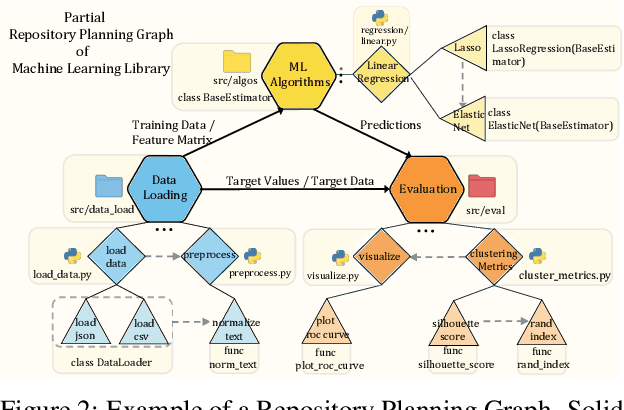
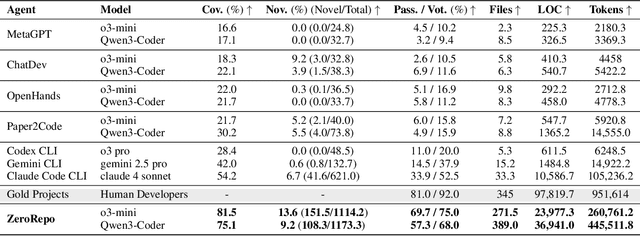
Large language models excel at function- and file-level code generation, yet generating complete repositories from scratch remains a fundamental challenge. This process demands coherent and reliable planning across proposal- and implementation-level stages, while natural language, due to its ambiguity and verbosity, is ill-suited for faithfully representing complex software structures. To address this, we introduce the Repository Planning Graph (RPG), a persistent representation that unifies proposal- and implementation-level planning by encoding capabilities, file structures, data flows, and functions in one graph. RPG replaces ambiguous natural language with an explicit blueprint, enabling long-horizon planning and scalable repository generation. Building on RPG, we develop ZeroRepo, a graph-driven framework for repository generation from scratch. It operates in three stages: proposal-level planning and implementation-level refinement to construct the graph, followed by graph-guided code generation with test validation. To evaluate this setting, we construct RepoCraft, a benchmark of six real-world projects with 1,052 tasks. On RepoCraft, ZeroRepo produces repositories averaging nearly 36K LOC, roughly 3.9$\times$ the strongest baseline (Claude Code) and about 64$\times$ other baselines. It attains 81.5% functional coverage and a 69.7% pass rate, exceeding Claude Code by 27.3 and 35.8 percentage points, respectively. Further analysis shows that RPG models complex dependencies, enables progressively more sophisticated planning through near-linear scaling, and enhances LLM understanding of repositories, thereby accelerating agent localization.
Flow Matching-Based Active Learning for Radio Map Construction with Low-Altitude UAVs
Sep 17, 2025The employment of unmanned aerial vehicles (UAVs) in the lowaltitude economy necessitates precise and real-time radio maps for reliable communication and safe navigation. However, constructing such maps is hindered by the infeasibility of exhaustive measurements due to UAVs' limited flight endurance. To address this, we propose a novel active learning framework for low-altitude radio map construction based on limited measurements. First, a Plug-and-Play (PnP)-refined flow matching algorithm is introduced, which leverages flow matching as a powerful generative prior within a PnP scheme to reconstruct high-fidelity radio maps. Second, the generative nature of flow matching is exploited to quantify uncertainty by generating an ensemble of radio maps and computing the location-wise variance. The resulting uncertainty map guides a multi-objective candidate selection and then a trajectory is planned via utility-aware path search (UAPS), directing the UAV to the most informative locations while taking travel costs into account. Simulation results demonstrate that our method significantly outperforms the baselines, achieving more than a 70% reduction in normalized mean squared error (NMSE).
FlowDrive: Energy Flow Field for End-to-End Autonomous Driving
Sep 17, 2025Recent advances in end-to-end autonomous driving leverage multi-view images to construct BEV representations for motion planning. In motion planning, autonomous vehicles need considering both hard constraints imposed by geometrically occupied obstacles (e.g., vehicles, pedestrians) and soft, rule-based semantics with no explicit geometry (e.g., lane boundaries, traffic priors). However, existing end-to-end frameworks typically rely on BEV features learned in an implicit manner, lacking explicit modeling of risk and guidance priors for safe and interpretable planning. To address this, we propose FlowDrive, a novel framework that introduces physically interpretable energy-based flow fields-including risk potential and lane attraction fields-to encode semantic priors and safety cues into the BEV space. These flow-aware features enable adaptive refinement of anchor trajectories and serve as interpretable guidance for trajectory generation. Moreover, FlowDrive decouples motion intent prediction from trajectory denoising via a conditional diffusion planner with feature-level gating, alleviating task interference and enhancing multimodal diversity. Experiments on the NAVSIM v2 benchmark demonstrate that FlowDrive achieves state-of-the-art performance with an EPDMS of 86.3, surpassing prior baselines in both safety and planning quality. The project is available at https://astrixdrive.github.io/FlowDrive.github.io/.
Secure Tug-of-War (SecTOW): Iterative Defense-Attack Training with Reinforcement Learning for Multimodal Model Security
Jul 29, 2025The rapid advancement of multimodal large language models (MLLMs) has led to breakthroughs in various applications, yet their security remains a critical challenge. One pressing issue involves unsafe image-query pairs--jailbreak inputs specifically designed to bypass security constraints and elicit unintended responses from MLLMs. Compared to general multimodal data, such unsafe inputs are relatively sparse, which limits the diversity and richness of training samples available for developing robust defense models. Meanwhile, existing guardrail-type methods rely on external modules to enforce security constraints but fail to address intrinsic vulnerabilities within MLLMs. Traditional supervised fine-tuning (SFT), on the other hand, often over-refuses harmless inputs, compromising general performance. Given these challenges, we propose Secure Tug-of-War (SecTOW), an innovative iterative defense-attack training method to enhance the security of MLLMs. SecTOW consists of two modules: a defender and an auxiliary attacker, both trained iteratively using reinforcement learning (GRPO). During the iterative process, the attacker identifies security vulnerabilities in the defense model and expands jailbreak data. The expanded data are then used to train the defender, enabling it to address identified security vulnerabilities. We also design reward mechanisms used for GRPO to simplify the use of response labels, reducing dependence on complex generative labels and enabling the efficient use of synthetic data. Additionally, a quality monitoring mechanism is used to mitigate the defender's over-refusal of harmless inputs and ensure the diversity of the jailbreak data generated by the attacker. Experimental results on safety-specific and general benchmarks demonstrate that SecTOW significantly improves security while preserving general performance.
Test-Time-Matching: Decouple Personality, Memory, and Linguistic Style in LLM-based Role-Playing Language Agent
Jul 23, 2025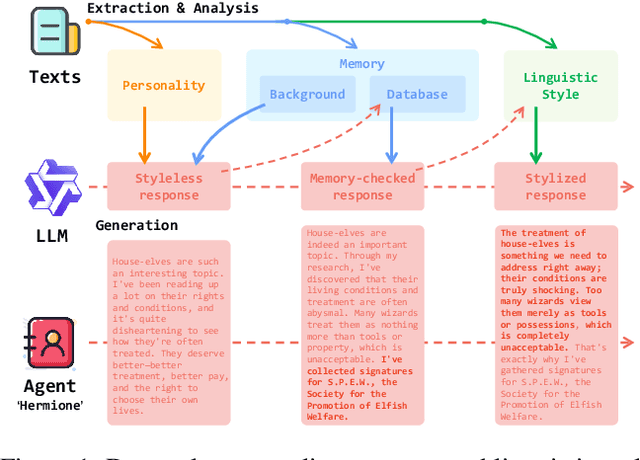
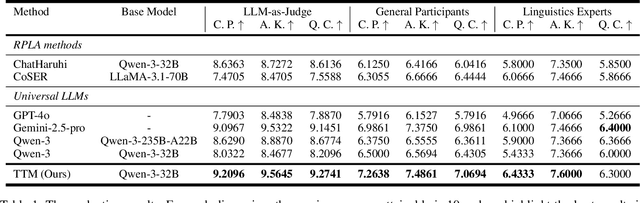
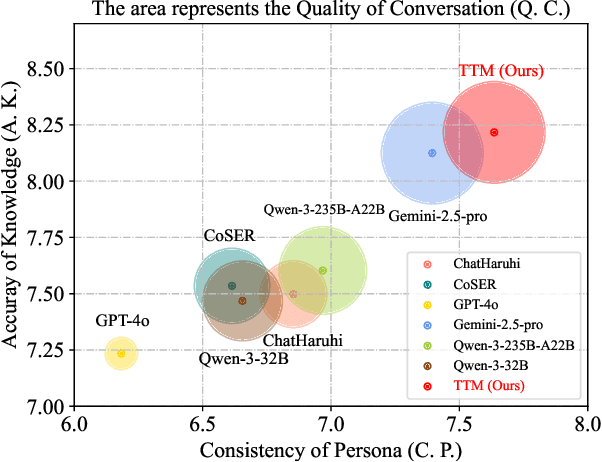
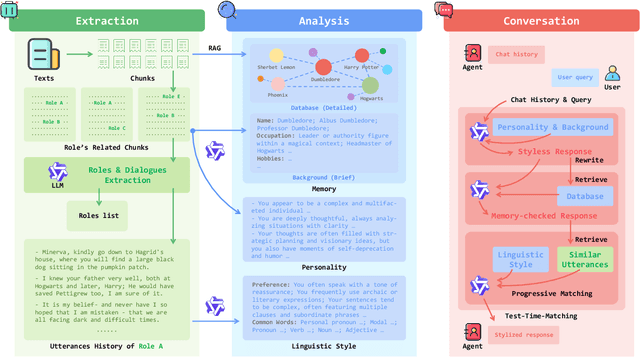
The rapid advancement of large language models (LLMs) has enabled role-playing language agents to demonstrate significant potential in various applications. However, relying solely on prompts and contextual inputs often proves insufficient for achieving deep immersion in specific roles, particularly well-known fictional or public figures. On the other hand, fine-tuning-based approaches face limitations due to the challenges associated with data collection and the computational resources required for training, thereby restricting their broader applicability. To address these issues, we propose Test-Time-Matching (TTM), a training-free role-playing framework through test-time scaling and context engineering. TTM uses LLM agents to automatically decouple a character's features into personality, memory, and linguistic style. Our framework involves a structured, three-stage generation pipeline that utilizes these features for controlled role-playing. It achieves high-fidelity role-playing performance, also enables seamless combinations across diverse linguistic styles and even variations in personality and memory. We evaluate our framework through human assessment, and the results demonstrate that our method achieves the outstanding performance in generating expressive and stylistically consistent character dialogues.
Inverse Reinforcement Learning Meets Large Language Model Post-Training: Basics, Advances, and Opportunities
Jul 17, 2025In the era of Large Language Models (LLMs), alignment has emerged as a fundamental yet challenging problem in the pursuit of more reliable, controllable, and capable machine intelligence. The recent success of reasoning models and conversational AI systems has underscored the critical role of reinforcement learning (RL) in enhancing these systems, driving increased research interest at the intersection of RL and LLM alignment. This paper provides a comprehensive review of recent advances in LLM alignment through the lens of inverse reinforcement learning (IRL), emphasizing the distinctions between RL techniques employed in LLM alignment and those in conventional RL tasks. In particular, we highlight the necessity of constructing neural reward models from human data and discuss the formal and practical implications of this paradigm shift. We begin by introducing fundamental concepts in RL to provide a foundation for readers unfamiliar with the field. We then examine recent advances in this research agenda, discussing key challenges and opportunities in conducting IRL for LLM alignment. Beyond methodological considerations, we explore practical aspects, including datasets, benchmarks, evaluation metrics, infrastructure, and computationally efficient training and inference techniques. Finally, we draw insights from the literature on sparse-reward RL to identify open questions and potential research directions. By synthesizing findings from diverse studies, we aim to provide a structured and critical overview of the field, highlight unresolved challenges, and outline promising future directions for improving LLM alignment through RL and IRL techniques.