 Add to Chrome
 Add to Firefox
 Add to Edge
VAIC: Vision-Guided Humanoid Agile Object Interaction Control via Decoupled Commands
Jun 08, 2026
Humanoid robots hold immense potential for real-world assistance, yet agile interaction with objects in unstructured environments demands tightly coupled whole-body coordination. Despite recent advancements, current controllers face a critical deployment gap. They rely heavily on dense reference trajectories and perfect state observability, which inherently limits physical generalization. We present Vision Guided Agile Interaction Control (VAIC), a unified framework that bridges this gap by operating exclusively on onboard depth, historical proprioception, and a decoupled user command interface. VAIC employs a two-stage distillation paradigm. First, a privileged teacher policy masters diverse interaction skills using precise object kinematics and exact environmental states. Second, a deployable student policy distills these capabilities by replacing full body tracking with velocity targets across multiple axes and an interaction indicator for each frame. The student utilizes a recurrent object adaptation module to implicitly infer unobservable object dynamics from raw depth streams and proprioception. Evaluations and real-world deployments on the humanoid robot demonstrate that a single VAIC policy successfully executes highly diverse dynamic tasks. These tasks include box carrying, cart interaction, and skateboarding, consistently outperforming baselines and advancing autonomous humanoid deployment.

HAIC: Humanoid Agile Object Interaction Control via Dynamics-Aware World Model
Feb 12, 2026Humanoid robots show promise for complex whole-body tasks in unstructured environments. Although Human-Object Interaction (HOI) has advanced, most methods focus on fully actuated objects rigidly coupled to the robot, ignoring underactuated objects with independent dynamics and non-holonomic constraints. These introduce control challenges from coupling forces and occlusions. We present HAIC, a unified framework for robust interaction across diverse object dynamics without external state estimation. Our key contribution is a dynamics predictor that estimates high-order object states (velocity, acceleration) solely from proprioceptive history. These predictions are projected onto static geometric priors to form a spatially grounded dynamic occupancy map, enabling the policy to infer collision boundaries and contact affordances in blind spots. We use asymmetric fine-tuning, where a world model continuously adapts to the student policy's exploration, ensuring robust state estimation under distribution shifts. Experiments on a humanoid robot show HAIC achieves high success rates in agile tasks (skateboarding, cart pushing/pulling under various loads) by proactively compensating for inertial perturbations, and also masters multi-object long-horizon tasks like carrying a box across varied terrain by predicting the dynamics of multiple objects.
3D Brainformer: 3D Fusion Transformer for Brain Tumor Segmentation
Apr 28, 2023

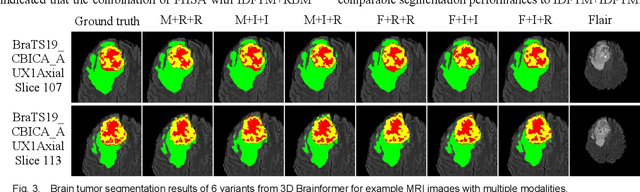
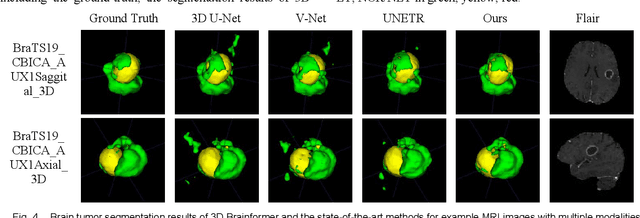
Magnetic resonance imaging (MRI) is critically important for brain mapping in both scientific research and clinical studies. Precise segmentation of brain tumors facilitates clinical diagnosis, evaluations, and surgical planning. Deep learning has recently emerged to improve brain tumor segmentation and achieved impressive results. Convolutional architectures are widely used to implement those neural networks. By the nature of limited receptive fields, however, those architectures are subject to representing long-range spatial dependencies of the voxel intensities in MRI images. Transformers have been leveraged recently to address the above limitations of convolutional networks. Unfortunately, the majority of current Transformers-based methods in segmentation are performed with 2D MRI slices, instead of 3D volumes. Moreover, it is difficult to incorporate the structures between layers because each head is calculated independently in the Multi-Head Self-Attention mechanism (MHSA). In this work, we proposed a 3D Transformer-based segmentation approach. We developed a Fusion-Head Self-Attention mechanism (FHSA) to combine each attention head through attention logic and weight mapping, for the exploration of the long-range spatial dependencies in 3D MRI images. We implemented a plug-and-play self-attention module, named the Infinite Deformable Fusion Transformer Module (IDFTM), to extract features on any deformable feature maps. We applied our approach to the task of brain tumor segmentation, and assessed it on the public BRATS datasets. The experimental results demonstrated that our proposed approach achieved superior performance, in comparison to several state-of-the-art segmentation methods.