 Add to Chrome
 Add to Firefox
 Add to Edge
DynaWeb: Model-Based Reinforcement Learning of Web Agents
Jan 29, 2026
The development of autonomous web agents, powered by Large Language Models (LLMs) and reinforcement learning (RL), represents a significant step towards general-purpose AI assistants. However, training these agents is severely hampered by the challenges of interacting with the live internet, which is inefficient, costly, and fraught with risks. Model-based reinforcement learning (MBRL) offers a promising solution by learning a world model of the environment to enable simulated interaction. This paper introduces DynaWeb, a novel MBRL framework that trains web agents through interacting with a web world model trained to predict naturalistic web page representations given agent actions. This model serves as a synthetic web environment where an agent policy can dream by generating vast quantities of rollout action trajectories for efficient online reinforcement learning. Beyond free policy rollouts, DynaWeb incorporates real expert trajectories from training data, which are randomly interleaved with on-policy rollouts during training to improve stability and sample efficiency. Experiments conducted on the challenging WebArena and WebVoyager benchmarks demonstrate that DynaWeb consistently and significantly improves the performance of state-of-the-art open-source web agent models. Our findings establish the viability of training web agents through imagination, offering a scalable and efficient way to scale up online agentic RL.

Disco-RAG: Discourse-Aware Retrieval-Augmented Generation
Jan 07, 2026Retrieval-Augmented Generation (RAG) has emerged as an important means of enhancing the performance of large language models (LLMs) in knowledge-intensive tasks. However, most existing RAG strategies treat retrieved passages in a flat and unstructured way, which prevents the model from capturing structural cues and constrains its ability to synthesize knowledge from dispersed evidence across documents. To overcome these limitations, we propose Disco-RAG, a discourse-aware framework that explicitly injects discourse signals into the generation process. Our method constructs intra-chunk discourse trees to capture local hierarchies and builds inter-chunk rhetorical graphs to model cross-passage coherence. These structures are jointly integrated into a planning blueprint that conditions the generation. Experiments on question answering and long-document summarization benchmarks show the efficacy of our approach. Disco-RAG achieves state-of-the-art results on the benchmarks without fine-tuning. These findings underscore the important role of discourse structure in advancing RAG systems.
RoleRMBench & RoleRM: Towards Reward Modeling for Profile-Based Role Play in Dialogue Systems
Dec 11, 2025Reward modeling has become a cornerstone of aligning large language models (LLMs) with human preferences. Yet, when extended to subjective and open-ended domains such as role play, existing reward models exhibit severe degradation, struggling to capture nuanced and persona-grounded human judgments. To address this gap, we introduce RoleRMBench, the first systematic benchmark for reward modeling in role-playing dialogue, covering seven fine-grained capabilities from narrative management to role consistency and engagement. Evaluation on RoleRMBench reveals large and consistent gaps between general-purpose reward models and human judgment, particularly in narrative and stylistic dimensions. We further propose RoleRM, a reward model trained with Continuous Implicit Preferences (CIP), which reformulates subjective evaluation as continuous consistent pairwise supervision under multiple structuring strategies. Comprehensive experiments show that RoleRM surpasses strong open- and closed-source reward models by over 24% on average, demonstrating substantial gains in narrative coherence and stylistic fidelity. Our findings highlight the importance of continuous preference representation and annotation consistency, establishing a foundation for subjective alignment in human-centered dialogue systems.
SciRAG: Adaptive, Citation-Aware, and Outline-Guided Retrieval and Synthesis for Scientific Literature
Nov 18, 2025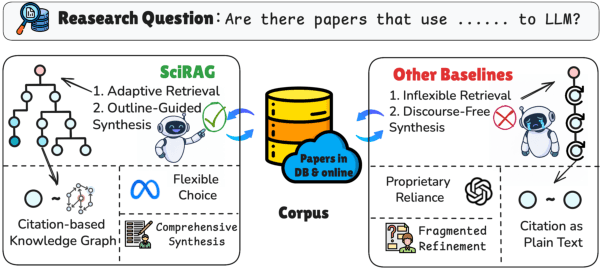
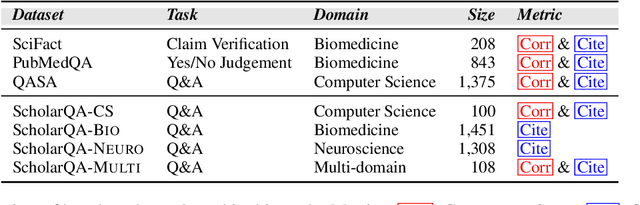
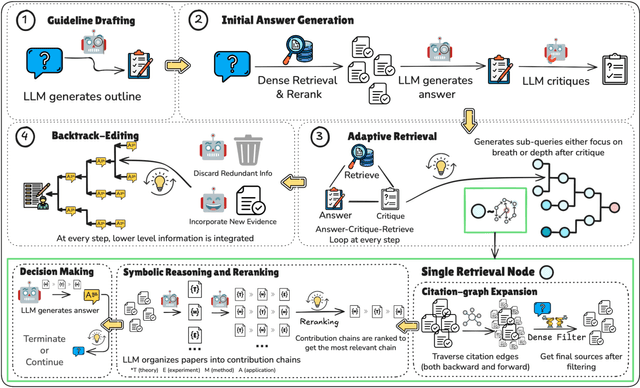
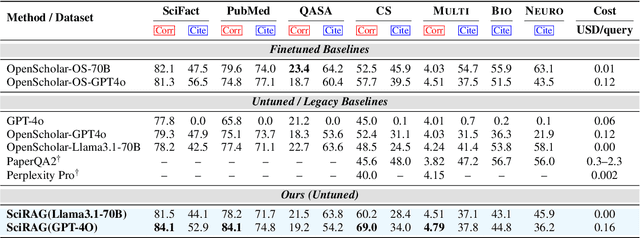
The accelerating growth of scientific publications has intensified the need for scalable, trustworthy systems to synthesize knowledge across diverse literature. While recent retrieval-augmented generation (RAG) methods have improved access to scientific information, they often overlook citation graph structure, adapt poorly to complex queries, and yield fragmented, hard-to-verify syntheses. We introduce SciRAG, an open-source framework for scientific literature exploration that addresses these gaps through three key innovations: (1) adaptive retrieval that flexibly alternates between sequential and parallel evidence gathering; (2) citation-aware symbolic reasoning that leverages citation graphs to organize and filter supporting documents; and (3) outline-guided synthesis that plans, critiques, and refines answers to ensure coherence and transparent attribution. Extensive experiments across multiple benchmarks such as QASA and ScholarQA demonstrate that SciRAG outperforms prior systems in factual accuracy and synthesis quality, establishing a new foundation for reliable, large-scale scientific knowledge aggregation.
Aligning by Misaligning: Boundary-aware Curriculum Learning for Multimodal Alignment
Nov 11, 2025Most multimodal models treat every negative pair alike, ignoring the ambiguous negatives that differ from the positive by only a small detail. We propose Boundary-Aware Curriculum with Local Attention (BACL), a lightweight add-on that turns these borderline cases into a curriculum signal. A Boundary-aware Negative Sampler gradually raises difficulty, while a Contrastive Local Attention loss highlights where the mismatch occurs. The two modules are fully differentiable and work with any off-the-shelf dual encoder. Theory predicts a fast O(1/n) error rate; practice shows up to +32% R@1 over CLIP and new SOTA on four large-scale benchmarks, all without extra labels.