 Add to Chrome
 Add to Firefox
 Add to Edge
Spiking Layer-Adaptive Magnitude-based Pruning
Mar 16, 2026
Spiking Neural Networks (SNNs) provide energy-efficient computation but their deployment is constrained by dense connectivity and high spiking operation costs. Existing magnitude-based pruning strategies, when naively applied to SNNs, fail to account for temporal accumulation, non-uniform timestep contributions, and membrane stability, often leading to severe performance degradation. This paper proposes Spiking Layer-Adaptive Magnitude-based Pruning (SLAMP), a theory-guided pruning framework that generalizes layer-adaptive magnitude pruning to temporal SNNs by explicitly controlling worst-case output distortion across layers and timesteps. SLAMP formulates sparsity allocation as a temporal distortion-constrained optimization problem, yielding time-aware layer importance scores that reduce to conventional layer-adaptive pruning in single-timestep limit. An efficient two-stage procedure is derived, combining temporal score estimation, global sparsity allocation, and magnitude pruning with retraining for stability recovery. Experiments on CIFAR10, CIFAR100, and the event-based CIFAR10-DVS datasets demonstrate that SLAMP achieves substantial connectivity and spiking operation reductions while preserving accuracy, enabling efficient and deployable SNN inference.

DynaWeb: Model-Based Reinforcement Learning of Web Agents
Jan 29, 2026The development of autonomous web agents, powered by Large Language Models (LLMs) and reinforcement learning (RL), represents a significant step towards general-purpose AI assistants. However, training these agents is severely hampered by the challenges of interacting with the live internet, which is inefficient, costly, and fraught with risks. Model-based reinforcement learning (MBRL) offers a promising solution by learning a world model of the environment to enable simulated interaction. This paper introduces DynaWeb, a novel MBRL framework that trains web agents through interacting with a web world model trained to predict naturalistic web page representations given agent actions. This model serves as a synthetic web environment where an agent policy can dream by generating vast quantities of rollout action trajectories for efficient online reinforcement learning. Beyond free policy rollouts, DynaWeb incorporates real expert trajectories from training data, which are randomly interleaved with on-policy rollouts during training to improve stability and sample efficiency. Experiments conducted on the challenging WebArena and WebVoyager benchmarks demonstrate that DynaWeb consistently and significantly improves the performance of state-of-the-art open-source web agent models. Our findings establish the viability of training web agents through imagination, offering a scalable and efficient way to scale up online agentic RL.
Multi-Agent Intelligence for Multidisciplinary Decision-Making in Gastrointestinal Oncology
Dec 23, 2025Multimodal clinical reasoning in the field of gastrointestinal (GI) oncology necessitates the integrated interpretation of endoscopic imagery, radiological data, and biochemical markers. Despite the evident potential exhibited by Multimodal Large Language Models (MLLMs), they frequently encounter challenges such as context dilution and hallucination when confronted with intricate, heterogeneous medical histories. In order to address these limitations, a hierarchical Multi-Agent Framework is proposed, which emulates the collaborative workflow of a human Multidisciplinary Team (MDT). The system attained a composite expert evaluation score of 4.60/5.00, thereby demonstrating a substantial improvement over the monolithic baseline. It is noteworthy that the agent-based architecture yielded the most substantial enhancements in reasoning logic and medical accuracy. The findings indicate that mimetic, agent-based collaboration provides a scalable, interpretable, and clinically robust paradigm for automated decision support in oncology.
Adaptive Detector-Verifier Framework for Zero-Shot Polyp Detection in Open-World Settings
Dec 16, 2025Polyp detectors trained on clean datasets often underperform in real-world endoscopy, where illumination changes, motion blur, and occlusions degrade image quality. Existing approaches struggle with the domain gap between controlled laboratory conditions and clinical practice, where adverse imaging conditions are prevalent. In this work, we propose AdaptiveDetector, a novel two-stage detector-verifier framework comprising a YOLOv11 detector with a vision-language model (VLM) verifier. The detector adaptively adjusts per-frame confidence thresholds under VLM guidance, while the verifier is fine-tuned with Group Relative Policy Optimization (GRPO) using an asymmetric, cost-sensitive reward function specifically designed to discourage missed detections -- a critical clinical requirement. To enable realistic assessment under challenging conditions, we construct a comprehensive synthetic testbed by systematically degrading clean datasets with adverse conditions commonly encountered in clinical practice, providing a rigorous benchmark for zero-shot evaluation. Extensive zero-shot evaluation on synthetically degraded CVC-ClinicDB and Kvasir-SEG images demonstrates that our approach improves recall by 14 to 22 percentage points over YOLO alone, while precision remains within 0.7 points below to 1.7 points above the baseline. This combination of adaptive thresholding and cost-sensitive reinforcement learning achieves clinically aligned, open-world polyp detection with substantially fewer false negatives, thereby reducing the risk of missed precancerous polyps and improving patient outcomes.
Physics-Informed Video Flare Synthesis and Removal Leveraging Motion Independence between Flare and Scene
Dec 12, 2025Lens flare is a degradation phenomenon caused by strong light sources. Existing researches on flare removal have mainly focused on images, while the spatiotemporal characteristics of video flare remain largely unexplored. Video flare synthesis and removal pose significantly greater challenges than in image, owing to the complex and mutually independent motion of flare, light sources, and scene content. This motion independence further affects restoration performance, often resulting in flicker and artifacts. To address this issue, we propose a physics-informed dynamic flare synthesis pipeline, which simulates light source motion using optical flow and models the temporal behaviors of both scattering and reflective flares. Meanwhile, we design a video flare removal network that employs an attention module to spatially suppress flare regions and incorporates a Mamba-based temporal modeling component to capture long range spatio-temporal dependencies. This motion-independent spatiotemporal representation effectively eliminates the need for multi-frame alignment, alleviating temporal aliasing between flares and scene content and thereby improving video flare removal performance. Building upon this, we construct the first video flare dataset to comprehensively evaluate our method, which includes a large set of synthetic paired videos and additional real-world videos collected from the Internet to assess generalization capability. Extensive experiments demonstrate that our method consistently outperforms existing video-based restoration and image-based flare removal methods on both real and synthetic videos, effectively removing dynamic flares while preserving light source integrity and maintaining spatiotemporal consistency of scene.
Vi-SAFE: A Spatial-Temporal Framework for Efficient Violence Detection in Public Surveillance
Sep 16, 2025Violence detection in public surveillance is critical for public safety. This study addresses challenges such as small-scale targets, complex environments, and real-time temporal analysis. We propose Vi-SAFE, a spatial-temporal framework that integrates an enhanced YOLOv8 with a Temporal Segment Network (TSN) for video surveillance. The YOLOv8 model is optimized with GhostNetV3 as a lightweight backbone, an exponential moving average (EMA) attention mechanism, and pruning to reduce computational cost while maintaining accuracy. YOLOv8 and TSN are trained separately on pedestrian and violence datasets, where YOLOv8 extracts human regions and TSN performs binary classification of violent behavior. Experiments on the RWF-2000 dataset show that Vi-SAFE achieves an accuracy of 0.88, surpassing TSN alone (0.77) and outperforming existing methods in both accuracy and efficiency, demonstrating its effectiveness for public safety surveillance. Code is available at https://anonymous.4open.science/r/Vi-SAFE-3B42/README.md.
Language-Conditioned Open-Vocabulary Mobile Manipulation with Pretrained Models
Jul 23, 2025Open-vocabulary mobile manipulation (OVMM) that involves the handling of novel and unseen objects across different workspaces remains a significant challenge for real-world robotic applications. In this paper, we propose a novel Language-conditioned Open-Vocabulary Mobile Manipulation framework, named LOVMM, incorporating the large language model (LLM) and vision-language model (VLM) to tackle various mobile manipulation tasks in household environments. Our approach is capable of solving various OVMM tasks with free-form natural language instructions (e.g. "toss the food boxes on the office room desk to the trash bin in the corner", and "pack the bottles from the bed to the box in the guestroom"). Extensive experiments simulated in complex household environments show strong zero-shot generalization and multi-task learning abilities of LOVMM. Moreover, our approach can also generalize to multiple tabletop manipulation tasks and achieve better success rates compared to other state-of-the-art methods.
Enhancing Code LLMs with Reinforcement Learning in Code Generation
Dec 29, 2024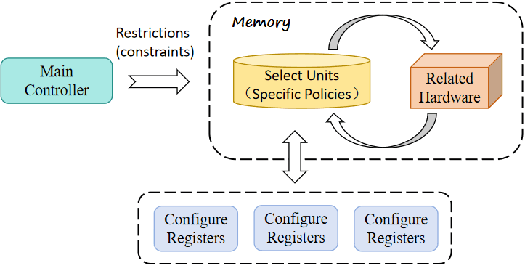
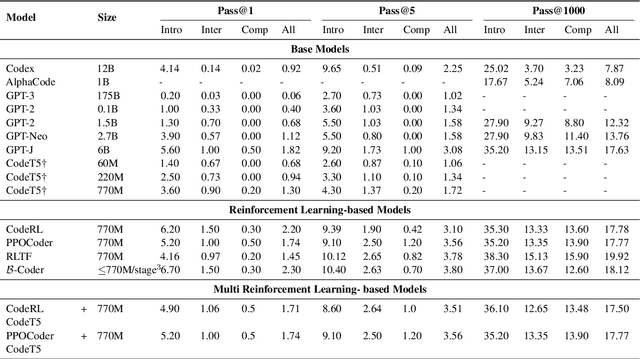
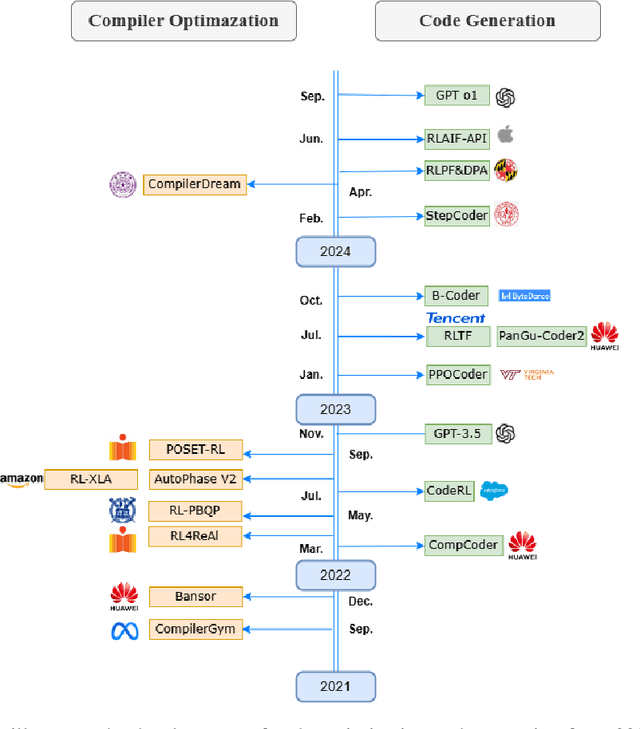
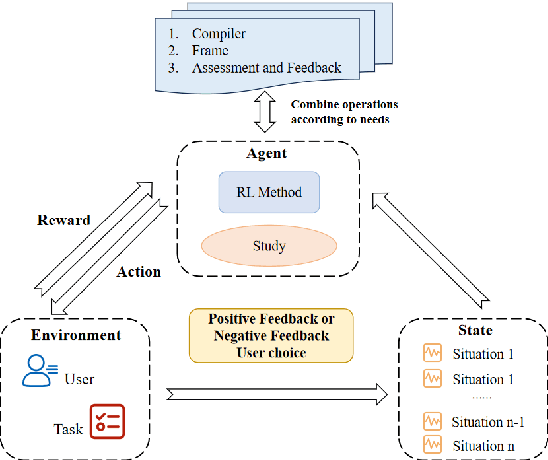
With the rapid evolution of large language models (LLM), reinforcement learning (RL) has emerged as a pivotal technique for code generation and optimization in various domains. This paper presents a systematic survey of the application of RL in code optimization and generation, highlighting its role in enhancing compiler optimization, resource allocation, and the development of frameworks and tools. Subsequent sections first delve into the intricate processes of compiler optimization, where RL algorithms are leveraged to improve efficiency and resource utilization. The discussion then progresses to the function of RL in resource allocation, emphasizing register allocation and system optimization. We also explore the burgeoning role of frameworks and tools in code generation, examining how RL can be integrated to bolster their capabilities. This survey aims to serve as a comprehensive resource for researchers and practitioners interested in harnessing the power of RL to advance code generation and optimization techniques.
Vision-Based Deep Reinforcement Learning of UAV Autonomous Navigation Using Privileged Information
Dec 09, 2024The capability of UAVs for efficient autonomous navigation and obstacle avoidance in complex and unknown environments is critical for applications in agricultural irrigation, disaster relief and logistics. In this paper, we propose the DPRL (Distributed Privileged Reinforcement Learning) navigation algorithm, an end-to-end policy designed to address the challenge of high-speed autonomous UAV navigation under partially observable environmental conditions. Our approach combines deep reinforcement learning with privileged learning to overcome the impact of observation data corruption caused by partial observability. We leverage an asymmetric Actor-Critic architecture to provide the agent with privileged information during training, which enhances the model's perceptual capabilities. Additionally, we present a multi-agent exploration strategy across diverse environments to accelerate experience collection, which in turn expedites model convergence. We conducted extensive simulations across various scenarios, benchmarking our DPRL algorithm against the state-of-the-art navigation algorithms. The results consistently demonstrate the superior performance of our algorithm in terms of flight efficiency, robustness and overall success rate.