 Add to Chrome
 Add to Firefox
 Add to Edge
Seirênes: Adversarial Self-Play with Evolving Distractions for LLM Reasoning
May 12, 2026
We present Seirênes, a self-play RL framework that transforms contextual interference from a failure mode of LLM reasoning into an internal training signal for co-evolving more resilient reasoners. While RL with verifiable rewards has significantly advanced reasoning capabilities, models can still exhibit fragility when encountering non-idealized contexts: scenarios characterized by superfluous information, tangential instructions, or incidental correlations that differ from the clean distributions typical of standard benchmarks. Seirênes harnesses this vulnerability through a parameter-shared and adversarial self-play loop. Within this framework, a single model is trained to both construct plausible yet distracting contexts that expose its own reasoning blind spots, and solve problems by discerning the essential task from these perturbations to recover the core underlying logic. By pitting these competing objectives against each other, Seirênes compels the model to move beyond superficial pattern matching and anchors its capabilities in robust underlying reasoning. This continuous interaction sustains an informative co-evolutionary curriculum as the model improves. Across seven mathematical reasoning benchmarks and model scales from 4B to 30B, Seirênes achieves average gains of +10.2, +9.1, and +7.2 points. Besides, distracting contexts produced by the 4B Seirênes model reduce the accuracy of top-tier closed-source models (GPT and Gemini) by roughly 4--5 points, revealing Seirênes' general ability to uncover reasoning models' blind spots.

Omni-I2C: A Holistic Benchmark for High-Fidelity Image-to-Code Generation
Mar 18, 2026We present Omni-I2C, a comprehensive benchmark designed to evaluate the capability of Large Multimodal Models (LMMs) in converting complex, structured digital graphics into executable code. We argue that this task represents a non-trivial challenge for the current generation of LMMs: it demands an unprecedented synergy between high-fidelity visual perception -- to parse intricate spatial hierarchies and symbolic details -- and precise generative expression -- to synthesize syntactically sound and logically consistent code. Unlike traditional descriptive tasks, Omni-I2C requires a holistic understanding where any minor perceptual hallucination or coding error leads to a complete failure in visual reconstruction. Omni-I2C features 1080 meticulously curated samples, defined by its breadth across subjects, image modalities, and programming languages. By incorporating authentic user-sourced cases, the benchmark spans a vast spectrum of digital content -- from scientific visualizations to complex symbolic notations -- each paired with executable reference code. To complement this diversity, our evaluation framework provides necessary depth; by decoupling performance into perceptual fidelity and symbolic precision, it transcends surface-level accuracy to expose the granular structural failures and reasoning bottlenecks of current LMMs. Our evaluation reveals a substantial performance gap among leading LMMs; even state-of-the-art models struggle to preserve structural integrity in complex scenarios, underscoring that multimodal code generation remains a formidable challenge. Data and code are available at https://github.com/MiliLab/Omni-I2C.
TreeCUA: Efficiently Scaling GUI Automation with Tree-Structured Verifiable Evolution
Feb 10, 2026Effectively scaling GUI automation is essential for computer-use agents (CUAs); however, existing work primarily focuses on scaling GUI grounding rather than the more crucial GUI planning, which requires more sophisticated data collection. In reality, the exploration process of a CUA across apps/desktops/web pages typically follows a tree structure, with earlier functional entry points often being explored more frequently. Thus, organizing large-scale trajectories into tree structures can reduce data cost and streamline the data scaling of GUI planning. In this work, we propose TreeCUA to efficiently scale GUI automation with tree-structured verifiable evolution. We propose a multi-agent collaborative framework to explore the environment, verify actions, summarize trajectories, and evaluate quality to generate high-quality and scalable GUI trajectories. To improve efficiency, we devise a novel tree-based topology to store and replay duplicate exploration nodes, and design an adaptive exploration algorithm to balance the depth (\emph{i.e.}, trajectory difficulty) and breadth (\emph{i.e.}, trajectory diversity). Moreover, we develop world knowledge guidance and global memory backtracking to avoid low-quality generation. Finally, we naturally extend and propose the TreeCUA-DPO method from abundant tree node information, improving GUI planning capability by referring to the branch information of adjacent trajectories. Experimental results show that TreeCUA and TreeCUA-DPO offer significant improvements, and out-of-domain (OOD) studies further demonstrate strong generalization. All trajectory node information and code will be available at https://github.com/UITron-hub/TreeCUA.
Flexible Entropy Control in RLVR with Gradient-Preserving Perspective
Feb 10, 2026Reinforcement Learning with Verifiable Rewards (RLVR) has emerged as a critical method for enhancing the reasoning capabilities of Large Language Models (LLMs). However, continuous training often leads to policy entropy collapse, characterized by a rapid decay in entropy that results in premature overconfidence, reduced output diversity, and vanishing gradient norms that inhibit learning. Gradient-Preserving Clipping is a primary factor influencing these dynamics, but existing mitigation strategies are largely static and lack a framework connecting clipping mechanisms to precise entropy control. This paper proposes reshaping entropy control in RL from the perspective of Gradient-Preserving Clipping. We first theoretically and empirically verify the contributions of specific importance sampling ratio regions to entropy growth and reduction. Leveraging these findings, we introduce a novel regulation mechanism using dynamic clipping threshold to precisely manage entropy. Furthermore, we design and evaluate dynamic entropy control strategies, including increase-then-decrease, decrease-increase-decrease, and oscillatory decay. Experimental results demonstrate that these strategies effectively mitigate entropy collapse, and achieve superior performance across multiple benchmarks.
Length-Unbiased Sequence Policy Optimization: Revealing and Controlling Response Length Variation in RLVR
Feb 05, 2026Recent applications of Reinforcement Learning with Verifiable Rewards (RLVR) to Large Language Models (LLMs) and Vision-Language Models (VLMs) have demonstrated significant success in enhancing reasoning capabilities for complex tasks. During RLVR training, an increase in response length is often regarded as a key factor contributing to the growth of reasoning ability. However, the patterns of change in response length vary significantly across different RLVR algorithms during the training process. To provide a fundamental explanation for these variations, this paper conducts an in-depth analysis of the components of mainstream RLVR algorithms. We present a theoretical analysis of the factors influencing response length and validate our theory through extensive experimentation. Building upon these theoretical findings, we propose the Length-Unbiased Sequence Policy Optimization (LUSPO) algorithm. Specifically, we rectify the length bias inherent in Group Sequence Policy Optimization (GSPO), rendering its loss function unbiased with respect to response length and thereby resolving the issue of response length collapse. We conduct extensive experiments across mathematical reasoning benchmarks and multimodal reasoning scenarios, where LUSPO consistently achieves superior performance. Empirical results demonstrate that LUSPO represents a novel, state-of-the-art optimization strategy compared to existing methods such as GRPO and GSPO.
MobileDreamer: Generative Sketch World Model for GUI Agent
Jan 07, 2026Mobile GUI agents have shown strong potential in real-world automation and practical applications. However, most existing agents remain reactive, making decisions mainly from current screen, which limits their performance on long-horizon tasks. Building a world model from repeated interactions enables forecasting action outcomes and supports better decision making for mobile GUI agents. This is challenging because the model must predict post-action states with spatial awareness while remaining efficient enough for practical deployment. In this paper, we propose MobileDreamer, an efficient world-model-based lookahead framework to equip the GUI agents based on the future imagination provided by the world model. It consists of textual sketch world model and rollout imagination for GUI agent. Textual sketch world model forecasts post-action states through a learning process to transform digital images into key task-related sketches, and designs a novel order-invariant learning strategy to preserve the spatial information of GUI elements. The rollout imagination strategy for GUI agent optimizes the action-selection process by leveraging the prediction capability of world model. Experiments on Android World show that MobileDreamer achieves state-of-the-art performance and improves task success by 5.25%. World model evaluations further verify that our textual sketch modeling accurately forecasts key GUI elements.
Learning When to Look: A Disentangled Curriculum for Strategic Perception in Multimodal Reasoning
Dec 19, 2025Multimodal Large Language Models (MLLMs) demonstrate significant potential but remain brittle in complex, long-chain visual reasoning tasks. A critical failure mode is "visual forgetting", where models progressively lose visual grounding as reasoning extends, a phenomenon aptly described as "think longer, see less". We posit this failure stems from current training paradigms prematurely entangling two distinct cognitive skills: (1) abstract logical reasoning "how-to-think") and (2) strategic visual perception ("when-to-look"). This creates a foundational cold-start deficiency -- weakening abstract reasoning -- and a strategic perception deficit, as models lack a policy for when to perceive. In this paper, we propose a novel curriculum-based framework to disentangle these skills. First, we introduce a disentangled Supervised Fine-Tuning (SFT) curriculum that builds a robust abstract reasoning backbone on text-only data before anchoring it to vision with a novel Perception-Grounded Chain-of-Thought (PG-CoT) paradigm. Second, we resolve the strategic perception deficit by formulating timing as a reinforcement learning problem. We design a Pivotal Perception Reward that teaches the model when to look by coupling perceptual actions to linguistic markers of cognitive uncertainty (e.g., "wait", "verify"), thereby learning an autonomous grounding policy. Our contributions include the formalization of these two deficiencies and the development of a principled, two-stage framework to address them, transforming the model from a heuristic-driven observer to a strategic, grounded reasoner. \textbf{Code}: \url{https://github.com/gaozilve-max/learning-when-to-look}.
Context Cascade Compression: Exploring the Upper Limits of Text Compression
Nov 19, 2025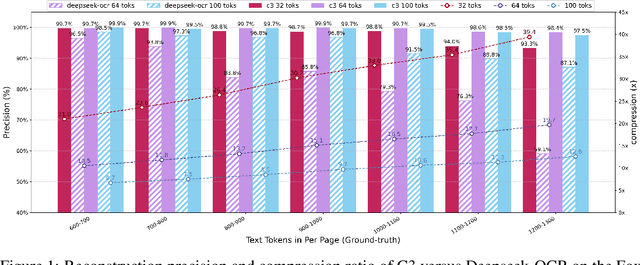
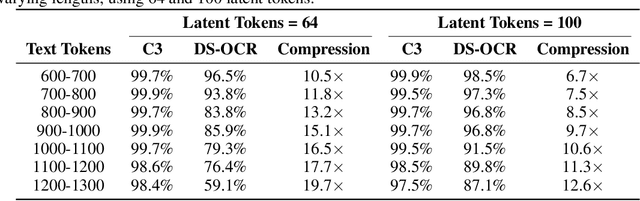
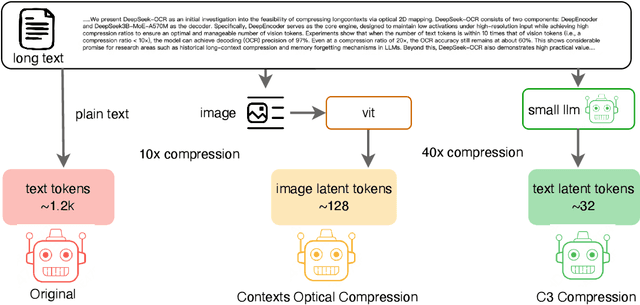
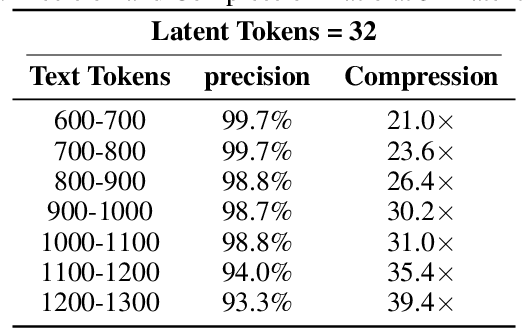
Million-level token inputs in long-context tasks pose significant computational and memory challenges for Large Language Models (LLMs). Recently, DeepSeek-OCR conducted research into the feasibility of Contexts Optical Compression and achieved preliminary results. Inspired by this, we introduce Context Cascade Compression C3 to explore the upper limits of text compression. Our method cascades two LLMs of different sizes to handle the compression and decoding tasks. Specifically, a small LLM, acting as the first stage, performs text compression by condensing a long context into a set of latent tokens (e.g., 32 or 64 in length), achieving a high ratio of text tokens to latent tokens. A large LLM, as the second stage, then executes the decoding task on this compressed context. Experiments show that at a 20x compression ratio (where the number of text tokens is 20 times the number of latent tokens), our model achieves 98% decoding accuracy, compared to approximately 60% for DeepSeek-OCR. When we further increase the compression ratio to 40x, the accuracy is maintained at around 93%. This indicates that in the domain of context compression, C3 Compression demonstrates superior performance and feasibility over optical character compression. C3 uses a simpler, pure-text pipeline that ignores factors like layout, color, and information loss from a visual encoder. This also suggests a potential upper bound for compression ratios in future work on optical character compression, OCR, and related fields. Codes and model weights are publicly accessible at https://github.com/liufanfanlff/C3-Context-Cascade-Compression
Metis-HOME: Hybrid Optimized Mixture-of-Experts for Multimodal Reasoning
Oct 23, 2025Inspired by recent advancements in LLM reasoning, the field of multimodal reasoning has seen remarkable progress, achieving significant performance gains on intricate tasks such as mathematical problem-solving. Despite this progress, current multimodal large reasoning models exhibit two key limitations. They tend to employ computationally expensive reasoning even for simple queries, leading to inefficiency. Furthermore, this focus on specialized reasoning often impairs their broader, more general understanding capabilities. In this paper, we propose Metis-HOME: a Hybrid Optimized Mixture-of-Experts framework designed to address this trade-off. Metis-HOME enables a ''Hybrid Thinking'' paradigm by structuring the original dense model into two distinct expert branches: a thinking branch tailored for complex, multi-step reasoning, and a non-thinking branch optimized for rapid, direct inference on tasks like general VQA and OCR. A lightweight, trainable router dynamically allocates queries to the most suitable expert. We instantiate Metis-HOME by adapting the Qwen2.5-VL-7B into an MoE architecture. Comprehensive evaluations reveal that our approach not only substantially enhances complex reasoning abilities but also improves the model's general capabilities, reversing the degradation trend observed in other reasoning-specialized models. Our work establishes a new paradigm for building powerful and versatile MLLMs, effectively resolving the prevalent reasoning-vs-generalization dilemma.
Metis-RISE: RL Incentivizes and SFT Enhances Multimodal Reasoning Model Learning
Jun 16, 2025Recent advancements in large language models (LLMs) have witnessed a surge in the development of advanced reasoning paradigms, which are now being integrated into multimodal large language models (MLLMs). However, existing approaches often fall short: methods solely employing reinforcement learning (RL) can struggle with sample inefficiency and activating entirely absent reasoning capabilities, while conventional pipelines that initiate with a cold-start supervised fine-tuning (SFT) phase before RL may restrict the model's exploratory capacity and face suboptimal convergence. In this work, we introduce \textbf{Metis-RISE} (\textbf{R}L \textbf{I}ncentivizes and \textbf{S}FT \textbf{E}nhances) for multimodal reasoning model learning. Unlike conventional approaches, Metis-RISE distinctively omits an initial SFT stage, beginning instead with an RL phase (e.g., using a Group Relative Policy Optimization variant) to incentivize and activate the model's latent reasoning capacity. Subsequently, the targeted SFT stage addresses two key challenges identified during RL: (1) \textit{inefficient trajectory sampling} for tasks where the model possesses but inconsistently applies correct reasoning, which we tackle using self-distilled reasoning trajectories from the RL model itself; and (2) \textit{fundamental capability absence}, which we address by injecting expert-augmented knowledge for prompts where the model entirely fails. This strategic application of RL for incentivization followed by SFT for enhancement forms the core of Metis-RISE, leading to two versions of our MLLMs (7B and 72B parameters). Evaluations on the OpenCompass Multimodal Reasoning Leaderboard demonstrate that both models achieve state-of-the-art performance among similar-sized models, with the 72B version ranking fourth overall.