 Add to Chrome
 Add to Firefox
 Add to Edge
Learning When to Look: A Disentangled Curriculum for Strategic Perception in Multimodal Reasoning
Dec 19, 2025
Multimodal Large Language Models (MLLMs) demonstrate significant potential but remain brittle in complex, long-chain visual reasoning tasks. A critical failure mode is "visual forgetting", where models progressively lose visual grounding as reasoning extends, a phenomenon aptly described as "think longer, see less". We posit this failure stems from current training paradigms prematurely entangling two distinct cognitive skills: (1) abstract logical reasoning "how-to-think") and (2) strategic visual perception ("when-to-look"). This creates a foundational cold-start deficiency -- weakening abstract reasoning -- and a strategic perception deficit, as models lack a policy for when to perceive. In this paper, we propose a novel curriculum-based framework to disentangle these skills. First, we introduce a disentangled Supervised Fine-Tuning (SFT) curriculum that builds a robust abstract reasoning backbone on text-only data before anchoring it to vision with a novel Perception-Grounded Chain-of-Thought (PG-CoT) paradigm. Second, we resolve the strategic perception deficit by formulating timing as a reinforcement learning problem. We design a Pivotal Perception Reward that teaches the model when to look by coupling perceptual actions to linguistic markers of cognitive uncertainty (e.g., "wait", "verify"), thereby learning an autonomous grounding policy. Our contributions include the formalization of these two deficiencies and the development of a principled, two-stage framework to address them, transforming the model from a heuristic-driven observer to a strategic, grounded reasoner. \textbf{Code}: \url{https://github.com/gaozilve-max/learning-when-to-look}.

Centerline Boundary Dice Loss for Vascular Segmentation
Jul 01, 2024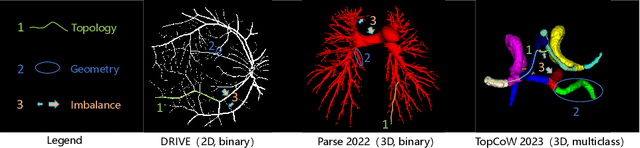
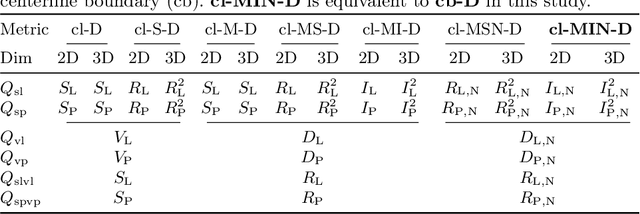
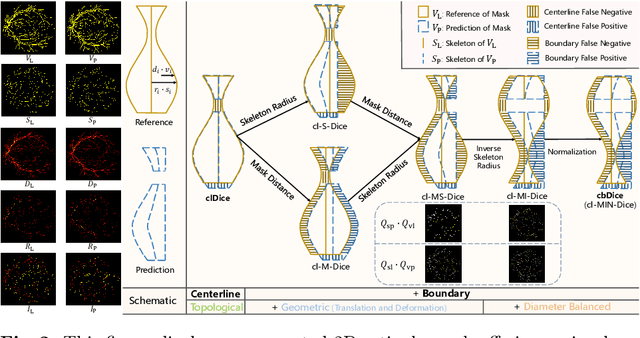
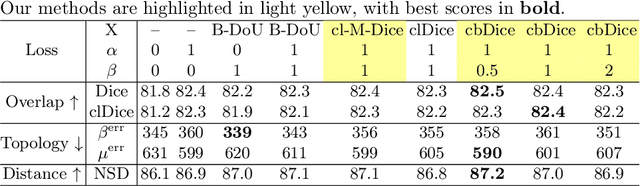
Vascular segmentation in medical imaging plays a crucial role in analysing morphological and functional assessments. Traditional methods, like the centerline Dice (clDice) loss, ensure topology preservation but falter in capturing geometric details, especially under translation and deformation. The combination of clDice with traditional Dice loss can lead to diameter imbalance, favoring larger vessels. Addressing these challenges, we introduce the centerline boundary Dice (cbDice) loss function, which harmonizes topological integrity and geometric nuances, ensuring consistent segmentation across various vessel sizes. cbDice enriches the clDice approach by including boundary-aware aspects, thereby improving geometric detail recognition. It matches the performance of the boundary difference over union (B-DoU) loss through a mask-distance-based approach, enhancing traslation sensitivity. Crucially, cbDice incorporates radius information from vascular skeletons, enabling uniform adaptation to vascular diameter changes and maintaining balance in branch growth and fracture impacts. Furthermore, we conducted a theoretical analysis of clDice variants (cl-X-Dice). We validated cbDice's efficacy on three diverse vascular segmentation datasets, encompassing both 2D and 3D, and binary and multi-class segmentation. Particularly, the method integrated with cbDice demonstrated outstanding performance on the MICCAI 2023 TopCoW Challenge dataset. Our code is made publicly available at: https://github.com/PengchengShi1220/cbDice.