 Add to Chrome
 Add to Firefox
 Add to Edge
HGT: Leveraging Heterogeneous Graph-enhanced Large Language Models for Few-shot Complex Table Understanding
Mar 28, 2024
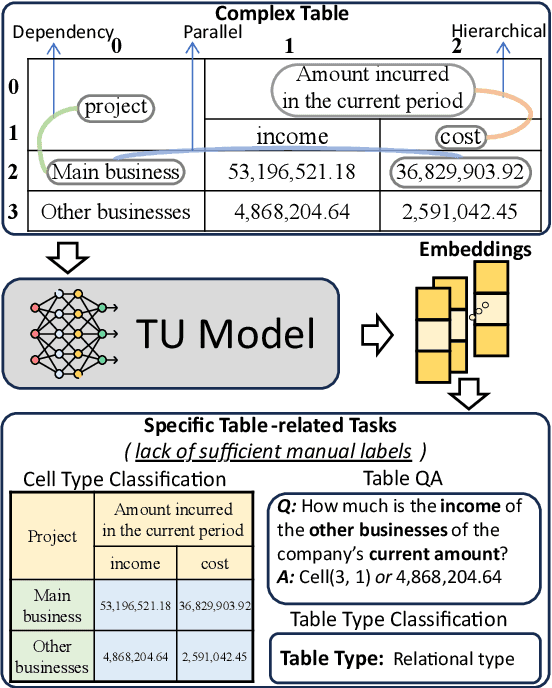
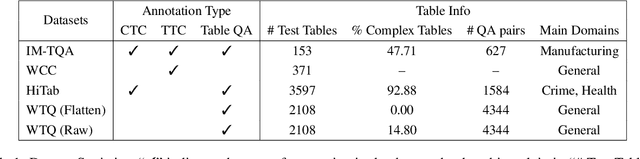
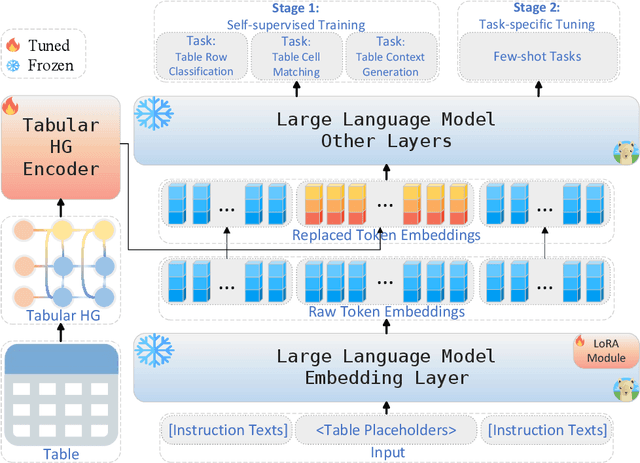

Table understanding (TU) has achieved promising advancements, but it faces the challenges of the scarcity of manually labeled tables and the presence of complex table structures.To address these challenges, we propose HGT, a framework with a heterogeneous graph (HG)-enhanced large language model (LLM) to tackle few-shot TU tasks.It leverages the LLM by aligning the table semantics with the LLM's parametric knowledge through soft prompts and instruction turning and deals with complex tables by a multi-task pre-training scheme involving three novel multi-granularity self-supervised HG pre-training objectives.We empirically demonstrate the effectiveness of HGT, showing that it outperforms the SOTA for few-shot complex TU on several benchmarks.

MATEval: A Multi-Agent Discussion Framework for Advancing Open-Ended Text Evaluation
Mar 28, 2024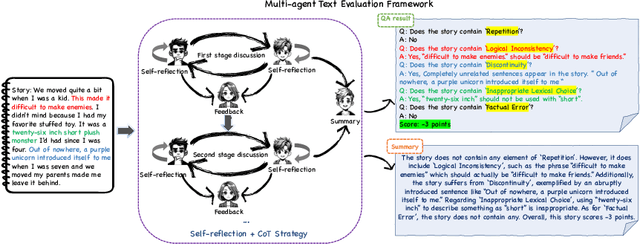
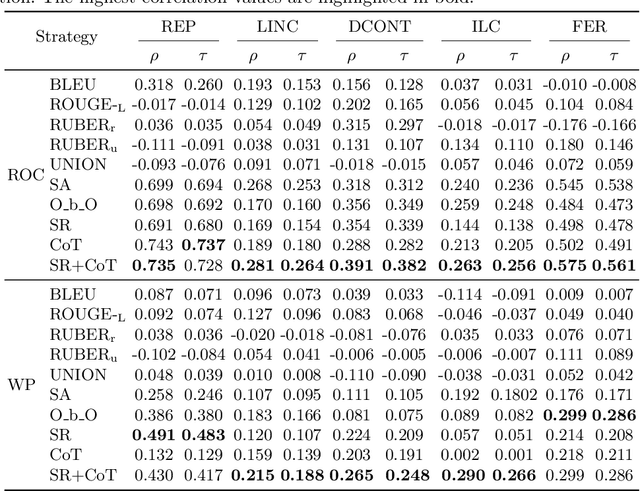
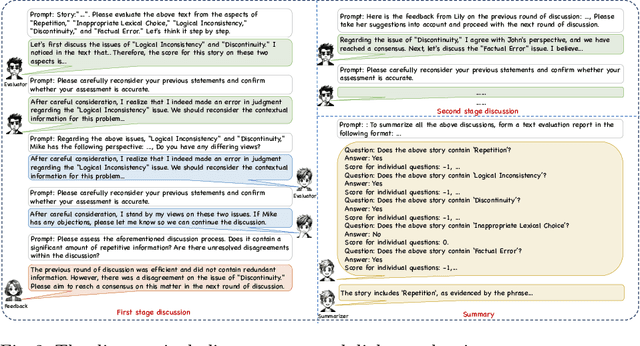

Recent advancements in generative Large Language Models(LLMs) have been remarkable, however, the quality of the text generated by these models often reveals persistent issues. Evaluating the quality of text generated by these models, especially in open-ended text, has consistently presented a significant challenge. Addressing this, recent work has explored the possibility of using LLMs as evaluators. While using a single LLM as an evaluation agent shows potential, it is filled with significant uncertainty and instability. To address these issues, we propose the MATEval: A "Multi-Agent Text Evaluation framework" where all agents are played by LLMs like GPT-4. The MATEval framework emulates human collaborative discussion methods, integrating multiple agents' interactions to evaluate open-ended text. Our framework incorporates self-reflection and Chain-of-Thought (CoT) strategies, along with feedback mechanisms, enhancing the depth and breadth of the evaluation process and guiding discussions towards consensus, while the framework generates comprehensive evaluation reports, including error localization, error types and scoring. Experimental results show that our framework outperforms existing open-ended text evaluation methods and achieves the highest correlation with human evaluation, which confirms the effectiveness and advancement of our framework in addressing the uncertainties and instabilities in evaluating LLMs-generated text. Furthermore, our framework significantly improves the efficiency of text evaluation and model iteration in industrial scenarios.
DEE: Dual-stage Explainable Evaluation Method for Text Generation
Mar 18, 2024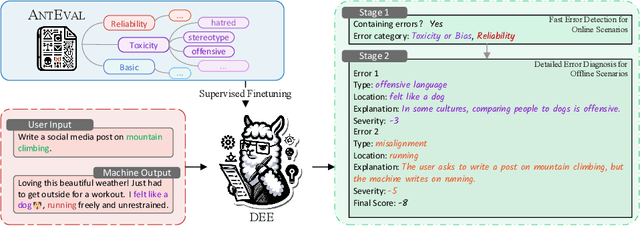
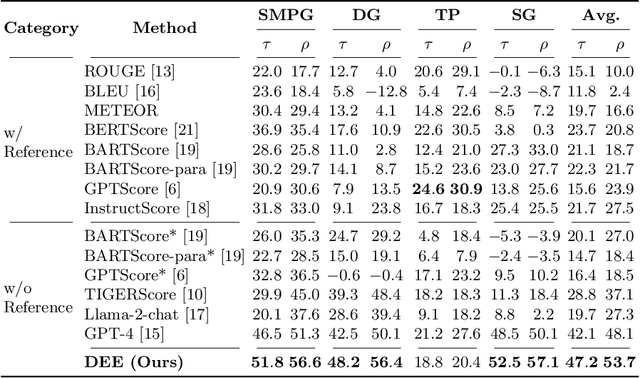
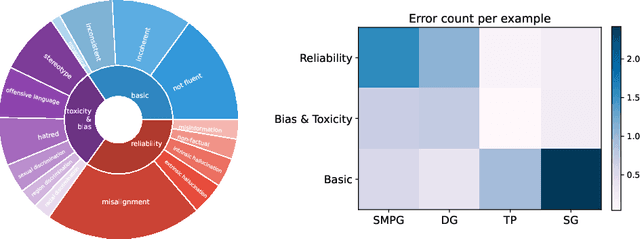
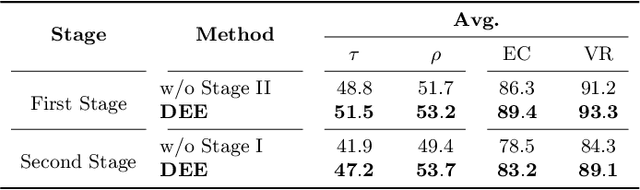
Automatic methods for evaluating machine-generated texts hold significant importance due to the expanding applications of generative systems. Conventional methods tend to grapple with a lack of explainability, issuing a solitary numerical score to signify the assessment outcome. Recent advancements have sought to mitigate this limitation by incorporating large language models (LLMs) to offer more detailed error analyses, yet their applicability remains constrained, particularly in industrial contexts where comprehensive error coverage and swift detection are paramount. To alleviate these challenges, we introduce DEE, a Dual-stage Explainable Evaluation method for estimating the quality of text generation. Built upon Llama 2, DEE follows a dual-stage principle guided by stage-specific instructions to perform efficient identification of errors in generated texts in the initial stage and subsequently delves into providing comprehensive diagnostic reports in the second stage. DEE is fine-tuned on our elaborately assembled dataset AntEval, which encompasses 15K examples from 4 real-world applications of Alipay that employ generative systems. The dataset concerns newly emerged issues like hallucination and toxicity, thereby broadening the scope of DEE's evaluation criteria. Experimental results affirm that DEE's superiority over existing evaluation methods, achieving significant improvements in both human correlation as well as efficiency.
Exploring the Impact of Table-to-Text Methods on Augmenting LLM-based Question Answering with Domain Hybrid Data
Feb 20, 2024Augmenting Large Language Models (LLMs) for Question Answering (QA) with domain specific data has attracted wide attention. However, domain data often exists in a hybrid format, including text and semi-structured tables, posing challenges for the seamless integration of information. Table-to-Text Generation is a promising solution by facilitating the transformation of hybrid data into a uniformly text-formatted corpus. Although this technique has been widely studied by the NLP community, there is currently no comparative analysis on how corpora generated by different table-to-text methods affect the performance of QA systems. In this paper, we address this research gap in two steps. First, we innovatively integrate table-to-text generation into the framework of enhancing LLM-based QA systems with domain hybrid data. Then, we utilize this framework in real-world industrial data to conduct extensive experiments on two types of QA systems (DSFT and RAG frameworks) with four representative methods: Markdown format, Template serialization, TPLM-based method, and LLM-based method. Based on the experimental results, we draw some empirical findings and explore the underlying reasons behind the success of some methods. We hope the findings of this work will provide a valuable reference for the academic and industrial communities in developing robust QA systems.
MIKE: A New Benchmark for Fine-grained Multimodal Entity Knowledge Editing
Feb 18, 2024Multimodal knowledge editing represents a critical advancement in enhancing the capabilities of Multimodal Large Language Models (MLLMs). Despite its potential, current benchmarks predominantly focus on coarse-grained knowledge, leaving the intricacies of fine-grained (FG) multimodal entity knowledge largely unexplored. This gap presents a notable challenge, as FG entity recognition is pivotal for the practical deployment and effectiveness of MLLMs in diverse real-world scenarios. To bridge this gap, we introduce MIKE, a comprehensive benchmark and dataset specifically designed for the FG multimodal entity knowledge editing. MIKE encompasses a suite of tasks tailored to assess different perspectives, including Vanilla Name Answering, Entity-Level Caption, and Complex-Scenario Recognition. In addition, a new form of knowledge editing, Multi-step Editing, is introduced to evaluate the editing efficiency. Through our extensive evaluations, we demonstrate that the current state-of-the-art methods face significant challenges in tackling our proposed benchmark, underscoring the complexity of FG knowledge editing in MLLMs. Our findings spotlight the urgent need for novel approaches in this domain, setting a clear agenda for future research and development efforts within the community.
Question Answering Over Spatio-Temporal Knowledge Graph
Feb 18, 2024

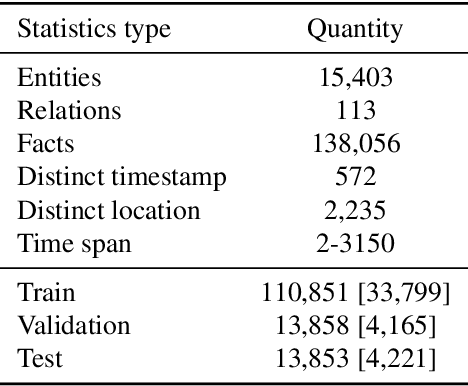

Spatio-temporal knowledge graphs (STKGs) extend the concept of knowledge graphs (KGs) by incorporating time and location information. While the research community's focus on Knowledge Graph Question Answering (KGQA), the field of answering questions incorporating both spatio-temporal information based on STKGs remains largely unexplored. Furthermore, a lack of comprehensive datasets also has hindered progress in this area. To address this issue, we present STQAD, a dataset comprising 10,000 natural language questions for spatio-temporal knowledge graph question answering (STKGQA). Unfortunately, various state-of-the-art KGQA approaches fall far short of achieving satisfactory performance on our dataset. In response, we propose STCQA, a new spatio-temporal KGQA approach that utilizes a novel STKG embedding method named STComplEx. By extracting temporal and spatial information from a question, our QA model can better comprehend the question and retrieve accurate answers from the STKG. Through extensive experiments, we demonstrate the quality of our dataset and the effectiveness of our STKGQA method.
Counter-intuitive: Large Language Models Can Better Understand Knowledge Graphs Than We Thought
Feb 18, 2024Although the method of enhancing large language models' (LLMs') reasoning ability and reducing their hallucinations through the use of knowledge graphs (KGs) has received widespread attention, the exploration of how to enable LLMs to integrate the structured knowledge in KGs on-the-fly remains inadequate. Researchers often co-train KG embeddings and LLM parameters to equip LLMs with the ability of comprehending KG knowledge. However, this resource-hungry training paradigm significantly increases the model learning cost and is also unsuitable for non-open-source, black-box LLMs. In this paper, we employ complex question answering (CQA) as a task to assess the LLM's ability of comprehending KG knowledge. We conducted a comprehensive comparison of KG knowledge injection methods (from triples to natural language text), aiming to explore the optimal prompting method for supplying KG knowledge to LLMs, thereby enhancing their comprehension of KG. Contrary to our initial expectations, our analysis revealed that LLMs effectively handle messy, noisy, and linearized KG knowledge, outperforming methods that employ well-designed natural language (NL) textual prompts. This counter-intuitive finding provides substantial insights for future research on LLMs' comprehension of structured knowledge.
KGroot: Enhancing Root Cause Analysis through Knowledge Graphs and Graph Convolutional Neural Networks
Feb 11, 2024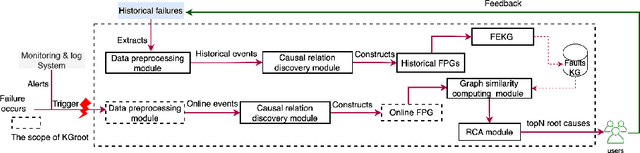
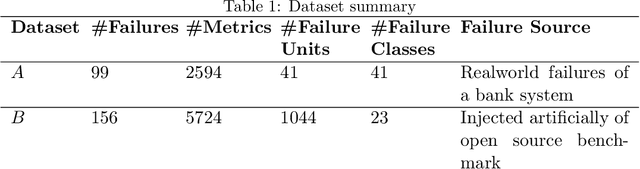
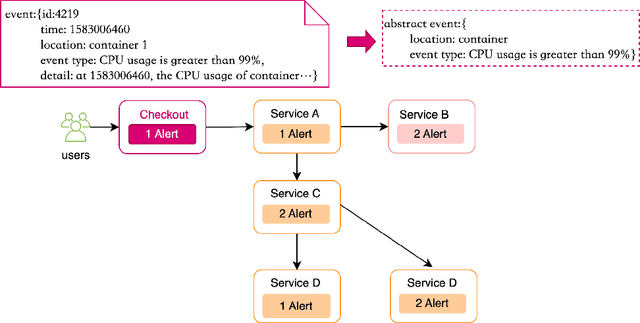
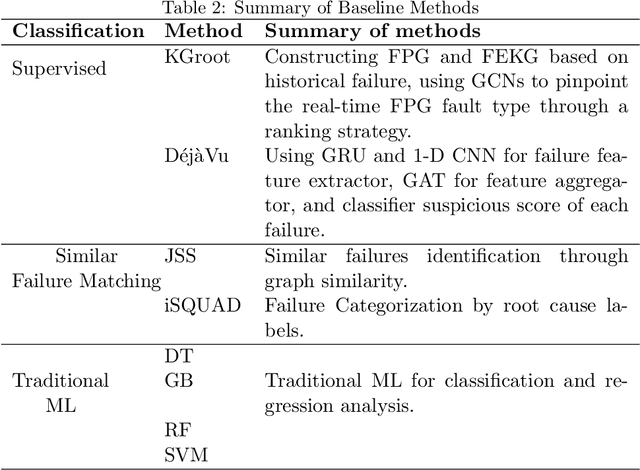
Fault localization is challenging in online micro-service due to the wide variety of monitoring data volume, types, events and complex interdependencies in service and components. Faults events in services are propagative and can trigger a cascade of alerts in a short period of time. In the industry, fault localization is typically conducted manually by experienced personnel. This reliance on experience is unreliable and lacks automation. Different modules present information barriers during manual localization, making it difficult to quickly align during urgent faults. This inefficiency lags stability assurance to minimize fault detection and repair time. Though actionable methods aimed to automatic the process, the accuracy and efficiency are less than satisfactory. The precision of fault localization results is of paramount importance as it underpins engineers trust in the diagnostic conclusions, which are derived from multiple perspectives and offer comprehensive insights. Therefore, a more reliable method is required to automatically identify the associative relationships among fault events and propagation path. To achieve this, KGroot uses event knowledge and the correlation between events to perform root cause reasoning by integrating knowledge graphs and GCNs for RCA. FEKG is built based on historical data, an online graph is constructed in real-time when a failure event occurs, and the similarity between each knowledge graph and online graph is compared using GCNs to pinpoint the fault type through a ranking strategy. Comprehensive experiments demonstrate KGroot can locate the root cause with accuracy of 93.5% top 3 potential causes in second-level. This performance matches the level of real-time fault diagnosis in the industrial environment and significantly surpasses state-of-the-art baselines in RCA in terms of effectiveness and efficiency.
The Role of LLMs in Sustainable Smart Cities: Applications, Challenges, and Future Directions
Feb 07, 2024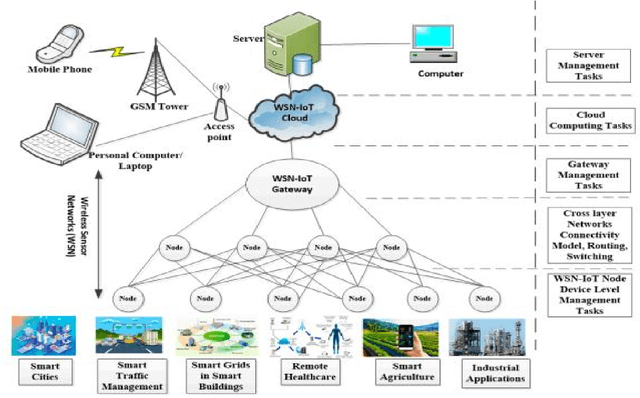

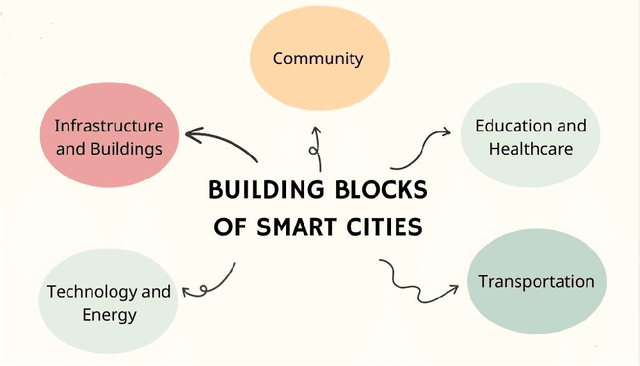
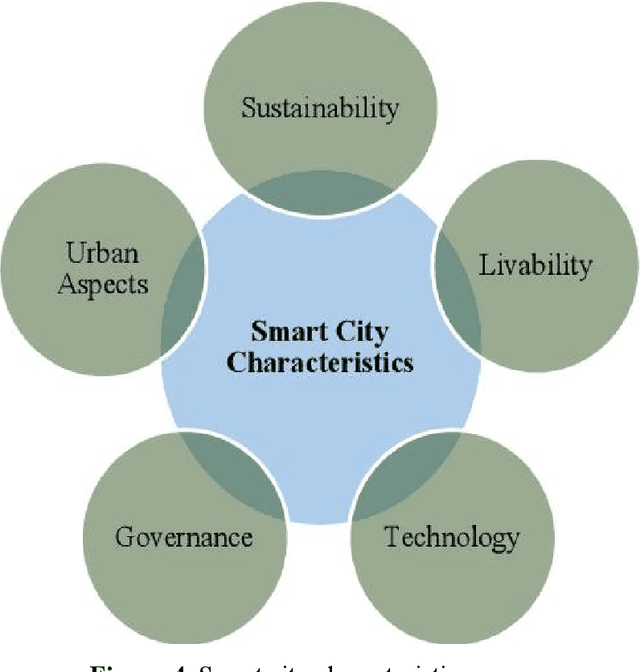
Smart cities stand as pivotal components in the ongoing pursuit of elevating urban living standards, facilitating the rapid expansion of urban areas while efficiently managing resources through sustainable and scalable innovations. In this regard, as emerging technologies like Artificial Intelligence (AI), the Internet of Things (IoT), big data analytics, and fog and edge computing have become increasingly prevalent, smart city applications grapple with various challenges, including the potential for unauthorized disclosure of confidential and sensitive data. The seamless integration of emerging technologies has played a vital role in sustaining the dynamic pace of their development. This paper explores the substantial potential and applications of Deep Learning (DL), Federated Learning (FL), IoT, Blockchain, Natural Language Processing (NLP), and large language models (LLMs) in optimizing ICT processes within smart cities. We aim to spotlight the vast potential of these technologies as foundational elements that technically strengthen the realization and advancement of smart cities, underscoring their significance in driving innovation within this transformative urban milieu. Our discourse culminates with an exploration of the formidable challenges that DL, FL, IoT, Blockchain, NLP, and LLMs face within these contexts, and we offer insights into potential future directions.
Towards Event Extraction from Speech with Contextual Clues
Jan 27, 2024While text-based event extraction has been an active research area and has seen successful application in many domains, extracting semantic events from speech directly is an under-explored problem. In this paper, we introduce the Speech Event Extraction (SpeechEE) task and construct three synthetic training sets and one human-spoken test set. Compared to event extraction from text, SpeechEE poses greater challenges mainly due to complex speech signals that are continuous and have no word boundaries. Additionally, unlike perceptible sound events, semantic events are more subtle and require a deeper understanding. To tackle these challenges, we introduce a sequence-to-structure generation paradigm that can produce events from speech signals in an end-to-end manner, together with a conditioned generation method that utilizes speech recognition transcripts as the contextual clue. We further propose to represent events with a flat format to make outputs more natural language-like. Our experimental results show that our method brings significant improvements on all datasets, achieving a maximum F1 gain of 10.7%. The code and datasets are released on https://github.com/jodie-kang/SpeechEE.