 Add to Chrome
 Add to Firefox
 Add to Edge
Rate-Distortion-Perception Theory for Semantic Communication
Dec 09, 2023
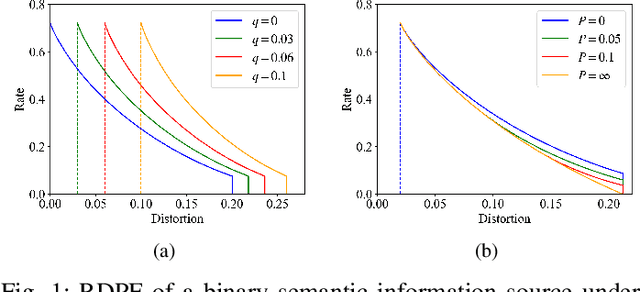
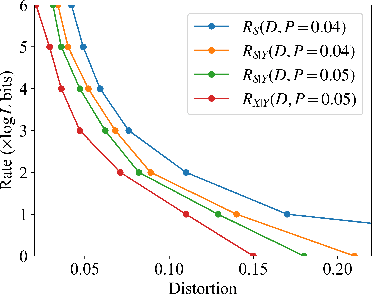
Semantic communication has attracted significant interest recently due to its capability to meet the fast growing demand on user-defined and human-oriented communication services such as holographic communications, eXtended reality (XR), and human-to-machine interactions. Unfortunately, recent study suggests that the traditional Shannon information theory, focusing mainly on delivering semantic-agnostic symbols, will not be sufficient to investigate the semantic-level perceptual quality of the recovered messages at the receiver. In this paper, we study the achievable data rate of semantic communication under the symbol distortion and semantic perception constraints. Motivated by the fact that the semantic information generally involves rich intrinsic knowledge that cannot always be directly observed by the encoder, we consider a semantic information source that can only be indirectly sensed by the encoder. Both encoder and decoder can access to various types of side information that may be closely related to the user's communication preference. We derive the achievable region that characterizes the tradeoff among the data rate, symbol distortion, and semantic perception, which is then theoretically proved to be achievable by a stochastic coding scheme. We derive a closed-form achievable rate for binary semantic information source under any given distortion and perception constraints. We observe that there exists cases that the receiver can directly infer the semantic information source satisfying certain distortion and perception constraints without requiring any data communication from the transmitter. Experimental results based on the image semantic source signal have been presented to verify our theoretical observations.

Physical-Layer Semantic-Aware Network for Zero-Shot Wireless Sensing
Dec 08, 2023Device-free wireless sensing has recently attracted significant interest due to its potential to support a wide range of immersive human-machine interactive applications. However, data heterogeneity in wireless signals and data privacy regulation of distributed sensing have been considered as the major challenges that hinder the wide applications of wireless sensing in large area networking systems. Motivated by the observation that signals recorded by wireless receivers are closely related to a set of physical-layer semantic features, in this paper we propose a novel zero-shot wireless sensing solution that allows models constructed in one or a limited number of locations to be directly transferred to other locations without any labeled data. We develop a novel physical-layer semantic-aware network (pSAN) framework to characterize the correlation between physical-layer semantic features and the sensing data distributions across different receivers. We then propose a pSAN-based zero-shot learning solution in which each receiver can obtain a location-specific gesture recognition model by directly aggregating the already constructed models of other receivers. We theoretically prove that models obtained by our proposed solution can approach the optimal model without requiring any local model training. Experimental results once again verify that the accuracy of models derived by our proposed solution matches that of the models trained by the real labeled data based on supervised learning approach.
Degradation Estimation Recurrent Neural Network with Local and Non-Local Priors for Compressive Spectral Imaging
Nov 15, 2023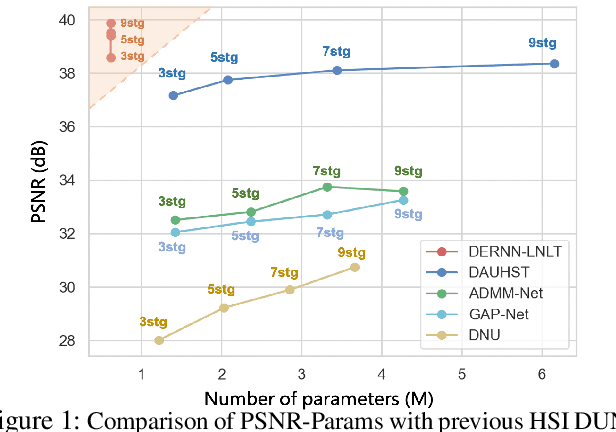
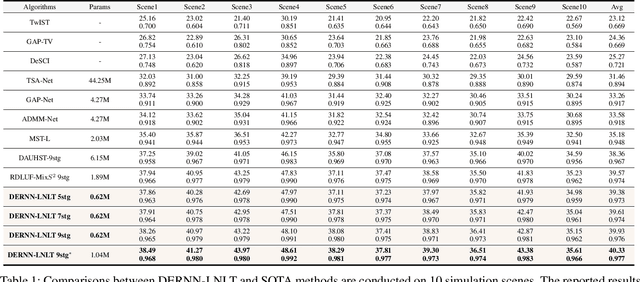
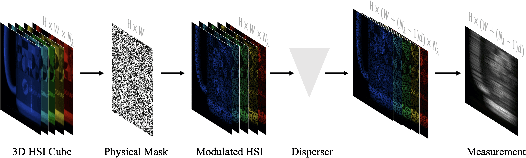
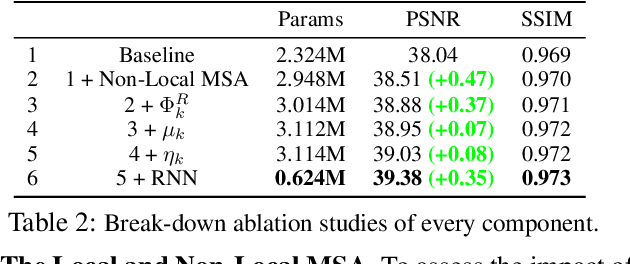
In coded aperture snapshot spectral imaging (CASSI) systems, a core problem is to recover the 3D hyperspectral image (HSI) from the 2D measurement. Current deep unfolding networks (DUNs) for the HSI reconstruction mainly suffered from three issues. Firstly, in previous DUNs, the DNNs across different stages were unable to share the feature representations learned from different stages, leading to parameter sparsity, which in turn limited their reconstruction potential. Secondly, previous DUNs fail to estimate degradation-related parameters within a unified framework, including the degradation matrix in the data subproblem and the noise level in the prior subproblem. Consequently, either the accuracy of solving the data or the prior subproblem is compromised. Thirdly, exploiting both local and non-local priors for the HSI reconstruction is crucial, and it remains a key issue to be addressed. In this paper, we first transform the DUN into a Recurrent Neural Network (RNN) by sharing parameters across stages, which allows the DNN in each stage could learn feature representation from different stages, enhancing the representativeness of the DUN. Secondly, we incorporate the Degradation Estimation Network into the RNN (DERNN), which simultaneously estimates the degradation matrix and the noise level by residual learning with reference to the sensing matrix. Thirdly, we propose a Local and Non-Local Transformer (LNLT) to effectively exploit both local and non-local priors in HSIs. By integrating the LNLT into the DERNN for solving the prior subproblem, we propose the DERNN-LNLT, which achieves state-of-the-art performance.
Myriad: Large Multimodal Model by Applying Vision Experts for Industrial Anomaly Detection
Nov 01, 2023


Existing industrial anomaly detection (IAD) methods predict anomaly scores for both anomaly detection and localization. However, they struggle to perform a multi-turn dialog and detailed descriptions for anomaly regions, e.g., color, shape, and categories of industrial anomalies. Recently, large multimodal (i.e., vision and language) models (LMMs) have shown eminent perception abilities on multiple vision tasks such as image captioning, visual understanding, visual reasoning, etc., making it a competitive potential choice for more comprehensible anomaly detection. However, the knowledge about anomaly detection is absent in existing general LMMs, while training a specific LMM for anomaly detection requires a tremendous amount of annotated data and massive computation resources. In this paper, we propose a novel large multi-modal model by applying vision experts for industrial anomaly detection (dubbed Myriad), which leads to definite anomaly detection and high-quality anomaly description. Specifically, we adopt MiniGPT-4 as the base LMM and design an Expert Perception module to embed the prior knowledge from vision experts as tokens which are intelligible to Large Language Models (LLMs). To compensate for the errors and confusions of vision experts, we introduce a domain adapter to bridge the visual representation gaps between generic and industrial images. Furthermore, we propose a Vision Expert Instructor, which enables the Q-Former to generate IAD domain vision-language tokens according to vision expert prior. Extensive experiments on MVTec-AD and VisA benchmarks demonstrate that our proposed method not only performs favorably against state-of-the-art methods under the 1-class and few-shot settings, but also provide definite anomaly prediction along with detailed descriptions in IAD domain.
Retinex-guided Channel-grouping based Patch Swap for Arbitrary Style Transfer
Sep 19, 2023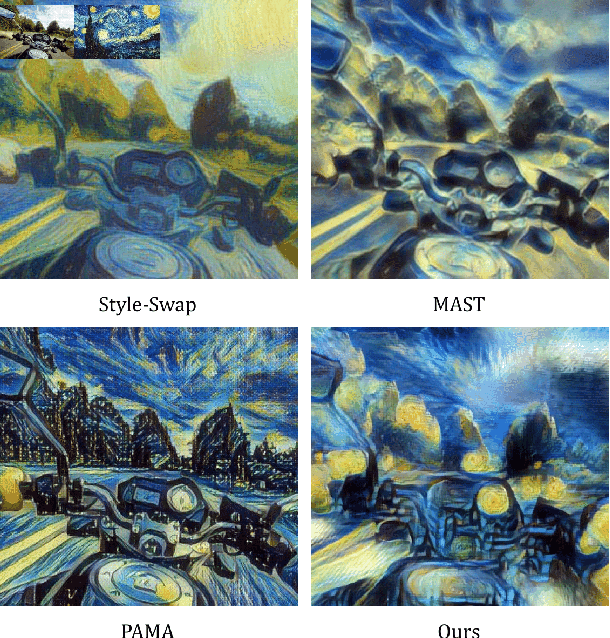
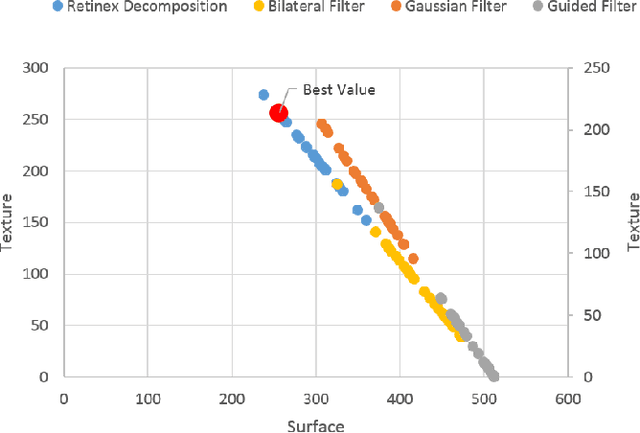
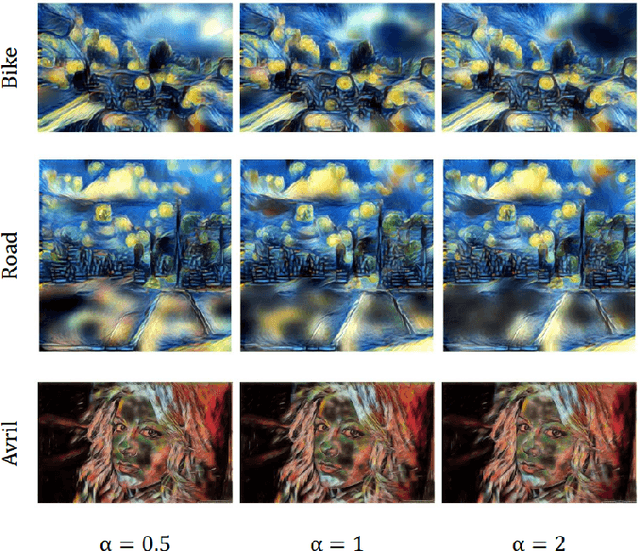

The basic principle of the patch-matching based style transfer is to substitute the patches of the content image feature maps by the closest patches from the style image feature maps. Since the finite features harvested from one single aesthetic style image are inadequate to represent the rich textures of the content natural image, existing techniques treat the full-channel style feature patches as simple signal tensors and create new style feature patches via signal-level fusion, which ignore the implicit diversities existed in style features and thus fail for generating better stylised results. In this paper, we propose a Retinex theory guided, channel-grouping based patch swap technique to solve the above challenges. Channel-grouping strategy groups the style feature maps into surface and texture channels, which prevents the winner-takes-all problem. Retinex theory based decomposition controls a more stable channel code rate generation. In addition, we provide complementary fusion and multi-scale generation strategy to prevent unexpected black area and over-stylised results respectively. Experimental results demonstrate that the proposed method outperforms the existing techniques in providing more style-consistent textures while keeping the content fidelity.
EEG-based Emotion Style Transfer Network for Cross-dataset Emotion Recognition
Aug 09, 2023
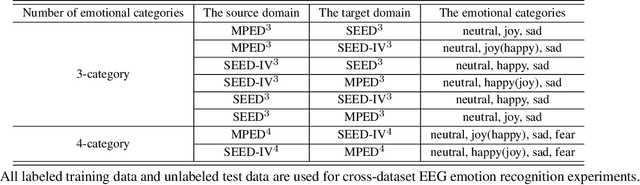


As the key to realizing aBCIs, EEG emotion recognition has been widely studied by many researchers. Previous methods have performed well for intra-subject EEG emotion recognition. However, the style mismatch between source domain (training data) and target domain (test data) EEG samples caused by huge inter-domain differences is still a critical problem for EEG emotion recognition. To solve the problem of cross-dataset EEG emotion recognition, in this paper, we propose an EEG-based Emotion Style Transfer Network (E2STN) to obtain EEG representations that contain the content information of source domain and the style information of target domain, which is called stylized emotional EEG representations. The representations are helpful for cross-dataset discriminative prediction. Concretely, E2STN consists of three modules, i.e., transfer module, transfer evaluation module, and discriminative prediction module. The transfer module encodes the domain-specific information of source and target domains and then re-constructs the source domain's emotional pattern and the target domain's statistical characteristics into the new stylized EEG representations. In this process, the transfer evaluation module is adopted to constrain the generated representations that can more precisely fuse two kinds of complementary information from source and target domains and avoid distorting. Finally, the generated stylized EEG representations are fed into the discriminative prediction module for final classification. Extensive experiments show that the E2STN can achieve the state-of-the-art performance on cross-dataset EEG emotion recognition tasks.
Reasoning over the Air: A Reasoning-based Implicit Semantic-Aware Communication Framework
Jun 20, 2023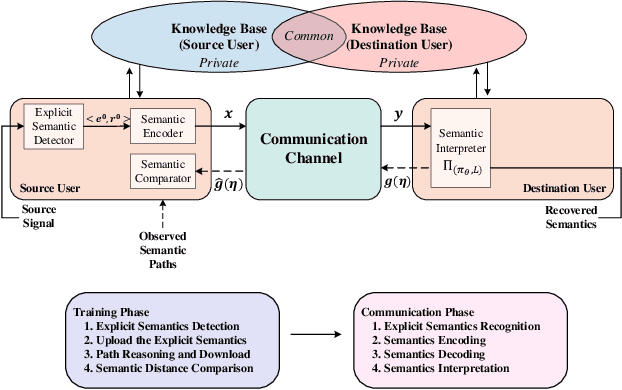
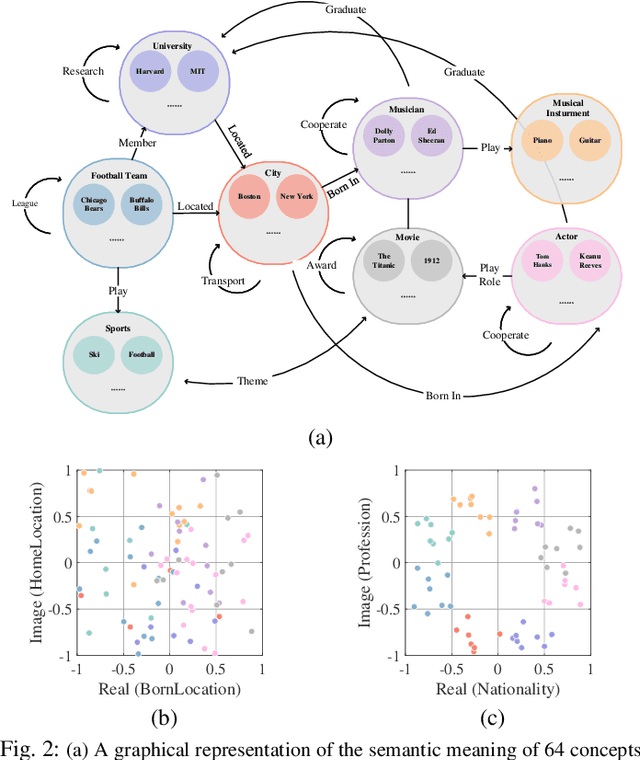
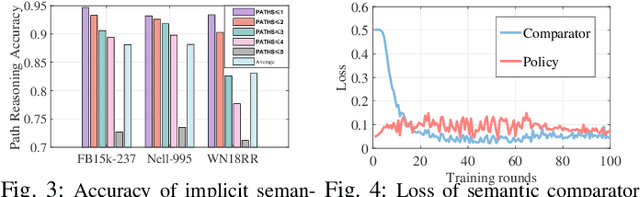
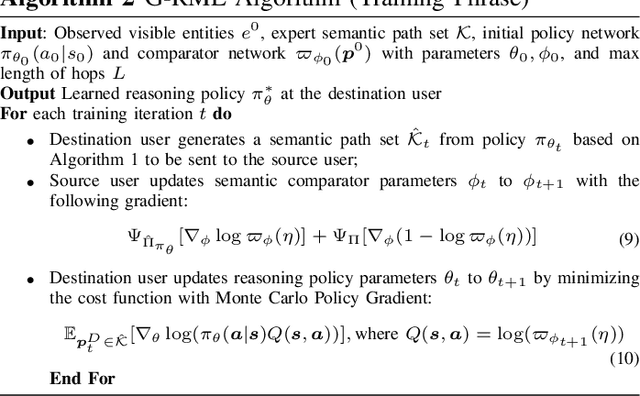
Semantic-aware communication is a novel paradigm that draws inspiration from human communication focusing on the delivery of the meaning of messages. It has attracted significant interest recently due to its potential to improve the efficiency and reliability of communication and enhance users' QoE. Most existing works focus on transmitting and delivering the explicit semantic meaning that can be directly identified from the source signal. This paper investigates the implicit semantic-aware communication in which the hidden information that cannot be directly observed from the source signal must be recognized and interpreted by the intended users. To this end, a novel implicit semantic-aware communication (iSAC) architecture is proposed for representing, communicating, and interpreting the implicit semantic meaning between source and destination users. A projection-based semantic encoder is proposed to convert the high-dimensional graphical representation of explicit semantics into a low-dimensional semantic constellation space for efficient physical channel transmission. To enable the destination user to learn and imitate the implicit semantic reasoning process of source user, a generative adversarial imitation learning-based solution, called G-RML, is proposed. Different from existing communication solutions, the source user in G-RML does not focus only on sending as much of the useful messages as possible; but, instead, it tries to guide the destination user to learn a reasoning mechanism to map any observed explicit semantics to the corresponding implicit semantics that are most relevant to the semantic meaning. Compared to the existing solutions, our proposed G-RML requires much less communication and computational resources and scales well to the scenarios involving the communication of rich semantic meanings consisting of a large number of concepts and relations.
Mathematical Characterization of Signal Semantics and Rethinking of the Mathematical Theory of Information
Mar 26, 2023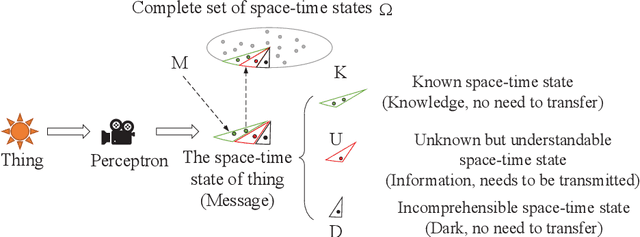


Shannon information theory is established based on probability and bits, and the communication technology based on this theory realizes the information age. The original goal of Shannon's information theory is to describe and transmit information content. However, due to information is related to cognition, and cognition is considered to be subjective, Shannon information theory is to describe and transmit information-bearing signals. With the development of the information age to the intelligent age, the traditional signal-oriented processing needs to be upgraded to content-oriented processing. For example, chat generative pre-trained transformer (ChatGPT) has initially realized the content processing capability based on massive data. For many years, researchers have been searching for the answer to what the information content in the signal is, because only when the information content is mathematically and accurately described can information-based machines be truly intelligent. This paper starts from rethinking the essence of the basic concepts of the information, such as semantics, meaning, information and knowledge, presents the mathematical characterization of the information content, investigate the relationship between them, studies the transformation from Shannon's signal information theory to semantic information theory, and therefore proposes a content-oriented semantic communication framework. Furthermore, we propose semantic decomposition and composition scheme to achieve conversion between complex and simple semantics. Finally, we verify the proposed characterization of information-related concepts by implementing evolvable knowledge-based semantic recognition.
Features Disentangled Semantic Broadcast Communication Networks
Mar 03, 2023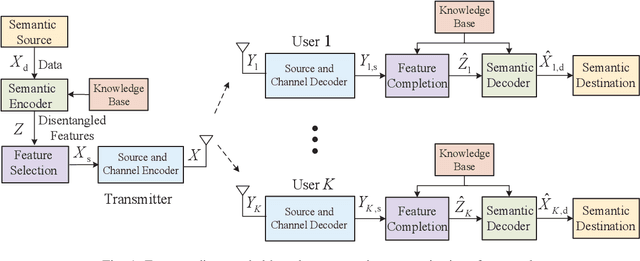


Single-user semantic communications have attracted extensive research recently, but multi-user semantic broadcast communication (BC) is still in its infancy. In this paper, we propose a practical robust features-disentangled multi-user semantic BC framework, where the transmitter includes a feature selection module and each user has a feature completion module. Instead of broadcasting all extracted features, the semantic encoder extracts the disentangled semantic features, and then only the users' intended semantic features are selected for broadcasting, which can further improve the transmission efficiency. Within this framework, we further investigate two information-theoretic metrics, including the ultimate compression rate under both the distortion and perception constraints, and the achievable rate region of the semantic BC. Furthermore, to realize the proposed semantic BC framework, we design a lightweight robust semantic BC network by exploiting a supervised autoencoder (AE), which can controllably disentangle sematic features. Moreover, we design the first hardware proof-of-concept prototype of the semantic BC network, where the proposed semantic BC network can be implemented in real time. Simulations and experiments demonstrate that the proposed robust semantic BC network can significantly improve transmission efficiency.
Task-oriented Explainable Semantic Communications
Feb 27, 2023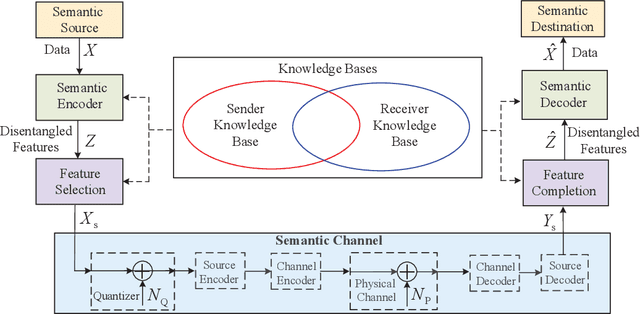
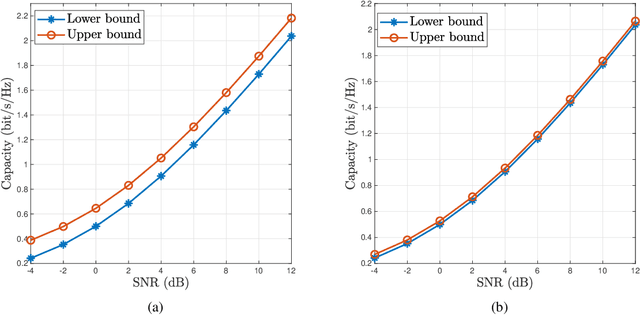
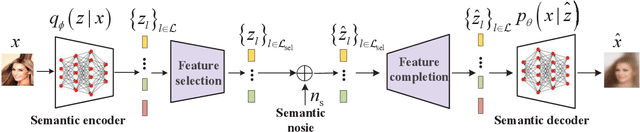
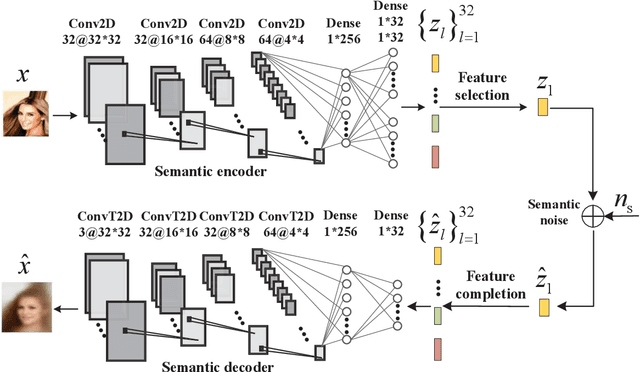
Semantic communications utilize the transceiver computing resources to alleviate scarce transmission resources, such as bandwidth and energy. Although the conventional deep learning (DL) based designs may achieve certain transmission efficiency, the uninterpretability issue of extracted features is the major challenge in the development of semantic communications. In this paper, we propose an explainable and robust semantic communication framework by incorporating the well-established bit-level communication system, which not only extracts and disentangles features into independent and semantically interpretable features, but also only selects task-relevant features for transmission, instead of all extracted features. Based on this framework, we derive the optimal input for rate-distortion-perception theory, and derive both lower and upper bounds on the semantic channel capacity. Furthermore, based on the $\beta $-variational autoencoder ($\beta $-VAE), we propose a practical explainable semantic communication system design, which simultaneously achieves semantic features selection and is robust against semantic channel noise. We further design a real-time wireless mobile semantic communication proof-of-concept prototype. Our simulations and experiments demonstrate that our proposed explainable semantic communications system can significantly improve transmission efficiency, and also verify the effectiveness of our proposed robust semantic transmission scheme.