 Add to Chrome
 Add to Firefox
 Add to Edge
Implicit Semantic-Aware Communication Based on Hypergraph Reasoning
Jun 18, 2026
Semantic-aware communication has emerged as a transformative paradigm for next-generation communication systems, shifting the fundamental goal from transmitting bit-level symbols to reliably recovering and understanding the semantic meaning of information. Previous studies have demonstrated that representing the semantic content of source messages as graph-based structures can significantly improve communication efficiency and the accuracy of semantic inference at the receiver. However, existing solutions typically employ graphs that capture only pairwise relationships, thereby neglecting higher-order implicit correlations commonly observed in real-world scenarios, such as group interactions, multi-entity associations, and complex relational contexts. This limitation reduces semantic expressiveness and makes semantic inference susceptible to ambiguity and performance degradation, particularly under noisy or corrupted channel conditions. To address these issues, this paper proposes a novel hypergraph-based implicit semantic reasoning framework, HISR, which leverages hypergraphs to represent complex multi-entity relationships among semantic knowledge entities. In HISR, entities and their associated higher-order relations are mapped into dedicated semantic subspaces tailored to distinct relational contexts. This design not only disentangles diverse semantic interactions to mitigate the over-smoothing effects commonly found in traditional graph embedding methods but also enables robust semantic inference even when partial information loss occurs during transmission. Numerical results show that the proposed HISR achieves up to a 36.6% improvement in implicit semantic interpretation accuracy over the state-of-the-art benchmarks.

Reasoning over the Air: A Reasoning-based Implicit Semantic-Aware Communication Framework
Jun 20, 2023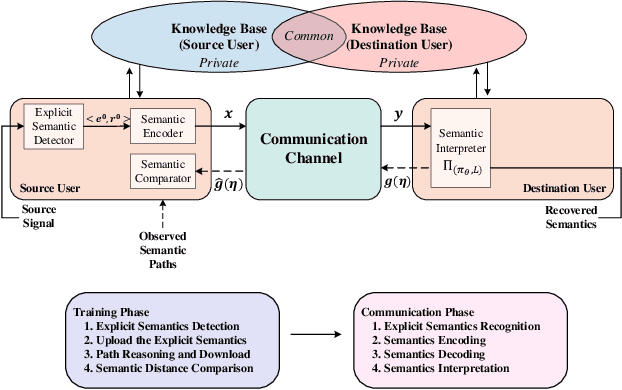
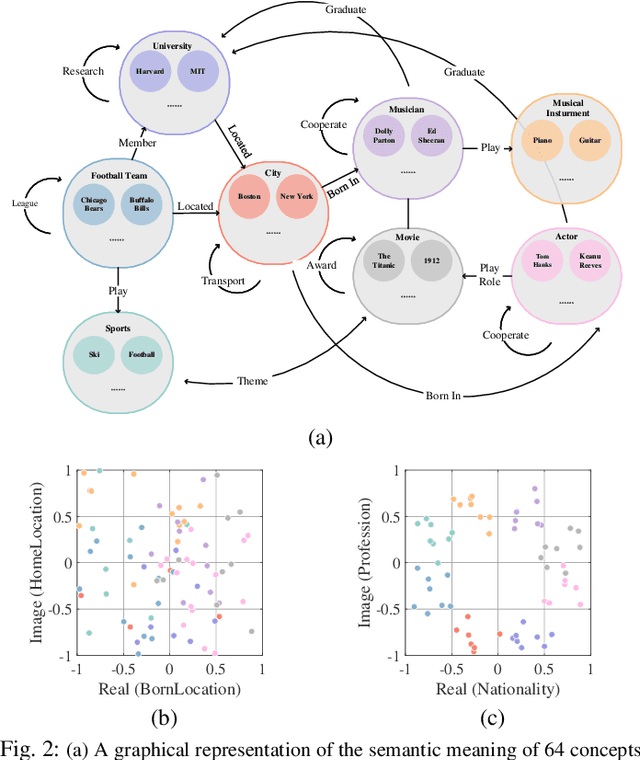
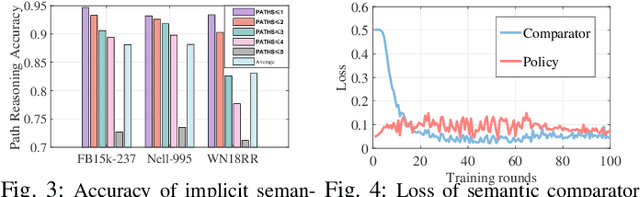
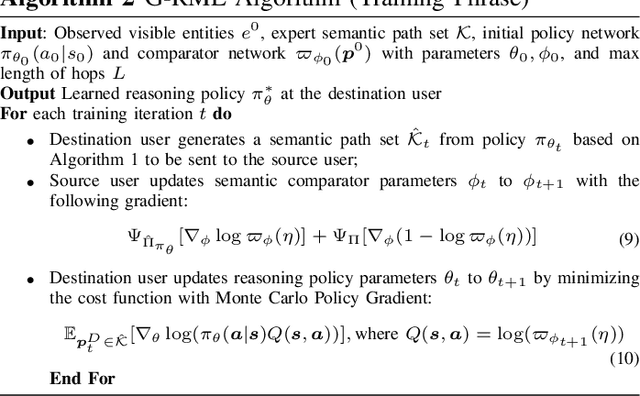
Semantic-aware communication is a novel paradigm that draws inspiration from human communication focusing on the delivery of the meaning of messages. It has attracted significant interest recently due to its potential to improve the efficiency and reliability of communication and enhance users' QoE. Most existing works focus on transmitting and delivering the explicit semantic meaning that can be directly identified from the source signal. This paper investigates the implicit semantic-aware communication in which the hidden information that cannot be directly observed from the source signal must be recognized and interpreted by the intended users. To this end, a novel implicit semantic-aware communication (iSAC) architecture is proposed for representing, communicating, and interpreting the implicit semantic meaning between source and destination users. A projection-based semantic encoder is proposed to convert the high-dimensional graphical representation of explicit semantics into a low-dimensional semantic constellation space for efficient physical channel transmission. To enable the destination user to learn and imitate the implicit semantic reasoning process of source user, a generative adversarial imitation learning-based solution, called G-RML, is proposed. Different from existing communication solutions, the source user in G-RML does not focus only on sending as much of the useful messages as possible; but, instead, it tries to guide the destination user to learn a reasoning mechanism to map any observed explicit semantics to the corresponding implicit semantics that are most relevant to the semantic meaning. Compared to the existing solutions, our proposed G-RML requires much less communication and computational resources and scales well to the scenarios involving the communication of rich semantic meanings consisting of a large number of concepts and relations.