 Add to Chrome
 Add to Firefox
 Add to Edge
Seedance 1.5 pro: A Native Audio-Visual Joint Generation Foundation Model
Dec 23, 2025
Recent strides in video generation have paved the way for unified audio-visual generation. In this work, we present Seedance 1.5 pro, a foundational model engineered specifically for native, joint audio-video generation. Leveraging a dual-branch Diffusion Transformer architecture, the model integrates a cross-modal joint module with a specialized multi-stage data pipeline, achieving exceptional audio-visual synchronization and superior generation quality. To ensure practical utility, we implement meticulous post-training optimizations, including Supervised Fine-Tuning (SFT) on high-quality datasets and Reinforcement Learning from Human Feedback (RLHF) with multi-dimensional reward models. Furthermore, we introduce an acceleration framework that boosts inference speed by over 10X. Seedance 1.5 pro distinguishes itself through precise multilingual and dialect lip-syncing, dynamic cinematic camera control, and enhanced narrative coherence, positioning it as a robust engine for professional-grade content creation. Seedance 1.5 pro is now accessible on Volcano Engine at https://console.volcengine.com/ark/region:ark+cn-beijing/experience/vision?type=GenVideo.

Evo-1: Lightweight Vision-Language-Action Model with Preserved Semantic Alignment
Nov 06, 2025Vision-Language-Action (VLA) models have emerged as a powerful framework that unifies perception, language, and control, enabling robots to perform diverse tasks through multimodal understanding. However, current VLA models typically contain massive parameters and rely heavily on large-scale robot data pretraining, leading to high computational costs during training, as well as limited deployability for real-time inference. Moreover, most training paradigms often degrade the perceptual representations of the vision-language backbone, resulting in overfitting and poor generalization to downstream tasks. In this work, we present Evo-1, a lightweight VLA model that reduces computation and improves deployment efficiency, while maintaining strong performance without pretraining on robot data. Evo-1 builds on a native multimodal Vision-Language model (VLM), incorporating a novel cross-modulated diffusion transformer along with an optimized integration module, together forming an effective architecture. We further introduce a two-stage training paradigm that progressively aligns action with perception, preserving the representations of the VLM. Notably, with only 0.77 billion parameters, Evo-1 achieves state-of-the-art results on the Meta-World and RoboTwin suite, surpassing the previous best models by 12.4% and 6.9%, respectively, and also attains a competitive result of 94.8% on LIBERO. In real-world evaluations, Evo-1 attains a 78% success rate with high inference frequency and low memory overhead, outperforming all baseline methods. We release code, data, and model weights to facilitate future research on lightweight and efficient VLA models.
Scaffolding Metacognition in Programming Education: Understanding Student-AI Interactions and Design Implications
Nov 06, 2025Generative AI tools such as ChatGPT now provide novice programmers with unprecedented access to instant, personalized support. While this holds clear promise, their influence on students' metacognitive processes remains underexplored. Existing work has largely focused on correctness and usability, with limited attention to whether and how students' use of AI assistants supports or bypasses key metacognitive processes. This study addresses that gap by analyzing student-AI interactions through a metacognitive lens in university-level programming courses. We examined more than 10,000 dialogue logs collected over three years, complemented by surveys of students and educators. Our analysis focused on how prompts and responses aligned with metacognitive phases and strategies. Synthesizing these findings across data sources, we distill design considerations for AI-powered coding assistants that aim to support rather than supplant metacognitive engagement. Our findings provide guidance for developing educational AI tools that strengthen students' learning processes in programming education.
Optimal Convergence Analysis of DDPM for General Distributions
Oct 31, 2025Score-based diffusion models have achieved remarkable empirical success in generating high-quality samples from target data distributions. Among them, the Denoising Diffusion Probabilistic Model (DDPM) is one of the most widely used samplers, generating samples via estimated score functions. Despite its empirical success, a tight theoretical understanding of DDPM -- especially its convergence properties -- remains limited. In this paper, we provide a refined convergence analysis of the DDPM sampler and establish near-optimal convergence rates under general distributional assumptions. Specifically, we introduce a relaxed smoothness condition parameterized by a constant $L$, which is small for many practical distributions (e.g., Gaussian mixture models). We prove that the DDPM sampler with accurate score estimates achieves a convergence rate of $$\widetilde{O}\left(\frac{d\min\{d,L^2\}}{T^2}\right)~\text{in Kullback-Leibler divergence},$$ where $d$ is the data dimension, $T$ is the number of iterations, and $\widetilde{O}$ hides polylogarithmic factors in $T$. This result substantially improves upon the best-known $d^2/T^2$ rate when $L < \sqrt{d}$. By establishing a matching lower bound, we show that our convergence analysis is tight for a wide array of target distributions. Moreover, it reveals that DDPM and DDIM share the same dependence on $d$, raising an interesting question of why DDIM often appears empirically faster.
Towards Efficient Online Exploration for Reinforcement Learning with Human Feedback
Sep 26, 2025Reinforcement learning with human feedback (RLHF), which learns a reward model from human preference data and then optimizes a policy to favor preferred responses, has emerged as a central paradigm for aligning large language models (LLMs) with human preferences. In this paper, we investigate exploration principles for online RLHF, where one seeks to adaptively collect new preference data to refine both the reward model and the policy in a data-efficient manner. By examining existing optimism-based exploration algorithms, we identify a drawback in their sampling protocol: they tend to gather comparisons that fail to reduce the most informative uncertainties in reward differences, and we prove lower bounds showing that such methods can incur linear regret over exponentially long horizons. Motivated by this insight, we propose a new exploration scheme that directs preference queries toward reducing uncertainty in reward differences most relevant to policy improvement. Under a multi-armed bandit model of RLHF, we establish regret bounds of order $T^{(\beta+1)/(\beta+2)}$, where $\beta>0$ is a hyperparameter that balances reward maximization against mitigating distribution shift. To our knowledge, this is the first online RLHF algorithm with regret scaling polynomially in all model parameters.
HuMo: Human-Centric Video Generation via Collaborative Multi-Modal Conditioning
Sep 10, 2025Human-Centric Video Generation (HCVG) methods seek to synthesize human videos from multimodal inputs, including text, image, and audio. Existing methods struggle to effectively coordinate these heterogeneous modalities due to two challenges: the scarcity of training data with paired triplet conditions and the difficulty of collaborating the sub-tasks of subject preservation and audio-visual sync with multimodal inputs. In this work, we present HuMo, a unified HCVG framework for collaborative multimodal control. For the first challenge, we construct a high-quality dataset with diverse and paired text, reference images, and audio. For the second challenge, we propose a two-stage progressive multimodal training paradigm with task-specific strategies. For the subject preservation task, to maintain the prompt following and visual generation abilities of the foundation model, we adopt the minimal-invasive image injection strategy. For the audio-visual sync task, besides the commonly adopted audio cross-attention layer, we propose a focus-by-predicting strategy that implicitly guides the model to associate audio with facial regions. For joint learning of controllabilities across multimodal inputs, building on previously acquired capabilities, we progressively incorporate the audio-visual sync task. During inference, for flexible and fine-grained multimodal control, we design a time-adaptive Classifier-Free Guidance strategy that dynamically adjusts guidance weights across denoising steps. Extensive experimental results demonstrate that HuMo surpasses specialized state-of-the-art methods in sub-tasks, establishing a unified framework for collaborative multimodal-conditioned HCVG. Project Page: https://phantom-video.github.io/HuMo.
Connections between reinforcement learning with feedback,test-time scaling, and diffusion guidance: An anthology
Sep 04, 2025In this note, we reflect on several fundamental connections among widely used post-training techniques. We clarify some intimate connections and equivalences between reinforcement learning with human feedback, reinforcement learning with internal feedback, and test-time scaling (particularly soft best-of-$N$ sampling), while also illuminating intrinsic links between diffusion guidance and test-time scaling. Additionally, we introduce a resampling approach for alignment and reward-directed diffusion models, sidestepping the need for explicit reinforcement learning techniques.
Can Structured Templates Facilitate LLMs in Tackling Harder Tasks? : An Exploration of Scaling Laws by Difficulty
Aug 26, 2025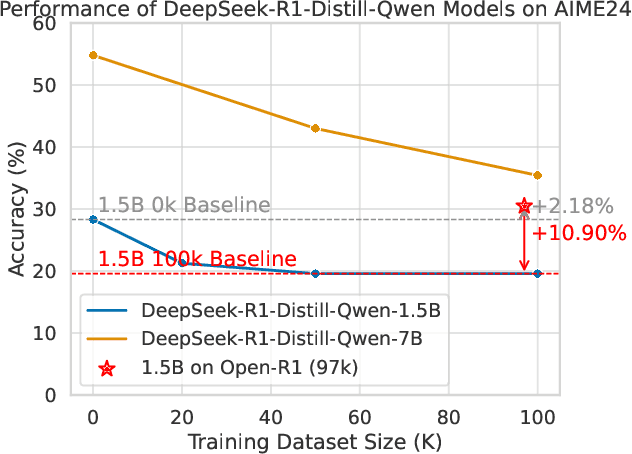
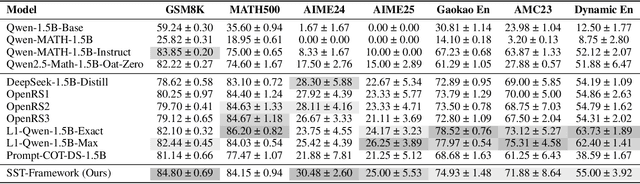
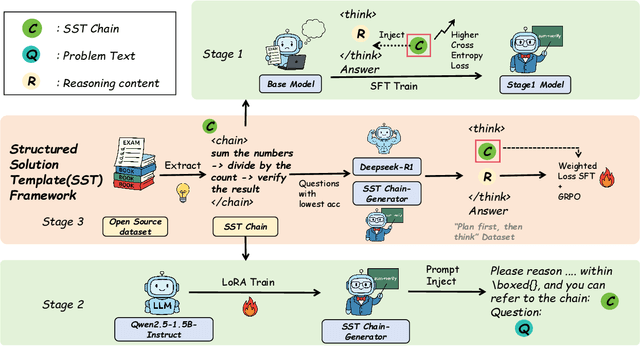

Structured, procedural reasoning is essential for Large Language Models (LLMs), especially in mathematics. While post-training methods have improved LLM performance, they still fall short in capturing deep procedural logic on complex tasks. To tackle the issue, in this paper, we first investigate this limitation and uncover a novel finding: a Scaling Law by Difficulty, which reveals that model performance follows a U-shaped curve with respect to training data complexity -- excessive low-difficulty data impedes abstraction, while high-difficulty data significantly enhances reasoning ability. Motivated by this, we propose the Structured Solution Template (SST) framework, which uses solution templates and a curriculum of varied difficulty to explicitly teach procedural reasoning. Specifically, SST comprises (1) fine-tuning with structured solution-template chains and dynamically weighted loss to prioritize procedural logic, (2) prompt-time injection of solution templates as cognitive scaffolds to guide inference, and (3) integrated curriculum fine-tuning that explicitly teaches the model to self-plan - execute - self-correct. Experiments on GSM8K, AIME24, and new Dynamic En benchmark show that SST significantly improves both accuracy and efficiency, especially on harder problems.
Dual Enhancement on 3D Vision-Language Perception for Monocular 3D Visual Grounding
Aug 26, 2025Monocular 3D visual grounding is a novel task that aims to locate 3D objects in RGB images using text descriptions with explicit geometry information. Despite the inclusion of geometry details in the text, we observe that the text embeddings are sensitive to the magnitude of numerical values but largely ignore the associated measurement units. For example, simply equidistant mapping the length with unit "meter" to "decimeters" or "centimeters" leads to severe performance degradation, even though the physical length remains equivalent. This observation signifies the weak 3D comprehension of pre-trained language model, which generates misguiding text features to hinder 3D perception. Therefore, we propose to enhance the 3D perception of model on text embeddings and geometry features with two simple and effective methods. Firstly, we introduce a pre-processing method named 3D-text Enhancement (3DTE), which enhances the comprehension of mapping relationships between different units by augmenting the diversity of distance descriptors in text queries. Next, we propose a Text-Guided Geometry Enhancement (TGE) module to further enhance the 3D-text information by projecting the basic text features into geometrically consistent space. These 3D-enhanced text features are then leveraged to precisely guide the attention of geometry features. We evaluate the proposed method through extensive comparisons and ablation studies on the Mono3DRefer dataset. Experimental results demonstrate substantial improvements over previous methods, achieving new state-of-the-art results with a notable accuracy gain of 11.94\% in the "Far" scenario. Our code will be made publicly available.
Hydra-Bench: A Benchmark for Multi-Modal Leaf Wetness Sensing
Jul 30, 2025Leaf wetness detection is a crucial task in agricultural monitoring, as it directly impacts the prediction and protection of plant diseases. However, existing sensing systems suffer from limitations in robustness, accuracy, and environmental resilience when applied to natural leaves under dynamic real-world conditions. To address these challenges, we introduce a new multi-modal dataset specifically designed for evaluating and advancing machine learning algorithms in leaf wetness detection. Our dataset comprises synchronized mmWave raw data, Synthetic Aperture Radar (SAR) images, and RGB images collected over six months from five diverse plant species in both controlled and outdoor field environments. We provide detailed benchmarks using the Hydra model, including comparisons against single modality baselines and multiple fusion strategies, as well as performance under varying scan distances. Additionally, our dataset can serve as a benchmark for future SAR imaging algorithm optimization, enabling a systematic evaluation of detection accuracy under diverse conditions.