 Add to Chrome
 Add to Firefox
 Add to Edge
Disease-informed Adaptation of Vision-Language Models
May 24, 2024
In medical image analysis, the expertise scarcity and the high cost of data annotation limits the development of large artificial intelligence models. This paper investigates the potential of transfer learning with pre-trained vision-language models (VLMs) in this domain. Currently, VLMs still struggle to transfer to the underrepresented diseases with minimal presence and new diseases entirely absent from the pretraining dataset. We argue that effective adaptation of VLMs hinges on the nuanced representation learning of disease concepts. By capitalizing on the joint visual-linguistic capabilities of VLMs, we introduce disease-informed contextual prompting in a novel disease prototype learning framework. This approach enables VLMs to grasp the concepts of new disease effectively and efficiently, even with limited data. Extensive experiments across multiple image modalities showcase notable enhancements in performance compared to existing techniques.

Physics-informed Score-based Diffusion Model for Limited-angle Reconstruction of Cardiac Computed Tomography
May 23, 2024Cardiac computed tomography (CT) has emerged as a major imaging modality for the diagnosis and monitoring of cardiovascular diseases. High temporal resolution is essential to ensure diagnostic accuracy. Limited-angle data acquisition can reduce scan time and improve temporal resolution, but typically leads to severe image degradation and motivates for improved reconstruction techniques. In this paper, we propose a novel physics-informed score-based diffusion model (PSDM) for limited-angle reconstruction of cardiac CT. At the sampling time, we combine a data prior from a diffusion model and a model prior obtained via an iterative algorithm and Fourier fusion to further enhance the image quality. Specifically, our approach integrates the primal-dual hybrid gradient (PDHG) algorithm with score-based diffusion models, thereby enabling us to reconstruct high-quality cardiac CT images from limited-angle data. The numerical simulations and real data experiments confirm the effectiveness of our proposed approach.
High Noise Scheduling is a Must
Apr 09, 2024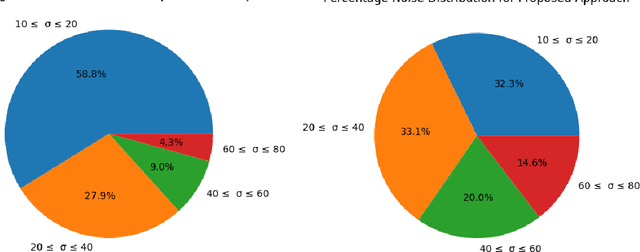

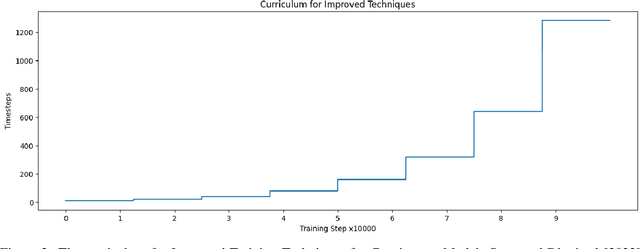

Consistency models possess high capabilities for image generation, advancing sampling steps to a single step through their advanced techniques. Current advancements move one step forward consistency training techniques and eliminates the limitation of distillation training. Even though the proposed curriculum and noise scheduling in improved training techniques yield better results than basic consistency models, it lacks well balanced noise distribution and its consistency between curriculum. In this study, it is investigated the balance between high and low noise levels in noise distribution and offered polynomial noise distribution to maintain the stability. This proposed polynomial noise distribution is also supported with a predefined Karras noises to prevent unique noise levels arises with Karras noise generation algorithm. Furthermore, by elimination of learned noisy steps with a curriculum based on sinusoidal function increase the performance of the model in denoising. To make a fair comparison with the latest released consistency model training techniques, experiments are conducted with same hyper-parameters except curriculum and noise distribution. The models utilized during experiments are determined with low depth to prove the robustness of our proposed technique. The results show that the polynomial noise distribution outperforms the model trained with log-normal noise distribution, yielding a 33.54 FID score after 100,000 training steps with constant discretization steps. Additionally, the implementation of a sinusoidal-based curriculum enhances denoising performance, resulting in a FID score of 30.48.
Deep Few-view High-resolution Photon-counting Extremity CT at Halved Dose for a Clinical Trial
Mar 19, 2024The latest X-ray photon-counting computed tomography (PCCT) for extremity allows multi-energy high-resolution (HR) imaging for tissue characterization and material decomposition. However, both radiation dose and imaging speed need improvement for contrast-enhanced and other studies. Despite the success of deep learning methods for 2D few-view reconstruction, applying them to HR volumetric reconstruction of extremity scans for clinical diagnosis has been limited due to GPU memory constraints, training data scarcity, and domain gap issues. In this paper, we propose a deep learning-based approach for PCCT image reconstruction at halved dose and doubled speed in a New Zealand clinical trial. Particularly, we present a patch-based volumetric refinement network to alleviate the GPU memory limitation, train network with synthetic data, and use model-based iterative refinement to bridge the gap between synthetic and real-world data. The simulation and phantom experiments demonstrate consistently improved results under different acquisition conditions on both in- and off-domain structures using a fixed network. The image quality of 8 patients from the clinical trial are evaluated by three radiologists in comparison with the standard image reconstruction with a full-view dataset. It is shown that our proposed approach is essentially identical to or better than the clinical benchmark in terms of diagnostic image quality scores. Our approach has a great potential to improve the safety and efficiency of PCCT without compromising image quality.
Low-dose CT Denoising with Language-engaged Dual-space Alignment
Mar 10, 2024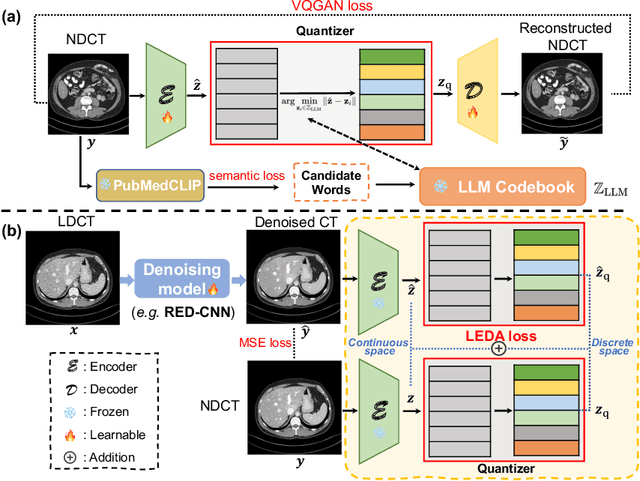
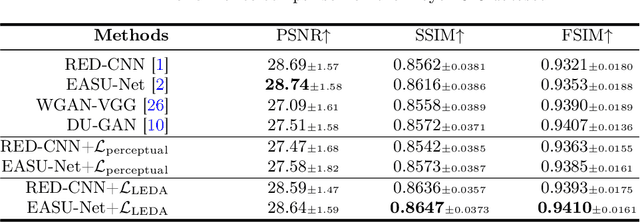
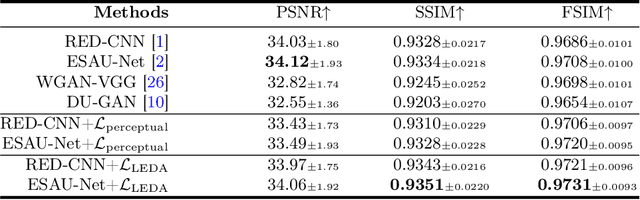
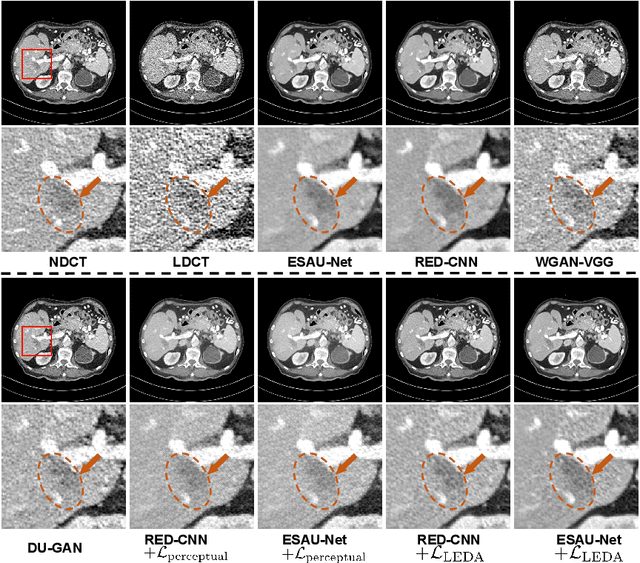
While various deep learning methods were proposed for low-dose computed tomography (CT) denoising, they often suffer from over-smoothing, blurring, and lack of explainability. To alleviate these issues, we propose a plug-and-play Language-Engaged Dual-space Alignment loss (LEDA) to optimize low-dose CT denoising models. Our idea is to leverage large language models (LLMs) to align denoised CT and normal dose CT images in both the continuous perceptual space and discrete semantic space, which is the first LLM-based scheme for low-dose CT denoising. LEDA involves two steps: the first is to pretrain an LLM-guided CT autoencoder, which can encode a CT image into continuous high-level features and quantize them into a token space to produce semantic tokens derived from the LLM's vocabulary; and the second is to minimize the discrepancy between the denoised CT images and normal dose CT in terms of both encoded high-level features and quantized token embeddings derived by the LLM-guided CT autoencoder. Extensive experimental results on two public LDCT denoising datasets demonstrate that our LEDA can enhance existing denoising models in terms of quantitative metrics and qualitative evaluation, and also provide explainability through language-level image understanding. Source code is available at https://github.com/hao1635/LEDA.
Photon-counting CT using a Conditional Diffusion Model for Super-resolution and Texture-preservation
Feb 25, 2024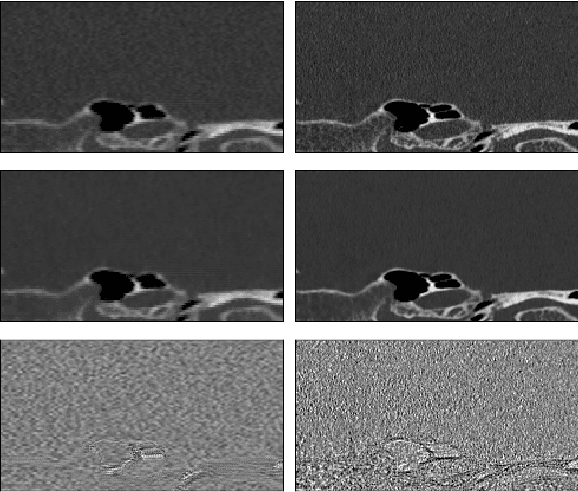
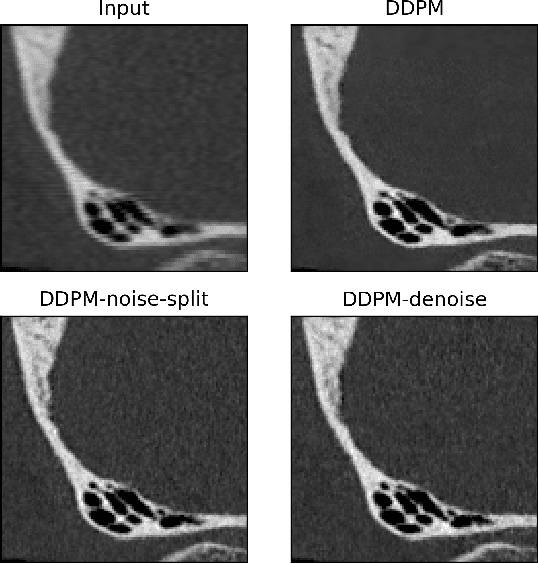
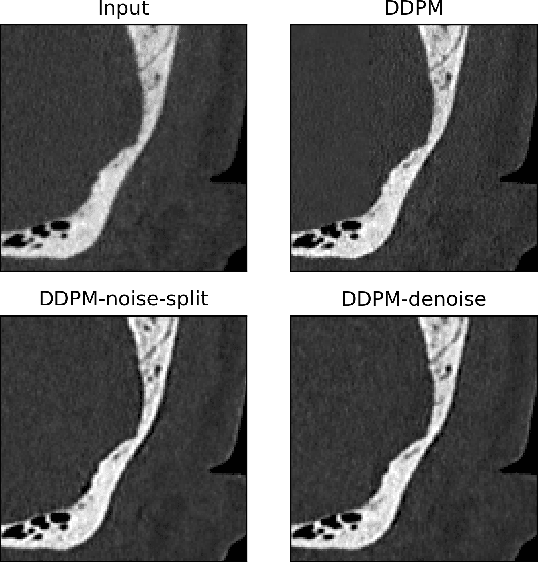
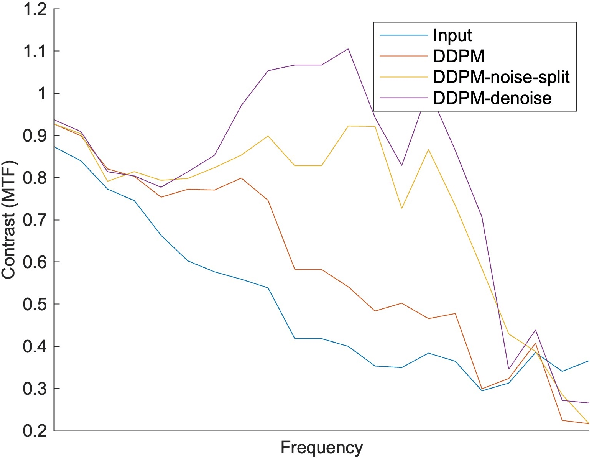
Ultra-high resolution images are desirable in photon counting CT (PCCT), but resolution is physically limited by interactions such as charge sharing. Deep learning is a possible method for super-resolution (SR), but sourcing paired training data that adequately models the target task is difficult. Additionally, SR algorithms can distort noise texture, which is an important in many clinical diagnostic scenarios. Here, we train conditional denoising diffusion probabilistic models (DDPMs) for PCCT super-resolution, with the objective to retain textural characteristics of local noise. PCCT simulation methods are used to synthesize realistic resolution degradation. To preserve noise texture, we explore decoupling the noise and signal image inputs and outputs via deep denoisers, explicitly mapping to each during the SR process. Our experimental results indicate that our DDPM trained on simulated data can improve sharpness in real PCCT images. Additionally, the disentanglement of noise from the original image allows our model more faithfully preserve noise texture.
Switch EMA: A Free Lunch for Better Flatness and Sharpness
Feb 14, 2024Exponential Moving Average (EMA) is a widely used weight averaging (WA) regularization to learn flat optima for better generalizations without extra cost in deep neural network (DNN) optimization. Despite achieving better flatness, existing WA methods might fall into worse final performances or require extra test-time computations. This work unveils the full potential of EMA with a single line of modification, i.e., switching the EMA parameters to the original model after each epoch, dubbed as Switch EMA (SEMA). From both theoretical and empirical aspects, we demonstrate that SEMA can help DNNs to reach generalization optima that better trade-off between flatness and sharpness. To verify the effectiveness of SEMA, we conduct comparison experiments with discriminative, generative, and regression tasks on vision and language datasets, including image classification, self-supervised learning, object detection and segmentation, image generation, video prediction, attribute regression, and language modeling. Comprehensive results with popular optimizers and networks show that SEMA is a free lunch for DNN training by improving performances and boosting convergence speeds.
Poisson flow consistency models for low-dose CT image denoising
Feb 13, 2024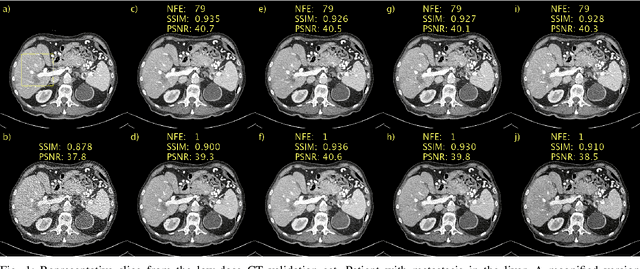
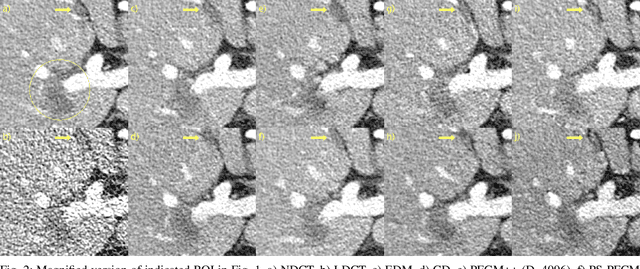
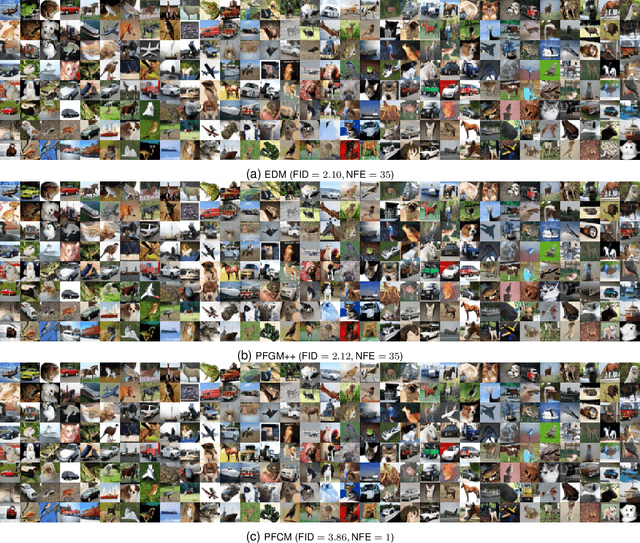
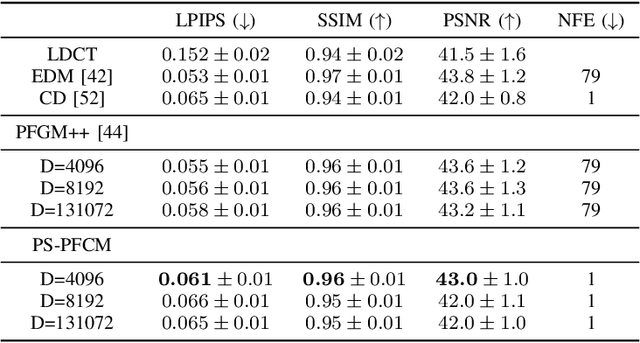
Diffusion and Poisson flow models have demonstrated remarkable success for a wide range of generative tasks. Nevertheless, their iterative nature results in computationally expensive sampling and the number of function evaluations (NFE) required can be orders of magnitude larger than for single-step methods. Consistency models are a recent class of deep generative models which enable single-step sampling of high quality data without the need for adversarial training. In this paper, we introduce a novel image denoising technique which combines the flexibility afforded in Poisson flow generative models (PFGM)++ with the, high quality, single step sampling of consistency models. The proposed method first learns a trajectory between a noise distribution and the posterior distribution of interest by training PFGM++ in a supervised fashion. These pre-trained PFGM++ are subsequently "distilled" into Poisson flow consistency models (PFCM) via an updated version of consistency distillation. We call this approach posterior sampling Poisson flow consistency models (PS-PFCM). Our results indicate that the added flexibility of tuning the hyperparameter D, the dimensionality of the augmentation variables in PFGM++, allows us to outperform consistency models, a current state-of-the-art diffusion-style model with NFE=1 on clinical low-dose CT images. Notably, PFCM is in itself a novel family of deep generative models and we provide initial results on the CIFAR-10 dataset.
Data and Physics driven Deep Learning Models for Fast MRI Reconstruction: Fundamentals and Methodologies
Jan 29, 2024
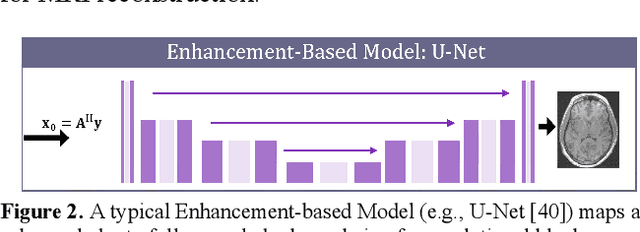

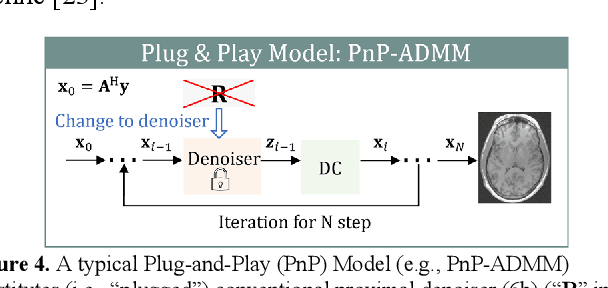
Magnetic Resonance Imaging (MRI) is a pivotal clinical diagnostic tool, yet its extended scanning times often compromise patient comfort and image quality, especially in volumetric, temporal and quantitative scans. This review elucidates recent advances in MRI acceleration via data and physics-driven models, leveraging techniques from algorithm unrolling models, enhancement-based models, and plug-and-play models to emergent full spectrum of generative models. We also explore the synergistic integration of data models with physics-based insights, encompassing the advancements in multi-coil hardware accelerations like parallel imaging and simultaneous multi-slice imaging, and the optimization of sampling patterns. We then focus on domain-specific challenges and opportunities, including image redundancy exploitation, image integrity, evaluation metrics, data heterogeneity, and model generalization. This work also discusses potential solutions and future research directions, emphasizing the role of data harmonization, and federated learning for further improving the general applicability and performance of these methods in MRI reconstruction.
Graph-level Protein Representation Learning by Structure Knowledge Refinement
Jan 05, 2024This paper focuses on learning representation on the whole graph level in an unsupervised manner. Learning graph-level representation plays an important role in a variety of real-world issues such as molecule property prediction, protein structure feature extraction, and social network analysis. The mainstream method is utilizing contrastive learning to facilitate graph feature extraction, known as Graph Contrastive Learning (GCL). GCL, although effective, suffers from some complications in contrastive learning, such as the effect of false negative pairs. Moreover, augmentation strategies in GCL are weakly adaptive to diverse graph datasets. Motivated by these problems, we propose a novel framework called Structure Knowledge Refinement (SKR) which uses data structure to determine the probability of whether a pair is positive or negative. Meanwhile, we propose an augmentation strategy that naturally preserves the semantic meaning of the original data and is compatible with our SKR framework. Furthermore, we illustrate the effectiveness of our SKR framework through intuition and experiments. The experimental results on the tasks of graph-level classification demonstrate that our SKR framework is superior to most state-of-the-art baselines.