 Add to Chrome
 Add to Firefox
 Add to Edge
AutoAWG: Adverse Weather Generation with Adaptive Multi-Controls for Automotive Videos
Apr 21, 2026
Perception robustness under adverse weather remains a critical challenge for autonomous driving, with the core bottleneck being the scarcity of real-world video data in adverse weather. Existing weather generation approaches struggle to balance visual quality and annotation reusability. We present AutoAWG, a controllable Adverse Weather video Generation framework for Autonomous driving. Our method employs a semantics-guided adaptive fusion of multiple controls to balance strong weather stylization with high-fidelity preservation of safety-critical targets; leverages a vanishing point-anchored temporal synthesis strategy to construct training sequences from static images, thereby reducing reliance on synthetic data; and adopts masked training to enhance long-horizon generation stability. On the nuScenes validation set, AutoAWG significantly outperforms prior state-of-the-art methods: without first-frame conditioning, FID and FVD are relatively reduced by 50.0% and 16.1%; with first-frame conditioning, they are further reduced by 8.7% and 7.2%, respectively. Extensive qualitative and quantitative results demonstrate advantages in style fidelity, temporal consistency, and semantic--structural integrity, underscoring the practical value of AutoAWG for improving downstream perception in autonomous driving. Our code is available at: https://github.com/higherhu/AutoAWG

Controllable Pedestrian Video Editing for Multi-View Driving Scenarios via Motion Sequence
Aug 01, 2025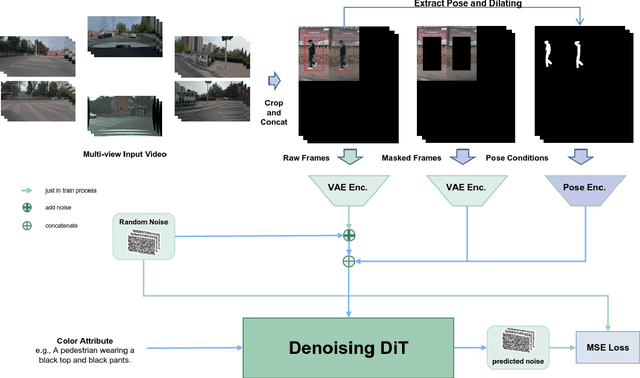
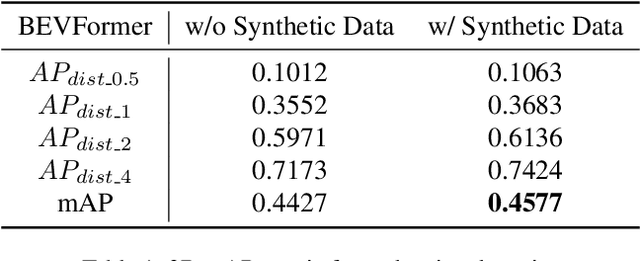
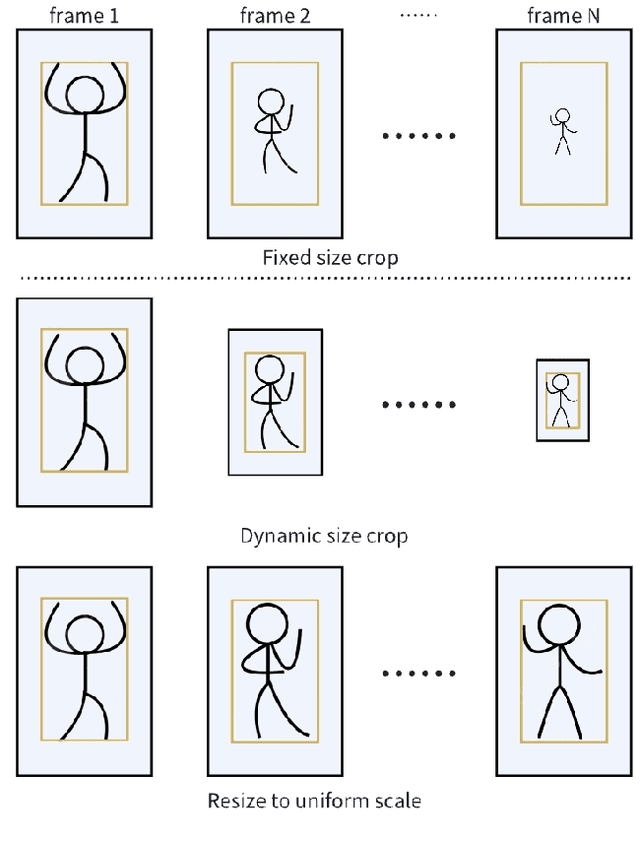

Pedestrian detection models in autonomous driving systems often lack robustness due to insufficient representation of dangerous pedestrian scenarios in training datasets. To address this limitation, we present a novel framework for controllable pedestrian video editing in multi-view driving scenarios by integrating video inpainting and human motion control techniques. Our approach begins by identifying pedestrian regions of interest across multiple camera views, expanding detection bounding boxes with a fixed ratio, and resizing and stitching these regions into a unified canvas while preserving cross-view spatial relationships. A binary mask is then applied to designate the editable area, within which pedestrian editing is guided by pose sequence control conditions. This enables flexible editing functionalities, including pedestrian insertion, replacement, and removal. Extensive experiments demonstrate that our framework achieves high-quality pedestrian editing with strong visual realism, spatiotemporal coherence, and cross-view consistency. These results establish the proposed method as a robust and versatile solution for multi-view pedestrian video generation, with broad potential for applications in data augmentation and scenario simulation in autonomous driving.