 Add to Chrome
 Add to Firefox
 Add to Edge
ConceptTree: Bringing Semantic Transparency to Black-Box Decision Making for Robotic Manipulation
Jul 20, 2026
Establishing interpretable decision-making processes in long-horizon robotic manipulation is critical for enabling reliable human oversight and intervention. However, existing approaches to robotic manipulation largely treat skill selection as opaque mappings from observations to actions, offering limited transparency into how decisions are formed. In this work, we propose ConceptTree, a framework that reframes high-level manipulation skill selection as reasoning over human-interpretable concepts, representing high-level policies as a sequence of concept-level predicates over visual observations. Rather than relying on implicit latent representations, our method learns a normalized concept space grounded in visual inputs, over which a decision tree is trained to predict high-level skills. This formulation yields a transparent decision process that is both traceable and intervenable, enabling direct inspection and modification of policy behavior. We evaluate our approach on a set of real-world robotic manipulation tasks with increasing complexity. Experimental results show that ConceptTree consistently outperforms existing concept-based baselines, particularly in complex, long-horizon scenarios. Furthermore, we provide qualitative case studies showing that our model supports fine-grained intervention by modifying individual concepts, enabling targeted correction of decision errors without retraining.

Exploring Accurate and Transparent Domain Adaptation in Predictive Healthcare via Concept-Grounded Orthogonal Inference
Feb 13, 2026Deep learning models for clinical event prediction on electronic health records (EHR) often suffer performance degradation when deployed under different data distributions. While domain adaptation (DA) methods can mitigate such shifts, its "black-box" nature prevents widespread adoption in clinical practice where transparency is essential for trust and safety. We propose ExtraCare to decompose patient representations into invariant and covariant components. By supervising these two components and enforcing their orthogonality during training, our model preserves label information while exposing domain-specific variation at the same time for more accurate predictions than most feature alignment models. More importantly, it offers human-understandable explanations by mapping sparse latent dimensions to medical concepts and quantifying their contributions via targeted ablations. ExtraCare is evaluated on two real-world EHR datasets across multiple domain partition settings, demonstrating superior performance along with enhanced transparency, as evidenced by its accurate predictions and explanations from extensive case studies.
Efficient Context Scaling with LongCat ZigZag Attention
Dec 30, 2025We introduce LongCat ZigZag Attention (LoZA), which is a sparse attention scheme designed to transform any existing full-attention models into sparse versions with rather limited compute budget. In long-context scenarios, LoZA can achieve significant speed-ups both for prefill-intensive (e.g., retrieval-augmented generation) and decode-intensive (e.g., tool-integrated reasoning) cases. Specifically, by applying LoZA to LongCat-Flash during mid-training, we serve LongCat-Flash-Exp as a long-context foundation model that can swiftly process up to 1 million tokens, enabling efficient long-term reasoning and long-horizon agentic capabilities.
Safe Planner: Empowering Safety Awareness in Large Pre-Trained Models for Robot Task Planning
Nov 11, 2024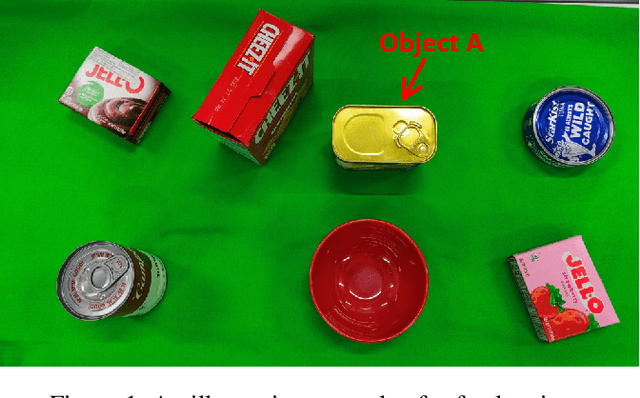

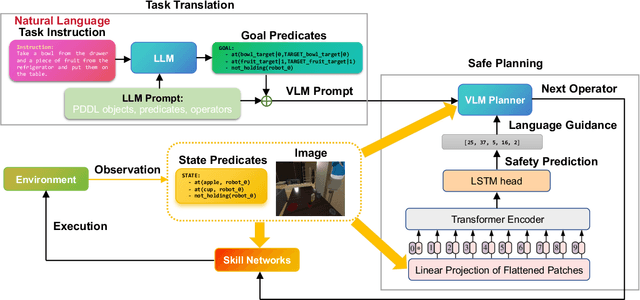

Robot task planning is an important problem for autonomous robots in long-horizon challenging tasks. As large pre-trained models have demonstrated superior planning ability, recent research investigates utilizing large models to achieve autonomous planning for robots in diverse tasks. However, since the large models are pre-trained with Internet data and lack the knowledge of real task scenes, large models as planners may make unsafe decisions that hurt the robots and the surrounding environments. To solve this challenge, we propose a novel Safe Planner framework, which empowers safety awareness in large pre-trained models to accomplish safe and executable planning. In this framework, we develop a safety prediction module to guide the high-level large model planner, and this safety module trained in a simulator can be effectively transferred to real-world tasks. The proposed Safe Planner framework is evaluated on both simulated environments and real robots. The experiment results demonstrate that Safe Planner not only achieves state-of-the-art task success rates, but also substantially improves safety during task execution. The experiment videos are shown in https://sites.google.com/view/safeplanner .
Learning for Biomedical Information Extraction: Methodological Review of Recent Advances
Jun 26, 2016
Biomedical information extraction (BioIE) is important to many applications, including clinical decision support, integrative biology, and pharmacovigilance, and therefore it has been an active research. Unlike existing reviews covering a holistic view on BioIE, this review focuses on mainly recent advances in learning based approaches, by systematically summarizing them into different aspects of methodological development. In addition, we dive into open information extraction and deep learning, two emerging and influential techniques and envision next generation of BioIE.