 Add to Chrome
 Add to Firefox
 Add to Edge
Series-to-Series Diffusion Bridge Model
Nov 07, 2024
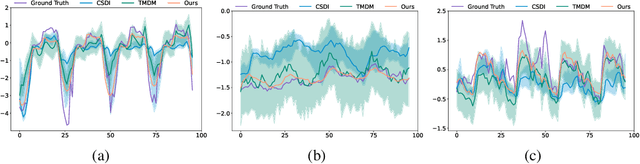

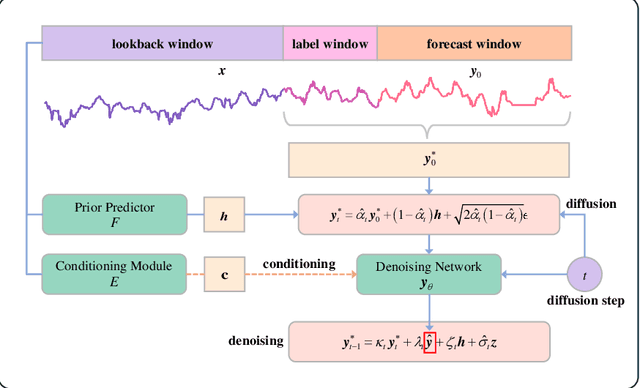
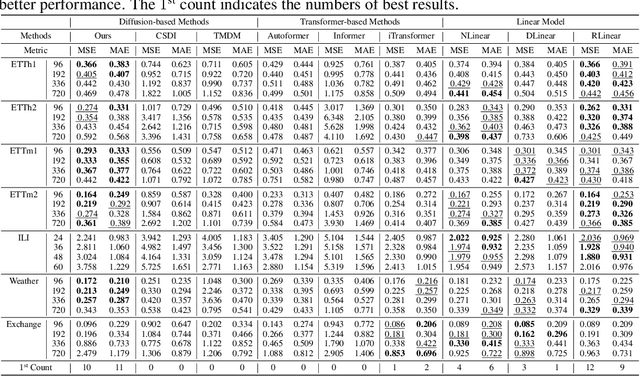
Diffusion models have risen to prominence in time series forecasting, showcasing their robust capability to model complex data distributions. However, their effectiveness in deterministic predictions is often constrained by instability arising from their inherent stochasticity. In this paper, we revisit time series diffusion models and present a comprehensive framework that encompasses most existing diffusion-based methods. Building on this theoretical foundation, we propose a novel diffusion-based time series forecasting model, the Series-to-Series Diffusion Bridge Model ($\mathrm{S^2DBM}$), which leverages the Brownian Bridge process to reduce randomness in reverse estimations and improves accuracy by incorporating informative priors and conditions derived from historical time series data. Experimental results demonstrate that $\mathrm{S^2DBM}$ delivers superior performance in point-to-point forecasting and competes effectively with other diffusion-based models in probabilistic forecasting.

Investigating the Capabilities of Deep Learning for Processing and Interpreting One-Shot Multi-offset GPR Data: A Numerical Case Study for Lunar and Martian Environments
Oct 18, 2024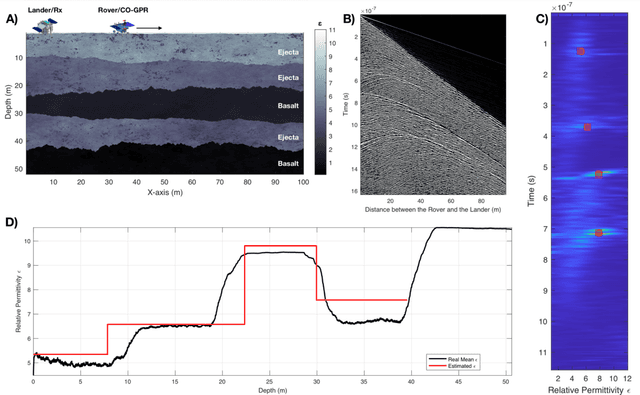
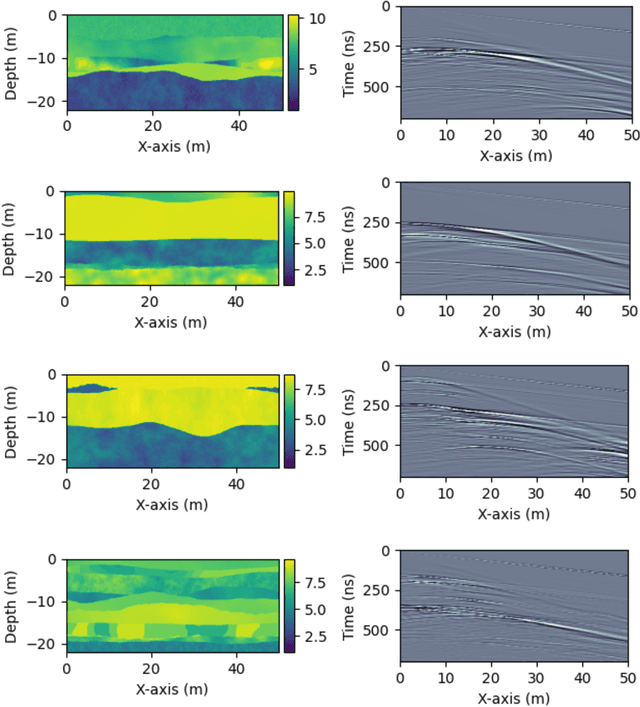
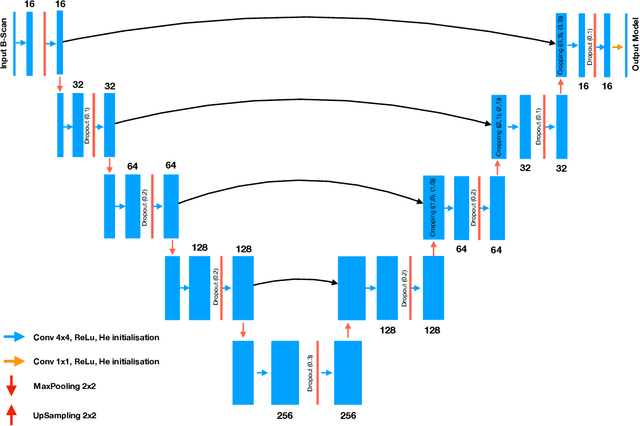
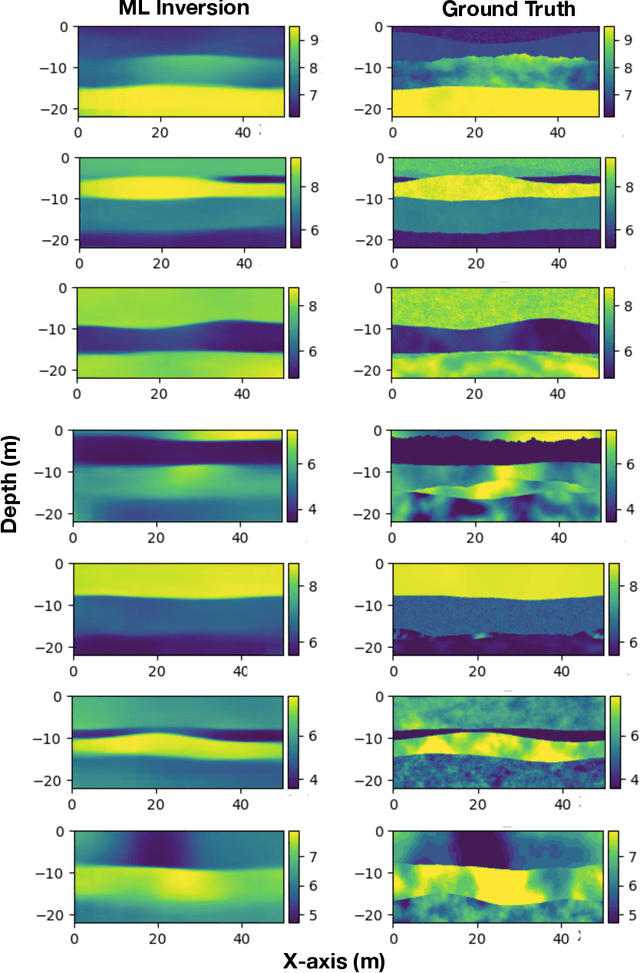
Ground-penetrating radar (GPR) is a mature geophysical method that has gained increasing popularity in planetary science over the past decade. GPR has been utilised both for Lunar and Martian missions providing pivotal information regarding the near surface geology of Terrestrial planets. Within that context, numerous processing pipelines have been suggested to address the unique challenges present in planetary setups. These processing pipelines often require manual tuning resulting to ambiguous outputs open to non-unique interpretations. These pitfalls combined with the large number of planetary GPR data (kilometers in magnitude), highlight the necessity for automatic, objective and advanced processing and interpretation schemes. The current paper investigates the potential of deep learning for interpreting and processing GPR data. The one-shot multi-offset configuration is investigated via a coherent numerical case study, showcasing the potential of deep learning for A) reconstructing the dielectric distribution of the the near surface of Terrestrial planets, and B) filling missing or bad-quality traces. Special care was taken for the numerical data to be both realistic and challenging. Moreover, the generated synthetic data are properly labelled and made publicly available for training future data-driven pipelines and contributing towards developing pre-trained foundation models for GPR.
IGNN-Solver: A Graph Neural Solver for Implicit Graph Neural Networks
Oct 11, 2024
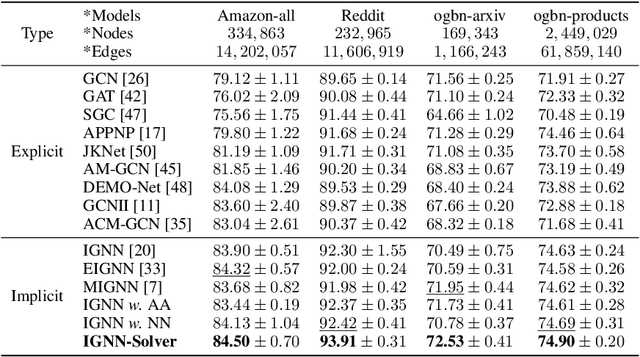
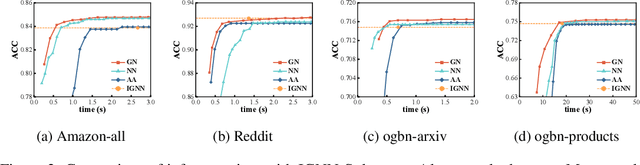
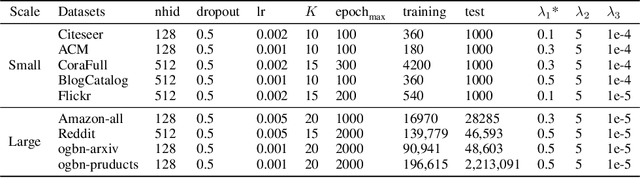
Implicit graph neural networks (IGNNs), which exhibit strong expressive power with a single layer, have recently demonstrated remarkable performance in capturing long-range dependencies (LRD) in underlying graphs while effectively mitigating the over-smoothing problem. However, IGNNs rely on computationally expensive fixed-point iterations, which lead to significant speed and scalability limitations, hindering their application to large-scale graphs. To achieve fast fixed-point solving for IGNNs, we propose a novel graph neural solver, IGNN-Solver, which leverages the generalized Anderson Acceleration method, parameterized by a small GNN, and learns iterative updates as a graph-dependent temporal process. Extensive experiments demonstrate that the IGNN-Solver significantly accelerates inference, achieving a $1.5\times$ to $8\times$ speedup without sacrificing accuracy. Moreover, this advantage becomes increasingly pronounced as the graph scale grows, facilitating its large-scale deployment in real-world applications.
Federated Neural Nonparametric Point Processes
Oct 08, 2024Temporal point processes (TPPs) are effective for modeling event occurrences over time, but they struggle with sparse and uncertain events in federated systems, where privacy is a major concern. To address this, we propose \textit{FedPP}, a Federated neural nonparametric Point Process model. FedPP integrates neural embeddings into Sigmoidal Gaussian Cox Processes (SGCPs) on the client side, which is a flexible and expressive class of TPPs, allowing it to generate highly flexible intensity functions that capture client-specific event dynamics and uncertainties while efficiently summarizing historical records. For global aggregation, FedPP introduces a divergence-based mechanism that communicates the distributions of SGCPs' kernel hyperparameters between the server and clients, while keeping client-specific parameters local to ensure privacy and personalization. FedPP effectively captures event uncertainty and sparsity, and extensive experiments demonstrate its superior performance in federated settings, particularly with KL divergence and Wasserstein distance-based global aggregation.
Is Score Matching Suitable for Estimating Point Processes?
Oct 05, 2024
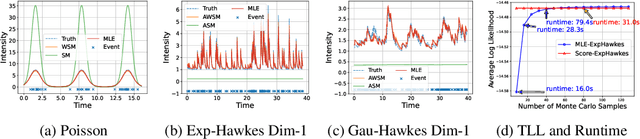
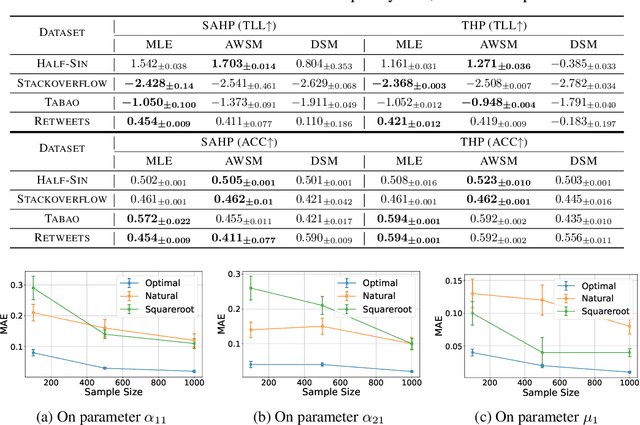

Score matching estimators have gained widespread attention in recent years partly because they are free from calculating the integral of normalizing constant, thereby addressing the computational challenges in maximum likelihood estimation (MLE). Some existing works have proposed score matching estimators for point processes. However, this work demonstrates that the incompleteness of the estimators proposed in those works renders them applicable only to specific problems, and they fail for more general point processes. To address this issue, this work introduces the weighted score matching estimator to point processes. Theoretically, we prove the consistency of our estimator and establish its rate of convergence. Experimental results indicate that our estimator accurately estimates model parameters on synthetic data and yields results consistent with MLE on real data. In contrast, existing score matching estimators fail to perform effectively. Codes are publicly available at \url{https://github.com/KenCao2007/WSM_TPP}.
Nonstationary Sparse Spectral Permanental Process
Oct 04, 2024


Existing permanental processes often impose constraints on kernel types or stationarity, limiting the model's expressiveness. To overcome these limitations, we propose a novel approach utilizing the sparse spectral representation of nonstationary kernels. This technique relaxes the constraints on kernel types and stationarity, allowing for more flexible modeling while reducing computational complexity to the linear level. Additionally, we introduce a deep kernel variant by hierarchically stacking multiple spectral feature mappings, further enhancing the model's expressiveness to capture complex patterns in data. Experimental results on both synthetic and real-world datasets demonstrate the effectiveness of our approach, particularly in scenarios with pronounced data nonstationarity. Additionally, ablation studies are conducted to provide insights into the impact of various hyperparameters on model performance.
Conjugate Bayesian Two-step Change Point Detection for Hawkes Process
Sep 26, 2024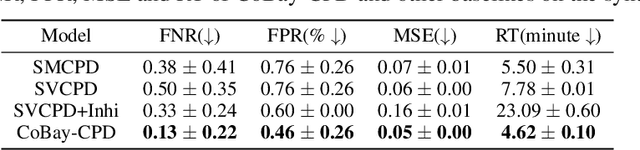
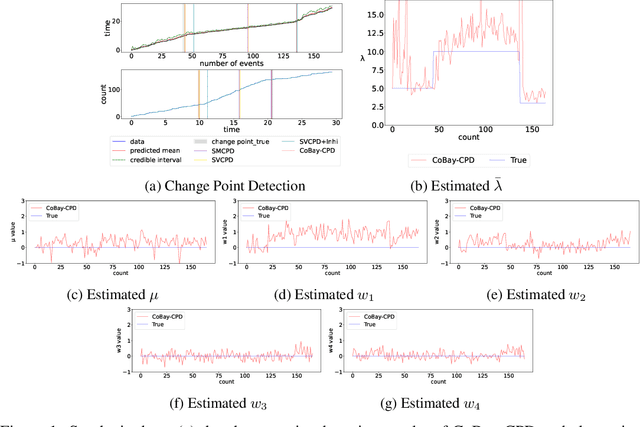

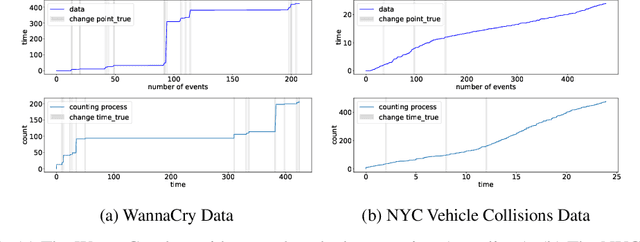
The Bayesian two-step change point detection method is popular for the Hawkes process due to its simplicity and intuitiveness. However, the non-conjugacy between the point process likelihood and the prior requires most existing Bayesian two-step change point detection methods to rely on non-conjugate inference methods. These methods lack analytical expressions, leading to low computational efficiency and impeding timely change point detection. To address this issue, this work employs data augmentation to propose a conjugate Bayesian two-step change point detection method for the Hawkes process, which proves to be more accurate and efficient. Extensive experiments on both synthetic and real data demonstrate the superior effectiveness and efficiency of our method compared to baseline methods. Additionally, we conduct ablation studies to explore the robustness of our method concerning various hyperparameters. Our code is publicly available at https://github.com/Aurora2050/CoBay-CPD.
Towards Physically-Realizable Adversarial Attacks in Embodied Vision Navigation
Sep 16, 2024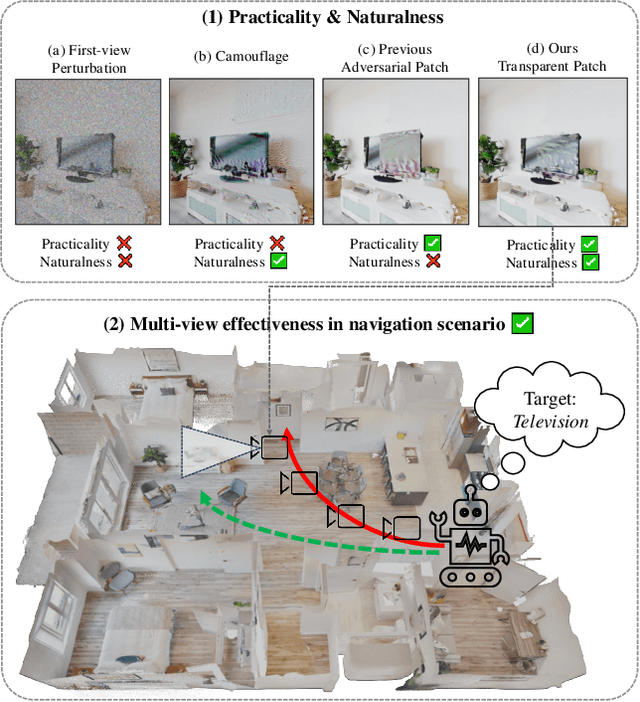
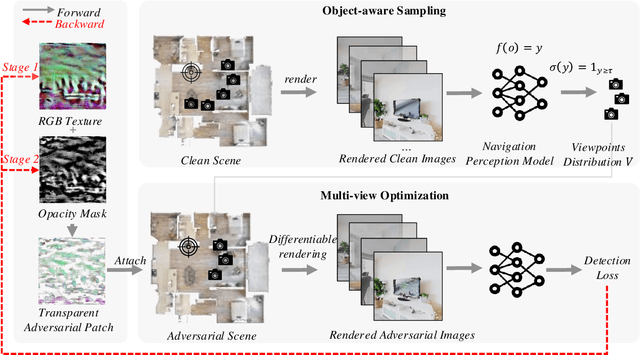
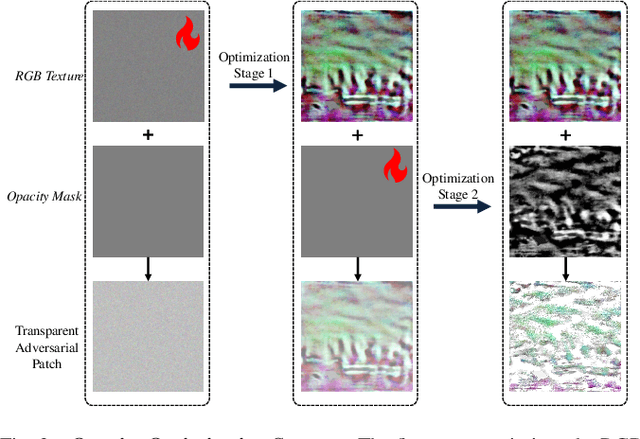

The deployment of embodied navigation agents in safety-critical environments raises concerns about their vulnerability to adversarial attacks on deep neural networks. However, current attack methods often lack practicality due to challenges in transitioning from the digital to the physical world, while existing physical attacks for object detection fail to achieve both multi-view effectiveness and naturalness. To address this, we propose a practical attack method for embodied navigation by attaching adversarial patches with learnable textures and opacity to objects. Specifically, to ensure effectiveness across varying viewpoints, we employ a multi-view optimization strategy based on object-aware sampling, which uses feedback from the navigation model to optimize the patch's texture. To make the patch inconspicuous to human observers, we introduce a two-stage opacity optimization mechanism, where opacity is refined after texture optimization. Experimental results show our adversarial patches reduce navigation success rates by about 40%, outperforming previous methods in practicality, effectiveness, and naturalness. Code is available at: [https://github.com/chen37058/Physical-Attacks-in-Embodied-Navigation].
Distillation Learning Guided by Image Reconstruction for One-Shot Medical Image Segmentation
Aug 07, 2024
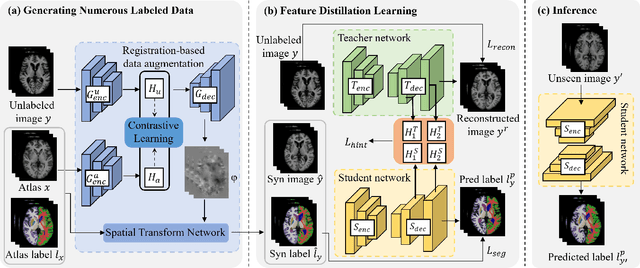


Traditional one-shot medical image segmentation (MIS) methods use registration networks to propagate labels from a reference atlas or rely on comprehensive sampling strategies to generate synthetic labeled data for training. However, these methods often struggle with registration errors and low-quality synthetic images, leading to poor performance and generalization. To overcome this, we introduce a novel one-shot MIS framework based on knowledge distillation, which allows the network to directly 'see' real images through a distillation process guided by image reconstruction. It focuses on anatomical structures in a single labeled image and a few unlabeled ones. A registration-based data augmentation network creates realistic, labeled samples, while a feature distillation module helps the student network learn segmentation from these samples, guided by the teacher network. During inference, the streamlined student network accurately segments new images. Evaluations on three public datasets (OASIS for T1 brain MRI, BCV for abdomen CT, and VerSe for vertebrae CT) show superior segmentation performance and generalization across different medical image datasets and modalities compared to leading methods. Our code is available at https://github.com/NoviceFodder/OS-MedSeg.
ActivityCLIP: Enhancing Group Activity Recognition by Mining Complementary Information from Text to Supplement Image Modality
Jul 29, 2024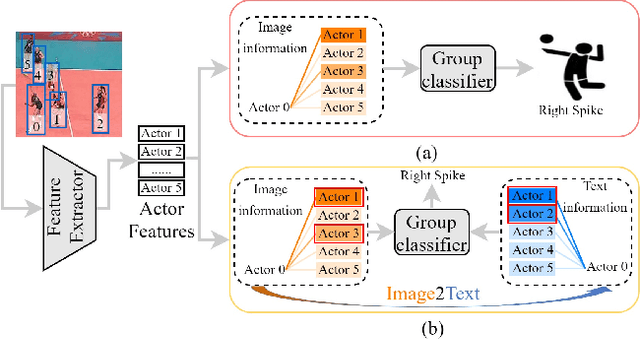
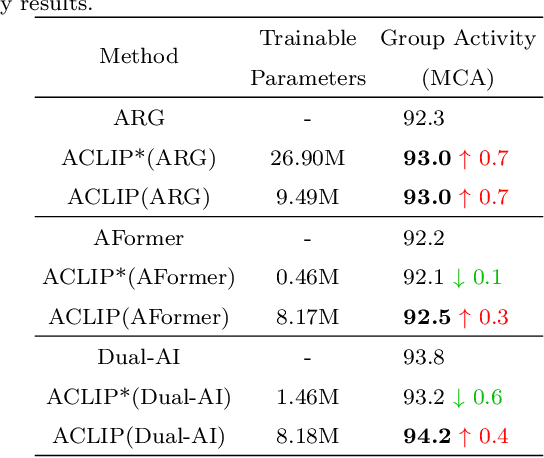
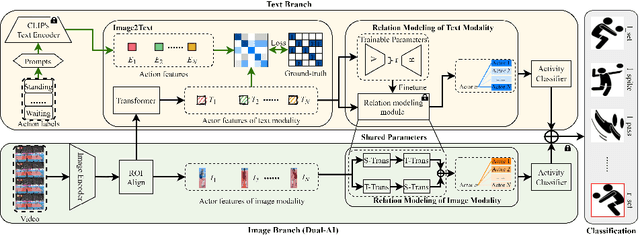
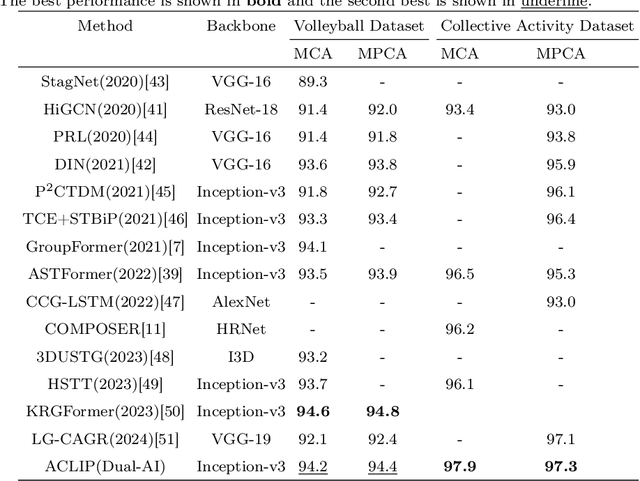
Previous methods usually only extract the image modality's information to recognize group activity. However, mining image information is approaching saturation, making it difficult to extract richer information. Therefore, extracting complementary information from other modalities to supplement image information has become increasingly important. In fact, action labels provide clear text information to express the action's semantics, which existing methods often overlook. Thus, we propose ActivityCLIP, a plug-and-play method for mining the text information contained in the action labels to supplement the image information for enhancing group activity recognition. ActivityCLIP consists of text and image branches, where the text branch is plugged into the image branch (The off-the-shelf image-based method). The text branch includes Image2Text and relation modeling modules. Specifically, we propose the knowledge transfer module, Image2Text, which adapts image information into text information extracted by CLIP via knowledge distillation. Further, to keep our method convenient, we add fewer trainable parameters based on the relation module of the image branch to model interaction relation in the text branch. To show our method's generality, we replicate three representative methods by ActivityCLIP, which adds only limited trainable parameters, achieving favorable performance improvements for each method. We also conduct extensive ablation studies and compare our method with state-of-the-art methods to demonstrate the effectiveness of ActivityCLIP.