 Add to Chrome
 Add to Firefox
 Add to Edge
Monocular Mesh Recovery and Body Measurement of Female Saanen Goats
Feb 23, 2026
The lactation performance of Saanen dairy goats, renowned for their high milk yield, is intrinsically linked to their body size, making accurate 3D body measurement essential for assessing milk production potential, yet existing reconstruction methods lack goat-specific authentic 3D data. To address this limitation, we establish the FemaleSaanenGoat dataset containing synchronized eight-view RGBD videos of 55 female Saanen goats (6-18 months). Using multi-view DynamicFusion, we fuse noisy, non-rigid point cloud sequences into high-fidelity 3D scans, overcoming challenges from irregular surfaces and rapid movement. Based on these scans, we develop SaanenGoat, a parametric 3D shape model specifically designed for female Saanen goats. This model features a refined template with 41 skeletal joints and enhanced udder representation, registered with our scan data. A comprehensive shape space constructed from 48 goats enables precise representation of diverse individual variations. With the help of SaanenGoat model, we get high-precision 3D reconstruction from single-view RGBD input, and achieve automated measurement of six critical body dimensions: body length, height, chest width, chest girth, hip width, and hip height. Experimental results demonstrate the superior accuracy of our method in both 3D reconstruction and body measurement, presenting a novel paradigm for large-scale 3D vision applications in precision livestock farming.

MagFace: A Universal Representation for Face Recognition and Quality Assessment
Apr 03, 2021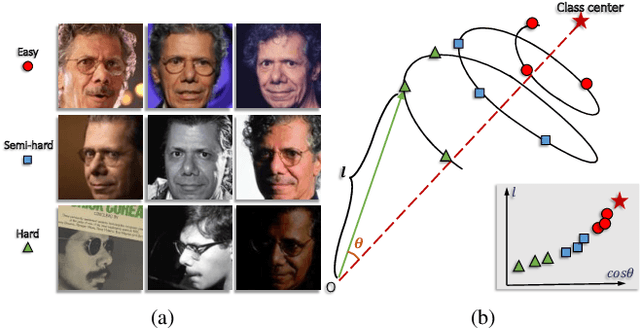
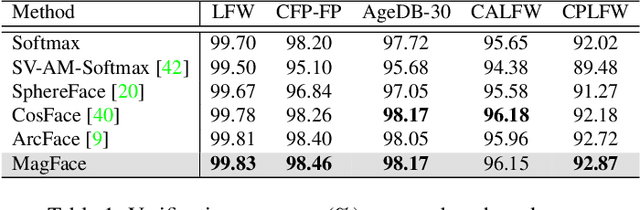
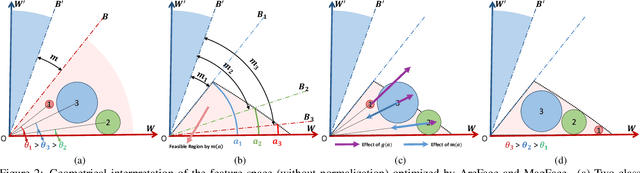
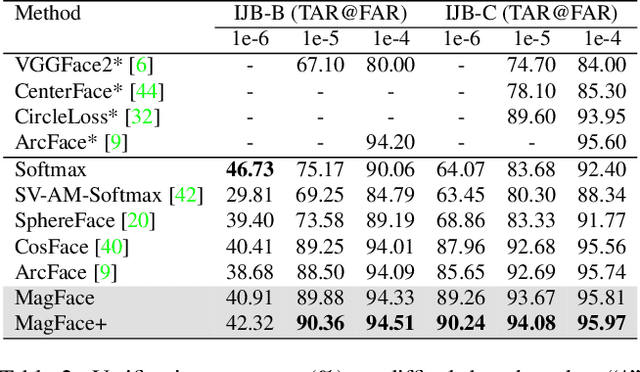
The performance of face recognition system degrades when the variability of the acquired faces increases. Prior work alleviates this issue by either monitoring the face quality in pre-processing or predicting the data uncertainty along with the face feature. This paper proposes MagFace, a category of losses that learn a universal feature embedding whose magnitude can measure the quality of the given face. Under the new loss, it can be proven that the magnitude of the feature embedding monotonically increases if the subject is more likely to be recognized. In addition, MagFace introduces an adaptive mechanism to learn a wellstructured within-class feature distributions by pulling easy samples to class centers while pushing hard samples away. This prevents models from overfitting on noisy low-quality samples and improves face recognition in the wild. Extensive experiments conducted on face recognition, quality assessments as well as clustering demonstrate its superiority over state-of-the-arts. The code is available at https://github.com/IrvingMeng/MagFace.
* accepted at CVPR 2021, Oral
Pooling the Convolutional Layers in Deep ConvNets for Action Recognition
Nov 06, 2015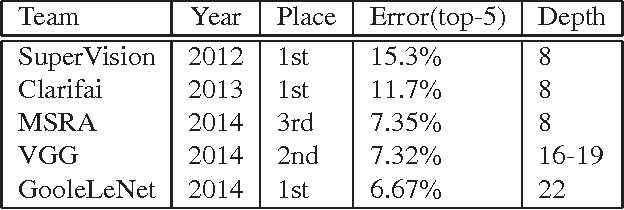
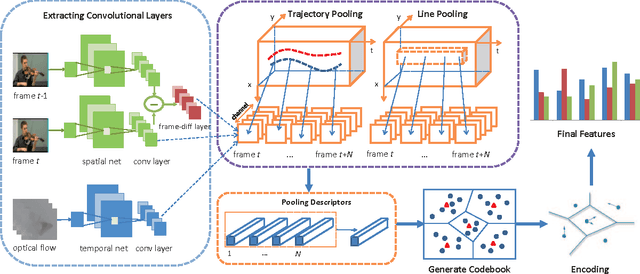
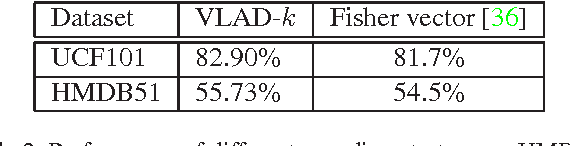
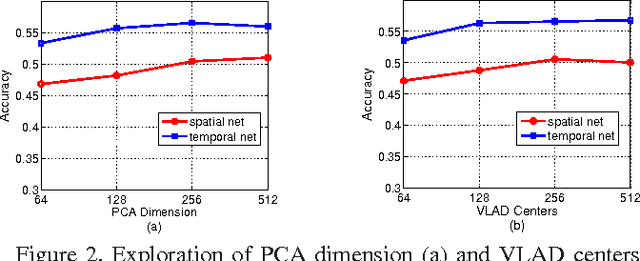
Deep ConvNets have shown its good performance in image classification tasks. However it still remains as a problem in deep video representation for action recognition. The problem comes from two aspects: on one hand, current video ConvNets are relatively shallow compared with image ConvNets, which limits its capability of capturing the complex video action information; on the other hand, temporal information of videos is not properly utilized to pool and encode the video sequences. Towards these issues, in this paper, we utilize two state-of-the-art ConvNets, i.e., the very deep spatial net (VGGNet) and the temporal net from Two-Stream ConvNets, for action representation. The convolutional layers and the proposed new layer, called frame-diff layer, are extracted and pooled with two temporal pooling strategy: Trajectory pooling and line pooling. The pooled local descriptors are then encoded with VLAD to form the video representations. In order to verify the effectiveness of the proposed framework, we conduct experiments on UCF101 and HMDB51 datasets. It achieves the accuracy of 93.78\% on UCF101 which is the state-of-the-art and the accuracy of 65.62\% on HMDB51 which is comparable to the state-of-the-art.