 Add to Chrome
 Add to Firefox
 Add to Edge
PosSAM: Panoptic Open-vocabulary Segment Anything
Mar 14, 2024
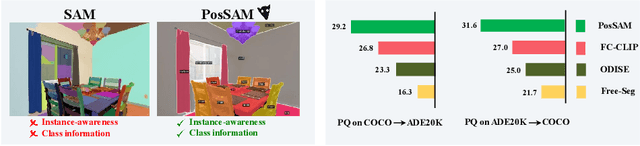


In this paper, we introduce an open-vocabulary panoptic segmentation model that effectively unifies the strengths of the Segment Anything Model (SAM) with the vision-language CLIP model in an end-to-end framework. While SAM excels in generating spatially-aware masks, it's decoder falls short in recognizing object class information and tends to oversegment without additional guidance. Existing approaches address this limitation by using multi-stage techniques and employing separate models to generate class-aware prompts, such as bounding boxes or segmentation masks. Our proposed method, PosSAM is an end-to-end model which leverages SAM's spatially rich features to produce instance-aware masks and harnesses CLIP's semantically discriminative features for effective instance classification. Specifically, we address the limitations of SAM and propose a novel Local Discriminative Pooling (LDP) module leveraging class-agnostic SAM and class-aware CLIP features for unbiased open-vocabulary classification. Furthermore, we introduce a Mask-Aware Selective Ensembling (MASE) algorithm that adaptively enhances the quality of generated masks and boosts the performance of open-vocabulary classification during inference for each image. We conducted extensive experiments to demonstrate our methods strong generalization properties across multiple datasets, achieving state-of-the-art performance with substantial improvements over SOTA open-vocabulary panoptic segmentation methods. In both COCO to ADE20K and ADE20K to COCO settings, PosSAM outperforms the previous state-of-the-art methods by a large margin, 2.4 PQ and 4.6 PQ, respectively. Project Website: https://vibashan.github.io/possam-web/.

Neural Mesh Fusion: Unsupervised 3D Planar Surface Understanding
Feb 26, 2024
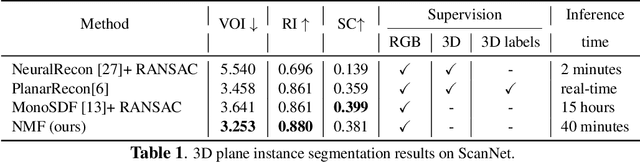
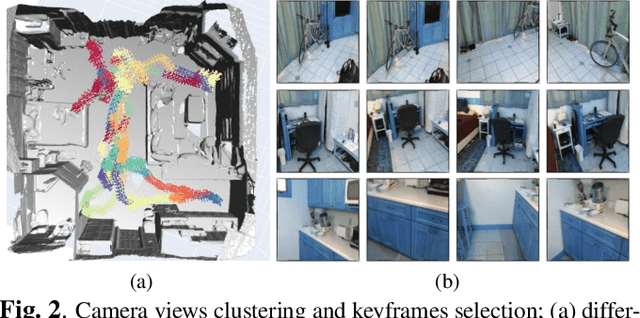
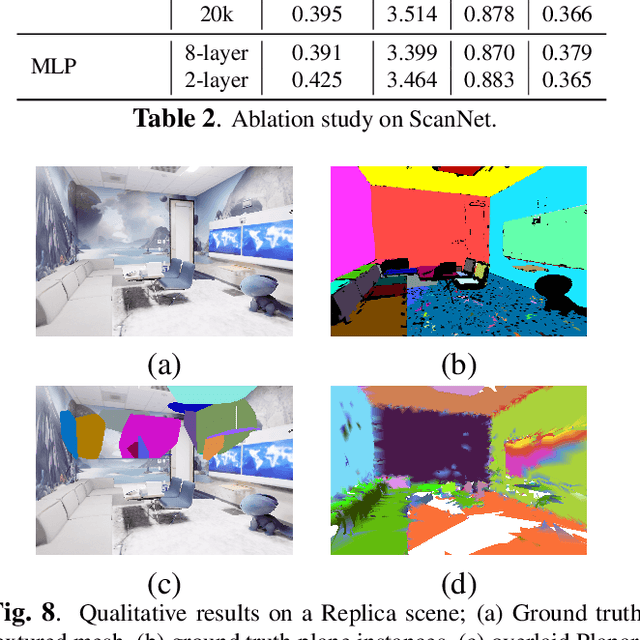
This paper presents Neural Mesh Fusion (NMF), an efficient approach for joint optimization of polygon mesh from multi-view image observations and unsupervised 3D planar-surface parsing of the scene. In contrast to implicit neural representations, NMF directly learns to deform surface triangle mesh and generate an embedding for unsupervised 3D planar segmentation through gradient-based optimization directly on the surface mesh. The conducted experiments show that NMF obtains competitive results compared to state-of-the-art multi-view planar reconstruction, while not requiring any ground-truth 3D or planar supervision. Moreover, NMF is significantly more computationally efficient compared to implicit neural rendering-based scene reconstruction approaches.
Neural 5G Indoor Localization with IMU Supervision
Feb 15, 2024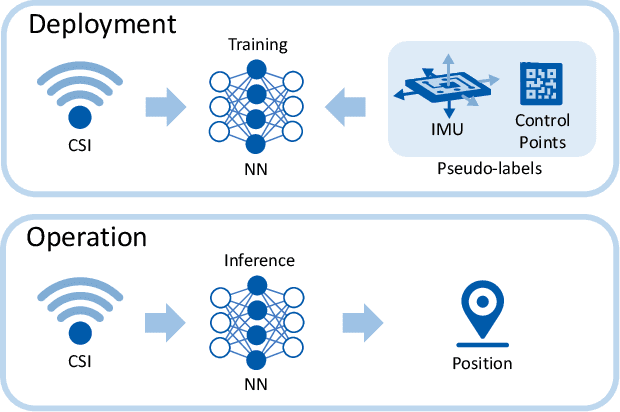
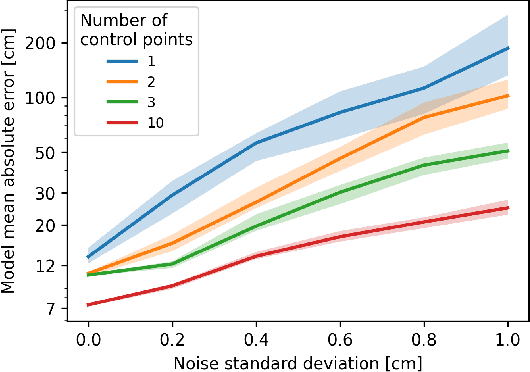


Radio signals are well suited for user localization because they are ubiquitous, can operate in the dark and maintain privacy. Many prior works learn mappings between channel state information (CSI) and position fully-supervised. However, that approach relies on position labels which are very expensive to acquire. In this work, this requirement is relaxed by using pseudo-labels during deployment, which are calculated from an inertial measurement unit (IMU). We propose practical algorithms for IMU double integration and training of the localization system. We show decimeter-level accuracy on simulated and challenging real data of 5G measurements. Our IMU-supervised method performs similarly to fully-supervised, but requires much less effort to deploy.
HexaGen3D: StableDiffusion is just one step away from Fast and Diverse Text-to-3D Generation
Jan 15, 2024Despite the latest remarkable advances in generative modeling, efficient generation of high-quality 3D assets from textual prompts remains a difficult task. A key challenge lies in data scarcity: the most extensive 3D datasets encompass merely millions of assets, while their 2D counterparts contain billions of text-image pairs. To address this, we propose a novel approach which harnesses the power of large, pretrained 2D diffusion models. More specifically, our approach, HexaGen3D, fine-tunes a pretrained text-to-image model to jointly predict 6 orthographic projections and the corresponding latent triplane. We then decode these latents to generate a textured mesh. HexaGen3D does not require per-sample optimization, and can infer high-quality and diverse objects from textual prompts in 7 seconds, offering significantly better quality-to-latency trade-offs when comparing to existing approaches. Furthermore, HexaGen3D demonstrates strong generalization to new objects or compositions.
Object-Centric Diffusion for Efficient Video Editing
Jan 11, 2024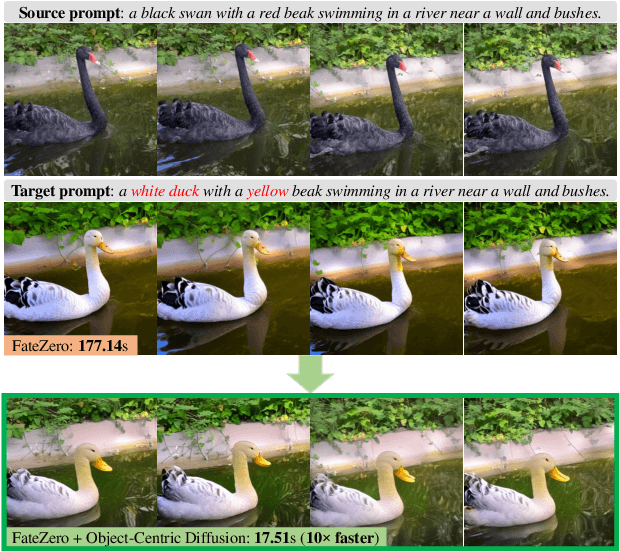
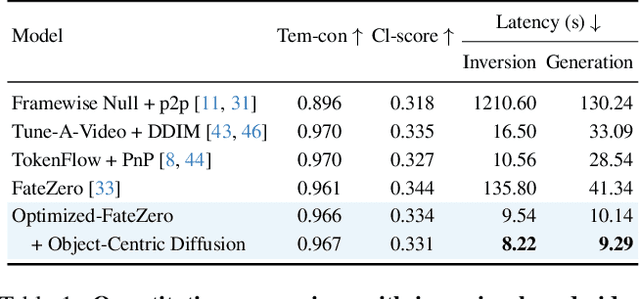
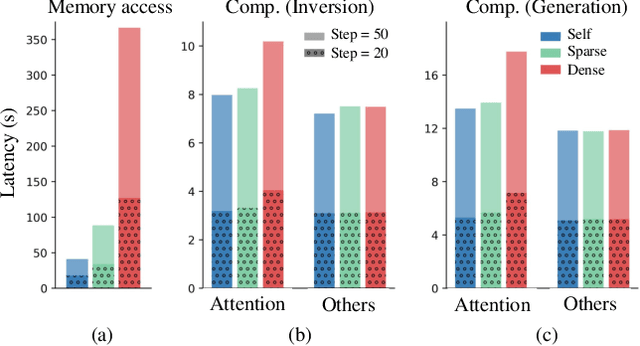
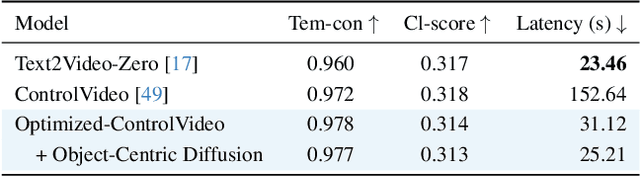
Diffusion-based video editing have reached impressive quality and can transform either the global style, local structure, and attributes of given video inputs, following textual edit prompts. However, such solutions typically incur heavy memory and computational costs to generate temporally-coherent frames, either in the form of diffusion inversion and/or cross-frame attention. In this paper, we conduct an analysis of such inefficiencies, and suggest simple yet effective modifications that allow significant speed-ups whilst maintaining quality. Moreover, we introduce Object-Centric Diffusion, coined as OCD, to further reduce latency by allocating computations more towards foreground edited regions that are arguably more important for perceptual quality. We achieve this by two novel proposals: i) Object-Centric Sampling, decoupling the diffusion steps spent on salient regions or background, allocating most of the model capacity to the former, and ii) Object-Centric 3D Token Merging, which reduces cost of cross-frame attention by fusing redundant tokens in unimportant background regions. Both techniques are readily applicable to a given video editing model \textit{without} retraining, and can drastically reduce its memory and computational cost. We evaluate our proposals on inversion-based and control-signal-based editing pipelines, and show a latency reduction up to 10x for a comparable synthesis quality.
Clockwork Diffusion: Efficient Generation With Model-Step Distillation
Dec 13, 2023
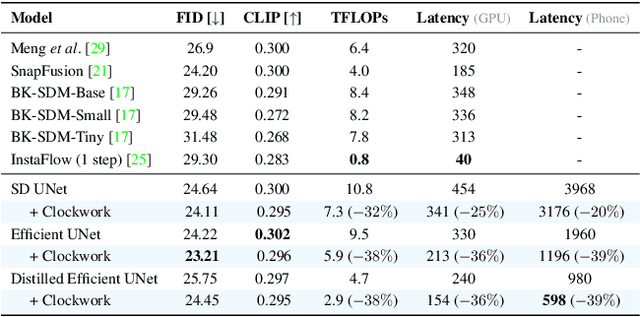
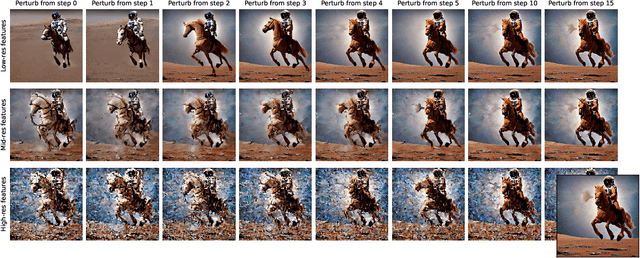
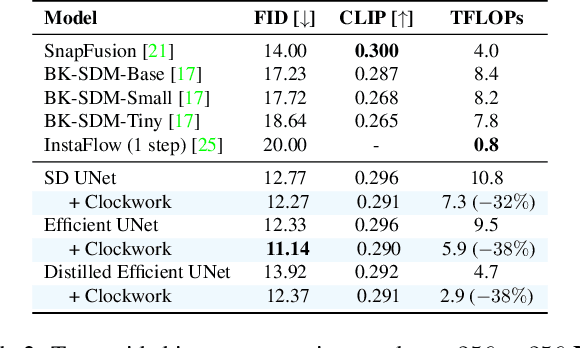
This work aims to improve the efficiency of text-to-image diffusion models. While diffusion models use computationally expensive UNet-based denoising operations in every generation step, we identify that not all operations are equally relevant for the final output quality. In particular, we observe that UNet layers operating on high-res feature maps are relatively sensitive to small perturbations. In contrast, low-res feature maps influence the semantic layout of the final image and can often be perturbed with no noticeable change in the output. Based on this observation, we propose Clockwork Diffusion, a method that periodically reuses computation from preceding denoising steps to approximate low-res feature maps at one or more subsequent steps. For multiple baselines, and for both text-to-image generation and image editing, we demonstrate that Clockwork leads to comparable or improved perceptual scores with drastically reduced computational complexity. As an example, for Stable Diffusion v1.5 with 8 DPM++ steps we save 32% of FLOPs with negligible FID and CLIP change.
Efficient neural supersampling on a novel gaming dataset
Aug 03, 2023Real-time rendering for video games has become increasingly challenging due to the need for higher resolutions, framerates and photorealism. Supersampling has emerged as an effective solution to address this challenge. Our work introduces a novel neural algorithm for supersampling rendered content that is 4 times more efficient than existing methods while maintaining the same level of accuracy. Additionally, we introduce a new dataset which provides auxiliary modalities such as motion vectors and depth generated using graphics rendering features like viewport jittering and mipmap biasing at different resolutions. We believe that this dataset fills a gap in the current dataset landscape and can serve as a valuable resource to help measure progress in the field and advance the state-of-the-art in super-resolution techniques for gaming content.
MAMo: Leveraging Memory and Attention for Monocular Video Depth Estimation
Jul 26, 2023We propose MAMo, a novel memory and attention frame-work for monocular video depth estimation. MAMo can augment and improve any single-image depth estimation networks into video depth estimation models, enabling them to take advantage of the temporal information to predict more accurate depth. In MAMo, we augment model with memory which aids the depth prediction as the model streams through the video. Specifically, the memory stores learned visual and displacement tokens of the previous time instances. This allows the depth network to cross-reference relevant features from the past when predicting depth on the current frame. We introduce a novel scheme to continuously update the memory, optimizing it to keep tokens that correspond with both the past and the present visual information. We adopt attention-based approach to process memory features where we first learn the spatio-temporal relation among the resultant visual and displacement memory tokens using self-attention module. Further, the output features of self-attention are aggregated with the current visual features through cross-attention. The cross-attended features are finally given to a decoder to predict depth on the current frame. Through extensive experiments on several benchmarks, including KITTI, NYU-Depth V2, and DDAD, we show that MAMo consistently improves monocular depth estimation networks and sets new state-of-the-art (SOTA) accuracy. Notably, our MAMo video depth estimation provides higher accuracy with lower latency, when omparing to SOTA cost-volume-based video depth models.
DIFT: Dynamic Iterative Field Transforms for Memory Efficient Optical Flow
Jun 09, 2023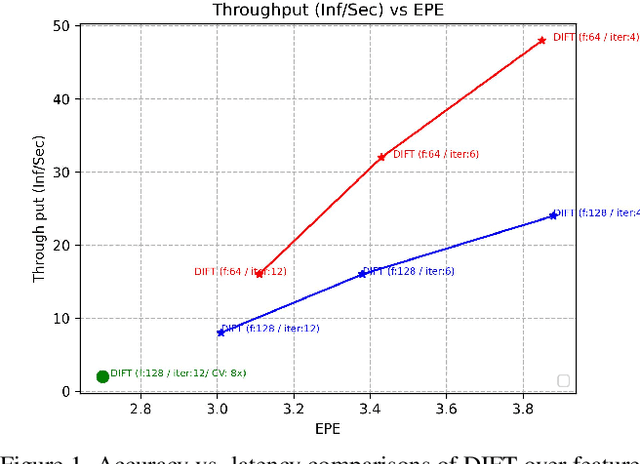
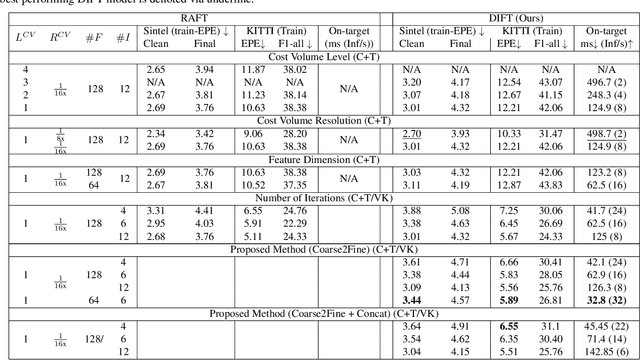
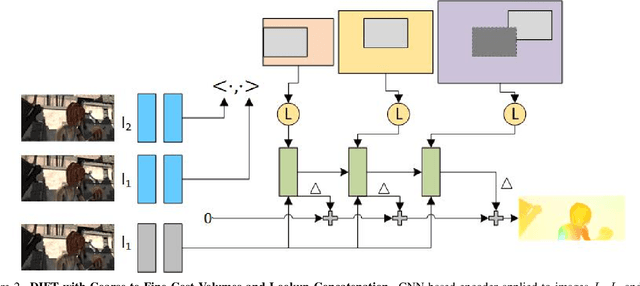
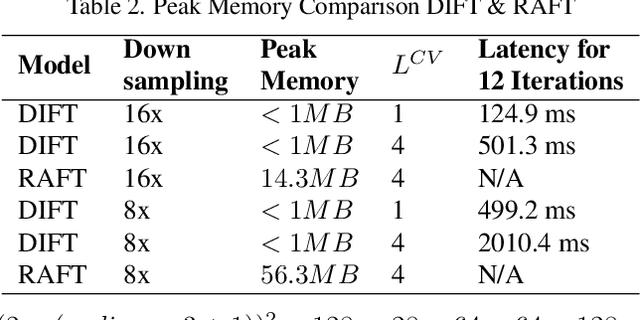
Recent advancements in neural network-based optical flow estimation often come with prohibitively high computational and memory requirements, presenting challenges in their model adaptation for mobile and low-power use cases. In this paper, we introduce a lightweight low-latency and memory-efficient model, Dynamic Iterative Field Transforms (DIFT), for optical flow estimation feasible for edge applications such as mobile, XR, micro UAVs, robotics and cameras. DIFT follows an iterative refinement framework leveraging variable resolution of cost volumes for correspondence estimation. We propose a memory efficient solution for cost volume processing to reduce peak memory. Also, we present a novel dynamic coarse-to-fine cost volume processing during various stages of refinement to avoid multiple levels of cost volumes. We demonstrate first real-time cost-volume based optical flow DL architecture on Snapdragon 8 Gen 1 HTP efficient mobile AI accelerator with 32 inf/sec and 5.89 EPE (endpoint error) on KITTI with manageable accuracy-performance tradeoffs.
X-Align++: cross-modal cross-view alignment for Bird's-eye-view segmentation
Jun 06, 2023Bird's-eye-view (BEV) grid is a typical representation of the perception of road components, e.g., drivable area, in autonomous driving. Most existing approaches rely on cameras only to perform segmentation in BEV space, which is fundamentally constrained by the absence of reliable depth information. The latest works leverage both camera and LiDAR modalities but suboptimally fuse their features using simple, concatenation-based mechanisms. In this paper, we address these problems by enhancing the alignment of the unimodal features in order to aid feature fusion, as well as enhancing the alignment between the cameras' perspective view (PV) and BEV representations. We propose X-Align, a novel end-to-end cross-modal and cross-view learning framework for BEV segmentation consisting of the following components: (i) a novel Cross-Modal Feature Alignment (X-FA) loss, (ii) an attention-based Cross-Modal Feature Fusion (X-FF) module to align multi-modal BEV features implicitly, and (iii) an auxiliary PV segmentation branch with Cross-View Segmentation Alignment (X-SA) losses to improve the PV-to-BEV transformation. We evaluate our proposed method across two commonly used benchmark datasets, i.e., nuScenes and KITTI-360. Notably, X-Align significantly outperforms the state-of-the-art by 3 absolute mIoU points on nuScenes. We also provide extensive ablation studies to demonstrate the effectiveness of the individual components.