 Add to Chrome
 Add to Firefox
 Add to Edge
ForeSea: AI Forensic Search with Multi-modal Queries for Video Surveillance
Mar 24, 2026
Despite decades of work, surveillance still struggles to find specific targets across long, multi-camera video. Prior methods -- tracking pipelines, CLIP based models, and VideoRAG -- require heavy manual filtering, capture only shallow attributes, and fail at temporal reasoning. Real-world searches are inherently multimodal (e.g., "When does this person join the fight?" with the person's image), yet this setting remains underexplored. Also, there are no proper benchmarks to evaluate those setting - asking video with multimodal queries. To address this gap, we introduce ForeSeaQA, a new benchmark specifically designed for video QA with image-and-text queries and timestamped annotations of key events. The dataset consists of long-horizon surveillance footage paired with diverse multimodal questions, enabling systematic evaluation of retrieval, temporal grounding, and multimodal reasoning in realistic forensic conditions. Not limited to this benchmark, we propose ForeSea, an AI forensic search system with a 3-stage, plug-and-play pipeline. (1) A tracking module filters irrelevant footage; (2) a multimodal embedding module indexes the remaining clips; and (3) during inference, the system retrieves top-K candidate clips for a Video Large Language Model (VideoLLM) to answer queries and localize events. On ForeSeaQA, ForeSea improves accuracy by 3.5% and temporal IoU by 11.0 over prior VideoRAG models. To our knowledge, ForeSeaQA is the first benchmark to support complex multimodal queries with precise temporal grounding, and ForeSea is the first VideoRAG system built to excel in this setting.

Concept-Aware LoRA for Domain-Aligned Segmentation Dataset Generation
Mar 28, 2025This paper addresses the challenge of data scarcity in semantic segmentation by generating datasets through text-to-image (T2I) generation models, reducing image acquisition and labeling costs. Segmentation dataset generation faces two key challenges: 1) aligning generated samples with the target domain and 2) producing informative samples beyond the training data. Fine-tuning T2I models can help generate samples aligned with the target domain. However, it often overfits and memorizes training data, limiting their ability to generate diverse and well-aligned samples. To overcome these issues, we propose Concept-Aware LoRA (CA-LoRA), a novel fine-tuning approach that selectively identifies and updates only the weights associated with necessary concepts (e.g., style or viewpoint) for domain alignment while preserving the pretrained knowledge of the T2I model to produce informative samples. We demonstrate its effectiveness in generating datasets for urban-scene segmentation, outperforming baseline and state-of-the-art methods in in-domain (few-shot and fully-supervised) settings, as well as in domain generalization tasks, especially under challenging conditions such as adverse weather and varying illumination, further highlighting its superiority.
SubZero: Composing Subject, Style, and Action via Zero-Shot Personalization
Feb 27, 2025Diffusion models are increasingly popular for generative tasks, including personalized composition of subjects and styles. While diffusion models can generate user-specified subjects performing text-guided actions in custom styles, they require fine-tuning and are not feasible for personalization on mobile devices. Hence, tuning-free personalization methods such as IP-Adapters have progressively gained traction. However, for the composition of subjects and styles, these works are less flexible due to their reliance on ControlNet, or show content and style leakage artifacts. To tackle these, we present SubZero, a novel framework to generate any subject in any style, performing any action without the need for fine-tuning. We propose a novel set of constraints to enhance subject and style similarity, while reducing leakage. Additionally, we propose an orthogonalized temporal aggregation scheme in the cross-attention blocks of denoising model, effectively conditioning on a text prompt along with single subject and style images. We also propose a novel method to train customized content and style projectors to reduce content and style leakage. Through extensive experiments, we show that our proposed approach, while suitable for running on-edge, shows significant improvements over state-of-the-art works performing subject, style and action composition.
PosSAM: Panoptic Open-vocabulary Segment Anything
Mar 14, 2024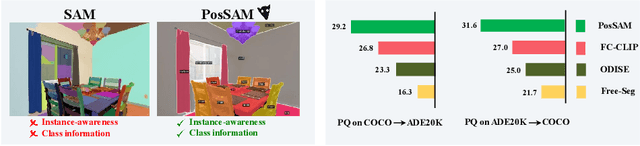


In this paper, we introduce an open-vocabulary panoptic segmentation model that effectively unifies the strengths of the Segment Anything Model (SAM) with the vision-language CLIP model in an end-to-end framework. While SAM excels in generating spatially-aware masks, it's decoder falls short in recognizing object class information and tends to oversegment without additional guidance. Existing approaches address this limitation by using multi-stage techniques and employing separate models to generate class-aware prompts, such as bounding boxes or segmentation masks. Our proposed method, PosSAM is an end-to-end model which leverages SAM's spatially rich features to produce instance-aware masks and harnesses CLIP's semantically discriminative features for effective instance classification. Specifically, we address the limitations of SAM and propose a novel Local Discriminative Pooling (LDP) module leveraging class-agnostic SAM and class-aware CLIP features for unbiased open-vocabulary classification. Furthermore, we introduce a Mask-Aware Selective Ensembling (MASE) algorithm that adaptively enhances the quality of generated masks and boosts the performance of open-vocabulary classification during inference for each image. We conducted extensive experiments to demonstrate our methods strong generalization properties across multiple datasets, achieving state-of-the-art performance with substantial improvements over SOTA open-vocabulary panoptic segmentation methods. In both COCO to ADE20K and ADE20K to COCO settings, PosSAM outperforms the previous state-of-the-art methods by a large margin, 2.4 PQ and 4.6 PQ, respectively. Project Website: https://vibashan.github.io/possam-web/.
DejaVu: Conditional Regenerative Learning to Enhance Dense Prediction
Mar 02, 2023We present DejaVu, a novel framework which leverages conditional image regeneration as additional supervision during training to improve deep networks for dense prediction tasks such as segmentation, depth estimation, and surface normal prediction. First, we apply redaction to the input image, which removes certain structural information by sparse sampling or selective frequency removal. Next, we use a conditional regenerator, which takes the redacted image and the dense predictions as inputs, and reconstructs the original image by filling in the missing structural information. In the redacted image, structural attributes like boundaries are broken while semantic context is largely preserved. In order to make the regeneration feasible, the conditional generator will then require the structure information from the other input source, i.e., the dense predictions. As such, by including this conditional regeneration objective during training, DejaVu encourages the base network to learn to embed accurate scene structure in its dense prediction. This leads to more accurate predictions with clearer boundaries and better spatial consistency. When it is feasible to leverage additional computation, DejaVu can be extended to incorporate an attention-based regeneration module within the dense prediction network, which further improves accuracy. Through extensive experiments on multiple dense prediction benchmarks such as Cityscapes, COCO, ADE20K, NYUD-v2, and KITTI, we demonstrate the efficacy of employing DejaVu during training, as it outperforms SOTA methods at no added computation cost.
TransAdapt: A Transformative Framework for Online Test Time Adaptive Semantic Segmentation
Feb 24, 2023Test-time adaptive (TTA) semantic segmentation adapts a source pre-trained image semantic segmentation model to unlabeled batches of target domain test images, different from real-world, where samples arrive one-by-one in an online fashion. To tackle online settings, we propose TransAdapt, a framework that uses transformer and input transformations to improve segmentation performance. Specifically, we pre-train a transformer-based module on a segmentation network that transforms unsupervised segmentation output to a more reliable supervised output, without requiring test-time online training. To also facilitate test-time adaptation, we propose an unsupervised loss based on the transformed input that enforces the model to be invariant and equivariant to photometric and geometric perturbations, respectively. Overall, our framework produces higher quality segmentation masks with up to 17.6% and 2.8% mIOU improvement over no-adaptation and competitive baselines, respectively.
Test-time Adaptation vs. Training-time Generalization: A Case Study in Human Instance Segmentation using Keypoints Estimation
Dec 12, 2022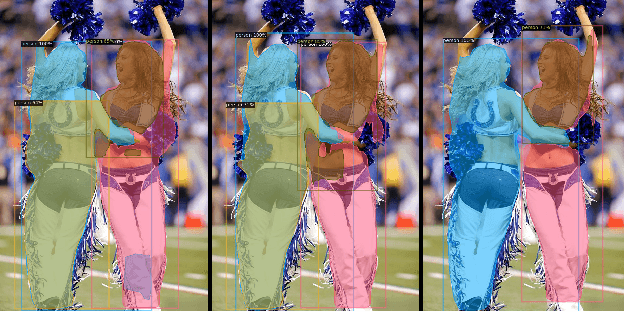
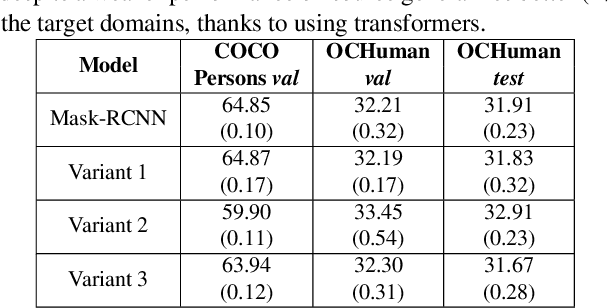
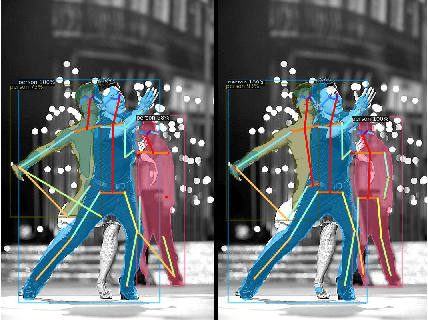
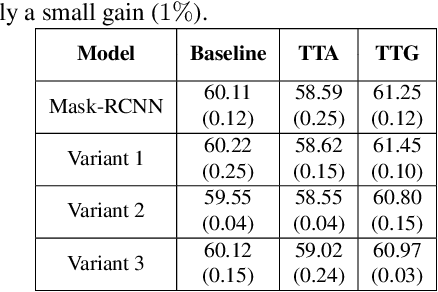
We consider the problem of improving the human instance segmentation mask quality for a given test image using keypoints estimation. We compare two alternative approaches. The first approach is a test-time adaptation (TTA) method, where we allow test-time modification of the segmentation network's weights using a single unlabeled test image. In this approach, we do not assume test-time access to the labeled source dataset. More specifically, our TTA method consists of using the keypoints estimates as pseudo labels and backpropagating them to adjust the backbone weights. The second approach is a training-time generalization (TTG) method, where we permit offline access to the labeled source dataset but not the test-time modification of weights. Furthermore, we do not assume the availability of any images from or knowledge about the target domain. Our TTG method consists of augmenting the backbone features with those generated by the keypoints head and feeding the aggregate vector to the mask head. Through a comprehensive set of ablations, we evaluate both approaches and identify several factors limiting the TTA gains. In particular, we show that in the absence of a significant domain shift, TTA may hurt and TTG show only a small gain in performance, whereas for a large domain shift, TTA gains are smaller and dependent on the heuristics used, while TTG gains are larger and robust to architectural choices.
Panoptic, Instance and Semantic Relations: A Relational Context Encoder to Enhance Panoptic Segmentation
Apr 11, 2022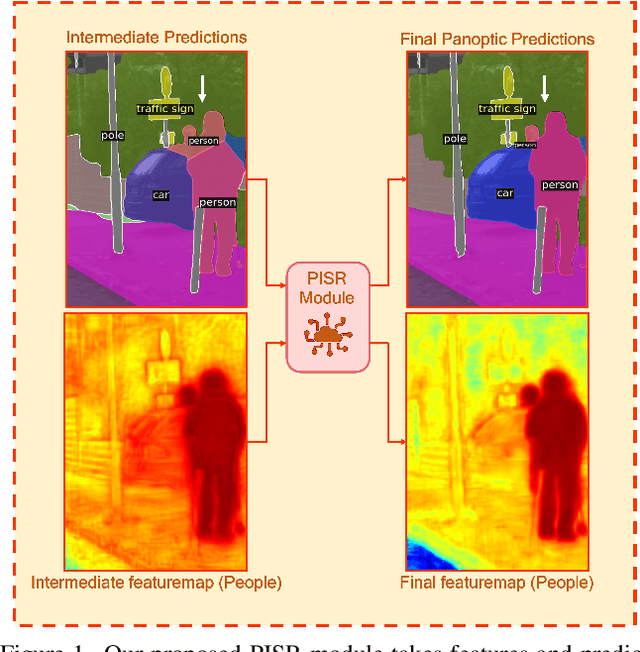
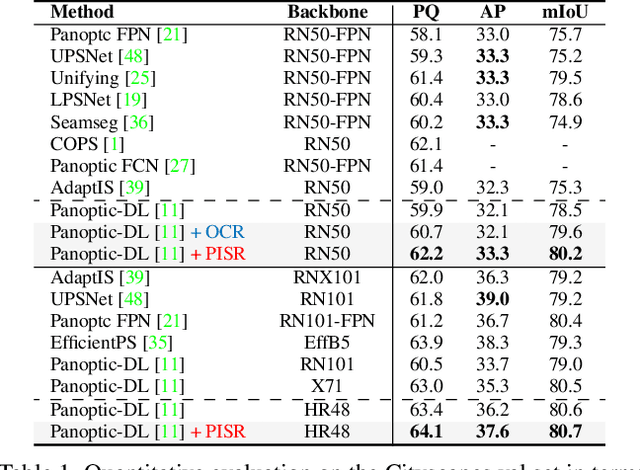
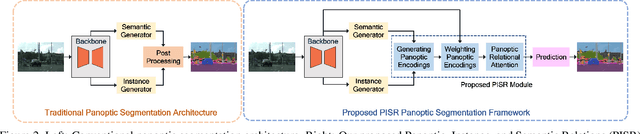
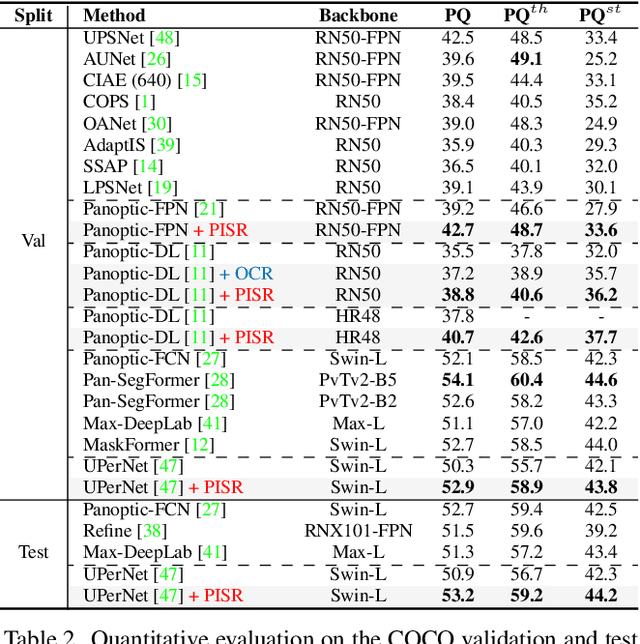
This paper presents a novel framework to integrate both semantic and instance contexts for panoptic segmentation. In existing works, it is common to use a shared backbone to extract features for both things (countable classes such as vehicles) and stuff (uncountable classes such as roads). This, however, fails to capture the rich relations among them, which can be utilized to enhance visual understanding and segmentation performance. To address this shortcoming, we propose a novel Panoptic, Instance, and Semantic Relations (PISR) module to exploit such contexts. First, we generate panoptic encodings to summarize key features of the semantic classes and predicted instances. A Panoptic Relational Attention (PRA) module is then applied to the encodings and the global feature map from the backbone. It produces a feature map that captures 1) the relations across semantic classes and instances and 2) the relations between these panoptic categories and spatial features. PISR also automatically learns to focus on the more important instances, making it robust to the number of instances used in the relational attention module. Moreover, PISR is a general module that can be applied to any existing panoptic segmentation architecture. Through extensive evaluations on panoptic segmentation benchmarks like Cityscapes, COCO, and ADE20K, we show that PISR attains considerable improvements over existing approaches.
Learning Dynamic Network Using a Reuse Gate Function in Semi-supervised Video Object Segmentation
Dec 21, 2020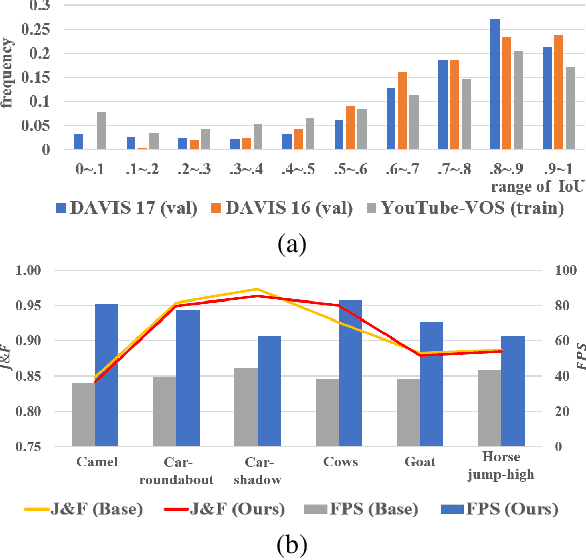
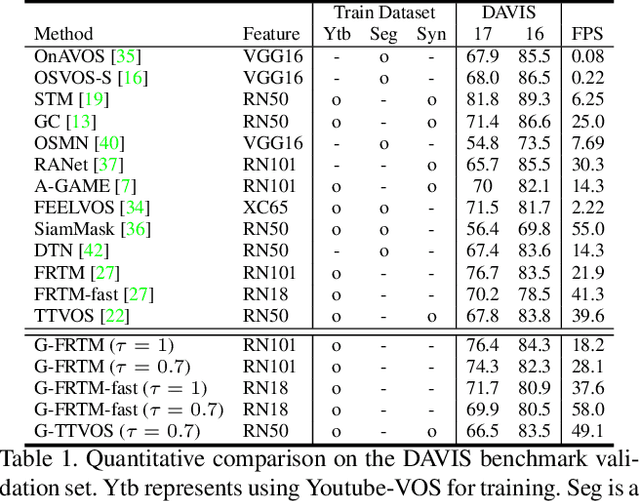
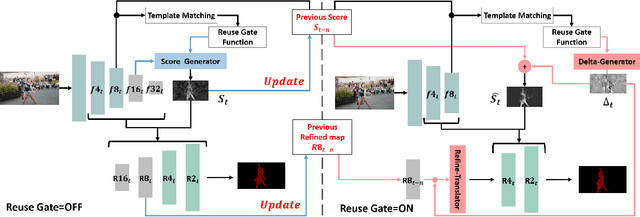
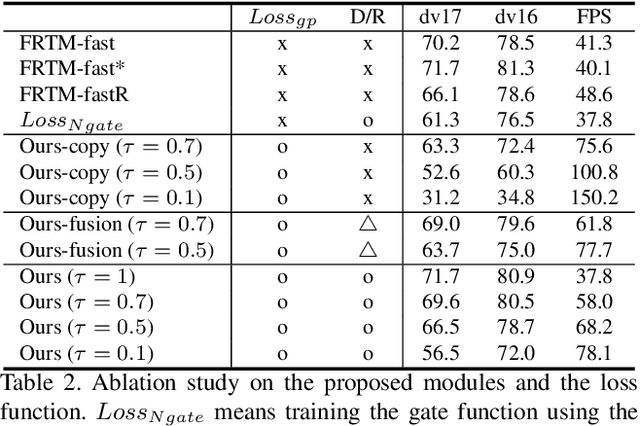
Current state-of-the-art approaches for Semi-supervised Video Object Segmentation (Semi-VOS) propagates information from previous frames to generate segmentation mask for the current frame. This results in high-quality segmentation across challenging scenarios such as changes in appearance and occlusion. But it also leads to unnecessary computations for stationary or slow-moving objects where the change across frames is minimal. In this work, we exploit this observation by using temporal information to quickly identify frames with minimal change and skip the heavyweight mask generation step. To realize this efficiency, we propose a novel dynamic network that estimates change across frames and decides which path -- computing a full network or reusing previous frame's feature -- to choose depending on the expected similarity. Experimental results show that our approach significantly improves inference speed without much accuracy degradation on challenging Semi-VOS datasets -- DAVIS 16, DAVIS 17, and YouTube-VOS. Furthermore, our approach can be applied to multiple Semi-VOS methods demonstrating its generality.
TTVOS: Lightweight Video Object Segmentation with Adaptive Template Attention Module and Temporal Consistency Loss
Nov 09, 2020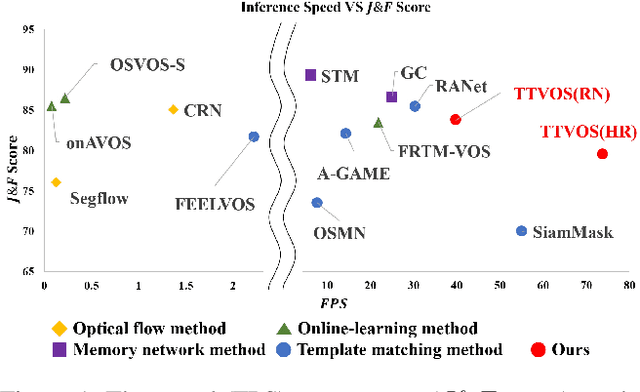
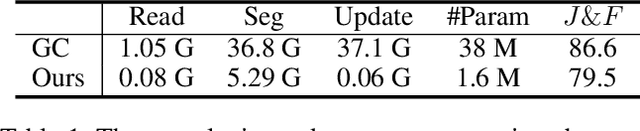
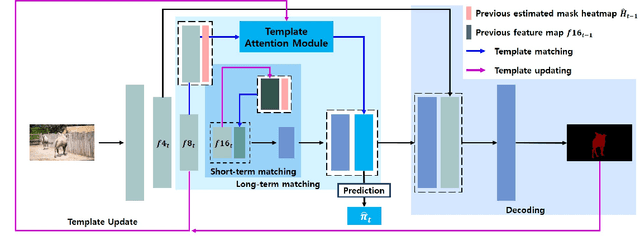
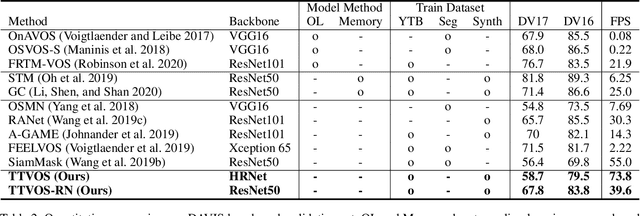
Semi-supervised video object segmentation (semi-VOS) is widely used in many applications. This task is tracking class-agnostic objects by a given segmentation mask. For doing this, various approaches have been developed based on optical flow, online-learning, and memory networks. These methods show high accuracy but are hard to be utilized in real-world applications due to slow inference time and tremendous complexity. To resolve this problem, template matching methods are devised for fast processing speed, sacrificing lots of performance. We introduce a novel semi-VOS model based on a temple matching method and a novel temporal consistency loss to reduce the performance gap from heavy models while expediting inference time a lot. Our temple matching method consists of short-term and long-term matching. The short-term matching enhances target object localization, while long-term matching improves fine details and handles object shape-changing through the newly proposed adaptive template attention module. However, the long-term matching causes error-propagation due to the inflow of the past estimated results when updating the template. To mitigate this problem, we also propose a temporal consistency loss for better temporal coherence between neighboring frames by adopting the concept of a transition matrix. Our model obtains 79.5% J&F score at the speed of 73.8 FPS on the DAVIS16 benchmark.