 Add to Chrome
 Add to Firefox
 Add to Edge
MagnifiQ: Patch-aware Text Guided Progressive Upscaling for High-Resolution Image Restoration
Aug 14, 2026
High-resolution image restoration from degraded inputs is challenging because it must preserve global structural consistency while recovering fine-grained local details, especially at 4K resolution where direct diffusion-based restoration is computationally expensive and prone to repeated or inconsistent textures. In this work, we introduce MagnifiQ, an image restoration framework that progressively upscales and restores images across resolutions, e.g., from 1024x1024 to 4096x4096. Our approach leverages a pre-trained text-to-image diffusion model such as SDXL and adapts it for more scalable high-resolution inference by replacing its original self-attention layers with convolutional operations whose computational cost grows linearly with image resolution. We further propose a progressive upscaling strategy that iteratively restores images over multiple resolution stages, refining each intermediate output rather than directly hallucinating the final 4K image, thereby improving global coherence and reducing high-resolution artifacts. To enhance local details while controlling content drift, MagnifiQ uses patch-specific text prompts that provide spatially localized semantic guidance during restoration. Extensive experiments on synthetic and real-world degraded images show that MagnifiQ outperforms prior diffusion-based restoration methods in perceptual quality and human preference, producing sharper textures and more coherent 4K results while offering practical speed--quality trade-offs through its scalable backbone and progressive design.

Efficient neural supersampling on a novel gaming dataset
Aug 03, 2023Real-time rendering for video games has become increasingly challenging due to the need for higher resolutions, framerates and photorealism. Supersampling has emerged as an effective solution to address this challenge. Our work introduces a novel neural algorithm for supersampling rendered content that is 4 times more efficient than existing methods while maintaining the same level of accuracy. Additionally, we introduce a new dataset which provides auxiliary modalities such as motion vectors and depth generated using graphics rendering features like viewport jittering and mipmap biasing at different resolutions. We believe that this dataset fills a gap in the current dataset landscape and can serve as a valuable resource to help measure progress in the field and advance the state-of-the-art in super-resolution techniques for gaming content.
QuickSRNet: Plain Single-Image Super-Resolution Architecture for Faster Inference on Mobile Platforms
Mar 08, 2023
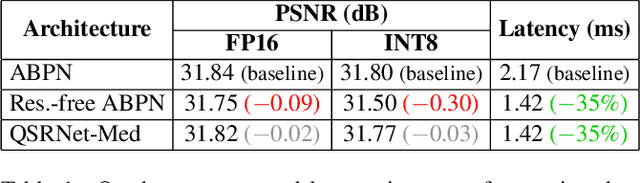

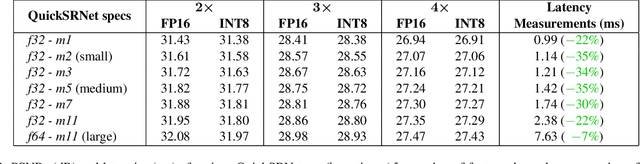
In this work, we present QuickSRNet, an efficient super-resolution architecture for real-time applications on mobile platforms. Super-resolution clarifies, sharpens, and upscales an image to higher resolution. Applications such as gaming and video playback along with the ever-improving display capabilities of TVs, smartphones, and VR headsets are driving the need for efficient upscaling solutions. While existing deep learning-based super-resolution approaches achieve impressive results in terms of visual quality, enabling real-time DL-based super-resolution on mobile devices with compute, thermal, and power constraints is challenging. To address these challenges, we propose QuickSRNet, a simple yet effective architecture that provides better accuracy-to-latency trade-offs than existing neural architectures for single-image super resolution. We present training tricks to speed up existing residual-based super-resolution architectures while maintaining robustness to quantization. Our proposed architecture produces 1080p outputs via 2x upscaling in 2.2 ms on a modern smartphone, making it ideal for high-fps real-time applications.