 Add to Chrome
 Add to Firefox
 Add to Edge
Open-Vocabulary and Referring Segmentation for 3D Gaussians Using 2D Detectors
Jun 29, 2026
3D Gaussian Splatting (3DGS) has emerged at the forefront of 3D scene reconstruction. Extending 3DGS with language-driven, open-vocabulary understanding has gained significant attention for real-world applications such as embodied AI. Recent methods achieve this by learning an instance feature attribute and assigning semantics by distilling high-dimensional Contrastive Language-Image Pretraining (CLIP) features directly into the scene representation. However, the instance grouping mechanisms of these methods either require a predefined number of instances or suffer from noise in their bottom-up grouping strategies. Furthermore, the reliance on CLIP restricts semantic understanding to simple noun phrases, preventing complex spatial reasoning and referential expression grounding. We present GaussDet, a method that circumvents the need for dense CLIP features by leveraging discrete, open-vocabulary 2D object detectors with referring expression capabilities. We learn instance features for individual Gaussians to decompose the scene into 3D instance groups. By rendering these groups and aggregating semantic votes from multi-view 2D detections, we generate a robust View-Aggregated Semantic Label Distribution (VASD) for each 3D instance. This view-aggregation strategy acts as a strong regularizer, attenuating spurious labels caused by low-quality instance grouping. Our approach enables a straightforward, zero-shot extension from simple language queries to complex referential grounding. Extensive evaluations across two key tasks -- open-vocabulary segmentation (LeRF-OVS, ScanNet) and referring expression grounding (Ref-LeRF) -- demonstrate that GaussDet achieves consistent improvements over existing methods. Most notably, we achieve a substantial 16.7% mIoU improvement in referential grounding within a strict zero-shot setting.

Expert Evaluation of Clinical AI Tools on Real Point-of-Care Clinical Queries
Jun 27, 2026Physicians now pose millions of clinical questions to AI tools each week, yet these tools are evaluated largely on hypothetical or exam-style questions, not those actually asked in practice. We report a blinded evaluation built on 620 Real-world Point-Of-Care Queries (Real-POCQi) submitted to the OpenEvidence (OE) platform by physicians spanning 30 specialties, as well as 187 questions from HealthBench. 149 practicing physicians across 36 states made head-to-head comparisons between answers from three frontier general-purpose models (Claude Opus 4.8, Gemini 3.1 Pro, and GPT-5.5) and a specialized clinical tool (OE), with graders matched to each question's specialty. When comparing answers along five dimensions relevant to clinical decision support -- accuracy, clinical utility, source quality, verifiability, & completeness -- physicians scored the specialized tool highest on all axes; in the primary analysis on Real-POCQi, win differences (margins between win and loss rates) ranged from 25 to 39 percentage points (p<0.001). Results remained consistent in sensitivity analyses stratifying by citation display, answer length, OE-user status, and Real-POCQi versus HealthBench. In parallel, LLM judges were found to systematically differ from expert judges, though both generally agreed on the best model. These findings underscore two conclusions: (i) AI tool evaluations should reflect real-world query distributions and use expert judges that mirror the specialization defining modern medicine and (ii) the consistent advantage of the specialized tool over general-purpose models does not necessarily mean that the latter cannot serve similar purposes, but that targeted engineering and customization can yield meaningful gains in performance for its users. We release Real-POCQi as a public benchmark, as well as the prespecified statistical analysis for reproducing results of this study.
3D Consistency Optimization for Self-Supervised Monocular Video Depth Estimation
Jun 14, 2026Reliable monocular video depth estimation is crucial for downstream 3D reasoning and embodied AI in endoscopic navigation. However, existing self-supervised approaches typically treat video frames independently or rely on weak temporal regularization. These methods, lacking a holistic perception of the underlying 3D scene, inevitably suffer from geometrically inconsistent predictions and severe cross-frame drift. To address these limitations, we introduce a new paradigm that recasts sequential video depth estimation as an unconstrained multi-view 3D reconstruction problem, enabling full exploitation of the powerful geometric priors embedded in recent 3D foundation models. The core of our approach is a 3D consistency optimization framework driven by three constraints: image-level photometric rendering, explicit world-coordinate geometric alignment, and multi-scale temporal gradient consistency. Such unified optimization elegantly anchors isolated frames to a globally coherent 3D structure. Our method has been validated in both the self-supervised training scenarios and challenging zero-shot clinical environments. Results show that the proposed approach achieves state-of-the-art spatial accuracy, outperforming the frame-based, video-based depth estimators and the multi-view 3D reconstruction baselines.
GenEyePose: Patient-Free, Knowledge-Based Saccadic Eye Movement Modeling for Digital Neurophysiologic Biomarker Development
Jun 09, 2026Eye movements, including saccades, are widely regarded as highly sensitive and objective biomarkers of neurophysiologic states. Detecting saccadic signatures in neurologic diseases offers a rapid, portable alternative to brain imaging, avoiding access and cost barriers. Currently, there are no robust AI-enabled video-oculographic solutions (e.g., digital biomarkers) for screening, triaging, or localizing brain abnormalities due to privacy issues and scarce datasets. In this work, we propose the first fully synthetic, patient-free, multimodal eye movement generation pipeline for generalizable saccade analysis. Using this synthetic dataset, we trained a deep learning classifier to distinguish between normal and abnormal (hypometria and hypermetria) saccadic accuracies and evaluated its performance on real-world clinical data. The model achieved an AUROC of 0.76 and a sensitivity of 0.71, showing that the synthetic data has strong potential to generalize for clinical applications, including as a screening tool in at-home and emergency room settings or a tool for precise neuroanatomic localization.
PromptPrint: Behavioral Biometrics Through Natural Language Prompting in LLMs
Jun 04, 2026Authorship attribution research has traditionally focused on long-form, expressive texts; however, interactions with large language models (LLMs) are typically brief and task-driven prompts. This raises a fundamental question: do such prompts contain a stable, author-identifiable, and distinctive signal? We introduce PromptPrint, a systematic study of prompt-based identity, the hypothesis that a user's habitual vocabulary, syntax, and discourse patterns form a learnable behavioral biometric. Using 20,680 real prompts from 1,034 users, we establish three key findings. First, lexical representations significantly outperform semantic encoders, supporting the "lexical stability hypothesis": identity is primarily encoded in surface-level word choice rather than abstract intent. Second, stylometric features exhibit a "uniqueness-consistency paradox": users are highly distinctive across the population, yet behaviorally inconsistent across contexts. Third, adversarial analysis reveals a clear vulnerability spectrum: identity signals are robust to minor lexical perturbations but degrade substantially under semantic paraphrasing. Overall, our results demonstrate strong identification performance at scale, establishing prompt-based identity as a viable behavioral biometric. This work introduces a new perspective on user modeling in LLM interactions, with important implications for security and privacy. Data and code will be released upon the acceptance of our work.
PosSAM: Panoptic Open-vocabulary Segment Anything
Mar 14, 2024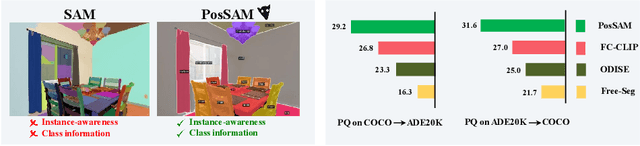


In this paper, we introduce an open-vocabulary panoptic segmentation model that effectively unifies the strengths of the Segment Anything Model (SAM) with the vision-language CLIP model in an end-to-end framework. While SAM excels in generating spatially-aware masks, it's decoder falls short in recognizing object class information and tends to oversegment without additional guidance. Existing approaches address this limitation by using multi-stage techniques and employing separate models to generate class-aware prompts, such as bounding boxes or segmentation masks. Our proposed method, PosSAM is an end-to-end model which leverages SAM's spatially rich features to produce instance-aware masks and harnesses CLIP's semantically discriminative features for effective instance classification. Specifically, we address the limitations of SAM and propose a novel Local Discriminative Pooling (LDP) module leveraging class-agnostic SAM and class-aware CLIP features for unbiased open-vocabulary classification. Furthermore, we introduce a Mask-Aware Selective Ensembling (MASE) algorithm that adaptively enhances the quality of generated masks and boosts the performance of open-vocabulary classification during inference for each image. We conducted extensive experiments to demonstrate our methods strong generalization properties across multiple datasets, achieving state-of-the-art performance with substantial improvements over SOTA open-vocabulary panoptic segmentation methods. In both COCO to ADE20K and ADE20K to COCO settings, PosSAM outperforms the previous state-of-the-art methods by a large margin, 2.4 PQ and 4.6 PQ, respectively. Project Website: https://vibashan.github.io/possam-web/.
Self-Supervised MRI Reconstruction with Unrolled Diffusion Models
Jun 29, 2023Magnetic Resonance Imaging (MRI) produces excellent soft tissue contrast, albeit it is an inherently slow imaging modality. Promising deep learning methods have recently been proposed to reconstruct accelerated MRI scans. However, existing methods still suffer from various limitations regarding image fidelity, contextual sensitivity, and reliance on fully-sampled acquisitions for model training. To comprehensively address these limitations, we propose a novel self-supervised deep reconstruction model, named Self-Supervised Diffusion Reconstruction (SSDiffRecon). SSDiffRecon expresses a conditional diffusion process as an unrolled architecture that interleaves cross-attention transformers for reverse diffusion steps with data-consistency blocks for physics-driven processing. Unlike recent diffusion methods for MRI reconstruction, a self-supervision strategy is adopted to train SSDiffRecon using only undersampled k-space data. Comprehensive experiments on public brain MR datasets demonstrates the superiority of SSDiffRecon against state-of-the-art supervised, and self-supervised baselines in terms of reconstruction speed and quality. Implementation will be available at https://github.com/yilmazkorkmaz1/SSDiffRecon.
Trends in Workplace Wearable Technologies and Connected-Worker Solutions for Next-Generation Occupational Safety, Health, and Productivity
May 24, 2022The workplace influences the safety, health, and productivity of workers at multiple levels. To protect and promote total worker health, smart hardware, and software tools have emerged for the identification, elimination, substitution, and control of occupational hazards. Wearable devices enable constant monitoring of individual workers and the environment, whereas connected worker solutions provide contextual information and decision support. Here, the recent trends in commercial workplace technologies to monitor and manage occupational risks, injuries, accidents, and diseases are reviewed. Workplace safety wearables for safe lifting, ergonomics, hazard identification, sleep monitoring, fatigue management, and heat and cold stress are discussed. Examples of workplace productivity wearables for asset tracking, augmented reality, gesture and motion control, brain wave sensing, and work stress management are given. Workplace health wearables designed for work-related musculoskeletal disorders, functional movement disorders, respiratory hazards, cardiovascular health, outdoor sun exposure, and continuous glucose monitoring are shown. Connected worker platforms are discussed with information about the architecture, system modules, intelligent operations, and industry applications. Predictive analytics provide contextual information about occupational safety risks, resource allocation, equipment failure, and predictive maintenance. Altogether, these examples highlight the ground-level benefits of real-time visibility about frontline workers, work environment, distributed assets, workforce efficiency, and safety compliance
ART-SS: An Adaptive Rejection Technique for Semi-Supervised restoration for adverse weather-affected images
Mar 17, 2022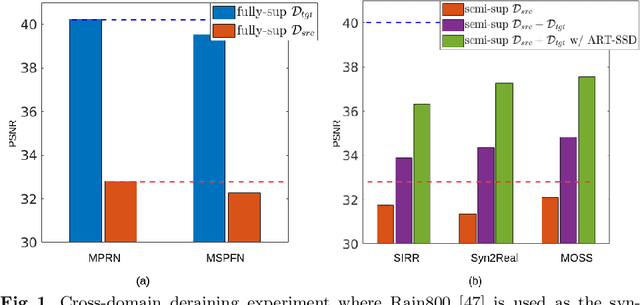
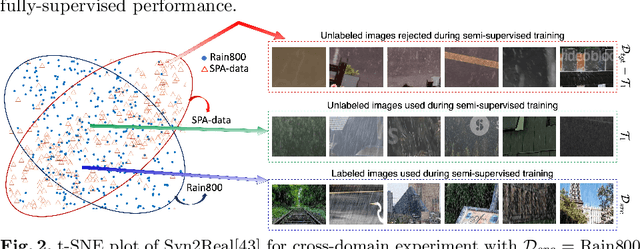

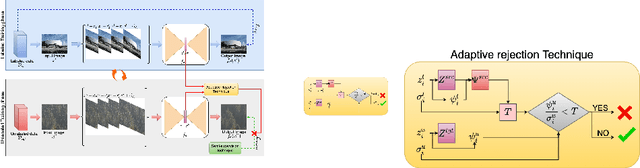
In recent years, convolutional neural network-based single image adverse weather removal methods have achieved significant performance improvements on many benchmark datasets. However, these methods require large amounts of clean-weather degraded image pairs for training, which is often difficult to obtain in practice. Although various weather degradation synthesis methods exist in the literature, the use of synthetically generated weather degraded images often results in sub-optimal performance on the real weather degraded images due to the domain gap between synthetic and real-world images. To deal with this problem, various semi-supervised restoration (SSR) methods have been proposed for deraining or dehazing which learn to restore the clean image using synthetically generated datasets while generalizing better using unlabeled real-world images. The performance of a semi-supervised method is essentially based on the quality of the unlabeled data. In particular, if the unlabeled data characteristics are very different from that of the labeled data, then the performance of a semi-supervised method degrades significantly. We theoretically study the effect of unlabeled data on the performance of an SSR method and develop a technique that rejects the unlabeled images that degrade the performance. Extensive experiments and ablation study show that the proposed sample rejection method increases the performance of existing SSR deraining and dehazing methods significantly. Code is available at :https://github.com/rajeevyasarla/ART-SS
Towards performant and reliable undersampled MR reconstruction via diffusion model sampling
Mar 11, 2022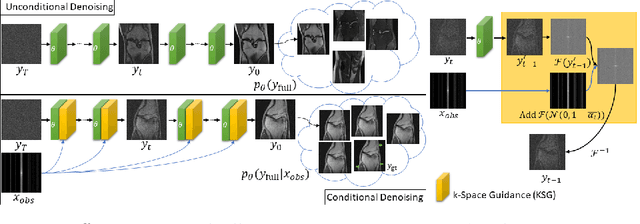
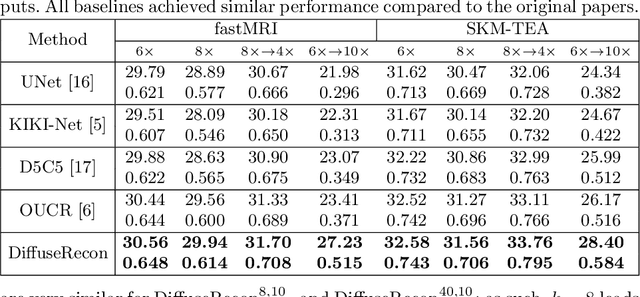
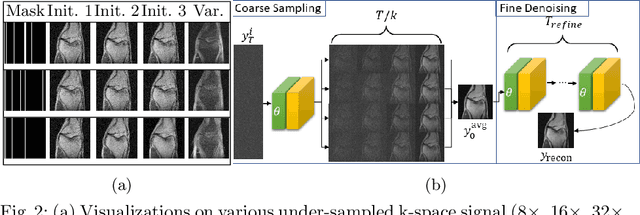
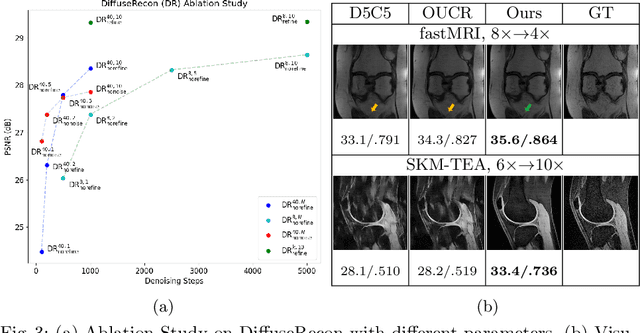
Magnetic Resonance (MR) image reconstruction from under-sampled acquisition promises faster scanning time. To this end, current State-of-The-Art (SoTA) approaches leverage deep neural networks and supervised training to learn a recovery model. While these approaches achieve impressive performances, the learned model can be fragile on unseen degradation, e.g. when given a different acceleration factor. These methods are also generally deterministic and provide a single solution to an ill-posed problem; as such, it can be difficult for practitioners to understand the reliability of the reconstruction. We introduce DiffuseRecon, a novel diffusion model-based MR reconstruction method. DiffuseRecon guides the generation process based on the observed signals and a pre-trained diffusion model, and does not require additional training on specific acceleration factors. DiffuseRecon is stochastic in nature and generates results from a distribution of fully-sampled MR images; as such, it allows us to explicitly visualize different potential reconstruction solutions. Lastly, DiffuseRecon proposes an accelerated, coarse-to-fine Monte-Carlo sampling scheme to approximate the most likely reconstruction candidate. The proposed DiffuseRecon achieves SoTA performances reconstructing from raw acquisition signals in fastMRI and SKM-TEA. Code will be open-sourced at www.github.com/cpeng93/DiffuseRecon.