 Add to Chrome
 Add to Firefox
 Add to Edge
Reasoning or Memorization: Can LLMs Understand and Generate Chinese Xiehouyu Riddles?
Jul 26, 2026
In this paper, we push the boundary of LLM reasoning by testing them in a Chinese language game, xiehouyu, with novel xiehouyu created by linguists that had not existed before to avoid data contamination. We use multiple-choice questions (MCQ), free-form explanation generation, and new xiehouyu creation to evaluate LLMs' ability to understand and create xiehouyu. In MCQ, we use the delta of accuracy ($Δ_{acc}$) between existing but low-frequency xiehouyu and novel ones as an index for memorization. $Δ_{acc}$ for native speakers is very low, suggesting similar processing mechanisms. However, we found that frontier Chinese models have on average a $Δ_{acc}$ of 23.6\%, while English-centric models tested have a mean $Δ_{acc}$ of 5.1\%, suggesting that frontier Chinese models are likely trained with much larger Chinese data, thus memorizing more low-frequency xiehouyu. For novel xiehouyu, Gemini 3.1 Pro demonstrated remarkable ability with acc 92.6, which is 24\% higher than human accuracy. In xiehouyu creation, those created by LLMs receive much worse ratings than those by humans. These results suggest that claims about the reasoning abilities of LLMs may need careful re-examination considering the data contamination issue, and that LLMs' creativity in language-related tasks may still be behind human experts, at least in Chinese xiehouyu.

Denoising-Enhanced YOLO for Robust SAR Ship Detection
Feb 27, 2026With the rapid advancement of deep learning, synthetic aperture radar (SAR) imagery has become a key modality for ship detection. However, robust performance remains challenging in complex scenes, where clutter and speckle noise can induce false alarms and small targets are easily missed. To address these issues, we propose CPN-YOLO, a high-precision ship detection framework built upon YOLOv8 with three targeted improvements. First, we introduce a learnable large-kernel denoising module for input pre-processing, producing cleaner representations and more discriminative features across diverse ship types. Second, we design a feature extraction enhancement strategy based on the PPA attention mechanism to strengthen multi-scale modeling and improve sensitivity to small ships. Third, we incorporate a Gaussian similarity loss derived from the normalized Wasserstein distance (NWD) to better measure similarity under complex bounding-box distributions and improve generalization. Extensive experiments on HRSID and SSDD demonstrate the effectiveness of our method. On SSDD, CPN-YOLO surpasses the YOLOv8 baseline, achieving 97.0% precision, 95.1% recall, and 98.9% mAP, and consistently outperforms other representative deep-learning detectors in overall performance.
Learning to Look at the Other Side: A Semantic Probing Study of Word Embeddings in LLMs with Enabled Bidirectional Attention
Oct 02, 2025Autoregressive Large Language Models (LLMs) demonstrate exceptional performance in language understanding and generation. However, their application in text embedding tasks has been relatively slow, along with the analysis of their semantic representation in probing tasks, due to the constraints of the unidirectional attention mechanism. This paper aims to explore whether such constraints can be overcome by enabling bidirectional attention in LLMs. We tested different variants of the Llama architecture through additional training steps, progressively enabling bidirectional attention and unsupervised/supervised contrastive learning.
ArguGPT: evaluating, understanding and identifying argumentative essays generated by GPT models
Apr 16, 2023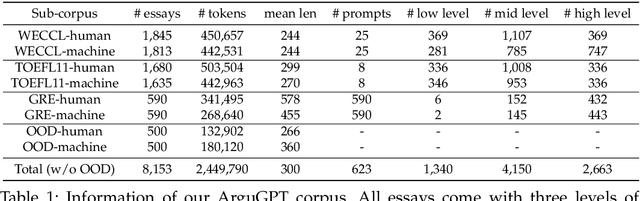
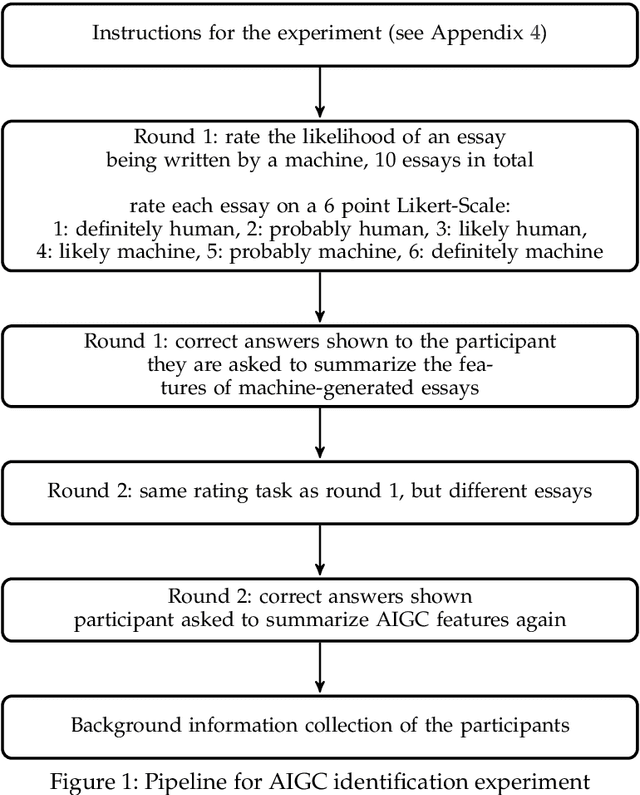
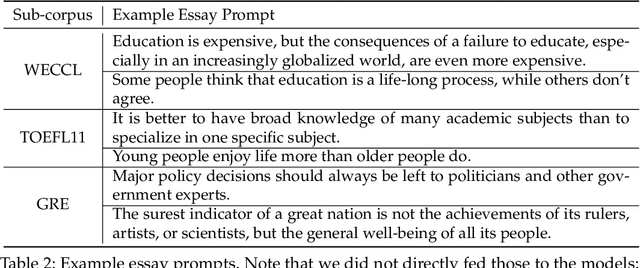
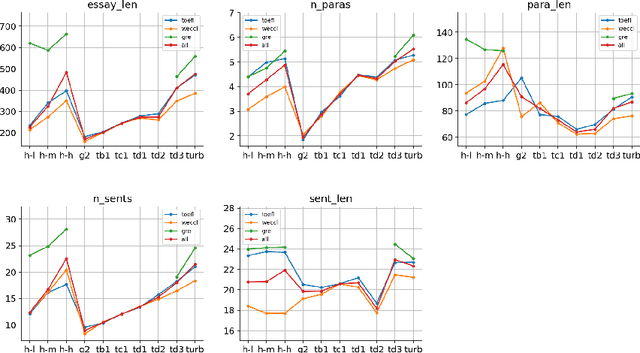
AI generated content (AIGC) presents considerable challenge to educators around the world. Instructors need to be able to detect such text generated by large language models, either with the naked eye or with the help of some tools. There is also growing need to understand the lexical, syntactic and stylistic features of AIGC. To address these challenges in English language teaching, we first present ArguGPT, a balanced corpus of 4,038 argumentative essays generated by 7 GPT models in response to essay prompts from three sources: (1) in-class or homework exercises, (2) TOEFL and (3) GRE writing tasks. Machine-generated texts are paired with roughly equal number of human-written essays with three score levels matched in essay prompts. We then hire English instructors to distinguish machine essays from human ones. Results show that when first exposed to machine-generated essays, the instructors only have an accuracy of 61% in detecting them. But the number rises to 67% after one round of minimal self-training. Next, we perform linguistic analyses of these essays, which show that machines produce sentences with more complex syntactic structures while human essays tend to be lexically more complex. Finally, we test existing AIGC detectors and build our own detectors using SVMs and RoBERTa. Results suggest that a RoBERTa fine-tuned with the training set of ArguGPT achieves above 90% accuracy in both essay- and sentence-level classification. To the best of our knowledge, this is the first comprehensive analysis of argumentative essays produced by generative large language models. Machine-authored essays in ArguGPT and our models will be made publicly available at https://github.com/huhailinguist/ArguGPT