 Add to Chrome
 Add to Firefox
 Add to Edge
Automated Information Flow Selection for Multi-scenario Multi-task Recommendation
Dec 15, 2025
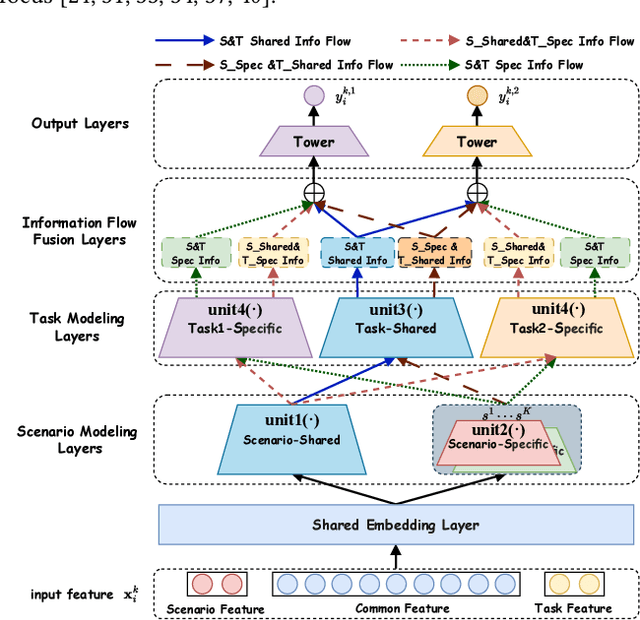
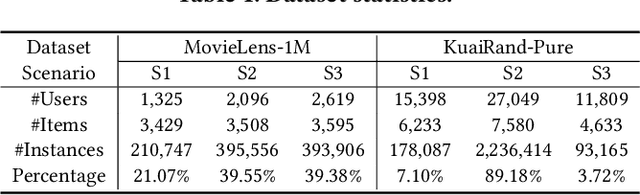
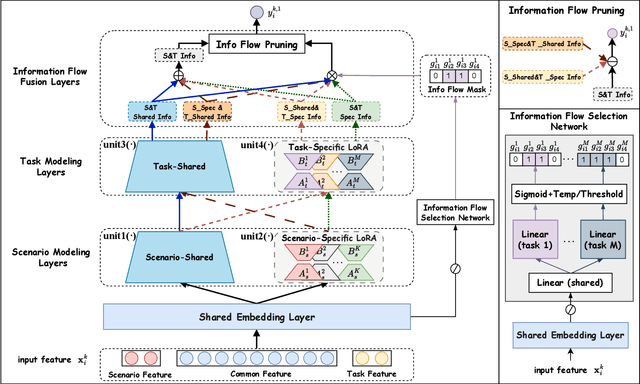
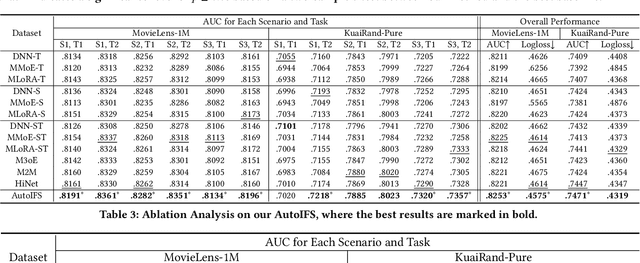
Multi-scenario multi-task recommendation (MSMTR) systems must address recommendation demands across diverse scenarios while simultaneously optimizing multiple objectives, such as click-through rate and conversion rate. Existing MSMTR models typically consist of four information units: scenario-shared, scenario-specific, task-shared, and task-specific networks. These units interact to generate four types of relationship information flows, directed from scenario-shared or scenario-specific networks to task-shared or task-specific networks. However, these models face two main limitations: 1) They often rely on complex architectures, such as mixture-of-experts (MoE) networks, which increase the complexity of information fusion, model size, and training cost. 2) They extract all available information flows without filtering out irrelevant or even harmful content, introducing potential noise. Regarding these challenges, we propose a lightweight Automated Information Flow Selection (AutoIFS) framework for MSMTR. To tackle the first issue, AutoIFS incorporates low-rank adaptation (LoRA) to decouple the four information units, enabling more flexible and efficient information fusion with minimal parameter overhead. To address the second issue, AutoIFS introduces an information flow selection network that automatically filters out invalid scenario-task information flows based on model performance feedback. It employs a simple yet effective pruning function to eliminate useless information flows, thereby enhancing the impact of key relationships and improving model performance. Finally, we evaluate AutoIFS and confirm its effectiveness through extensive experiments on two public benchmark datasets and an online A/B test.

OptMSM: Optimizing Multi-Scenario Modeling for Click-Through Rate Prediction
Jun 23, 2023A large-scale industrial recommendation platform typically consists of multiple associated scenarios, requiring a unified click-through rate (CTR) prediction model to serve them simultaneously. Existing approaches for multi-scenario CTR prediction generally consist of two main modules: i) a scenario-aware learning module that learns a set of multi-functional representations with scenario-shared and scenario-specific information from input features, and ii) a scenario-specific prediction module that serves each scenario based on these representations. However, most of these approaches primarily focus on improving the former module and neglect the latter module. This can result in challenges such as increased model parameter size, training difficulty, and performance bottlenecks for each scenario. To address these issues, we propose a novel framework called OptMSM (\textbf{Opt}imizing \textbf{M}ulti-\textbf{S}cenario \textbf{M}odeling). First, we introduce a simplified yet effective scenario-enhanced learning module to alleviate the aforementioned challenges. Specifically, we partition the input features into scenario-specific and scenario-shared features, which are mapped to specific information embedding encodings and a set of shared information embeddings, respectively. By imposing an orthogonality constraint on the shared information embeddings to facilitate the disentanglement of shared information corresponding to each scenario, we combine them with the specific information embeddings to obtain multi-functional representations. Second, we introduce a scenario-specific hypernetwork in the scenario-specific prediction module to capture interactions within each scenario more effectively, thereby alleviating the performance bottlenecks. Finally, we conduct extensive offline experiments and an online A/B test to demonstrate the effectiveness of OptMSM.