 Add to Chrome
 Add to Firefox
 Add to Edge
GAMEOPT+: Improving Fuel Efficiency in Unregulated Heterogeneous Traffic Intersections via Optimal Multi-agent Cooperative Control
May 26, 2024
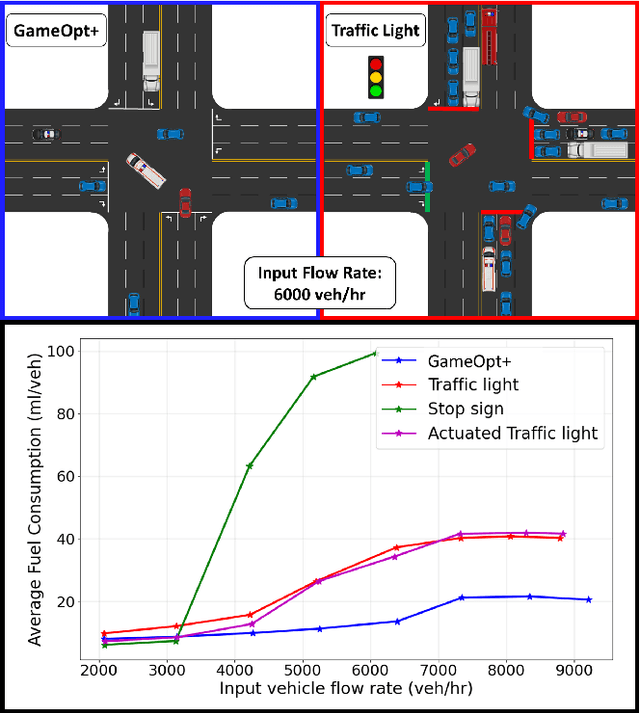
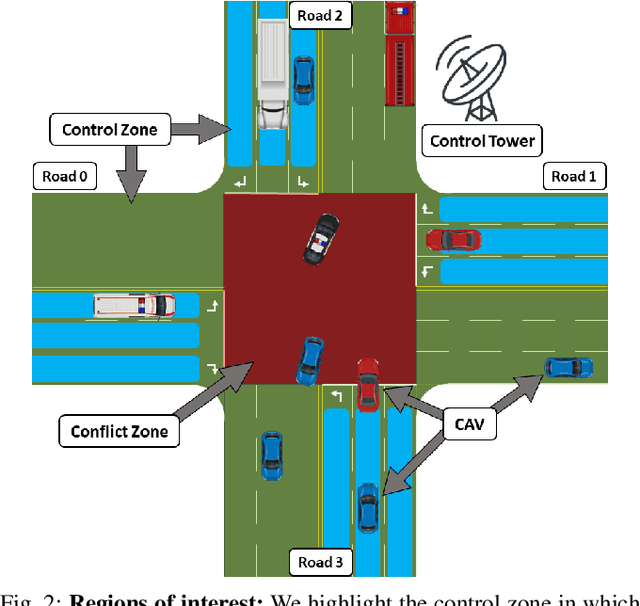
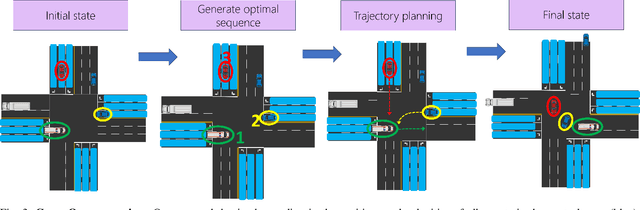
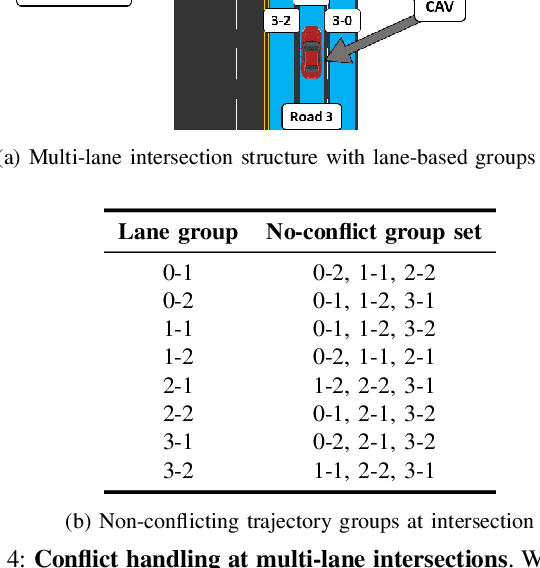
Better fuel efficiency leads to better financial security as well as a cleaner environment. We propose a novel approach for improving fuel efficiency in unstructured and unregulated traffic environments. Existing intelligent transportation solutions for improving fuel efficiency, however, apply only to traffic intersections with sparse traffic or traffic where drivers obey the regulations, or both. We propose GameOpt+, a novel hybrid approach for cooperative intersection control in dynamic, multi-lane, unsignalized intersections. GameOpt+ is a hybrid solution that combines an auction mechanism and an optimization-based trajectory planner. It generates a priority entrance sequence for each agent and computes velocity controls in real-time, taking less than 10 milliseconds even in high-density traffic with over 10,000 vehicles per hour. Compared to fully optimization-based methods, it operates 100 times faster while ensuring fairness, safety, and efficiency. Tested on the SUMO simulator, our algorithm improves throughput by at least 25%, reduces the time to reach the goal by at least 70%, and decreases fuel consumption by 50% compared to auction-based and signaled approaches using traffic lights and stop signs. GameOpt+ is also unaffected by unbalanced traffic inflows, whereas some of the other baselines encountered a decrease in performance in unbalanced traffic inflow environments.

VDGD: Mitigating LVLM Hallucinations in Cognitive Prompts by Bridging the Visual Perception Gap
May 24, 2024Recent interest in Large Vision-Language Models (LVLMs) for practical applications is moderated by the significant challenge of hallucination or the inconsistency between the factual information and the generated text. In this paper, we first perform an in-depth analysis of hallucinations and discover several novel insights about how and when LVLMs hallucinate. From our analysis, we show that: (1) The community's efforts have been primarily targeted towards reducing hallucinations related to visual recognition (VR) prompts (e.g., prompts that only require describing the image), thereby ignoring hallucinations for cognitive prompts (e.g., prompts that require additional skills like reasoning on contents of the image). (2) LVLMs lack visual perception, i.e., they can see but not necessarily understand or perceive the input image. We analyze responses to cognitive prompts and show that LVLMs hallucinate due to a perception gap: although LVLMs accurately recognize visual elements in the input image and possess sufficient cognitive skills, they struggle to respond accurately and hallucinate. To overcome this shortcoming, we propose Visual Description Grounded Decoding (VDGD), a simple, robust, and training-free method for alleviating hallucinations. Specifically, we first describe the image and add it as a prefix to the instruction. Next, during auto-regressive decoding, we sample from the plausible candidates according to their KL-Divergence (KLD) to the description, where lower KLD is given higher preference. Experimental results on several benchmarks and LVLMs show that VDGD improves significantly over other baselines in reducing hallucinations. We also propose VaLLu, a benchmark for the comprehensive evaluation of the cognitive capabilities of LVLMs.
Prompt Mixing in Diffusion Models using the Black Scholes Algorithm
May 22, 2024
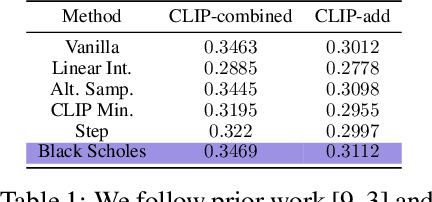


We introduce a novel approach for prompt mixing, aiming to generate images at the intersection of multiple text prompts using pre-trained text-to-image diffusion models. At each time step during diffusion denoising, our algorithm forecasts predictions w.r.t. the generated image and makes informed text conditioning decisions. To do so, we leverage the connection between diffusion models (rooted in non-equilibrium thermodynamics) and the Black-Scholes model for pricing options in Finance, and draw analogies between the variables in both contexts to derive an appropriate algorithm for prompt mixing using the Black Scholes model. Specifically, the parallels between diffusion models and the Black-Scholes model enable us to leverage properties related to the dynamics of the Markovian model derived in the Black-Scholes algorithm. Our prompt-mixing algorithm is data-efficient, meaning it does not need additional training. Furthermore, it operates without human intervention or hyperparameter tuning. We highlight the benefits of our approach by comparing it qualitatively and quantitatively to other prompt mixing techniques, including linear interpolation, alternating prompts, step-wise prompt switching, and CLIP-guided prompt selection across various scenarios such as single object per text prompt, multiple objects per text prompt and objects against backgrounds. Code is available at https://github.com/divyakraman/BlackScholesDiffusion2024.
Text Prompting for Multi-Concept Video Customization by Autoregressive Generation
May 22, 2024We present a method for multi-concept customization of pretrained text-to-video (T2V) models. Intuitively, the multi-concept customized video can be derived from the (non-linear) intersection of the video manifolds of the individual concepts, which is not straightforward to find. We hypothesize that sequential and controlled walking towards the intersection of the video manifolds, directed by text prompting, leads to the solution. To do so, we generate the various concepts and their corresponding interactions, sequentially, in an autoregressive manner. Our method can generate videos of multiple custom concepts (subjects, action and background) such as a teddy bear running towards a brown teapot, a dog playing violin and a teddy bear swimming in the ocean. We quantitatively evaluate our method using videoCLIP and DINO scores, in addition to human evaluation. Videos for results presented in this paper can be found at https://github.com/divyakraman/MultiConceptVideo2024.
LOC-ZSON: Language-driven Object-Centric Zero-Shot Object Retrieval and Navigation
May 08, 2024


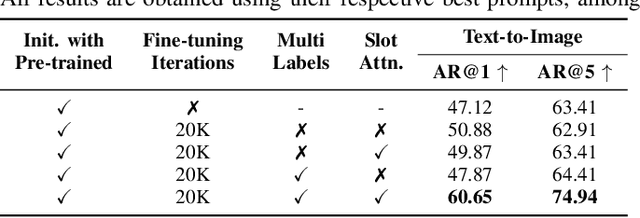
In this paper, we present LOC-ZSON, a novel Language-driven Object-Centric image representation for object navigation task within complex scenes. We propose an object-centric image representation and corresponding losses for visual-language model (VLM) fine-tuning, which can handle complex object-level queries. In addition, we design a novel LLM-based augmentation and prompt templates for stability during training and zero-shot inference. We implement our method on Astro robot and deploy it in both simulated and real-world environments for zero-shot object navigation. We show that our proposed method can achieve an improvement of 1.38 - 13.38% in terms of text-to-image recall on different benchmark settings for the retrieval task. For object navigation, we show the benefit of our approach in simulation and real world, showing 5% and 16.67% improvement in terms of navigation success rate, respectively.
S-EQA: Tackling Situational Queries in Embodied Question Answering
May 08, 2024We present and tackle the problem of Embodied Question Answering (EQA) with Situational Queries (S-EQA) in a household environment. Unlike prior EQA work tackling simple queries that directly reference target objects and quantifiable properties pertaining them, EQA with situational queries (such as "Is the bathroom clean and dry?") is more challenging, as the agent needs to figure out not just what the target objects pertaining to the query are, but also requires a consensus on their states to be answerable. Towards this objective, we first introduce a novel Prompt-Generate-Evaluate (PGE) scheme that wraps around an LLM's output to create a dataset of unique situational queries, corresponding consensus object information, and predicted answers. PGE maintains uniqueness among the generated queries, using multiple forms of semantic similarity. We validate the generated dataset via a large scale user-study conducted on M-Turk, and introduce it as S-EQA, the first dataset tackling EQA with situational queries. Our user study establishes the authenticity of S-EQA with a high 97.26% of the generated queries being deemed answerable, given the consensus object data. Conversely, we observe a low correlation of 46.2% on the LLM-predicted answers to human-evaluated ones; indicating the LLM's poor capability in directly answering situational queries, while establishing S-EQA's usability in providing a human-validated consensus for an indirect solution. We evaluate S-EQA via Visual Question Answering (VQA) on VirtualHome, which unlike other simulators, contains several objects with modifiable states that also visually appear different upon modification -- enabling us to set a quantitative benchmark for S-EQA. To the best of our knowledge, this is the first work to introduce EQA with situational queries, and also the first to use a generative approach for query creation.
TK-Planes: Tiered K-Planes with High Dimensional Feature Vectors for Dynamic UAV-based Scenes
May 04, 2024In this paper, we present a new approach to bridge the domain gap between synthetic and real-world data for un- manned aerial vehicle (UAV)-based perception. Our formu- lation is designed for dynamic scenes, consisting of moving objects or human actions, where the goal is to recognize the pose or actions. We propose an extension of K-Planes Neural Radiance Field (NeRF), wherein our algorithm stores a set of tiered feature vectors. The tiered feature vectors are generated to effectively model conceptual information about a scene as well as an image decoder that transforms output feature maps into RGB images. Our technique leverages the information amongst both static and dynamic objects within a scene and is able to capture salient scene attributes of high altitude videos. We evaluate its performance on challenging datasets, including Okutama Action and UG2, and observe considerable improvement in accuracy over state of the art aerial perception algorithms.
"Don't forget to put the milk back!" Dataset for Enabling Embodied Agents to Detect Anomalous Situations
Apr 12, 2024Home robots intend to make their users lives easier. Our work assists in this goal by enabling robots to inform their users of dangerous or unsanitary anomalies in their home. Some examples of these anomalies include the user leaving their milk out, forgetting to turn off the stove, or leaving poison accessible to children. To move towards enabling home robots with these abilities, we have created a new dataset, which we call SafetyDetect. The SafetyDetect dataset consists of 1000 anomalous home scenes, each of which contains unsafe or unsanitary situations for an agent to detect. Our approach utilizes large language models (LLMs) alongside both a graph representation of the scene and the relationships between the objects in the scene. Our key insight is that this connected scene graph and the object relationships it encodes enables the LLM to better reason about the scene -- especially as it relates to detecting dangerous or unsanitary situations. Our most promising approach utilizes GPT-4 and pursues a categorization technique where object relations from the scene graph are classified as normal, dangerous, unsanitary, or dangerous for children. This method is able to correctly identify over 90% of anomalous scenarios in the SafetyDetect Dataset. Additionally, we conduct real world experiments on a ClearPath TurtleBot where we generate a scene graph from visuals of the real world scene, and run our approach with no modification. This setup resulted in little performance loss. The SafetyDetect Dataset and code will be released to the public upon this papers publication.
AGL-NET: Aerial-Ground Cross-Modal Global Localization with Varying Scales
Apr 04, 2024
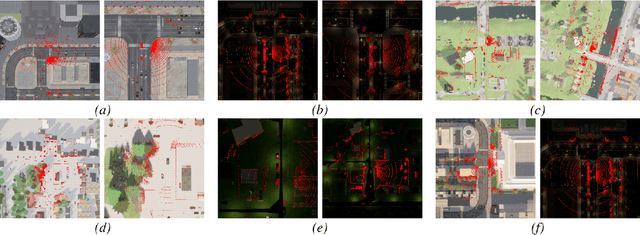
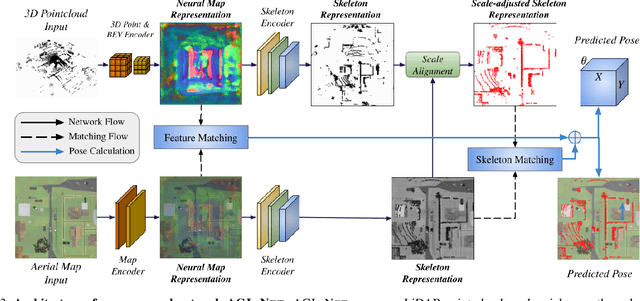
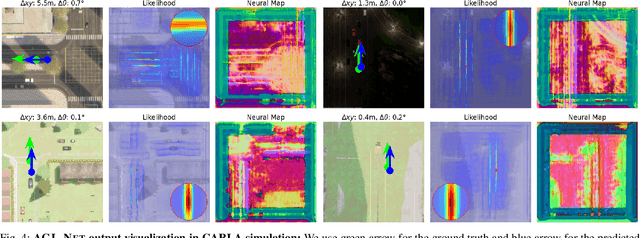
We present AGL-NET, a novel learning-based method for global localization using LiDAR point clouds and satellite maps. AGL-NET tackles two critical challenges: bridging the representation gap between image and points modalities for robust feature matching, and handling inherent scale discrepancies between global view and local view. To address these challenges, AGL-NET leverages a unified network architecture with a novel two-stage matching design. The first stage extracts informative neural features directly from raw sensor data and performs initial feature matching. The second stage refines this matching process by extracting informative skeleton features and incorporating a novel scale alignment step to rectify scale variations between LiDAR and map data. Furthermore, a novel scale and skeleton loss function guides the network toward learning scale-invariant feature representations, eliminating the need for pre-processing satellite maps. This significantly improves real-world applicability in scenarios with unknown map scales. To facilitate rigorous performance evaluation, we introduce a meticulously designed dataset within the CARLA simulator specifically tailored for metric localization training and assessment. The code and dataset will be made publicly available.
PoCo: Point Context Cluster for RGBD Indoor Place Recognition
Apr 03, 2024We present a novel end-to-end algorithm (PoCo) for the indoor RGB-D place recognition task, aimed at identifying the most likely match for a given query frame within a reference database. The task presents inherent challenges attributed to the constrained field of view and limited range of perception sensors. We propose a new network architecture, which generalizes the recent Context of Clusters (CoCs) to extract global descriptors directly from the noisy point clouds through end-to-end learning. Moreover, we develop the architecture by integrating both color and geometric modalities into the point features to enhance the global descriptor representation. We conducted evaluations on public datasets ScanNet-PR and ARKit with 807 and 5047 scenarios, respectively. PoCo achieves SOTA performance: on ScanNet-PR, we achieve R@1 of 64.63%, a 5.7% improvement from the best-published result CGis (61.12%); on Arkit, we achieve R@1 of 45.12%, a 13.3% improvement from the best-published result CGis (39.82%). In addition, PoCo shows higher efficiency than CGis in inference time (1.75X-faster), and we demonstrate the effectiveness of PoCo in recognizing places within a real-world laboratory environment.