 Add to Chrome
 Add to Firefox
 Add to Edge
On the Stability and Realizability of Recurrent Polynomial Surrogate Ternary Logic Gate Networks
May 23, 2026
Recurrent Neural Networks (RNNs) can learn to predict Signal Temporal Logic (STL) verdicts online from partial trajectories, but deploying them as runtime monitors in safety-critical systems demands more than predictive accuracy. Standard RNN architectures offer no structural guarantee that outputs degrade gracefully under sensor degradation; a dropped input can silently flip a verdict from safe to unsafe. We introduce the Recurrent Differentiable Ternary Logic Gate Network (R-DTLGN), a recurrent architecture that operates over Kleene's three-valued logic $\{-1, 0, +1\}$, where $0$ explicitly represents unknown. The R-DTLGN trains through continuous polynomial surrogates and hardens to a discrete ternary logic circuit at inference. We analyze the hardened circuit through two gate vocabularies derived from two orderings on the ternary domain: numerically monotone gates ensure stable recurrent dynamics, while information-monotone gates, when present, guarantee principled abstention (unknown inputs never produce wrong outputs) and monotonicity in input certainty (more information can only improve the verdict). We show that the recurrent connections required by bounded STL operators use exclusively AND and OR, which belong to both vocabularies, linking the monitoring task to the architecture's guarantees. A realizability bound derived from the STL formula's temporal operators directly sizes the network's hidden state, replacing hyperparameter search with a formula-driven specification. We evaluate on STL specifications over D4RL PointMaze navigation data, testing prediction accuracy, degradation under predicate dropout, and the accuracy-versus-safety tradeoff between two label construction pipelines. The R-DTLGN is, to our knowledge, the first recurrent architecture that couples learned temporal prediction with formal degradation guarantees rooted in three-valued logic.

Variational Neural Belief Parameterizations for Robust Dexterous Grasping under Multimodal Uncertainty
Apr 28, 2026Contact variability, sensing uncertainty, and external disturbances make grasp execution stochastic. Expected-quality objectives ignore tail outcomes and often select grasps that fail under adverse contact realizations. Risk-sensitive POMDPs address this failure mode, but many use particle-filter beliefs that scale poorly, obstruct gradient-based optimization, and estimate Conditional Value-at-Risk (CVaR) with high-variance approximations. We instead formulate grasp acquisition as variational inference over latent contact parameters and object pose, representing the belief with a differentiable Gaussian mixture. We use Gumbel-Softmax component selection and location-scale reparameterization to express samples as smooth functions of the belief parameters, enabling pathwise gradients through a differentiable CVaR surrogate for direct optimization of tail robustness. In simulation, our variational neural belief improves robust grasp success under contact-parameter uncertainty and exogenous force perturbations while reducing planning time by roughly an order of magnitude relative to particle-filter model-predictive control. On a serial-chain robot arm with a multifingered hand, we validate grasp-and-lift success under object-pose uncertainty against a Gaussian baseline. Both methods succeed on the tested perturbations, but our controller terminates in fewer steps and less wall-clock time while achieving a higher tactile grasp-quality proxy. Our learned belief also calibrates risk more accurately, keeping mean absolute calibration error below 0.14 across tested simulation regimes, compared with 0.58 for a Cross-Entropy Method planner.
Ternary Logic Encodings of Temporal Behavior Trees with Application to Control Synthesis
Apr 13, 2026Behavior Trees (BTs) provide designers an intuitive graphical interface to construct long-horizon plans for autonomous systems. To ensure their correctness and safety, rigorous formal models and verification techniques are essential. Temporal BTs (TBTs) offer a promising approach by leveraging existing temporal logic formalisms to specify and verify the executions of BTs. However, this analysis is currently limited to offline post hoc analysis and trace repair. In this paper, we reformulate TBTs using a ternary-valued Signal Temporal Logic (STL) amenable for control synthesis. Ternary logic introduces a third truth value \textit{Unknown}, formally capturing cases where a trajectory has neither fully satisfied or dissatisfied a specification. We propose mixed-integer linear encodings for partial trajectory STL and TBTs over ternary logic allowing for correct-by-construction control strategies for linear dynamical systems via mixed-integer optimization. We demonstrate the utility of our framework by solving optimal control problems.
Risk-Constrained Belief-Space Optimization for Safe Control under Latent Uncertainty
Apr 04, 2026Many safety-critical control systems must operate under latent uncertainty that sensors cannot directly resolve at decision time. Such uncertainty, arising from unknown physical properties, exogenous disturbances, or unobserved environment geometry, influences dynamics, task feasibility, and safety margins. Standard methods optimize expected performance and offer limited protection against rare but severe outcomes, while robust formulations treat uncertainty conservatively without exploiting its probabilistic structure. We consider partially observed dynamical systems whose dynamics, costs, and safety constraints depend on a latent parameter maintained as a belief distribution, and propose a risk-sensitive belief-space Model Predictive Path Integral (MPPI) control framework that plans under this belief while enforcing a Conditional Value-at-Risk (CVaR) constraint on a trajectory safety margin over the receding horizon. The resulting controller optimizes a risk-regularized performance objective while explicitly constraining the tail risk of safety violations induced by latent parameter variability. We establish three properties of the resulting risk-constrained controller: (1) the CVaR constraint implies a probabilistic safety guarantee, (2) the controller recovers the risk-neutral optimum as the risk weight in the objective tends to zero, and (3) a union-bound argument extends the per-horizon guarantee to cumulative safety over repeated solves. In physics-based simulations of a vision-guided dexterous stowing task in which a grasped object must be inserted into an occupied slot with pose uncertainty exceeding prescribed lateral clearance requirements, our method achieves 82% success with zero contact violations at high risk aversion, compared to 55% and 50% for a risk-neutral configuration and a chance-constrained baseline, both of which incur nonzero exterior contact forces.
Polynomial Surrogate Training for Differentiable Ternary Logic Gate Networks
Feb 27, 2026Differentiable logic gate networks (DLGNs) learn compact, interpretable Boolean circuits via gradient-based training, but all existing variants are restricted to the 16 two-input binary gates. Extending DLGNs to Ternary Kleene $K_3$ logic and training DTLGNs where the UNKNOWN state enables principled abstention under uncertainty is desirable. However, the support set of potential gates per neuron explodes to $19{,}683$, making the established softmax-over-gates training approach intractable. We introduce Polynomial Surrogate Training (PST), which represents each ternary neuron as a degree-$(2,2)$ polynomial with 9 learnable coefficients (a $2{,}187\times$ parameter reduction) and prove that the gap between the trained network and its discretized logic circuit is bounded by a data-independent commitment loss that vanishes at convergence. Scaling experiments from 48K to 512K neurons on CIFAR-10 demonstrate that this hardening gap contracts with overparameterization. Ternary networks train $2$-$3\times$ faster than binary DLGNs and discover true ternary gates that are functionally diverse. On synthetic and tabular tasks we find that the UNKNOWN output acts as a Bayes-optimal uncertainty proxy, enabling selective prediction in which ternary circuits surpass binary accuracy once low-confidence predictions are filtered. More broadly, PST establishes a general polynomial-surrogate methodology whose parameterization cost grows only quadratically with logic valence, opening the door to many-valued differentiable logic.
Robust Stochastic Shortest-Path Planning via Risk-Sensitive Incremental Sampling
Aug 16, 2024
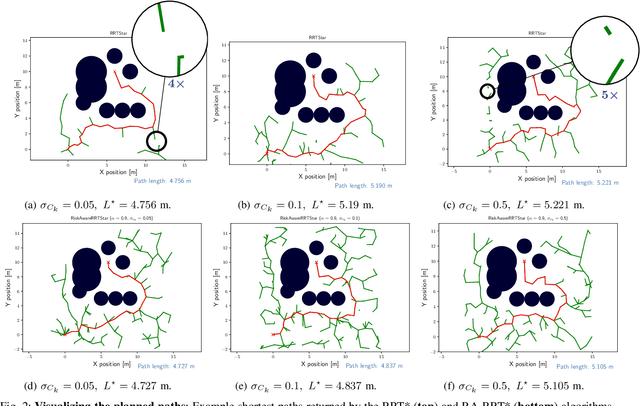


With the pervasiveness of Stochastic Shortest-Path (SSP) problems in high-risk industries, such as last-mile autonomous delivery and supply chain management, robust planning algorithms are crucial for ensuring successful task completion while mitigating hazardous outcomes. Mainstream chance-constrained incremental sampling techniques for solving SSP problems tend to be overly conservative and typically do not consider the likelihood of undesirable tail events. We propose an alternative risk-aware approach inspired by the asymptotically-optimal Rapidly-Exploring Random Trees (RRT*) planning algorithm, which selects nodes along path segments with minimal Conditional Value-at-Risk (CVaR). Our motivation rests on the step-wise coherence of the CVaR risk measure and the optimal substructure of the SSP problem. Thus, optimizing with respect to the CVaR at each sampling iteration necessarily leads to an optimal path in the limit of the sample size. We validate our approach via numerical path planning experiments in a two-dimensional grid world with obstacles and stochastic path-segment lengths. Our simulation results show that incorporating risk into the tree growth process yields paths with lengths that are significantly less sensitive to variations in the noise parameter, or equivalently, paths that are more robust to environmental uncertainty. Algorithmic analyses reveal similar query time and memory space complexity to the baseline RRT* procedure, with only a marginal increase in processing time. This increase is offset by significantly lower noise sensitivity and reduced planner failure rates.
GAMEOPT+: Improving Fuel Efficiency in Unregulated Heterogeneous Traffic Intersections via Optimal Multi-agent Cooperative Control
May 26, 2024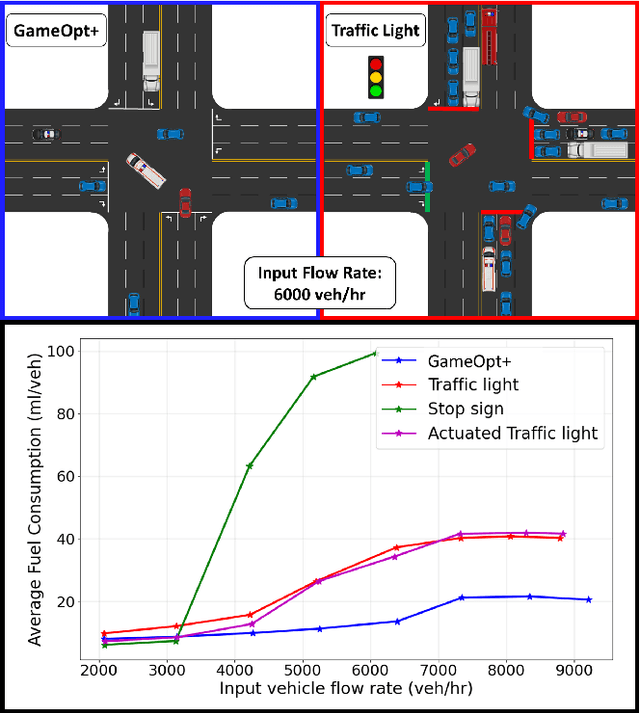
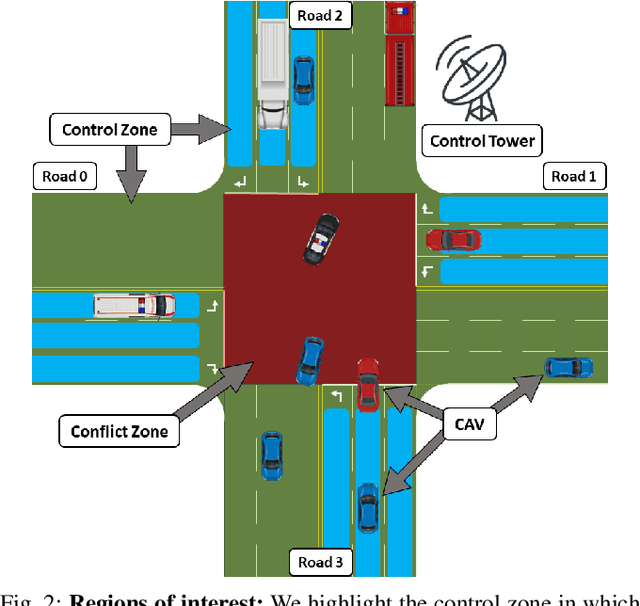
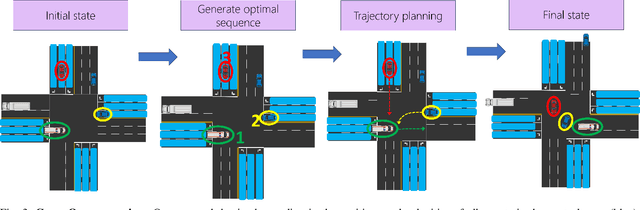
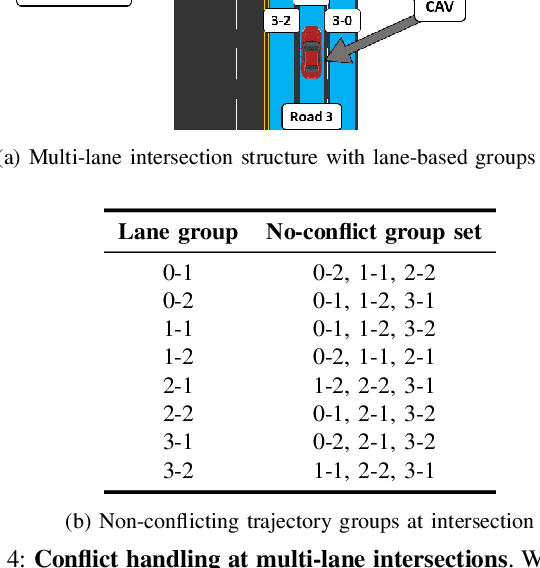
Better fuel efficiency leads to better financial security as well as a cleaner environment. We propose a novel approach for improving fuel efficiency in unstructured and unregulated traffic environments. Existing intelligent transportation solutions for improving fuel efficiency, however, apply only to traffic intersections with sparse traffic or traffic where drivers obey the regulations, or both. We propose GameOpt+, a novel hybrid approach for cooperative intersection control in dynamic, multi-lane, unsignalized intersections. GameOpt+ is a hybrid solution that combines an auction mechanism and an optimization-based trajectory planner. It generates a priority entrance sequence for each agent and computes velocity controls in real-time, taking less than 10 milliseconds even in high-density traffic with over 10,000 vehicles per hour. Compared to fully optimization-based methods, it operates 100 times faster while ensuring fairness, safety, and efficiency. Tested on the SUMO simulator, our algorithm improves throughput by at least 25%, reduces the time to reach the goal by at least 70%, and decreases fuel consumption by 50% compared to auction-based and signaled approaches using traffic lights and stop signs. GameOpt+ is also unaffected by unbalanced traffic inflows, whereas some of the other baselines encountered a decrease in performance in unbalanced traffic inflow environments.
Towards Efficient Risk-Sensitive Policy Gradient: An Iteration Complexity Analysis
Mar 13, 2024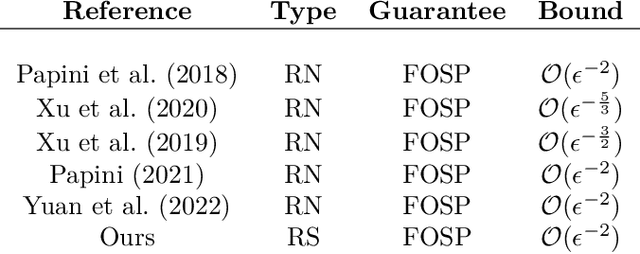
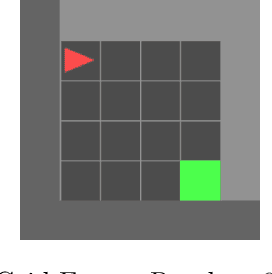
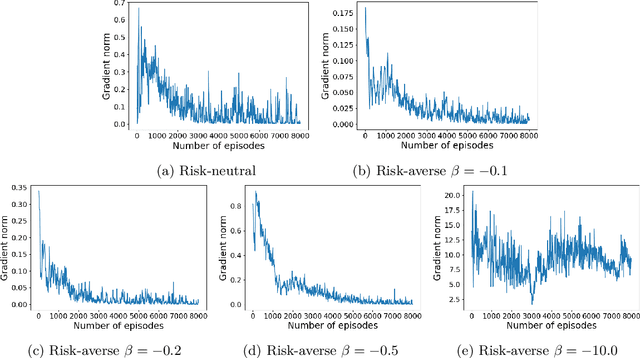
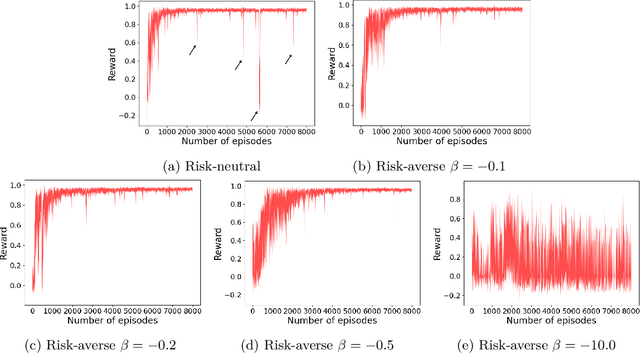
Reinforcement Learning (RL) has shown exceptional performance across various applications, enabling autonomous agents to learn optimal policies through interaction with their environments. However, traditional RL frameworks often face challenges in terms of iteration complexity and robustness. Risk-sensitive RL, which balances expected return and risk, has been explored for its potential to yield probabilistically robust policies, yet its iteration complexity analysis remains underexplored. In this study, we conduct a thorough iteration complexity analysis for the risk-sensitive policy gradient method, focusing on the REINFORCE algorithm and employing the exponential utility function. We obtain an iteration complexity of $\mathcal{O}(\epsilon^{-2})$ to reach an $\epsilon$-approximate first-order stationary point (FOSP). We investigate whether risk-sensitive algorithms can achieve better iteration complexity compared to their risk-neutral counterparts. Our theoretical analysis demonstrates that risk-sensitive REINFORCE can have a reduced number of iterations required for convergence. This leads to improved iteration complexity, as employing the exponential utility does not entail additional computation per iteration. We characterize the conditions under which risk-sensitive algorithms can achieve better iteration complexity. Our simulation results also validate that risk-averse cases can converge and stabilize more quickly after approximately half of the episodes compared to their risk-neutral counterparts.
Cooperative Bidirectional Mixed-Traffic Overtaking
Nov 14, 2023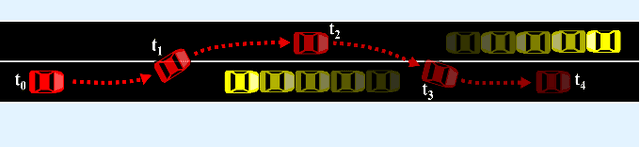
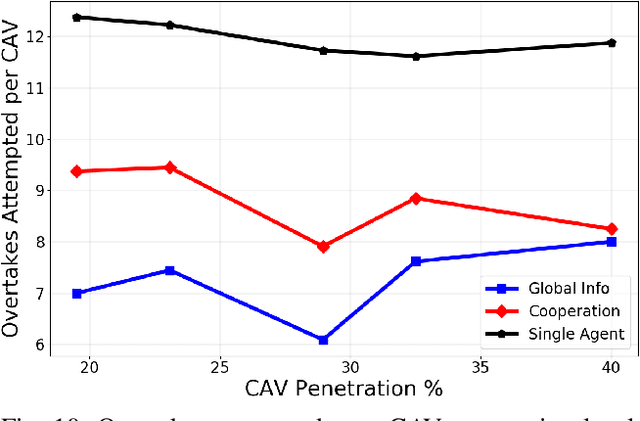
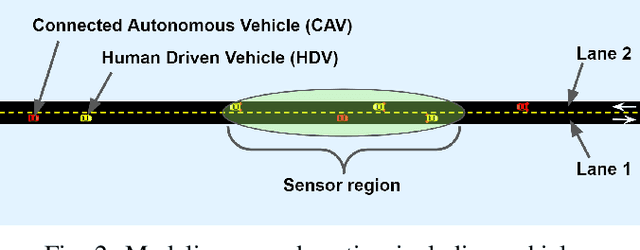
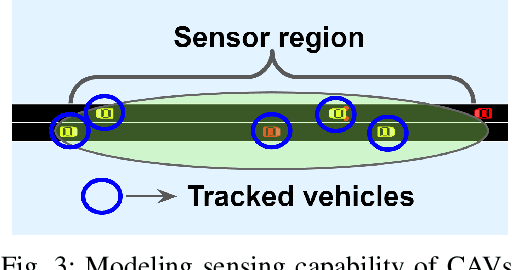
Safe overtaking, especially in a bidirectional mixed-traffic setting, remains a key challenge for Connected Autonomous Vehicles (CAVs). The presence of human-driven vehicles (HDVs), behavior unpredictability, and blind spots resulting from sensor occlusion make this a challenging control problem. To overcome these difficulties, we propose a cooperative communication-based approach that utilizes the information shared between CAVs to reduce the effects of sensor occlusion while benefiting from the local velocity prediction based on past tracking data. Our control framework aims to perform overtaking maneuvers with the objective of maximizing velocity while prioritizing safety and passenger comfort. Our method is also capable of reactively adjusting its plan to dynamic changes in the environment. The performance of the proposed approach is verified using realistic traffic simulations.
* Published in: 2022 IEEE 25th International Conference on Intelligent Transportation Systems (ITSC)
Safe Collective Control under Noisy Inputs and Competing Constraints via Non-Smooth Barrier Functions
Nov 06, 2023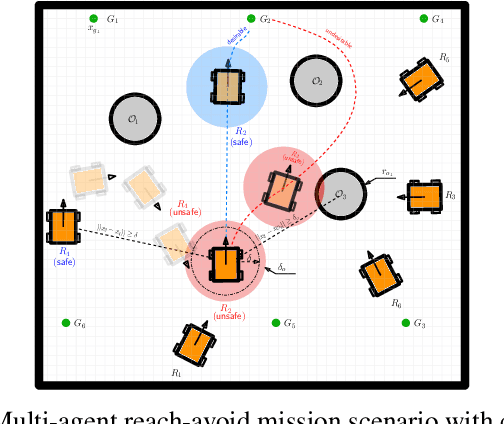

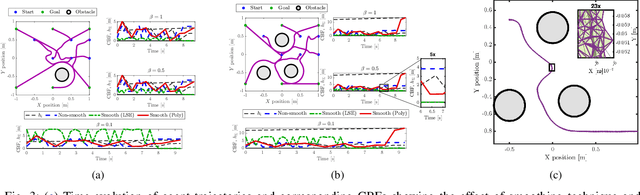

We consider the problem of safely coordinating ensembles of identical autonomous agents to conduct complex missions with conflicting safety requirements and under noisy control inputs. Using non-smooth control barrier functions (CBFs) and stochastic model-predictive control as springboards and by adopting an extrinsic approach where the ensemble is treated as a unified dynamic entity, we devise a method to synthesize safety-aware control inputs for uncertain collectives, drawing upon recent developments in Boolean CBF composition and extensions of CBFs to stochastic systems. Specifically, we approximate the combined CBF by a smooth function and solve a stochastic optimization problem, with agent-level forcing terms restricted to the resulting affine subspace of safe control inputs. For the smoothing step, we employ a polynomial approximation scheme, providing evidence for its advantage in generating more conservative yet sufficiently-filtered control signals than the smoother but more aggressive equivalents realized via an approximation technique based on the log-sum-exp function. To further demonstrate the utility of the proposed method, we present bounds for the expected value of the CBF approximation error, along with results from simulations of a single-integrator collective under velocity perturbations, comparing these results with those obtained using a naive state-feedback controller lacking safety filters.