 Add to Chrome
 Add to Firefox
 Add to Edge
Learning from Mistakes: Post-Training for Driving VLA with Takeover Data
Mar 16, 2026
Current Vision-Language-Action (VLA) paradigms in end-to-end autonomous driving rely on offline training from static datasets, leaving them vulnerable to distribution shift. Recent post-training methods use takeover data to mitigate this by augmenting the dataset with high-quality expert takeover samples, yet they suffer from two key limitations: supervision restricted to the period after the takeover moments leads to policies with limited safety margins, and passive preference optimization lacks active exploration for optimal performance. In this paper, we propose TakeVLA, a novel VLA post-training framework that overcomes these shortcomings through two complementary innovations. First, we introduce pre-takeover language supervision, which allows the VLA to learn from mistakes proactively. By explicitly teaching the model about what to do in error-prone situations, we cultivate a precautionary mindset that anticipates hazards early and substantially enlarges safety margins. Second, we propose Scenario Dreaming, a reinforcement fine-tuning paradigm that operates in reconstruceted takeover scenarios, encouraging active exploration beyond mere preference fitting. Experiments on the Bench2Drive benchmark demonstrate that TakeVLA achieves state-of-the-art closed-loop performance, surpassing the strong VLA baseline SimLingo by 4.93 in driving score, with an enhanced safety margin as evidenced by an 11.76% increase in average TTC.

PerlAD: Towards Enhanced Closed-loop End-to-end Autonomous Driving with Pseudo-simulation-based Reinforcement Learning
Mar 16, 2026End-to-end autonomous driving policies based on Imitation Learning (IL) often struggle in closed-loop execution due to the misalignment between inadequate open-loop training objectives and real driving requirements. While Reinforcement Learning (RL) offers a solution by directly optimizing driving goals via reward signals, the rendering-based training environments introduce the rendering gap and are inefficient due to high computational costs. To overcome these challenges, we present a novel Pseudo-simulation-based RL method for closed-loop end-to-end autonomous driving, PerlAD. Based on offline datasets, PerlAD constructs a pseudo-simulation that operates in vector space, enabling efficient, rendering-free trial-and-error training. To bridge the gap between static datasets and dynamic closed-loop environments, PerlAD introduces a prediction world model that generates reactive agent trajectories conditioned on the ego vehicle's plan. Furthermore, to facilitate efficient planning, PerlAD utilizes a hierarchical decoupled planner that combines IL for lateral path generation and RL for longitudinal speed optimization. Comprehensive experimental results demonstrate that PerlAD achieves state-of-the-art performance on the Bench2Drive benchmark, surpassing the previous E2E RL method by 10.29% in Driving Score without requiring expensive online interactions. Additional evaluations on the DOS benchmark further confirm its reliability in handling safety-critical occlusion scenarios.
TakeAD: Preference-based Post-optimization for End-to-end Autonomous Driving with Expert Takeover Data
Dec 22, 2025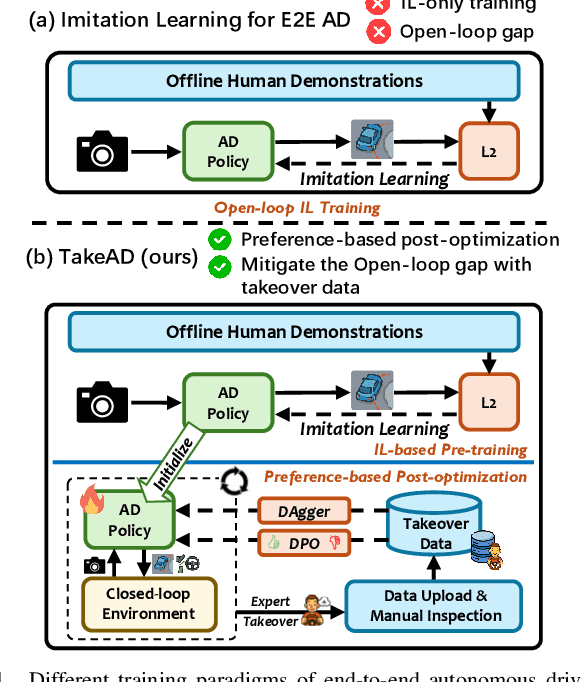
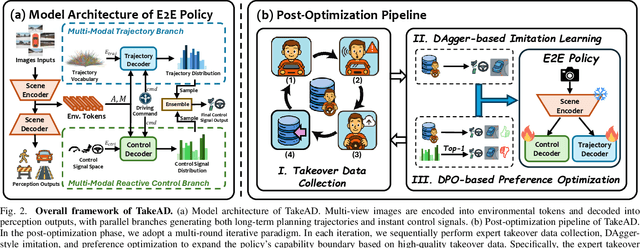
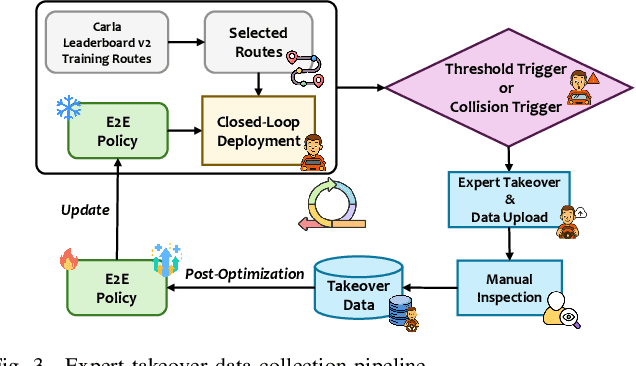
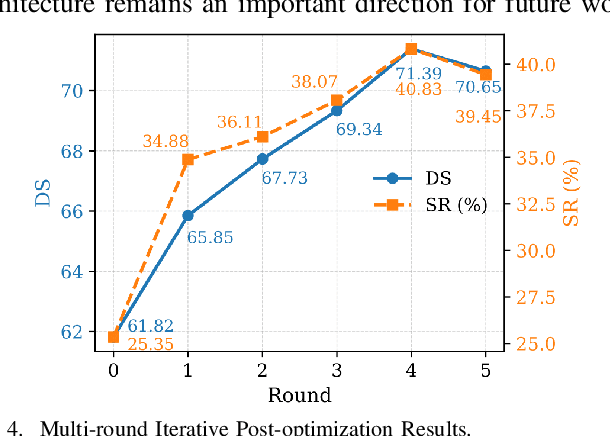
Existing end-to-end autonomous driving methods typically rely on imitation learning (IL) but face a key challenge: the misalignment between open-loop training and closed-loop deployment. This misalignment often triggers driver-initiated takeovers and system disengagements during closed-loop execution. How to leverage those expert takeover data from disengagement scenarios and effectively expand the IL policy's capability presents a valuable yet unexplored challenge. In this paper, we propose TakeAD, a novel preference-based post-optimization framework that fine-tunes the pre-trained IL policy with this disengagement data to enhance the closed-loop driving performance. First, we design an efficient expert takeover data collection pipeline inspired by human takeover mechanisms in real-world autonomous driving systems. Then, this post optimization framework integrates iterative Dataset Aggregation (DAgger) for imitation learning with Direct Preference Optimization (DPO) for preference alignment. The DAgger stage equips the policy with fundamental capabilities to handle disengagement states through direct imitation of expert interventions. Subsequently, the DPO stage refines the policy's behavior to better align with expert preferences in disengagement scenarios. Through multiple iterations, the policy progressively learns recovery strategies for disengagement states, thereby mitigating the open-loop gap. Experiments on the closed-loop Bench2Drive benchmark demonstrate our method's effectiveness compared with pure IL methods, with comprehensive ablations confirming the contribution of each component.