 Add to Chrome
 Add to Firefox
 Add to Edge
NESTOR: A Nested MOE-based Neural Operator for Large-Scale PDE Pre-Training
Feb 25, 2026
Neural operators have emerged as an efficient paradigm for solving PDEs, overcoming the limitations of traditional numerical methods and significantly improving computational efficiency. However, due to the diversity and complexity of PDE systems, existing neural operators typically rely on a single network architecture, which limits their capacity to fully capture heterogeneous features and complex system dependencies. This constraint poses a bottleneck for large-scale PDE pre-training based on neural operators. To address these challenges, we propose a large-scale PDE pre-trained neural operator based on a nested Mixture-of-Experts (MoE) framework. In particular, the image-level MoE is designed to capture global dependencies, while the token-level Sub-MoE focuses on local dependencies. Our model can selectively activate the most suitable expert networks for a given input, thereby enhancing generalization and transferability. We conduct large-scale pre-training on twelve PDE datasets from diverse sources and successfully transfer the model to downstream tasks. Extensive experiments demonstrate the effectiveness of our approach.

EDGE-LLM: Enabling Efficient Large Language Model Adaptation on Edge Devices via Layerwise Unified Compression and Adaptive Layer Tuning and Voting
Jun 22, 2024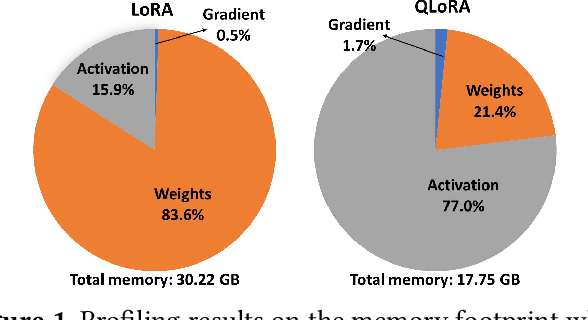
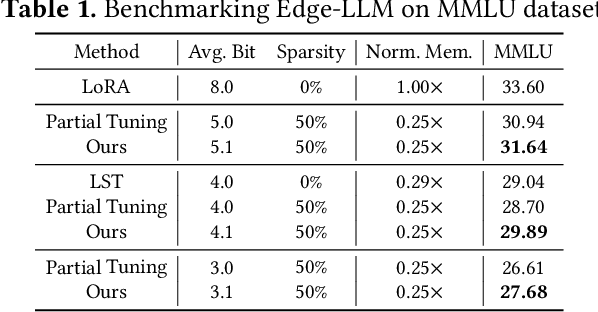
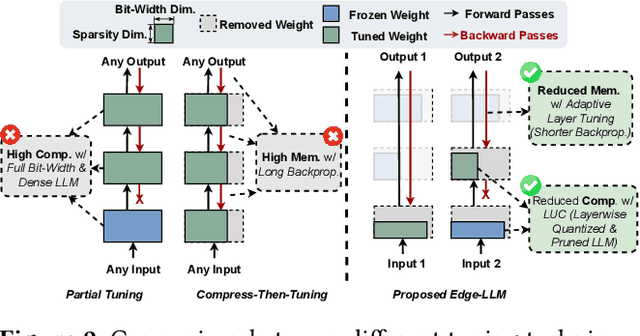
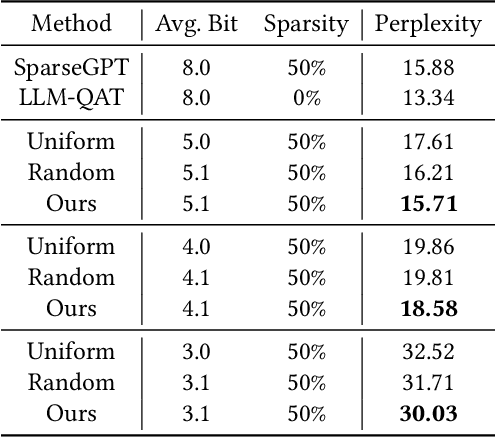
Efficient adaption of large language models (LLMs) on edge devices is essential for applications requiring continuous and privacy-preserving adaptation and inference. However, existing tuning techniques fall short because of the high computation and memory overheads. To this end, we introduce a computation- and memory-efficient LLM tuning framework, called Edge-LLM, to facilitate affordable and effective LLM adaptation on edge devices. Specifically, Edge-LLM features three core components: (1) a layer-wise unified compression (LUC) technique to reduce the computation overhead by generating layer-wise pruning sparsity and quantization bit-width policies, (2) an adaptive layer tuning and voting scheme to reduce the memory overhead by reducing the backpropagation depth, and (3) a complementary hardware scheduling strategy to handle the irregular computation patterns introduced by LUC and adaptive layer tuning, thereby achieving efficient computation and data movements. Extensive experiments demonstrate that Edge-LLM achieves a 2.92x speed up and a 4x memory overhead reduction as compared to vanilla tuning methods with comparable task accuracy. Our code is available at https://github.com/GATECH-EIC/Edge-LLM