 Add to Chrome
 Add to Firefox
 Add to Edge
MagicAgent: Towards Generalized Agent Planning
Feb 22, 2026
The evolution of Large Language Models (LLMs) from passive text processors to autonomous agents has established planning as a core component of modern intelligence. However, achieving generalized planning remains elusive, not only by the scarcity of high-quality interaction data but also by inherent conflicts across heterogeneous planning tasks. These challenges result in models that excel at isolated tasks yet struggle to generalize, while existing multi-task training attempts suffer from gradient interference. In this paper, we present \textbf{MagicAgent}, a series of foundation models specifically designed for generalized agent planning. We introduce a lightweight and scalable synthetic data framework that generates high-quality trajectories across diverse planning tasks, including hierarchical task decomposition, tool-augmented planning, multi-constraint scheduling, procedural logic orchestration, and long-horizon tool execution. To mitigate training conflicts, we propose a two-stage training paradigm comprising supervised fine-tuning followed by multi-objective reinforcement learning over both static datasets and dynamic environments. Empirical results demonstrate that MagicAgent-32B and MagicAgent-30B-A3B deliver superior performance, achieving accuracies of $75.1\%$ on Worfbench, $55.9\%$ on NaturalPlan, $57.5\%$ on $τ^2$-Bench, $86.9\%$ on BFCL-v3, and $81.2\%$ on ACEBench, as well as strong results on our in-house MagicEval benchmarks. These results substantially outperform existing sub-100B models and even surpass leading closed-source models.

Speech-Language Models with Decoupled Tokenizers and Multi-Token Prediction
Jun 14, 2025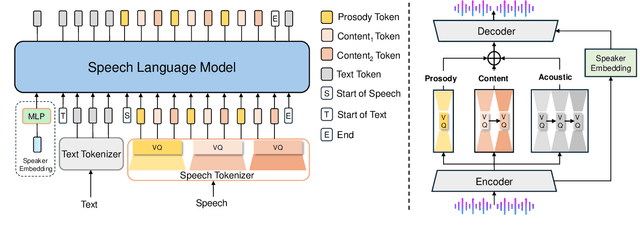
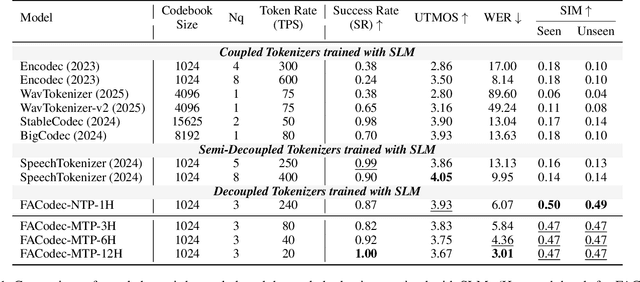
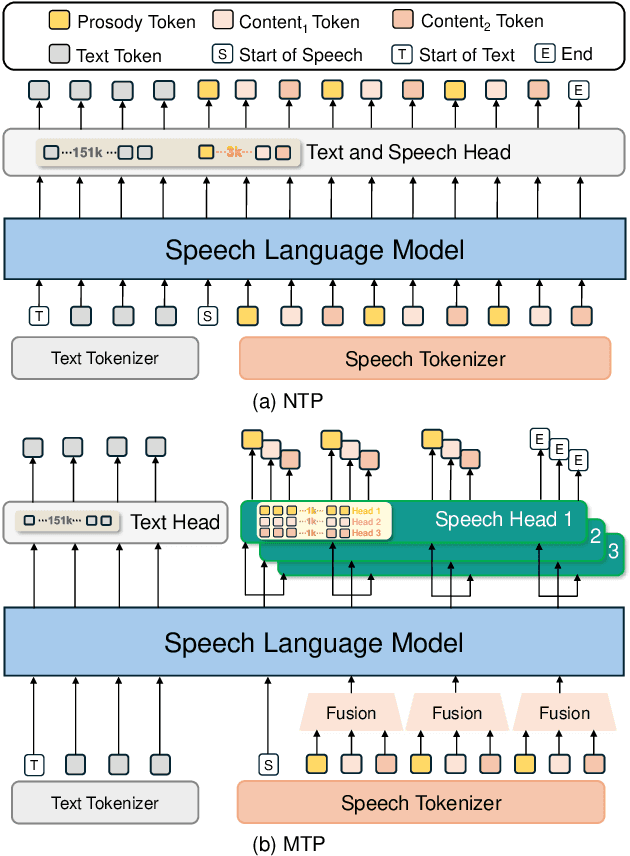
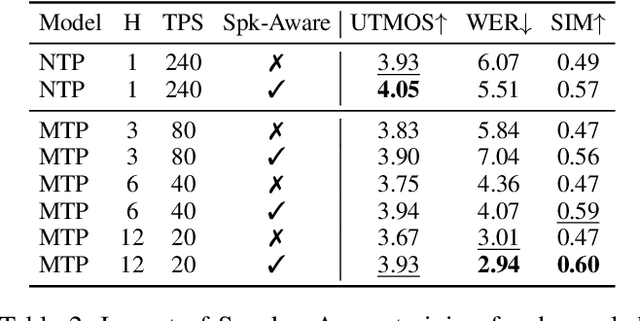
Speech-language models (SLMs) offer a promising path toward unifying speech and text understanding and generation. However, challenges remain in achieving effective cross-modal alignment and high-quality speech generation. In this work, we systematically investigate the impact of key components (i.e., speech tokenizers, speech heads, and speaker modeling) on the performance of LLM-centric SLMs. We compare coupled, semi-decoupled, and fully decoupled speech tokenizers under a fair SLM framework and find that decoupled tokenization significantly improves alignment and synthesis quality. To address the information density mismatch between speech and text, we introduce multi-token prediction (MTP) into SLMs, enabling each hidden state to decode multiple speech tokens. This leads to up to 12$\times$ faster decoding and a substantial drop in word error rate (from 6.07 to 3.01). Furthermore, we propose a speaker-aware generation paradigm and introduce RoleTriviaQA, a large-scale role-playing knowledge QA benchmark with diverse speaker identities. Experiments demonstrate that our methods enhance both knowledge understanding and speaker consistency.