 Add to Chrome
 Add to Firefox
 Add to Edge
MedPMC: A Systematic Framework for Scaling High-Fidelity Medical Multimodal Data for Foundation Models
Jul 08, 2026
Medicine is inherently multimodal, requiring clinicians to synthesize information across diverse data streams. Yet the development of multimodal foundation models is constrained by limited access to large-scale, high-quality clinical data. Although PubMed Central (PMC) offers a complementary source of expert-authored image-text data, existing PMC-derived resources remain limited in fidelity, reproducibility, and clinical validation. We introduce MedPMC, an automated, continuously updatable framework that transforms permissively licensed literature into high-fidelity infrastructure for medical multimodal models. Applied to 6.1 million PMC articles, MedPMC curated 11 million medical image-text pairs. Component evaluations showed strong performance for initial screening (F1 = 93.2), multi-panel figure detection (F1 = 96.5), figure separation (mAP = 89.8), caption separation and alignment (F1 = 81.4; ROUGE-L = 85.3), and medical figure classification (F1 = 96.5). Manual review by five annotators, three with medical training, found 95.3% of MedPMC images medically relevant, versus 19.7% in a prior PMC-derived dataset. Across 26 benchmarks spanning 11 specialties, a MedPMC-trained CLIP-style model improved average zero-shot AUC by 7.1 percentage points over the strongest architecture-matched biomedical CLIP baseline despite using fewer than half as many image-text pairs. As the vision encoder in a multimodal large language model, it improved medical visual question-answering by 1.9 and 16.9 percentage points across two benchmarks. In 10,524 Yale New Haven Health System dermatology photographs, it improved morphology-to-image retrieval Recall@5 by 11.7 percentage points. These findings show that high-fidelity literature curation strengthens medical multimodal foundation models across benchmark and clinical settings. We publicly release the framework, corpus, benchmarks, and pretrained models.

VOLMO: Versatile and Open Large Models for Ophthalmology
Mar 25, 2026Vision impairment affects millions globally, and early detection is critical to preventing irreversible vision loss. Ophthalmology workflows require clinicians to integrate medical images, structured clinical data, and free-text notes to determine disease severity and management, which is time-consuming and burdensome. Recent multimodal large language models (MLLMs) show promise, but existing general and medical MLLMs perform poorly in ophthalmology, and few ophthalmology-specific MLLMs are openly available. We present VOLMO (Versatile and Open Large Models for Ophthalmology), a model-agnostic, data-open framework for developing ophthalmology-specific MLLMs. VOLMO includes three stages: ophthalmology knowledge pretraining on 86,965 image-text pairs from 26,569 articles across 82 journals; domain task fine-tuning on 26,929 annotated instances spanning 12 eye conditions for disease screening and severity classification; and multi-step clinical reasoning on 913 patient case reports for assessment, planning, and follow-up care. Using this framework, we trained a compact 2B-parameter MLLM and compared it with strong baselines, including InternVL-2B, LLaVA-Med-7B, MedGemma-4B, MedGemma-27B, and RETFound. We evaluated these models on image description generation, disease screening and staging classification, and assessment-and-management generation, with additional manual review by two healthcare professionals and external validation on three independent cohorts for age-related macular degeneration and diabetic retinopathy. Across settings, VOLMO-2B consistently outperformed baselines, achieving stronger image description performance, an average F1 of 87.4% across 12 eye conditions, and higher scores in external validation.
ProtoDepth: Unsupervised Continual Depth Completion with Prototypes
Mar 17, 2025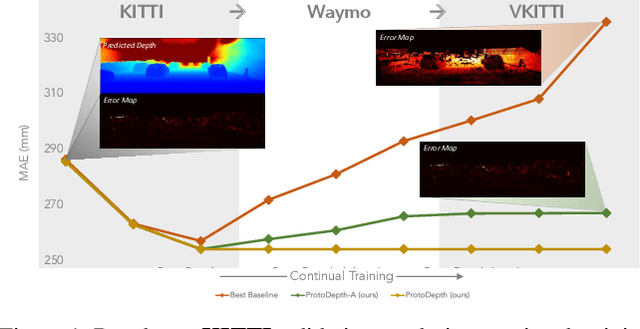
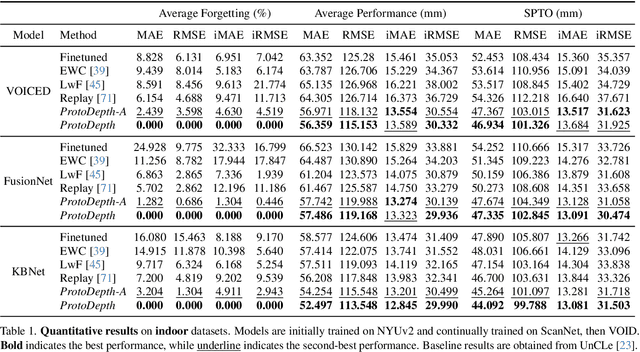
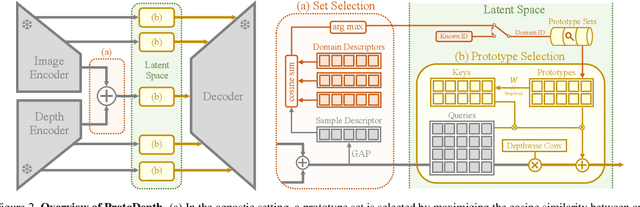
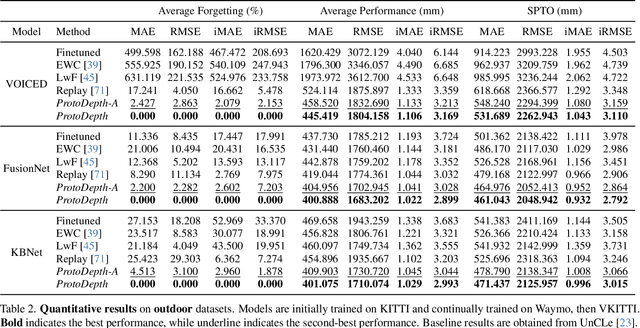
We present ProtoDepth, a novel prototype-based approach for continual learning of unsupervised depth completion, the multimodal 3D reconstruction task of predicting dense depth maps from RGB images and sparse point clouds. The unsupervised learning paradigm is well-suited for continual learning, as ground truth is not needed. However, when training on new non-stationary distributions, depth completion models will catastrophically forget previously learned information. We address forgetting by learning prototype sets that adapt the latent features of a frozen pretrained model to new domains. Since the original weights are not modified, ProtoDepth does not forget when test-time domain identity is known. To extend ProtoDepth to the challenging setting where the test-time domain identity is withheld, we propose to learn domain descriptors that enable the model to select the appropriate prototype set for inference. We evaluate ProtoDepth on benchmark dataset sequences, where we reduce forgetting compared to baselines by 52.2% for indoor and 53.2% for outdoor to achieve the state of the art.
PriorDiffusion: Leverage Language Prior in Diffusion Models for Monocular Depth Estimation
Nov 24, 2024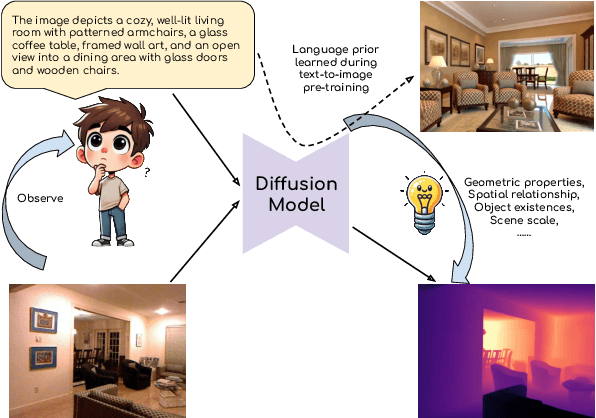
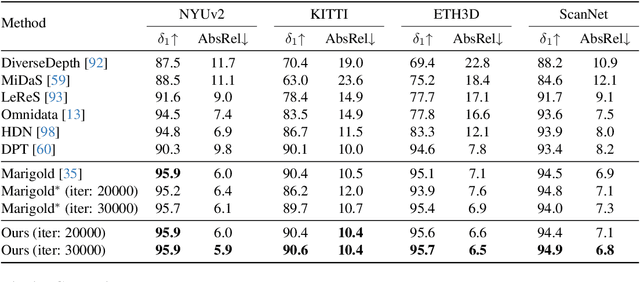
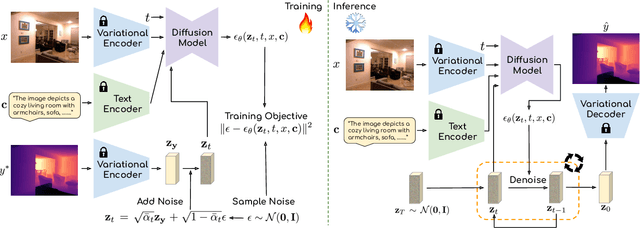
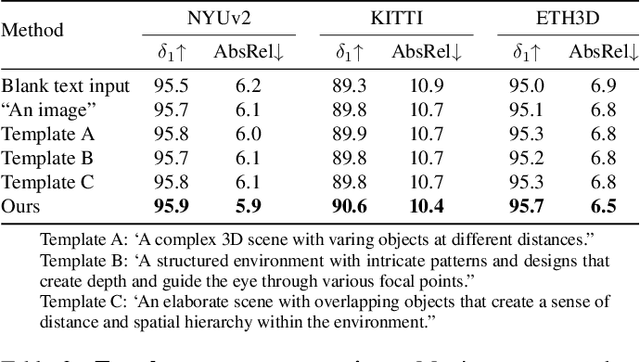
This paper explores the potential of leveraging language priors learned by text-to-image diffusion models to address ambiguity and visual nuisance in monocular depth estimation. Particularly, traditional monocular depth estimation suffers from inherent ambiguity due to the absence of stereo or multi-view depth cues, and nuisance due to lack of robustness of vision. We argue that language prior in diffusion models can enhance monocular depth estimation by leveraging the geometric prior aligned with the language description, which is learned during text-to-image pre-training. To generate images that reflect the text properly, the model must comprehend the size and shape of specified objects, their spatial relationship, and the scale of the scene. Thus, we propose PriorDiffusion, using a pre-trained text-to-image diffusion model that takes both image and text description that aligned with the scene to infer affine-invariant depth through a denoising process. We also show that language priors can guide the model's attention to specific regions and help it perceive the 3D scene in alignment with user intent. Simultaneously, it acts as a constraint to accelerate the convergence of the diffusion trajectory, since learning 3D properties from a condensed, low-dimensional language feature is more efficient compared with learning from a redundant, high-dimensional image feature. By training on HyperSim and Virtual KITTI, we achieve state-of-the-art zero-shot performance and a faster convergence speed, compared with other diffusion-based depth estimators, across NYUv2, KITTI, ETH3D, and ScanNet.