 Add to Chrome
 Add to Firefox
 Add to Edge
Ontology-Guided Evidence Path Inference for Multi-hop Knowledge Graph Question Answering
Jun 26, 2026
Knowledge graph question answering (KGQA) aims to answer natural-language questions by reasoning over structured facts. Existing multi-hop KGQA methods mainly rely on topic-centered expansion, which faces two key challenges: the search space rapidly grows with noisy mixed-type paths, and retrieved paths may fail to satisfy the semantic constraints of complex questions. To address these challenges, we propose OPI, an ontology-guided evidence path inference framework for multi-hop KGQA. OPI introduces a relation-centric ontology graph to capture the head-tail type constraints of relations, providing a compact interface for answer-side constraints. Based on this ontology graph, OPI first introduces a bidirectional retrieval mechanism by mapping the predicted answer type to compatible final-hop relations and combining topic-side prefix expansion with answer-side final-hop matching, thereby suppressing noisy mixed-type expansion. OPI further adopts an iterative refinement strategy to reassess retrieved paths and candidate answers under the question context, filtering type-compatible but question-irrelevant evidence for more reliable answer prediction. Experiments on WebQSP, CWQ, and MetaQA show that OPI substantially reduces the search space, improves Hit@1/F1 by 4.6/5.0 points on WebQSP and 8.9/3.3 points on CWQ over the strongest prior results, and achieves near-saturated Hit@1 on MetaQA with the retrieval module alone.

EFTViT: Efficient Federated Training of Vision Transformers with Masked Images on Resource-Constrained Edge Devices
Nov 30, 2024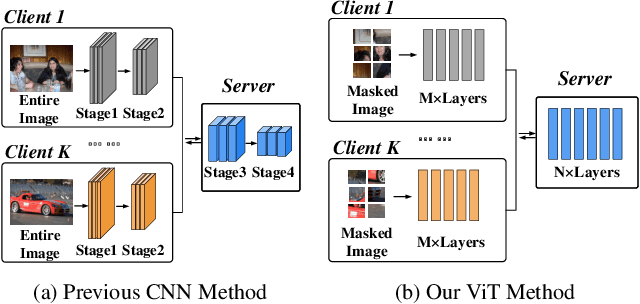

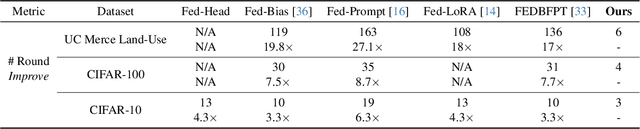

Federated learning research has recently shifted from Convolutional Neural Networks (CNNs) to Vision Transformers (ViTs) due to their superior capacity. ViTs training demands higher computational resources due to the lack of 2D inductive biases inherent in CNNs. However, efficient federated training of ViTs on resource-constrained edge devices remains unexplored in the community. In this paper, we propose EFTViT, a hierarchical federated framework that leverages masked images to enable efficient, full-parameter training on resource-constrained edge devices, offering substantial benefits for learning on heterogeneous data. In general, we patchify images and randomly mask a portion of the patches, observing that excluding them from training has minimal impact on performance while substantially reducing computation costs and enhancing data content privacy protection. Specifically, EFTViT comprises a series of lightweight local modules and a larger global module, updated independently on clients and the central server, respectively. The local modules are trained on masked image patches, while the global module is trained on intermediate patch features uploaded from the local client, balanced through a proposed median sampling strategy to erase client data distribution privacy. We analyze the computational complexity and privacy protection of EFTViT. Extensive experiments on popular benchmarks show that EFTViT achieves up to 28.17% accuracy improvement, reduces local training computational cost by up to 2.8$\times$, and cuts local training time by up to 4.4$\times$ compared to existing methods.