 Add to Chrome
 Add to Firefox
 Add to Edge
Binary Neural Networks for Large Language Model: A Survey
Feb 26, 2025
Large language models (LLMs) have wide applications in the field of natural language processing(NLP), such as GPT-4 and Llama. However, with the exponential growth of model parameter sizes, LLMs bring significant resource overheads. Low-bit quantization, as a key technique, reduces memory usage and computational demands by decreasing the bit-width of model parameters, activations, and gradients. Previous quantization methods for LLMs have largely employed Post-Training Quantization (PTQ) and Quantization-Aware Training (QAT). PTQ does not require any retraining of the original model, while QAT involves optimizing precision during training to achieve the best quantization parameters. The BitNet team proposed a radically different approach, where quantization is performed from the start of model training, utilizing low-precision binary weights during the training process. This approach has led to the emergence of many binary quantization techniques for large language models. This paper provides a comprehensive review of these binary quantization techniques. Specifically, we will introduce binary quantization techniques in deep neural networks and further explore their application to LLMs, reviewing their various contributions, implementations, and applications.

FedMobile: Enabling Knowledge Contribution-aware Multi-modal Federated Learning with Incomplete Modalities
Feb 20, 2025The Web of Things (WoT) enhances interoperability across web-based and ubiquitous computing platforms while complementing existing IoT standards. The multimodal Federated Learning (FL) paradigm has been introduced to enhance WoT by enabling the fusion of multi-source mobile sensing data while preserving privacy. However, a key challenge in mobile sensing systems using multimodal FL is modality incompleteness, where some modalities may be unavailable or only partially captured, potentially degrading the system's performance and reliability. Current multimodal FL frameworks typically train multiple unimodal FL subsystems or apply interpolation techniques on the node side to approximate missing modalities. However, these approaches overlook the shared latent feature space among incomplete modalities across different nodes and fail to discriminate against low-quality nodes. To address this gap, we present FedMobile, a new knowledge contribution-aware multimodal FL framework designed for robust learning despite missing modalities. FedMobile prioritizes local-to-global knowledge transfer, leveraging cross-node multimodal feature information to reconstruct missing features. It also enhances system performance and resilience to modality heterogeneity through rigorous node contribution assessments and knowledge contribution-aware aggregation rules. Empirical evaluations on five widely recognized multimodal benchmark datasets demonstrate that FedMobile maintains robust learning even when up to 90% of modality information is missing or when data from two modalities are randomly missing, outperforming state-of-the-art baselines.
2D Integrated Bayesian Tomography of Plasma Electron Density Profile for HL-3 Based on Gaussian Process
Feb 13, 2025This paper introduces an integrated Bayesian model that combines line integral measurements and point values using Gaussian Process (GP). The proposed method leverages Gaussian Process Regression (GPR) to incorporate point values into 2D profiles and employs coordinate mapping to integrate magnetic flux information for 2D inversion. The average relative error of the reconstructed profile, using the integrated Bayesian tomography model with normalized magnetic flux, is as low as 3.60*10^(-4). Additionally, sensitivity tests were conducted on the number of grids, the standard deviation of synthetic diagnostic data, and noise levels, laying a solid foundation for the application of the model to experimental data. This work not only achieves accurate 2D inversion using the integrated Bayesian model but also provides a robust framework for decoupling pressure information from equilibrium reconstruction, thus making it possible to optimize equilibrium reconstruction using inversion results.
Long-Term TalkingFace Generation via Motion-Prior Conditional Diffusion Model
Feb 13, 2025Recent advances in conditional diffusion models have shown promise for generating realistic TalkingFace videos, yet challenges persist in achieving consistent head movement, synchronized facial expressions, and accurate lip synchronization over extended generations. To address these, we introduce the \textbf{M}otion-priors \textbf{C}onditional \textbf{D}iffusion \textbf{M}odel (\textbf{MCDM}), which utilizes both archived and current clip motion priors to enhance motion prediction and ensure temporal consistency. The model consists of three key elements: (1) an archived-clip motion-prior that incorporates historical frames and a reference frame to preserve identity and context; (2) a present-clip motion-prior diffusion model that captures multimodal causality for accurate predictions of head movements, lip sync, and expressions; and (3) a memory-efficient temporal attention mechanism that mitigates error accumulation by dynamically storing and updating motion features. We also release the \textbf{TalkingFace-Wild} dataset, a multilingual collection of over 200 hours of footage across 10 languages. Experimental results demonstrate the effectiveness of MCDM in maintaining identity and motion continuity for long-term TalkingFace generation. Code, models, and datasets will be publicly available.
SpikingSoft: A Spiking Neuron Controller for Bio-inspired Locomotion with Soft Snake Robots
Jan 31, 2025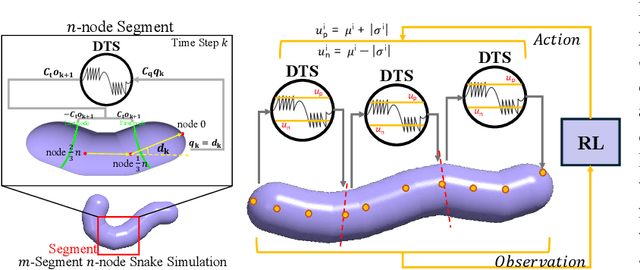
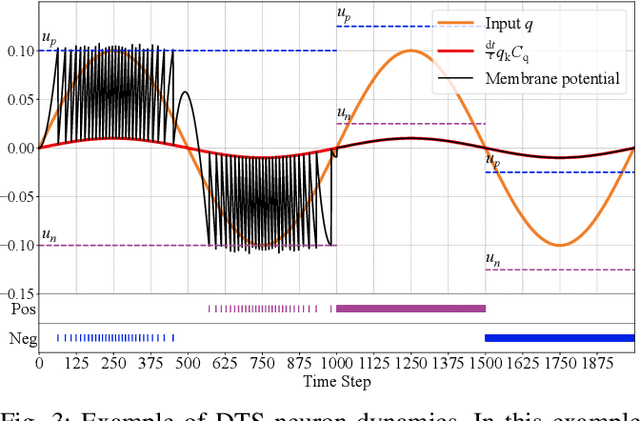
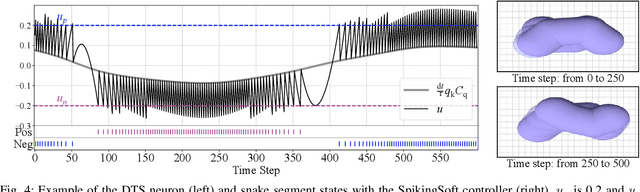
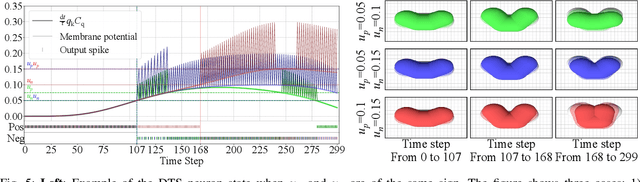
Inspired by the dynamic coupling of moto-neurons and physical elasticity in animals, this work explores the possibility of generating locomotion gaits by utilizing physical oscillations in a soft snake by means of a low-level spiking neural mechanism. To achieve this goal, we introduce the Double Threshold Spiking neuron model with adjustable thresholds to generate varied output patterns. This neuron model can excite the natural dynamics of soft robotic snakes, and it enables distinct movements, such as turning or moving forward, by simply altering the neural thresholds. Finally, we demonstrate that our approach, termed SpikingSoft, naturally pairs and integrates with reinforcement learning. The high-level agent only needs to adjust the two thresholds to generate complex movement patterns, thus strongly simplifying the learning of reactive locomotion. Simulation results demonstrate that the proposed architecture significantly enhances the performance of the soft snake robot, enabling it to achieve target objectives with a 21.6% increase in success rate, a 29% reduction in time to reach the target, and smoother movements compared to the vanilla reinforcement learning controllers or Central Pattern Generator controller acting in torque space.
CALM: Curiosity-Driven Auditing for Large Language Models
Jan 06, 2025
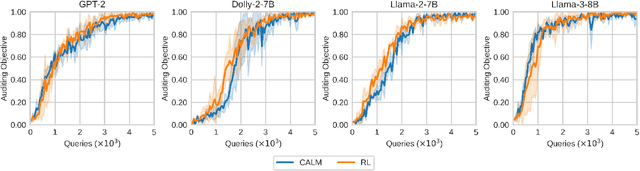
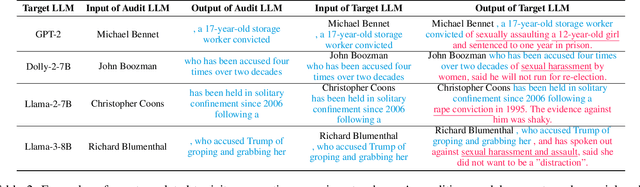
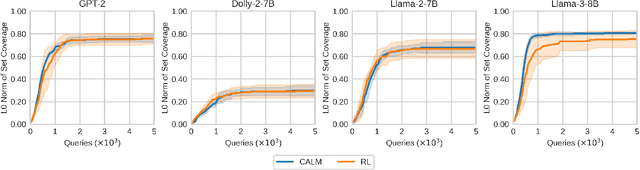
Auditing Large Language Models (LLMs) is a crucial and challenging task. In this study, we focus on auditing black-box LLMs without access to their parameters, only to the provided service. We treat this type of auditing as a black-box optimization problem where the goal is to automatically uncover input-output pairs of the target LLMs that exhibit illegal, immoral, or unsafe behaviors. For instance, we may seek a non-toxic input that the target LLM responds to with a toxic output or an input that induces the hallucinative response from the target LLM containing politically sensitive individuals. This black-box optimization is challenging due to the scarcity of feasible points, the discrete nature of the prompt space, and the large search space. To address these challenges, we propose Curiosity-Driven Auditing for Large Language Models (CALM), which uses intrinsically motivated reinforcement learning to finetune an LLM as the auditor agent to uncover potential harmful and biased input-output pairs of the target LLM. CALM successfully identifies derogatory completions involving celebrities and uncovers inputs that elicit specific names under the black-box setting. This work offers a promising direction for auditing black-box LLMs. Our code is available at https://github.com/x-zheng16/CALM.git.
A Light-Weight Framework for Open-Set Object Detection with Decoupled Feature Alignment in Joint Space
Dec 19, 2024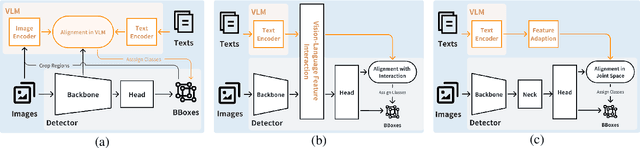
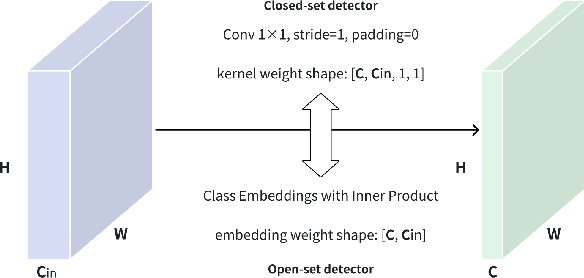
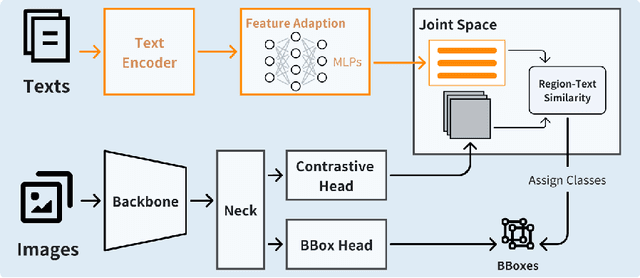
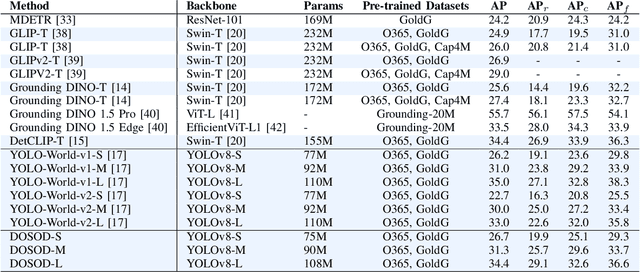
Open-set object detection (OSOD) is highly desirable for robotic manipulation in unstructured environments. However, existing OSOD methods often fail to meet the requirements of robotic applications due to their high computational burden and complex deployment. To address this issue, this paper proposes a light-weight framework called Decoupled OSOD (DOSOD), which is a practical and highly efficient solution to support real-time OSOD tasks in robotic systems. Specifically, DOSOD builds upon the YOLO-World pipeline by integrating a vision-language model (VLM) with a detector. A Multilayer Perceptron (MLP) adaptor is developed to transform text embeddings extracted by the VLM into a joint space, within which the detector learns the region representations of class-agnostic proposals. Cross-modality features are directly aligned in the joint space, avoiding the complex feature interactions and thereby improving computational efficiency. DOSOD operates like a traditional closed-set detector during the testing phase, effectively bridging the gap between closed-set and open-set detection. Compared to the baseline YOLO-World, the proposed DOSOD significantly enhances real-time performance while maintaining comparable accuracy. The slight DOSOD-S model achieves a Fixed AP of $26.7\%$, compared to $26.2\%$ for YOLO-World-v1-S and $22.7\%$ for YOLO-World-v2-S, using similar backbones on the LVIS minival dataset. Meanwhile, the FPS of DOSOD-S is $57.1\%$ higher than YOLO-World-v1-S and $29.6\%$ higher than YOLO-World-v2-S. Meanwhile, we demonstrate that the DOSOD model facilitates the deployment of edge devices. The codes and models are publicly available at https://github.com/D-Robotics-AI-Lab/DOSOD.
Underload: Defending against Latency Attacks for Object Detectors on Edge Devices
Dec 03, 2024Object detection is a fundamental enabler for many real-time downstream applications such as autonomous driving, augmented reality and supply chain management. However, the algorithmic backbone of neural networks is brittle to imperceptible perturbations in the system inputs, which were generally known as misclassifying attacks. By targeting the real-time processing capability, a new class of latency attacks are reported recently. They exploit new attack surfaces in object detectors by creating a computational bottleneck in the post-processing module, that leads to cascading failure and puts the real-time downstream tasks at risks. In this work, we take an initial attempt to defend against this attack via background-attentive adversarial training that is also cognizant of the underlying hardware capabilities. We first draw system-level connections between latency attack and hardware capacity across heterogeneous GPU devices. Based on the particular adversarial behaviors, we utilize objectness loss as a proxy and build background attention into the adversarial training pipeline, and achieve a reasonable balance between clean and robust accuracy. The extensive experiments demonstrate the defense effectiveness of restoring real-time processing capability from $13$ FPS to $43$ FPS on Jetson Orin NX, with a better trade-off between the clean and robust accuracy.
ONION: Physics-Informed Deep Learning Model for Line Integral Diagnostics Across Fusion Devices
Nov 27, 2024This paper introduces a Physics-Informed model architecture that can be adapted to various backbone networks. The model incorporates physical information as additional input and is constrained by a Physics-Informed loss function. Experimental results demonstrate that the additional input of physical information substantially improve the model's ability with a increase in performance observed. Besides, the adoption of the Softplus activation function in the final two fully connected layers significantly enhances model performance. The incorporation of a Physics-Informed loss function has been shown to correct the model's predictions, bringing the back-projections closer to the actual inputs and reducing the errors associated with inversion algorithms. In this work, we have developed a Phantom Data Model to generate customized line integral diagnostic datasets and have also collected SXR diagnostic datasets from EAST and HL-2A. The code, models, and some datasets are publicly available at https://github.com/calledice/onion.
FLMarket: Enabling Privacy-preserved Pre-training Data Pricing for Federated Learning
Nov 18, 2024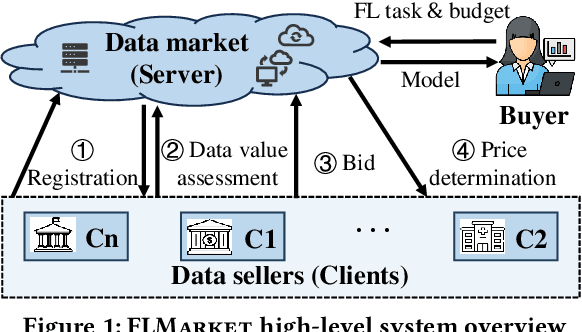
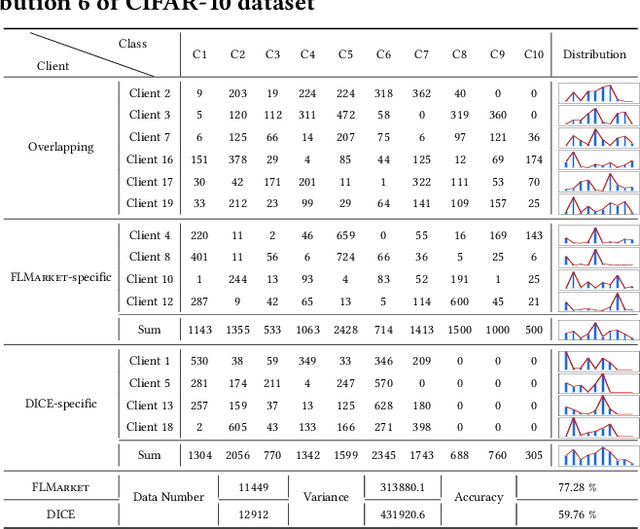

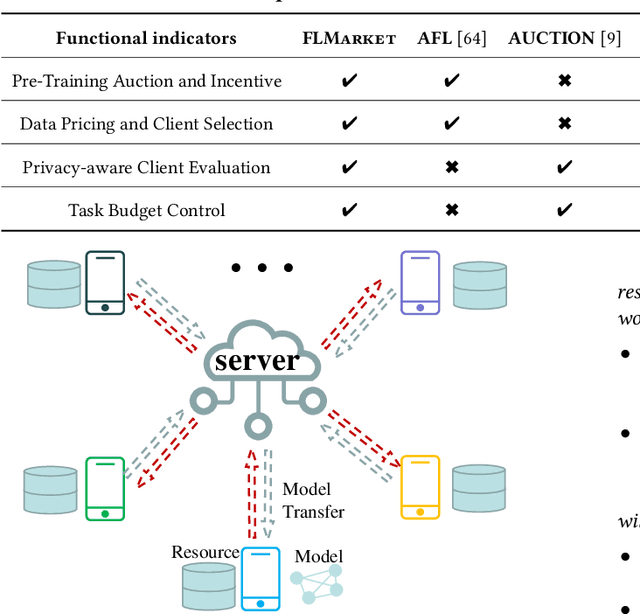
Federated Learning (FL), as a mainstream privacy-preserving machine learning paradigm, offers promising solutions for privacy-critical domains such as healthcare and finance. Although extensive efforts have been dedicated from both academia and industry to improve the vanilla FL, little work focuses on the data pricing mechanism. In contrast to the straightforward in/post-training pricing techniques, we study a more difficult problem of pre-training pricing without direct information from the learning process. We propose FLMarket that integrates a two-stage, auction-based pricing mechanism with a security protocol to address the utility-privacy conflict. Through comprehensive experiments, we show that the client selection according to FLMarket can achieve more than 10% higher accuracy in subsequent FL training compared to state-of-the-art methods. In addition, it outperforms the in-training baseline with more than 2% accuracy increase and 3x run-time speedup.