 Add to Chrome
 Add to Firefox
 Add to Edge
Step-Level On-Policy Distillation: Interpolating Between On-Policy Distillation and Supervised Fine-Tuning
Aug 17, 2026
On-policy distillation (OPD) aligns a student model with a teacher's logit distribution on student-generated trajectories. This approach has achieved strong empirical gains and can often surpass conventional off-policy distillation with substantially less data. However, standard token-level OPD can provide only fragmented corrections along an erroneous student trajectory and cannot unfold a complete and correct repair path. Motivated by this limitation, we propose \emph{Step-Level On-Policy Distillation} (SOPD), which combines the long-horizon correction of supervised fine-tuning (SFT) with the on-policy advantage of OPD to provide step-level supervision over complete student-generated trajectories. We show that, at different limits of step length, SOPD reduces to SFT or approximates OPD. Compared with SFT, the teacher responses in SOPD are conditioned on student trajectories and therefore align more closely with student-visited states; compared with OPD, SOPD provides longer-horizon corrections rather than fragmented token-level guidance. Across both reasoning and agent tasks, SOPD substantially outperforms conventional SFT and OPD. For example, on ALFWorld, SOPD improves the average success rate by 13.4 points over Vanilla OPD. We hope this work offers a new perspective for future research on distillation methods.

Dynamic Distribution-Aware Uncertainty Tracking in Vision-Language Representation Learning
Aug 10, 2026Uncertainty Quantification (UQ) aims to measure the reliability of model predictions, serving as a critical safeguard for deploying Vision-Language Models (VLMs) in safety-critical scenarios. Post-hoc approaches are widely adopted due to their lightweight nature, mapping the outputs of VLMs to uncertainty measures through learnable modules or inductive summarization. However, Post-hoc approaches remain inherently confined to fitting the failure patterns of the source domain, ignoring the dynamic nature of test distributions. To address this challenge, we propose a Dynamic Distribution-Aware Uncertainty Quantification framework (DDA-UQ) that shifts the paradigm from static mapping to a dynamic distribution-aware process. During training, we leverage a Gaussian Mixture Model to model the VVLMs'embedding space and extract distributional evidence, thereby dynamically deriving uncertainty estimates. During inference, the design dynamically responds to changes in the data distribution. Extensive experiments demonstrate that our approach significantly outperforms state-of-the-art methods.
Moving the Safety Barrier: Dynamic Routing Adaptive Alignment Against White-Box Attacks
Aug 02, 2026With the widespread deployment of large foundation models (LFMs) in open environments, safety threats are shifting from black-box jailbreaks toward white-box attacks that directly identify and disrupt internal safety neurons or routes. However, existing safety defenses often rely on static safety units or fixed refusal pathways, leaving models highly vulnerable to targeted route-level white-box attacks. For that, we propose dynamic routing adaptive alignment (DRAA), a framework that introduces dynamic compensatory routes to preserve robust refusal behavior when the safety route is compromised. Specifically, we first identify and localize the model's safety route by contrasting internal activations between safe and unsafe calibration samples. DRAA then masks this safety route to induce causal failure cases and selectively mines the resulting defense failures, thereby constructing failure-aware preference pairs. Extensive experiments demonstrate that DRAA effectively restructures the underlying pathway dependence of model safety, substantially improving robustness against route-level white-box attacks, while preserving general utility.
ScaleErasure: Inference-Time Minimal Intervention for Precise Concept Erasure in Next-Scale Autoregressive Image Generation
Jun 28, 2026Concept erasure aims to prevent image generative models from producing unsafe content while preserving their general generative capability. Meanwhile, next-scale autoregressive (AR) image generation has recently emerged as a new generative paradigm characterized by next-scale prediction, for which concept erasure remains largely unexplored. In this paradigm, semantic information is highly compressed at early scales, leading to severe entanglement between unsafe and unrelated semantics. In this paper, we propose ScaleErasure, an inference-time concept erasure method that performs minimal intervention. ScaleErasure precisely selects and guides predicted logits that are most relevant to the unsafe concept, thereby enabling effective erasure under severe semantic entanglement. Specifically, ScaleErasure performs two additional forward passes conditioned on the unsafe concept and the corresponding safe concept, and leverages their outputs to guide the target logits away from unsafe concepts toward safe concepts. To enable precise and minimal intervention, logits selection and guidance are conducted across three dimensions: scales, tokens, and bit channels. Experiments demonstrate that ScaleErasure outperforms adapted baselines in the next-scale AR paradigm, achieving more precise concept erasure while largely preserving general generative capability. The code is available at https://github.com/coziiizz/ScaleErasure.
Multi-Label Test-Time Adaptation with Bayesian Conditional Priors
Jun 11, 2026Multi-label recognition with frozen Vision-Language Models (VLMs) is brittle under distribution shift: standard zero-shot inference scores labels independently, ignoring co-occurrence structure and producing incoherent label sets where dominant concepts suppress weaker but compatible labels. We introduce Bayesian Conditional Priors (BCP) Estimation, a gradient-free test-time adaptation method that injects label dependency without tuning the backbone. BCP views zero-shot logits as a proxy for marginal posteriors under a fixed image-text likelihood and attributes shift-induced errors mainly to a mismatched label prior. For each test image, it selects a high-confidence anchor label and applies an anchor-conditioned Bayesian refinement. This update is closed-form in logit space and admits a pointwise mutual information (PMI) interpretation, explicitly promoting compatible labels and suppressing incompatible ones. BCP operates without target annotations by estimating anchor-conditioned priors online from the unlabeled test stream via lightweight second-order co-occurrence statistics, adding negligible overhead beyond a single forward pass. Across standard multi-label benchmarks and multiple CLIP backbones, BCP consistently outperforms strong TTA baselines, e.g., improving RN50 average mAP from 57.31 to 69.22 and ViT-B/16 from 62.61 to 71.79.
Who Transfers Safety? Identifying and Targeting Cross-Lingual Shared Safety Neurons
Feb 01, 2026Multilingual safety remains significantly imbalanced, leaving non-high-resource (NHR) languages vulnerable compared to robust high-resource (HR) ones. Moreover, the neural mechanisms driving safety alignment remain unclear despite observed cross-lingual representation transfer. In this paper, we find that LLMs contain a set of cross-lingual shared safety neurons (SS-Neurons), a remarkably small yet critical neuronal subset that jointly regulates safety behavior across languages. We first identify monolingual safety neurons (MS-Neurons) and validate their causal role in safety refusal behavior through targeted activation and suppression. Our cross-lingual analyses then identify SS-Neurons as the subset of MS-Neurons shared between HR and NHR languages, serving as a bridge to transfer safety capabilities from HR to NHR domains. We observe that suppressing these neurons causes concurrent safety drops across NHR languages, whereas reinforcing them improves cross-lingual defensive consistency. Building on these insights, we propose a simple neuron-oriented training strategy that targets SS-Neurons based on language resource distribution and model architecture. Experiments demonstrate that fine-tuning this tiny neuronal subset outperforms state-of-the-art methods, significantly enhancing NHR safety while maintaining the model's general capabilities. The code and dataset will be available athttps://github.com/1518630367/SS-Neuron-Expansion.
TraceRouter: Robust Safety for Large Foundation Models via Path-Level Intervention
Jan 29, 2026Despite their capabilities, large foundation models (LFMs) remain susceptible to adversarial manipulation. Current defenses predominantly rely on the "locality hypothesis", suppressing isolated neurons or features. However, harmful semantics act as distributed, cross-layer circuits, rendering such localized interventions brittle and detrimental to utility. To bridge this gap, we propose \textbf{TraceRouter}, a path-level framework that traces and disconnects the causal propagation circuits of illicit semantics. TraceRouter operates in three stages: (1) it pinpoints a sensitive onset layer by analyzing attention divergence; (2) it leverages sparse autoencoders (SAEs) and differential activation analysis to disentangle and isolate malicious features; and (3) it maps these features to downstream causal pathways via feature influence scores (FIS) derived from zero-out interventions. By selectively suppressing these causal chains, TraceRouter physically severs the flow of harmful information while leaving orthogonal computation routes intact. Extensive experiments demonstrate that TraceRouter significantly outperforms state-of-the-art baselines, achieving a superior trade-off between adversarial robustness and general utility. Our code will be publicly released. WARNING: This paper contains unsafe model responses.
RegionMarker: A Region-Triggered Semantic Watermarking Framework for Embedding-as-a-Service Copyright Protection
Nov 17, 2025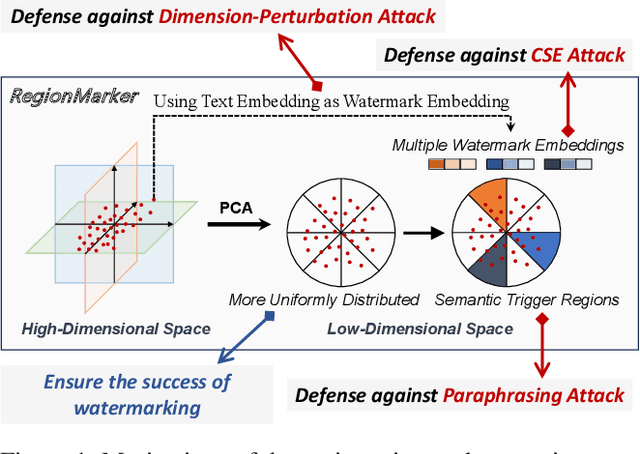
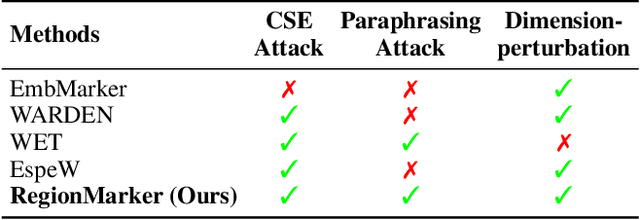
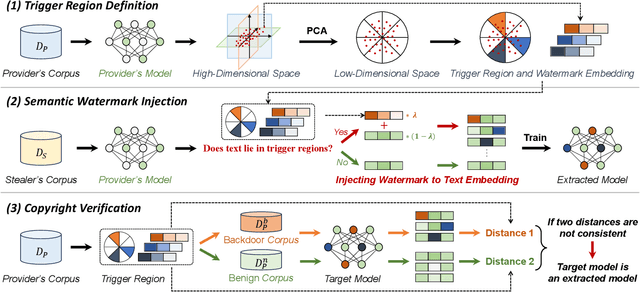
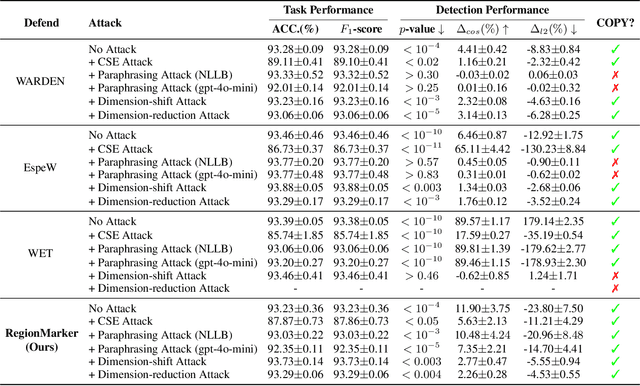
Embedding-as-a-Service (EaaS) is an effective and convenient deployment solution for addressing various NLP tasks. Nevertheless, recent research has shown that EaaS is vulnerable to model extraction attacks, which could lead to significant economic losses for model providers. For copyright protection, existing methods inject watermark embeddings into text embeddings and use them to detect copyright infringement. However, current watermarking methods often resist only a subset of attacks and fail to provide \textit{comprehensive} protection. To this end, we present the region-triggered semantic watermarking framework called RegionMarker, which defines trigger regions within a low-dimensional space and injects watermarks into text embeddings associated with these regions. By utilizing a secret dimensionality reduction matrix to project onto this subspace and randomly selecting trigger regions, RegionMarker makes it difficult for watermark removal attacks to evade detection. Furthermore, by embedding watermarks across the entire trigger region and using the text embedding as the watermark, RegionMarker is resilient to both paraphrasing and dimension-perturbation attacks. Extensive experiments on various datasets show that RegionMarker is effective in resisting different attack methods, thereby protecting the copyright of EaaS.
Steering When Necessary: Flexible Steering Large Language Models with Backtracking
Aug 25, 2025Large language models (LLMs) have achieved remarkable performance across many generation tasks. Nevertheless, effectively aligning them with desired behaviors remains a significant challenge. Activation steering is an effective and cost-efficient approach that directly modifies the activations of LLMs during the inference stage, aligning their responses with the desired behaviors and avoiding the high cost of fine-tuning. Existing methods typically indiscriminately intervene to all generations or rely solely on the question to determine intervention, which limits the accurate assessment of the intervention strength. To this end, we propose the Flexible Activation Steering with Backtracking (FASB) framework, which dynamically determines both the necessity and strength of intervention by tracking the internal states of the LLMs during generation, considering both the question and the generated content. Since intervening after detecting a deviation from the desired behavior is often too late, we further propose the backtracking mechanism to correct the deviated tokens and steer the LLMs toward the desired behavior. Extensive experiments on the TruthfulQA dataset and six multiple-choice datasets demonstrate that our method outperforms baselines. Our code will be released at https://github.com/gjw185/FASB.
Contrastive Prompting Enhances Sentence Embeddings in LLMs through Inference-Time Steering
May 19, 2025Extracting sentence embeddings from large language models (LLMs) is a practical direction, as it requires neither additional data nor fine-tuning. Previous studies usually focus on prompt engineering to guide LLMs to encode the core semantic information of the sentence into the embedding of the last token. However, the last token in these methods still encodes an excess of non-essential information, such as stop words, limiting its encoding capacity. To this end, we propose a Contrastive Prompting (CP) method that introduces an extra auxiliary prompt to elicit better sentence embedding. By contrasting with the auxiliary prompt, CP can steer existing prompts to encode the core semantics of the sentence, rather than non-essential information. CP is a plug-and-play inference-time intervention method that can be combined with various prompt-based methods. Extensive experiments on Semantic Textual Similarity (STS) tasks and downstream classification tasks demonstrate that our method can improve the performance of existing prompt-based methods across different LLMs. Our code will be released at https://github.com/zifengcheng/CP.