 Add to Chrome
 Add to Firefox
 Add to Edge
Bridging the Detection-to-Abstention Gap in Reasoning Models under Insufficient Information
May 27, 2026
We highlight a failure mode of large reasoning models on questions with insufficient information: models may recognize that a problem is under-specified, yet still continue reasoning and produce unsupported final answers instead of abstaining. We formalize this mismatch as the detection-to-abstention gap, where detected insufficiency fails to translate into final abstention. This gap is especially concerning in high-risk domains such as medical AI, where answers based on incomplete evidence can be more harmful than refusal. To close this gap, we propose Judge-Then-Solve (JTS), a trajectory-level reasoning-control framework that trains models to make an explicit answerability commitment before solution generation. Rather than treating abstention as a final-answer style, JTS casts it as a control decision: the model either proceeds to solve or terminates early based on its answerability judgment. We instantiate this policy through supervised warm-up and missing-premise reinforcement learning with consistency and length-shaping rewards. Experiments on dense and MoE reasoning models show that JTS substantially improves reliable abstention across datasets and pushes Abstention@Detection (A@D) to near-saturation, indicating that models not only detect missing information but also act on that detection. By terminating unanswerable trajectories immediately after the answerability judgment, JTS reduces unnecessary reasoning and improves inference efficiency when continued deliberation would amplify unsupported assumptions. We also observe that missing-premise training can alter reasoning behavior on difficult but answerable problems, reducing unproductive self-reflection. These results suggest that abstention under insufficient information is a key form of reasoning control for deploying reasoning models safely and efficiently.

MedMemoryBench: Benchmarking Agent Memory in Personalized Healthcare
May 12, 2026The large-scale deployment of personalized healthcare agents demands memory mechanisms that are exceptionally precise, safe, and capable of long-term clinical tracking. However, existing benchmarks primarily focus on daily open-domain conversations, failing to capture the high-stakes complexity of real-world medical applications. Motivated by the stringent production requirements of an industry-leading health management agent serving tens of millions of active users, we introduce MedMemoryBench. We develop a human-agent collaborative pipeline to synthesize highly realistic, long-horizon medical trajectories based on clinically grounded, synthetic patient archetypes. This process yields a massive, expertly validated dataset comprising approximately 2,000 sessions and 16,000 interaction turns. Crucially, MedMemoryBench departs from traditional static evaluations by pioneering an "evaluate-while-constructing" streaming assessment protocol, which precisely mirrors dynamic memory accumulation in production environments. Furthermore, we formalize and systematically investigate the critical phenomenon of memory saturation, where sustained information influx actively degrades retrieval and reasoning robustness. Comprehensive benchmarking reveals severe bottlenecks in mainstream architectures, particularly concerning complex medical reasoning and noise resilience. By exposing these fundamental flaws, MedMemoryBench establishes a vital foundation for developing robust, production-ready medical agents.
MedDialogRubrics: A Comprehensive Benchmark and Evaluation Framework for Multi-turn Medical Consultations in Large Language Models
Jan 07, 2026Medical conversational AI (AI) plays a pivotal role in the development of safer and more effective medical dialogue systems. However, existing benchmarks and evaluation frameworks for assessing the information-gathering and diagnostic reasoning abilities of medical large language models (LLMs) have not been rigorously evaluated. To address these gaps, we present MedDialogRubrics, a novel benchmark comprising 5,200 synthetically constructed patient cases and over 60,000 fine-grained evaluation rubrics generated by LLMs and subsequently refined by clinical experts, specifically designed to assess the multi-turn diagnostic capabilities of LLM. Our framework employs a multi-agent system to synthesize realistic patient records and chief complaints from underlying disease knowledge without accessing real-world electronic health records, thereby mitigating privacy and data-governance concerns. We design a robust Patient Agent that is limited to a set of atomic medical facts and augmented with a dynamic guidance mechanism that continuously detects and corrects hallucinations throughout the dialogue, ensuring internal coherence and clinical plausibility of the simulated cases. Furthermore, we propose a structured LLM-based and expert-annotated rubric-generation pipeline that retrieves Evidence-Based Medicine (EBM) guidelines and utilizes the reject sampling to derive a prioritized set of rubric items ("must-ask" items) for each case. We perform a comprehensive evaluation of state-of-the-art models and demonstrate that, across multiple assessment dimensions, current models face substantial challenges. Our results indicate that improving medical dialogue will require advances in dialogue management architectures, not just incremental tuning of the base-model.
Multi-Agent Deep Research: Training Multi-Agent Systems with M-GRPO
Nov 18, 2025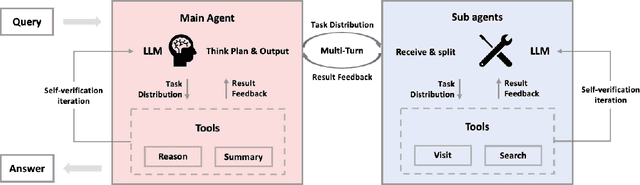
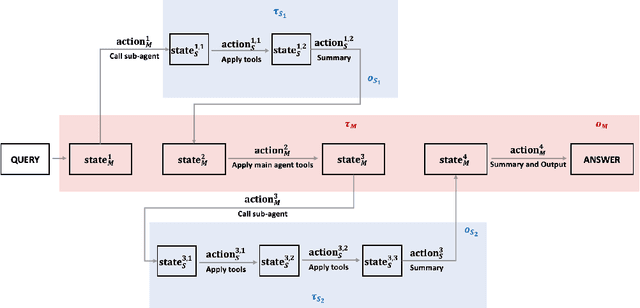
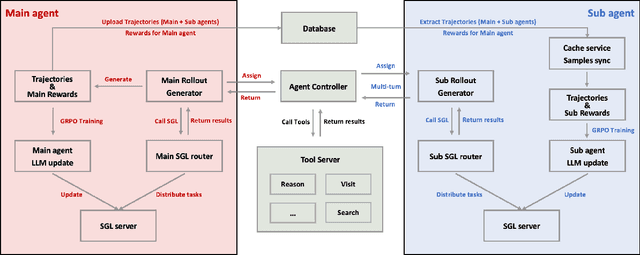
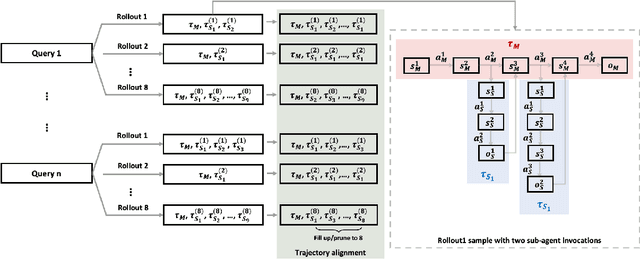
Multi-agent systems perform well on general reasoning tasks. However, the lack of training in specialized areas hinders their accuracy. Current training methods train a unified large language model (LLM) for all agents in the system. This may limit the performances due to different distributions underlying for different agents. Therefore, training multi-agent systems with distinct LLMs should be the next step to solve. However, this approach introduces optimization challenges. For example, agents operate at different frequencies, rollouts involve varying sub-agent invocations, and agents are often deployed across separate servers, disrupting end-to-end gradient flow. To address these issues, we propose M-GRPO, a hierarchical extension of Group Relative Policy Optimization designed for vertical Multi-agent systems with a main agent (planner) and multiple sub-agents (multi-turn tool executors). M-GRPO computes group-relative advantages for both main and sub-agents, maintaining hierarchical credit assignment. It also introduces a trajectory-alignment scheme that generates fixed-size batches despite variable sub-agent invocations. We deploy a decoupled training pipeline in which agents run on separate servers and exchange minimal statistics via a shared store. This enables scalable training without cross-server backpropagation. In experiments on real-world benchmarks (e.g., GAIA, XBench-DeepSearch, and WebWalkerQA), M-GRPO consistently outperforms both single-agent GRPO and multi-agent GRPO with frozen sub-agents, demonstrating improved stability and sample efficiency. These results show that aligning heterogeneous trajectories and decoupling optimization across specialized agents enhances tool-augmented reasoning tasks.
MedReseacher-R1: Expert-Level Medical Deep Researcher via A Knowledge-Informed Trajectory Synthesis Framework
Aug 20, 2025Recent developments in Large Language Model (LLM)-based agents have shown impressive capabilities spanning multiple domains, exemplified by deep research systems that demonstrate superior performance on complex information-seeking and synthesis tasks. While general-purpose deep research agents have shown impressive capabilities, they struggle significantly with medical domain challenges, as evidenced by leading proprietary systems achieving limited accuracy on complex medical benchmarks. The key limitations are: (1) the model lacks sufficient dense medical knowledge for clinical reasoning, and (2) the framework is constrained by the absence of specialized retrieval tools tailored for medical contexts.We present a medical deep research agent that addresses these challenges through two core innovations. First, we develop a novel data synthesis framework using medical knowledge graphs, extracting the longest chains from subgraphs around rare medical entities to generate complex multi-hop question-answer pairs. Second, we integrate a custom-built private medical retrieval engine alongside general-purpose tools, enabling accurate medical information synthesis. Our approach generates 2100+ diverse trajectories across 12 medical specialties, each averaging 4.2 tool interactions.Through a two-stage training paradigm combining supervised fine-tuning and online reinforcement learning with composite rewards, our MedResearcher-R1-32B model demonstrates exceptional performance, establishing new state-of-the-art results on medical benchmarks while maintaining competitive performance on general deep research tasks. Our work demonstrates that strategic domain-specific innovations in architecture, tool design, and training data construction can enable smaller open-source models to outperform much larger proprietary systems in specialized domains.
Learning to Align, Aligning to Learn: A Unified Approach for Self-Optimized Alignment
Aug 11, 2025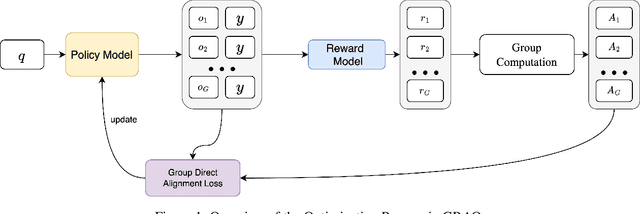
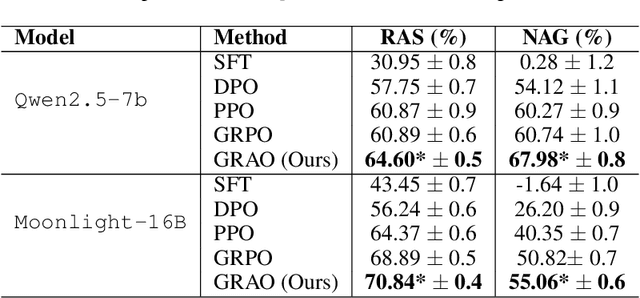
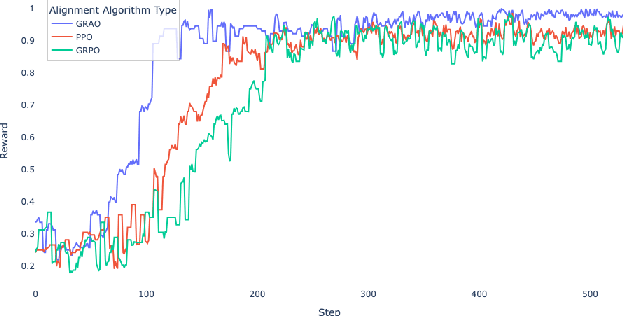
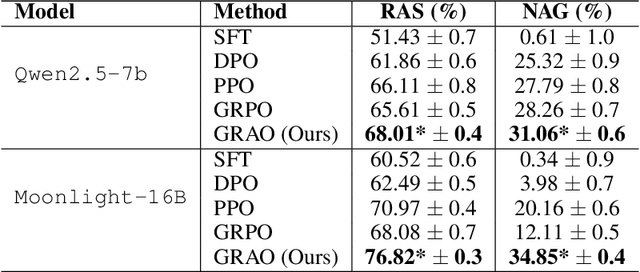
Alignment methodologies have emerged as a critical pathway for enhancing language model alignment capabilities. While SFT (supervised fine-tuning) accelerates convergence through direct token-level loss intervention, its efficacy is constrained by offline policy trajectory. In contrast, RL(reinforcement learning) facilitates exploratory policy optimization, but suffers from low sample efficiency and stringent dependency on high-quality base models. To address these dual challenges, we propose GRAO (Group Relative Alignment Optimization), a unified framework that synergizes the respective strengths of SFT and RL through three key innovations: 1) A multi-sample generation strategy enabling comparative quality assessment via reward feedback; 2) A novel Group Direct Alignment Loss formulation leveraging intra-group relative advantage weighting; 3) Reference-aware parameter updates guided by pairwise preference dynamics. Our theoretical analysis establishes GRAO's convergence guarantees and sample efficiency advantages over conventional approaches. Comprehensive evaluations across complex human alignment tasks demonstrate GRAO's superior performance, achieving 57.70\%,17.65\% 7.95\% and 5.18\% relative improvements over SFT, DPO, PPO and GRPO baselines respectively. This work provides both a theoretically grounded alignment framework and empirical evidence for efficient capability evolution in language models.