 Add to Chrome
 Add to Firefox
 Add to Edge
MoEUT: Mixture-of-Experts Universal Transformers
May 25, 2024
Previous work on Universal Transformers (UTs) has demonstrated the importance of parameter sharing across layers. By allowing recurrence in depth, UTs have advantages over standard Transformers in learning compositional generalizations, but layer-sharing comes with a practical limitation of parameter-compute ratio: it drastically reduces the parameter count compared to the non-shared model with the same dimensionality. Naively scaling up the layer size to compensate for the loss of parameters makes its computational resource requirements prohibitive. In practice, no previous work has succeeded in proposing a shared-layer Transformer design that is competitive in parameter count-dominated tasks such as language modeling. Here we propose MoEUT (pronounced "moot"), an effective mixture-of-experts (MoE)-based shared-layer Transformer architecture, which combines several recent advances in MoEs for both feedforward and attention layers of standard Transformers together with novel layer-normalization and grouping schemes that are specific and crucial to UTs. The resulting UT model, for the first time, slightly outperforms standard Transformers on language modeling tasks such as BLiMP and PIQA, while using significantly less compute and memory.

Semgrex and Ssurgeon, Searching and Manipulating Dependency Graphs
Apr 24, 2024
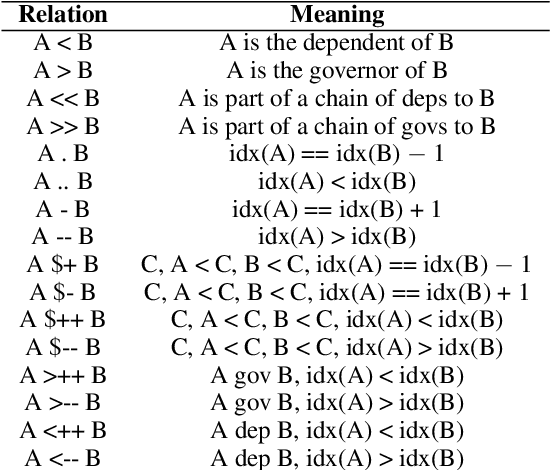
Searching dependency graphs and manipulating them can be a time consuming and challenging task to get right. We document Semgrex, a system for searching dependency graphs, and introduce Ssurgeon, a system for manipulating the output of Semgrex. The compact language used by these systems allows for easy command line or API processing of dependencies. Additionally, integration with publicly released toolkits in Java and Python allows for searching text relations and attributes over natural text.
Assessing The Potential Of Mid-Sized Language Models For Clinical QA
Apr 24, 2024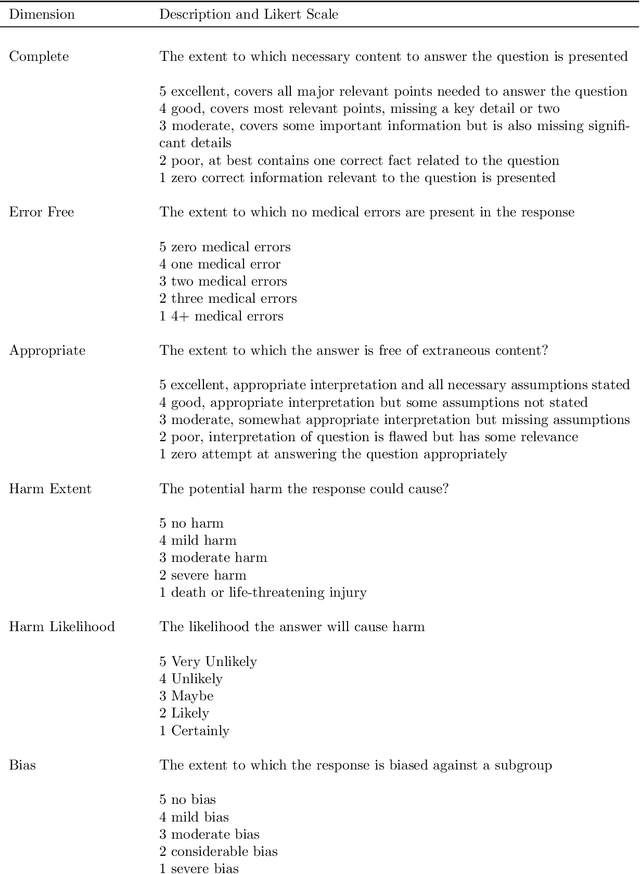
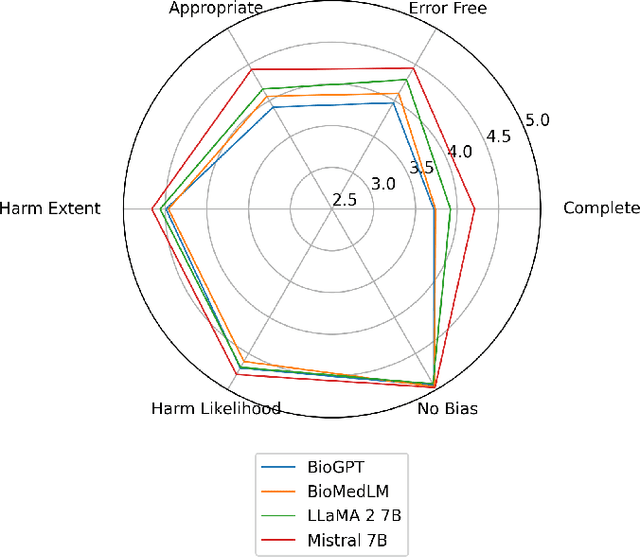
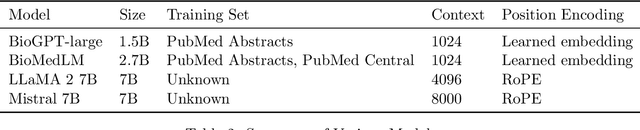
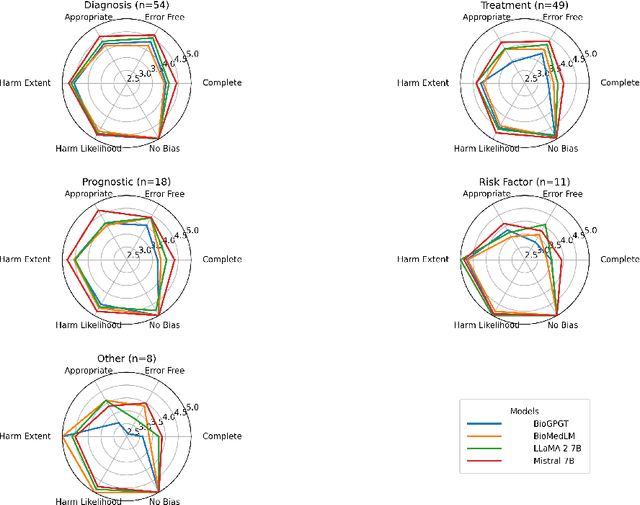
Large language models, such as GPT-4 and Med-PaLM, have shown impressive performance on clinical tasks; however, they require access to compute, are closed-source, and cannot be deployed on device. Mid-size models such as BioGPT-large, BioMedLM, LLaMA 2, and Mistral 7B avoid these drawbacks, but their capacity for clinical tasks has been understudied. To help assess their potential for clinical use and help researchers decide which model they should use, we compare their performance on two clinical question-answering (QA) tasks: MedQA and consumer query answering. We find that Mistral 7B is the best performing model, winning on all benchmarks and outperforming models trained specifically for the biomedical domain. While Mistral 7B's MedQA score of 63.0% approaches the original Med-PaLM, and it often can produce plausible responses to consumer health queries, room for improvement still exists. This study provides the first head-to-head assessment of open source mid-sized models on clinical tasks.
ReFT: Representation Finetuning for Language Models
Apr 08, 2024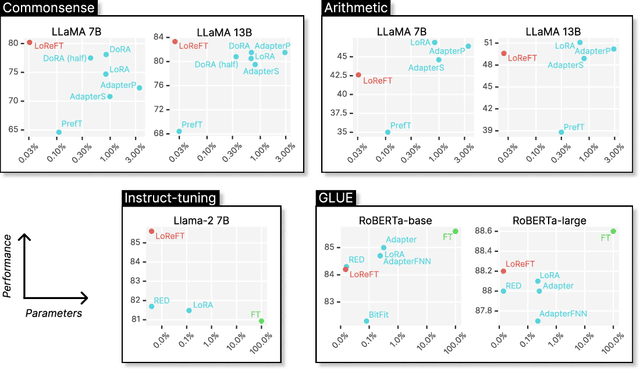
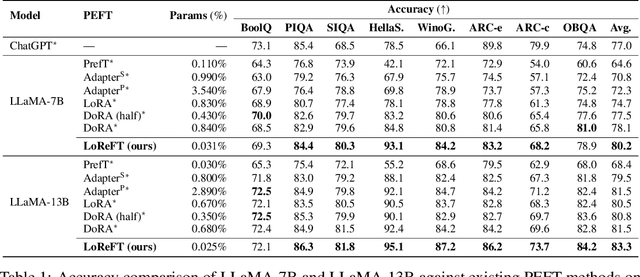
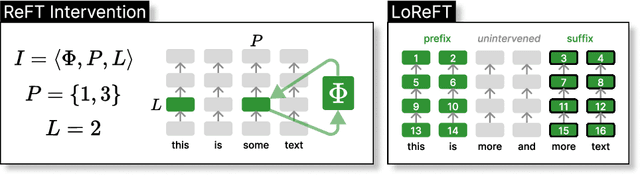
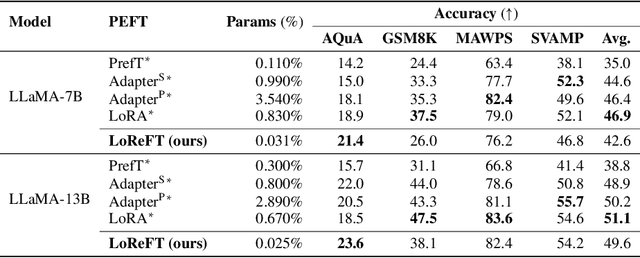
Parameter-efficient fine-tuning (PEFT) methods seek to adapt large models via updates to a small number of weights. However, much prior interpretability work has shown that representations encode rich semantic information, suggesting that editing representations might be a more powerful alternative. Here, we pursue this hypothesis by developing a family of $\textbf{Representation Finetuning (ReFT)}$ methods. ReFT methods operate on a frozen base model and learn task-specific interventions on hidden representations. We define a strong instance of the ReFT family, Low-rank Linear Subspace ReFT (LoReFT). LoReFT is a drop-in replacement for existing PEFTs and learns interventions that are 10x-50x more parameter-efficient than prior state-of-the-art PEFTs. We showcase LoReFT on eight commonsense reasoning tasks, four arithmetic reasoning tasks, Alpaca-Eval v1.0, and GLUE. In all these evaluations, LoReFT delivers the best balance of efficiency and performance, and almost always outperforms state-of-the-art PEFTs. We release a generic ReFT training library publicly at https://github.com/stanfordnlp/pyreft.
BioMedLM: A 2.7B Parameter Language Model Trained On Biomedical Text
Mar 27, 2024Models such as GPT-4 and Med-PaLM 2 have demonstrated impressive performance on a wide variety of biomedical NLP tasks. However, these models have hundreds of billions of parameters, are computationally expensive to run, require users to send their input data over the internet, and are trained on unknown data sources. Can smaller, more targeted models compete? To address this question, we build and release BioMedLM, a 2.7 billion parameter GPT-style autoregressive model trained exclusively on PubMed abstracts and full articles. When fine-tuned, BioMedLM can produce strong multiple-choice biomedical question-answering results competitive with much larger models, such as achieving a score of 57.3% on MedMCQA (dev) and 69.0% on the MMLU Medical Genetics exam. BioMedLM can also be fine-tuned to produce useful answers to patient questions on medical topics. This demonstrates that smaller models can potentially serve as transparent, privacy-preserving, economical and environmentally friendly foundations for particular NLP applications, such as in biomedicine. The model is available on the Hugging Face Hub: https://huggingface.co/stanford-crfm/BioMedLM.
pyvene: A Library for Understanding and Improving PyTorch Models via Interventions
Mar 12, 2024


Interventions on model-internal states are fundamental operations in many areas of AI, including model editing, steering, robustness, and interpretability. To facilitate such research, we introduce $\textbf{pyvene}$, an open-source Python library that supports customizable interventions on a range of different PyTorch modules. $\textbf{pyvene}$ supports complex intervention schemes with an intuitive configuration format, and its interventions can be static or include trainable parameters. We show how $\textbf{pyvene}$ provides a unified and extensible framework for performing interventions on neural models and sharing the intervened upon models with others. We illustrate the power of the library via interpretability analyses using causal abstraction and knowledge localization. We publish our library through Python Package Index (PyPI) and provide code, documentation, and tutorials at https://github.com/stanfordnlp/pyvene.
Model Editing with Canonical Examples
Feb 09, 2024
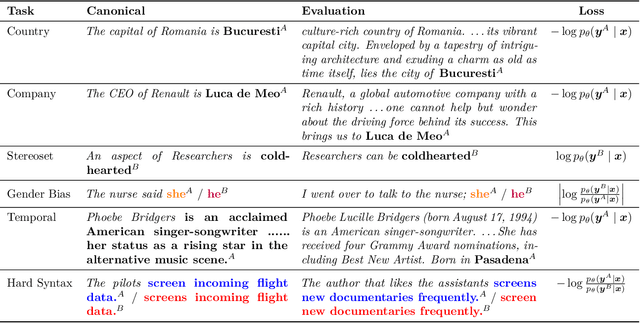

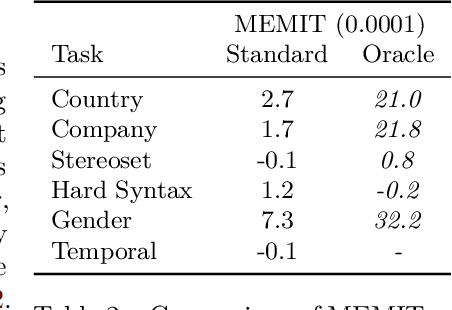
We introduce model editing with canonical examples, a setting in which (1) a single learning example is provided per desired behavior, (2) evaluation is performed exclusively out-of-distribution, and (3) deviation from an initial model is strictly limited. A canonical example is a simple instance of good behavior, e.g., The capital of Mauritius is Port Louis) or bad behavior, e.g., An aspect of researchers is coldhearted). The evaluation set contains more complex examples of each behavior (like a paragraph in which the capital of Mauritius is called for.) We create three datasets and modify three more for model editing with canonical examples, covering knowledge-intensive improvements, social bias mitigation, and syntactic edge cases. In our experiments on Pythia language models, we find that LoRA outperforms full finetuning and MEMIT. We then turn to the Backpack language model architecture because it is intended to enable targeted improvement. The Backpack defines a large bank of sense vectors--a decomposition of the different uses of each word--which are weighted and summed to form the output logits of the model. We propose sense finetuning, which selects and finetunes a few ($\approx$ 10) sense vectors for each canonical example, and find that it outperforms other finetuning methods, e.g., 4.8% improvement vs 0.3%. Finally, we improve GPT-J-6B by an inference-time ensemble with just the changes from sense finetuning of a 35x smaller Backpack, in one setting outperforming editing GPT-J itself (4.1% vs 1.0%).
RAPTOR: Recursive Abstractive Processing for Tree-Organized Retrieval
Jan 31, 2024Retrieval-augmented language models can better adapt to changes in world state and incorporate long-tail knowledge. However, most existing methods retrieve only short contiguous chunks from a retrieval corpus, limiting holistic understanding of the overall document context. We introduce the novel approach of recursively embedding, clustering, and summarizing chunks of text, constructing a tree with differing levels of summarization from the bottom up. At inference time, our RAPTOR model retrieves from this tree, integrating information across lengthy documents at different levels of abstraction. Controlled experiments show that retrieval with recursive summaries offers significant improvements over traditional retrieval-augmented LMs on several tasks. On question-answering tasks that involve complex, multi-step reasoning, we show state-of-the-art results; for example, by coupling RAPTOR retrieval with the use of GPT-4, we can improve the best performance on the QuALITY benchmark by 20% in absolute accuracy.
Multilingual self-supervised speech representations improve the speech recognition of low-resource African languages with codeswitching
Nov 25, 2023While many speakers of low-resource languages regularly code-switch between their languages and other regional languages or English, datasets of codeswitched speech are too small to train bespoke acoustic models from scratch or do language model rescoring. Here we propose finetuning self-supervised speech representations such as wav2vec 2.0 XLSR to recognize code-switched data. We find that finetuning self-supervised multilingual representations and augmenting them with n-gram language models trained from transcripts reduces absolute word error rates by up to 20% compared to baselines of hybrid models trained from scratch on code-switched data. Our findings suggest that in circumstances with limited training data finetuning self-supervised representations is a better performing and viable solution.
Fine-tuning Language Models for Factuality
Nov 14, 2023The fluency and creativity of large pre-trained language models (LLMs) have led to their widespread use, sometimes even as a replacement for traditional search engines. Yet language models are prone to making convincing but factually inaccurate claims, often referred to as 'hallucinations.' These errors can inadvertently spread misinformation or harmfully perpetuate misconceptions. Further, manual fact-checking of model responses is a time-consuming process, making human factuality labels expensive to acquire. In this work, we fine-tune language models to be more factual, without human labeling and targeting more open-ended generation settings than past work. We leverage two key recent innovations in NLP to do so. First, several recent works have proposed methods for judging the factuality of open-ended text by measuring consistency with an external knowledge base or simply a large model's confidence scores. Second, the direct preference optimization algorithm enables straightforward fine-tuning of language models on objectives other than supervised imitation, using a preference ranking over possible model responses. We show that learning from automatically generated factuality preference rankings, generated either through existing retrieval systems or our novel retrieval-free approach, significantly improves the factuality (percent of generated claims that are correct) of Llama-2 on held-out topics compared with RLHF or decoding strategies targeted at factuality. At 7B scale, compared to Llama-2-chat, we observe 58% and 40% reduction in factual error rate when generating biographies and answering medical questions, respectively.