 Add to Chrome
 Add to Firefox
 Add to Edge
Leptomeningeal Collateral Detection on DSA via Vessel-Graph Neural Networks
Jun 12, 2026
Leptomeningeal collaterals (LMCs) are an important prognostic factor in acute ischemic stroke. Existing automated methods rely on CT angiography (CTA), but individual LMCs are often too small to be resolved on CTA, limiting these methods to coarse collateral scoring. Digital subtraction angiography (DSA) visualizes individual collaterals at superior resolution, yet current assessment remains subjective, relying on manual grading scales that suffer from poor inter-rater agreement. We present a framework that formulates collateral detection as the classification of individual vessel segments on a graph derived from DSA. A hybrid graph-pixel architecture combines a topology-aware graph branch with a dense pixel branch, fused in a shared node-probability space. In a five-fold cross-validation setting, the fused model achieves a PR-AUC of 0.434, outperforming the graph-only (0.403) and pixel-only (0.362) baselines. To our knowledge, this is the first method to enable the individualization of LMCs in DSA, allowing for precise per-vessel quantitative assessment. This integration shifts DSA assessment toward objective evaluation, supporting future biomarker and pattern discovery for individual LMCs.

vesselFM-CT: Segmenting All Blood Vessels in CT Images for System-Level Cardiovascular Analysis
Jun 08, 2026The vascular network in the human body is characterized by blood vessels exhibiting drastic structural variations in radius, length, topological properties, and branching patterns. This heterogeneity, together with location-specific anatomical background variations, poses a significant challenge for robust, large-scale analysis of the entire cardiovascular system. As a result, most research has focused on narrow, isolated segments of the vascular network. While such targeted studies provide valuable insights, they inherently limit the ability to assess the systemic health and functional integrity of the vascular network as a whole. In this work, we aim to bridge this gap to advance both clinical diagnostics and our fundamental understanding of vascular physiology. We propose the task of segmenting all vessels in CT images, ranging from the largest components of the cardiovascular system to even minuscule mesenteric vessels. To this end, we introduce vesselFM-CT, the first model capable of robustly segmenting all blood vessels in 3D CT images. VesselFM-CT is trained via an iterative, multi-step process and optimizes our proposed TubeLoss loss function, effectively addressing the inherent heterogeneity of the cardiovascular system. We demonstrate that vesselFM-CT outperforms all baselines and enables automated, precise extraction of the cardiovascular system from CT images, thereby unlocking a wide range of clinical and technical perspectives, including automated disease classification and synthetic CT image generation.
Graph Energy Matching: Transport-Aligned Energy-Based Modeling for Graph Generation
Mar 24, 2026Energy-based models for discrete domains, such as graphs, explicitly capture relative likelihoods, naturally enabling composable probabilistic inference tasks like conditional generation or enforcing constraints at test-time. However, discrete energy-based models typically struggle with efficient and high-quality sampling, as off-support regions often contain spurious local minima, trapping samplers and causing training instabilities. This has historically resulted in a fidelity gap relative to discrete diffusion models. We introduce Graph Energy Matching (GEM), a generative framework for graphs that closes this fidelity gap. Motivated by the transport map optimization perspective of the Jordan-Kinderlehrer-Otto (JKO) scheme, GEM learns a permutation-invariant potential energy that simultaneously provides transport-aligned guidance from noise toward data and refines samples within regions of high data likelihood. Further, we introduce a sampling protocol that leverages an energy-based switch to seamlessly bridge: (i) rapid, gradient-guided transport toward high-probability regions to (ii) a mixing regime for exploration of the learned graph distribution. On molecular graph benchmarks, GEM matches or exceeds strong discrete diffusion baselines. Beyond sample quality, explicit modeling of relative likelihood enables targeted exploration at inference time, facilitating compositional generation, property-constrained sampling, and geodesic interpolation between graphs.
VesselTok: Tokenizing Vessel-like 3D Biomedical Graph Representations for Reconstruction and Generation
Mar 19, 2026Spatial graphs provide a lightweight and elegant representation of curvilinear anatomical structures such as blood vessels, lung airways, and neuronal networks. Accurately modeling these graphs is crucial in clinical and (bio-)medical research. However, the high spatial resolution of large networks drastically increases their complexity, resulting in significant computational challenges. In this work, we aim to tackle these challenges by proposing VesselTok, a framework that approaches spatially dense graphs from a parametric shape perspective to learn latent representations (tokens). VesselTok leverages centerline points with a pseudo radius to effectively encode tubular geometry. Specifically, we learn a novel latent representation conditioned on centerline points to encode neural implicit representations of vessel-like, tubular structures. We demonstrate VesselTok's performance across diverse anatomies, including lung airways, lung vessels, and brain vessels, highlighting its ability to robustly encode complex topologies. To prove the effectiveness of VesselTok's learnt latent representations, we show that they (i) generalize to unseen anatomies, (ii) support generative modeling of plausible anatomical graphs, and (iii) transfer effectively to downstream inverse problems, such as link prediction.
VariViT: A Vision Transformer for Variable Image Sizes
Feb 16, 2026Vision Transformers (ViTs) have emerged as the state-of-the-art architecture in representation learning, leveraging self-attention mechanisms to excel in various tasks. ViTs split images into fixed-size patches, constraining them to a predefined size and necessitating pre-processing steps like resizing, padding, or cropping. This poses challenges in medical imaging, particularly with irregularly shaped structures like tumors. A fixed bounding box crop size produces input images with highly variable foreground-to-background ratios. Resizing medical images can degrade information and introduce artefacts, impacting diagnosis. Hence, tailoring variable-sized crops to regions of interest can enhance feature representation capabilities. Moreover, large images are computationally expensive, and smaller sizes risk information loss, presenting a computation-accuracy tradeoff. We propose VariViT, an improved ViT model crafted to handle variable image sizes while maintaining a consistent patch size. VariViT employs a novel positional embedding resizing scheme for a variable number of patches. We also implement a new batching strategy within VariViT to reduce computational complexity, resulting in faster training and inference times. In our evaluations on two 3D brain MRI datasets, VariViT surpasses vanilla ViTs and ResNet in glioma genotype prediction and brain tumor classification. It achieves F1-scores of 75.5% and 76.3%, respectively, learning more discriminative features. Our proposed batching strategy reduces computation time by up to 30% compared to conventional architectures. These findings underscore the efficacy of VariViT in image representation learning. Our code can be found here: https://github.com/Aswathi-Varma/varivit
ProGiDiff: Prompt-Guided Diffusion-Based Medical Image Segmentation
Jan 22, 2026Widely adopted medical image segmentation methods, although efficient, are primarily deterministic and remain poorly amenable to natural language prompts. Thus, they lack the capability to estimate multiple proposals, human interaction, and cross-modality adaptation. Recently, text-to-image diffusion models have shown potential to bridge the gap. However, training them from scratch requires a large dataset-a limitation for medical image segmentation. Furthermore, they are often limited to binary segmentation and cannot be conditioned on a natural language prompt. To this end, we propose a novel framework called ProGiDiff that leverages existing image generation models for medical image segmentation purposes. Specifically, we propose a ControlNet-style conditioning mechanism with a custom encoder, suitable for image conditioning, to steer a pre-trained diffusion model to output segmentation masks. It naturally extends to a multi-class setting simply by prompting the target organ. Our experiment on organ segmentation from CT images demonstrates strong performance compared to previous methods and could greatly benefit from an expert-in-the-loop setting to leverage multiple proposals. Importantly, we demonstrate that the learned conditioning mechanism can be easily transferred through low-rank, few-shot adaptation to segment MR images.
3D Vessel Graph Generation Using Denoising Diffusion
Jul 08, 2024
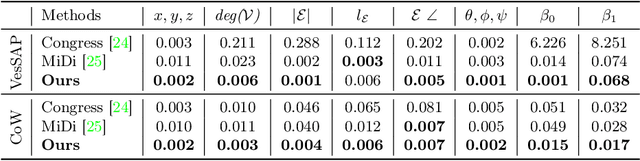


Blood vessel networks, represented as 3D graphs, help predict disease biomarkers, simulate blood flow, and aid in synthetic image generation, relevant in both clinical and pre-clinical settings. However, generating realistic vessel graphs that correspond to an anatomy of interest is challenging. Previous methods aimed at generating vessel trees mostly in an autoregressive style and could not be applied to vessel graphs with cycles such as capillaries or specific anatomical structures such as the Circle of Willis. Addressing this gap, we introduce the first application of \textit{denoising diffusion models} in 3D vessel graph generation. Our contributions include a novel, two-stage generation method that sequentially denoises node coordinates and edges. We experiment with two real-world vessel datasets, consisting of microscopic capillaries and major cerebral vessels, and demonstrate the generalizability of our method for producing diverse, novel, and anatomically plausible vessel graphs.
Self-pruning Graph Neural Network for Predicting Inflammatory Disease Activity in Multiple Sclerosis from Brain MR Images
Aug 31, 2023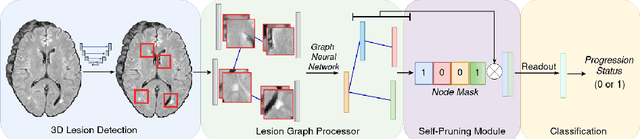
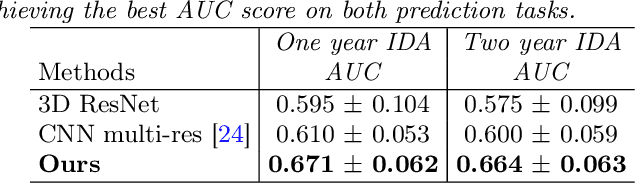
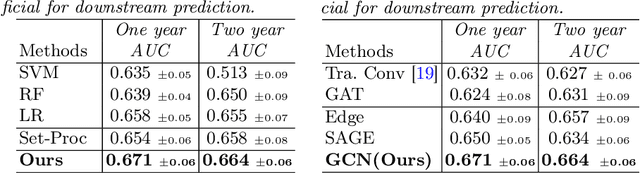
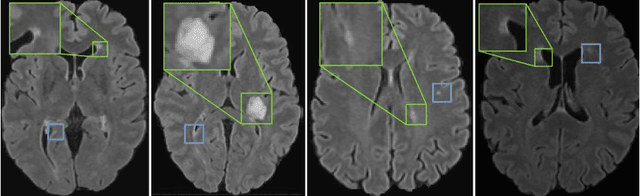
Multiple Sclerosis (MS) is a severe neurological disease characterized by inflammatory lesions in the central nervous system. Hence, predicting inflammatory disease activity is crucial for disease assessment and treatment. However, MS lesions can occur throughout the brain and vary in shape, size and total count among patients. The high variance in lesion load and locations makes it challenging for machine learning methods to learn a globally effective representation of whole-brain MRI scans to assess and predict disease. Technically it is non-trivial to incorporate essential biomarkers such as lesion load or spatial proximity. Our work represents the first attempt to utilize graph neural networks (GNN) to aggregate these biomarkers for a novel global representation. We propose a two-stage MS inflammatory disease activity prediction approach. First, a 3D segmentation network detects lesions, and a self-supervised algorithm extracts their image features. Second, the detected lesions are used to build a patient graph. The lesions act as nodes in the graph and are initialized with image features extracted in the first stage. Finally, the lesions are connected based on their spatial proximity and the inflammatory disease activity prediction is formulated as a graph classification task. Furthermore, we propose a self-pruning strategy to auto-select the most critical lesions for prediction. Our proposed method outperforms the existing baseline by a large margin (AUCs of 0.67 vs. 0.61 and 0.66 vs. 0.60 for one-year and two-year inflammatory disease activity, respectively). Finally, our proposed method enjoys inherent explainability by assigning an importance score to each lesion for the overall prediction. Code is available at https://github.com/chinmay5/ms_ida.git
Link Prediction for Flow-Driven Spatial Networks
Mar 25, 2023
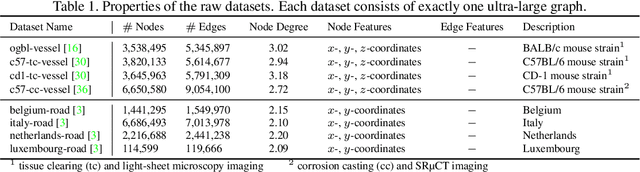
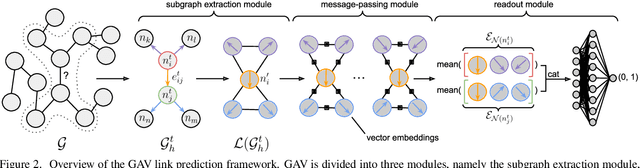
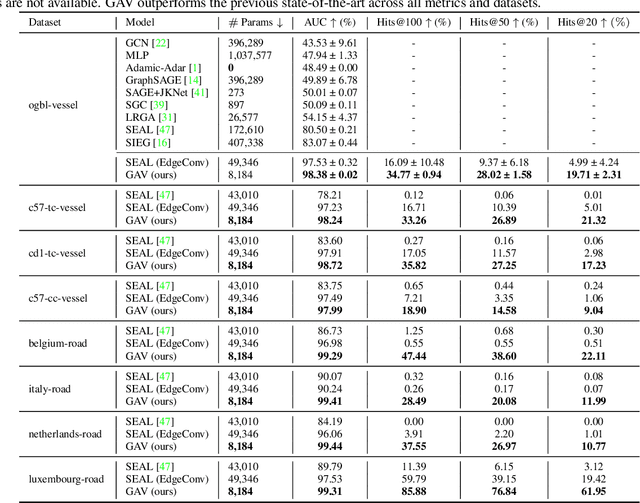
Link prediction algorithms predict the existence of connections between nodes in network-structured data and are typically applied to refine the connectivity among nodes by proposing meaningful new links. In this work, we focus on link prediction for flow-driven spatial networks, which are embedded in a Euclidean space and relate to physical exchange and transportation processes (e.g., blood flow in vessels or traffic flow in road networks). To this end, we propose the Graph Attentive Vectors (GAV) link prediction framework. GAV models simplified dynamics of physical flow in spatial networks via an attentive, neighborhood-aware message-passing paradigm, updating vector embeddings in a constrained manner. We evaluate GAV on eight flow-driven spatial networks given by whole-brain vessel graphs and road networks. GAV demonstrates superior performances across all datasets and metrics and outperforms the current state-of-the-art on the ogbl-vessel benchmark by more than 18% (98.38 vs. 83.07 AUC).
ViT-AE++: Improving Vision Transformer Autoencoder for Self-supervised Medical Image Representations
Jan 18, 2023Self-supervised learning has attracted increasing attention as it learns data-driven representation from data without annotations. Vision transformer-based autoencoder (ViT-AE) by He et al. (2021) is a recent self-supervised learning technique that employs a patch-masking strategy to learn a meaningful latent space. In this paper, we focus on improving ViT-AE (nicknamed ViT-AE++) for a more effective representation of both 2D and 3D medical images. We propose two new loss functions to enhance the representation during the training stage. The first loss term aims to improve self-reconstruction by considering the structured dependencies and hence indirectly improving the representation. The second loss term leverages contrastive loss to directly optimize the representation from two randomly masked views. As an independent contribution, we extended ViT-AE++ to a 3D fashion for volumetric medical images. We extensively evaluate ViT-AE++ on both natural images and medical images, demonstrating consistent improvement over vanilla ViT-AE and its superiority over other contrastive learning approaches.