 Add to Chrome
 Add to Firefox
 Add to Edge
Intracranial Aneurysm Classification and Segmentation via Tri-Axial ROI and Multi-Task Learning
Jun 25, 2026
Intracranial aneurysms are often asymptomatic until rupture, which carries high mortality. Rupture risk assessment and treatment planning depend on both aneurysm morphology and anatomical location, yet existing automated methods remain limited to binary detection without fine-grained anatomical classification or multi-class segmentation. We present a multi-task framework that simultaneously performs multi-label classification, multi-class aneurysm segmentation, and multi-class vessel segmentation across 13 anatomical locations and four imaging modalities (CTA, MRA, T2, T1-post). Our two-stage approach combines a fast 2D tri-axial Region of Interest (ROI) extraction method with a 3D multi-task nnU-Net backbone. A dual-decoder design mitigates the extreme volume imbalance between aneurysm and vessel classes, while cross-attention pooling and modality-specific auxiliary heads improve feature learning across heterogeneous inputs. Our two-fold ensemble achieved 2nd place in the RSNA 2025 Intracranial Aneurysm Detection challenge. Code, model weights, and a 3D Slicer plugin are publicly available.

ProGiDiff: Prompt-Guided Diffusion-Based Medical Image Segmentation
Jan 22, 2026Widely adopted medical image segmentation methods, although efficient, are primarily deterministic and remain poorly amenable to natural language prompts. Thus, they lack the capability to estimate multiple proposals, human interaction, and cross-modality adaptation. Recently, text-to-image diffusion models have shown potential to bridge the gap. However, training them from scratch requires a large dataset-a limitation for medical image segmentation. Furthermore, they are often limited to binary segmentation and cannot be conditioned on a natural language prompt. To this end, we propose a novel framework called ProGiDiff that leverages existing image generation models for medical image segmentation purposes. Specifically, we propose a ControlNet-style conditioning mechanism with a custom encoder, suitable for image conditioning, to steer a pre-trained diffusion model to output segmentation masks. It naturally extends to a multi-class setting simply by prompting the target organ. Our experiment on organ segmentation from CT images demonstrates strong performance compared to previous methods and could greatly benefit from an expert-in-the-loop setting to leverage multiple proposals. Importantly, we demonstrate that the learned conditioning mechanism can be easily transferred through low-rank, few-shot adaptation to segment MR images.
In search of truth: Evaluating concordance of AI-based anatomy segmentation models
Dec 17, 2025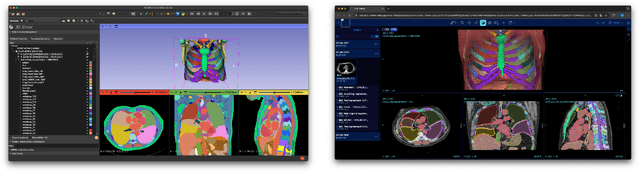

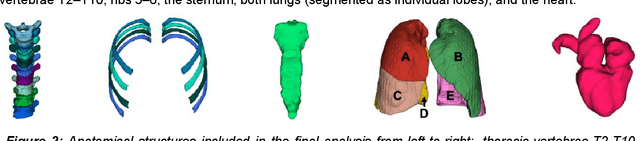
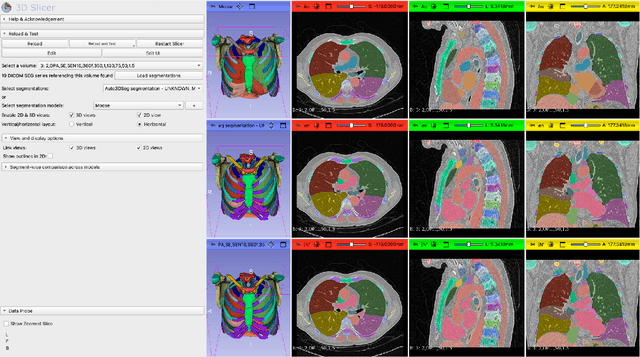
Purpose AI-based methods for anatomy segmentation can help automate characterization of large imaging datasets. The growing number of similar in functionality models raises the challenge of evaluating them on datasets that do not contain ground truth annotations. We introduce a practical framework to assist in this task. Approach We harmonize the segmentation results into a standard, interoperable representation, which enables consistent, terminology-based labeling of the structures. We extend 3D Slicer to streamline loading and comparison of these harmonized segmentations, and demonstrate how standard representation simplifies review of the results using interactive summary plots and browser-based visualization using OHIF Viewer. To demonstrate the utility of the approach we apply it to evaluating segmentation of 31 anatomical structures (lungs, vertebrae, ribs, and heart) by six open-source models - TotalSegmentator 1.5 and 2.6, Auto3DSeg, MOOSE, MultiTalent, and CADS - for a sample of Computed Tomography (CT) scans from the publicly available National Lung Screening Trial (NLST) dataset. Results We demonstrate the utility of the framework in enabling automating loading, structure-wise inspection and comparison across models. Preliminary results ascertain practical utility of the approach in allowing quick detection and review of problematic results. The comparison shows excellent agreement segmenting some (e.g., lung) but not all structures (e.g., some models produce invalid vertebrae or rib segmentations). Conclusions The resources developed are linked from https://imagingdatacommons.github.io/segmentation-comparison/ including segmentation harmonization scripts, summary plots, and visualization tools. This work assists in model evaluation in absence of ground truth, ultimately enabling informed model selection.
RIDE: Difficulty Evolving Perturbation with Item Response Theory for Mathematical Reasoning
Nov 06, 2025Large language models (LLMs) achieve high performance on mathematical reasoning, but these results can be inflated by training data leakage or superficial pattern matching rather than genuine reasoning. To this end, an adversarial perturbation-based evaluation is needed to measure true mathematical reasoning ability. Current rule-based perturbation methods often generate ill-posed questions and impede the systematic evaluation of question difficulty and the evolution of benchmarks. To bridge this gap, we propose RIDE, a novel adversarial question-rewriting framework that leverages Item Response Theory (IRT) to rigorously measure question difficulty and to generate intrinsically more challenging, well-posed variations of mathematical problems. We employ 35 LLMs to simulate students and build a difficulty ranker from their responses. This ranker provides a reward signal during reinforcement learning and guides a question-rewriting model to reformulate existing questions across difficulty levels. Applying RIDE to competition-level mathematical benchmarks yields perturbed versions that degrade advanced LLM performance, with experiments showing an average 21.73% drop across 26 models, thereby exposing limited robustness in mathematical reasoning and confirming the validity of our evaluation approach.
HALOS: Hallucination-free Organ Segmentation after Organ Resection Surgery
Mar 14, 2023The wide range of research in deep learning-based medical image segmentation pushed the boundaries in a multitude of applications. A clinically relevant problem that received less attention is the handling of scans with irregular anatomy, e.g., after organ resection. State-of-the-art segmentation models often lead to organ hallucinations, i.e., false-positive predictions of organs, which cannot be alleviated by oversampling or post-processing. Motivated by the increasing need to develop robust deep learning models, we propose HALOS for abdominal organ segmentation in MR images that handles cases after organ resection surgery. To this end, we combine missing organ classification and multi-organ segmentation tasks into a multi-task model, yielding a classification-assisted segmentation pipeline. The segmentation network learns to incorporate knowledge about organ existence via feature fusion modules. Extensive experiments on a small labeled test set and large-scale UK Biobank data demonstrate the effectiveness of our approach in terms of higher segmentation Dice scores and near-to-zero false positive prediction rate.