 Add to Chrome
 Add to Firefox
 Add to Edge
Offline Deep Q* Estimation with Diffusion Models
Aug 14, 2026
In offline RL, estimating the optimal action-value function $Q^*$ can be formulated as solving the optimal Bellman equation based solely on offline observations. A fundamental challenge is that the reward function and transition kernel are unknown, so the optimal Bellman operator is not directly observable from data. To address this issue, we propose a novel framework that decouples operator estimation from value function learning. In this approach, we first formulate conditional diffusion models to estimate the reward law and transition kernel, which induces a data-driven approximation of the optimal Bellman operator. We then plug these estimators into the Bellman equation and obtain a deep estimator of $Q^*$ by minimizing the empirical Bellman residual over a neural network function class. Theoretically, we first establish sharp nonasymptotic convergence rates for learning the optimal Bellman operator through an end-to-end analysis of conditional diffusion estimation in total variation distance. We then establish the oracle value-stage rate $\widetilde{\mathcal O}\bigl(n^{-\frac{2β}{d_x+d_a+2β}}\bigr)$ for the excess Bellman residual risk. Finally, under a concentrability condition, we translate this residual bound into an $L^2$ convergence rate of $\widetilde{\mathcal O}\bigl(n^{-\fracβ{d_x+d_a+2β}}\bigr)$ for the resulting deep estimator of $Q^*$, where $d_x$ and $d_a$ denote the dimensions of the state and action spaces, respectively, and $β$ denotes the Hölder smoothness index of $Q^*$. Importantly, our theoretical analysis does not rely on completeness assumptions commonly used in deep RL theory. Extensive numerical experiments demonstrate the effectiveness of the proposed method and its strong empirical performance.

CogVis: Must Open-Vocabulary Change Detection Perceive the Scene Anew for Every Query?
Aug 06, 2026Earth-surface monitoring requires change detection models capable of recognizing arbitrary semantic categories. Open-Vocabulary Change Detection (OVCD) addresses this need. However, existing methods often entangle temporal perception, semantic discrimination, and region verification, causing unstable results and redundant computation. Inspired by human visual change perception, we propose CogVis, a cognitive memory-guided framework that reformulates OVCD as a perception-memory-verification paradigm. CogVis first employs a Scene Change Perceptron (SCP) to extract a reusable, category-agnostic change prior from frozen bi-temporal features, thereby decoupling temporal evidence from semantic category decisions. A Semantic Memory Calibrator (SMC) then compensates for category-dependent score shifts by dynamically estimating an image-query-specific decision threshold. Finally, an Adaptive Region Filter (ARF) filters connected candidates using learned semantic, temporal, and structural reliability. Experiments on seven benchmarks spanning semantic change detection, binary change localization, and building-damage assessment show that CogVis achieves state-of-the-art performance across all evaluated datasets. By sharing scene-level change perception, CogVis further avoids repeating category-agnostic temporal perception across queries and improves inference throughput by 28.50%.
DIVE: Dynamic Iterative Visual Evidence Construction for Efficient Vision-Language Models
Aug 05, 2026Visual inputs in vision-language models (VLMs) are often encoded into substantially longer token sequences than text, making visual tokens a major bottleneck for efficient inference. Abundant recent methods address this bottleneck by scoring token importance and pruning low-scoring tokens in a single pass. However, one-shot scoring is insufficient because a token's prompt-relevant usefulness depends on the evidence already retained. Motivated by this insight, we introduce DIVE (Dynamic Iterative Visual Evidence Construction), a training-free framework that recasts visual-token pruning as dynamic evidence construction. DIVE repeatedly selects the remaining token with the highest residual-conditioned score, updates the visual and prompt residuals to discount the evidence already explained, and re-evaluates the remaining tokens. This select-update-re-evaluate process builds a retained set of complementary, prompt-relevant evidence. Experiments across eight image-understanding benchmarks show that DIVE consistently preserves performance across token budgets. With an 88.9% reduction in visual tokens, DIVE retains 98.2% of the uncompressed model's average performance. Code is available at https://github.com/Zhong-Chenchen/DIVE.git.
Advancing All-Weather Building Damage Mapping to the Instance Level: Outcomes and Insights from the 2026 Bright Challenge
Jul 23, 2026Rapid post-disaster response requires timely, building-level information on whether structures remain intact, are damaged, or are destroyed. Post-event optical imagery, however, may be unavailable because of cloud, smoke, or darkness. The Bright Challenge evaluated all-weather building damage mapping from a submeter-resolution pre-event optical image and a post-event SAR image. Participants were required to detect and delineate each building and assign exactly one of three mutually exclusive damage labels. The challenge extended the globally distributed \textsc{Bright} dataset with instance-level annotations for about 291,000 buildings across 16 disaster events spanning seven disaster types. The final phase was evaluated exclusively on two 2025 events absent from training: a wildfire event in California and a hurricane in Jamaica. A total of 157 participants made 1,289 submissions, and 46 teams entered the final phase. The two winning solutions achieved test mAPs of 0.182 and 0.181, approximately 8.7 times the public baseline of 0.021, but remained far below the best in-domain holdout score of 0.513. Across teams ranked in both phases, performance declined sharply and the rank order changed substantially. The two leading solutions independently favored modality-specific encoding, staged or late optical--SAR fusion, and an optical-dominant separation of building localization from damage recognition. The winning method additionally used scene-aware threshold adjustment and pseudo-label adaptation. These results identify cross-event generalization and stable severity discrimination as the principal remaining challenges. All data, annotations, baseline code, and winning solutions are publicly available at https://github.com/ChenHongruixuan/BRIGHT.
NebulaExp-8B: An Empirical Post-Training Pipeline via Full-Scale Ablation Research
Jun 25, 2026Post-training alignment determines the reasoning and human preference following capabilities of large language models, yet most existing works withhold detailed data construction, filtering rules and training recipes, which hinders community reproducibility and lightweight model optimization. This work presents NebulaExp, a fully transparent, ablation-driven post-training pipeline built on Qwen3-8B-base, covering two orthogonal model branches: general instruct model and complex reasoning-specialized model. We curate a raw corpus of 3.84M multi-source SFT samples and a 200K verifiable RL candidate pool, and design an end-to-end data processing stack including response distillation, multi-dimensional cross-verification filtering, fine-grained difficulty grading, task classification and diversity-aware sampling. For the Instruct branch, our three-stage optimized supervised fine-tuning approach NebulaExp-Ins-SFT improves the average benchmark score from the 55.01 baseline of Qwen3-8B-nothink to 60.99. GRPO reinforcement learning then further elevates the average score to 61.85. For the Reasoning branch, medium-difficulty GRPO RL improves average reasoning score from 73.88 to 75.17. To address RL's dependency on task verifiers, we systematically investigate single-teacher and multi-teacher OPD (MOPD): utilizing merely 4K instruction-following samples and outperforms RL baseline by 3.26 points on IFEval with +4.43 average overall gain; MOPD fuses four domain-specialist teachers with merely 10K samples, lifting average performance by 4.18 over the base model. This report provides a fully reproducible empirical post-training recipe for 8B-scale LLMs, and comprehensively dissects the capability trade-offs among instruction adherence, mathematical reasoning, code generation and general knowledge.
SenseBench: A Benchmark for Remote Sensing Low-Level Visual Perception and Description in Large Vision-Language Models
May 11, 2026Low-level visual perception underpins reliable remote sensing (RS) image analysis, yet current image quality assessment (IQA) methods output uninterpretable scalar scores rather than characterizing physics-driven RS degradations, deviating markedly from the diagnostic needs of RS experts. While Vision-Language Models (VLMs) present a compelling alternative by delivering language-grounded IQA, their visual priors are heavily biased toward ground-level natural images. Consequently, whether VLMs can overcome this domain gap to perceive and articulate RS artifacts remains insufficiently studied. To bridge this gap, we propose \textbf{SenseBench}, the first dedicated diagnostic benchmark for RS low-level visual perception and description. Driven by a physics-based hierarchical taxonomy that unifies both non-reference and reference-based paradigms, SenseBench features over 10K meticulously curated instances across 6 major and 22 fine-grained RS degradation categories. Specifically, two complementary protocols are designed for evaluation: objective low-level visual \textit{perception} and subjective diagnostic \textit{description}. Comprehensive evaluation of 29 state-of-the-art VLMs reveals not only skewed domain priors and multi-distortion collapse, but also \textit{fluency illusion} and a \textit{perception-description inversion} effect. We hope SenseBench provides a robust evaluation testbed and high-quality diagnostic data to advance the development of VLMs in RS low-level perception. Code and datasets are available \href{https://github.com/Zhong-Chenchen/SenseBench}{\textcolor{blue}{here}}.
Co-Sight: Enhancing LLM-Based Agents via Conflict-Aware Meta-Verification and Trustworthy Reasoning with Structured Facts
Oct 24, 2025Long-horizon reasoning in LLM-based agents often fails not from generative weakness but from insufficient verification of intermediate reasoning. Co-Sight addresses this challenge by turning reasoning into a falsifiable and auditable process through two complementary mechanisms: Conflict-Aware Meta-Verification (CAMV) and Trustworthy Reasoning with Structured Facts (TRSF). CAMV reformulates verification as conflict identification and targeted falsification, allocating computation only to disagreement hotspots among expert agents rather than to full reasoning chains. This bounds verification cost to the number of inconsistencies and improves efficiency and reliability. TRSF continuously organizes, validates, and synchronizes evidence across agents through a structured facts module. By maintaining verified, traceable, and auditable knowledge, it ensures that all reasoning is grounded in consistent, source-verified information and supports transparent verification throughout the reasoning process. Together, TRSF and CAMV form a closed verification loop, where TRSF supplies structured facts and CAMV selectively falsifies or reinforces them, yielding transparent and trustworthy reasoning. Empirically, Co-Sight achieves state-of-the-art accuracy on GAIA (84.4%) and Humanity's Last Exam (35.5%), and strong results on Chinese-SimpleQA (93.8%). Ablation studies confirm that the synergy between structured factual grounding and conflict-aware verification drives these improvements. Co-Sight thus offers a scalable paradigm for reliable long-horizon reasoning in LLM-based agents. Code is available at https://github.com/ZTE-AICloud/Co-Sight/tree/cosight2.0_benchmarks.
An End-to-End Reinforcement Learning Based Approach for Micro-View Order-Dispatching in Ride-Hailing
Aug 20, 2024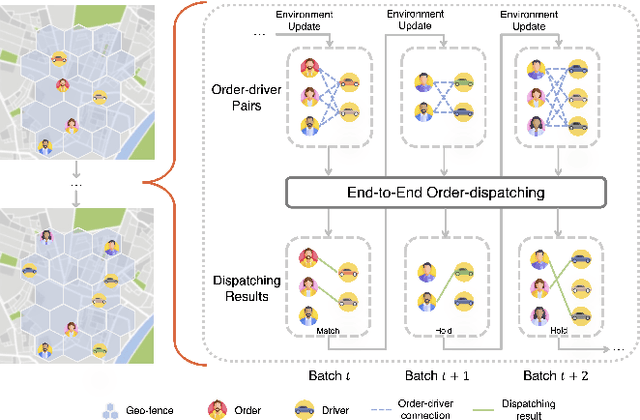

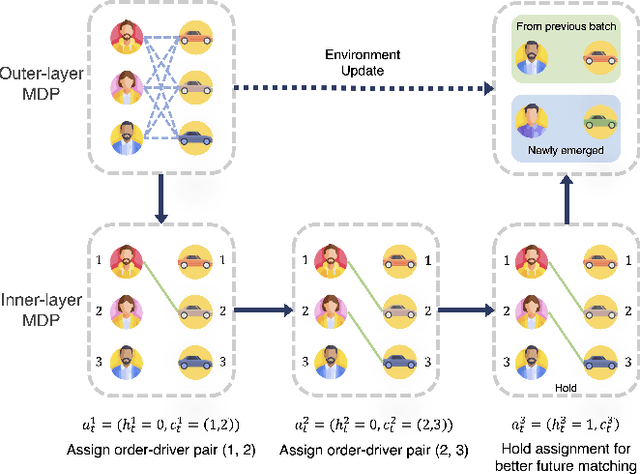

Assigning orders to drivers under localized spatiotemporal context (micro-view order-dispatching) is a major task in Didi, as it influences ride-hailing service experience. Existing industrial solutions mainly follow a two-stage pattern that incorporate heuristic or learning-based algorithms with naive combinatorial methods, tackling the uncertainty of both sides' behaviors, including emerging timings, spatial relationships, and travel duration, etc. In this paper, we propose a one-stage end-to-end reinforcement learning based order-dispatching approach that solves behavior prediction and combinatorial optimization uniformly in a sequential decision-making manner. Specifically, we employ a two-layer Markov Decision Process framework to model this problem, and present \underline{D}eep \underline{D}ouble \underline{S}calable \underline{N}etwork (D2SN), an encoder-decoder structure network to generate order-driver assignments directly and stop assignments accordingly. Besides, by leveraging contextual dynamics, our approach can adapt to the behavioral patterns for better performance. Extensive experiments on Didi's real-world benchmarks justify that the proposed approach significantly outperforms competitive baselines in optimizing matching efficiency and user experience tasks. In addition, we evaluate the deployment outline and discuss the gains and experiences obtained during the deployment tests from the view of large-scale engineering implementation.
Large Language Models Powered Context-aware Motion Prediction
Mar 17, 2024


Motion prediction is among the most fundamental tasks in autonomous driving. Traditional methods of motion forecasting primarily encode vector information of maps and historical trajectory data of traffic participants, lacking a comprehensive understanding of overall traffic semantics, which in turn affects the performance of prediction tasks. In this paper, we utilized Large Language Models (LLMs) to enhance the global traffic context understanding for motion prediction tasks. We first conducted systematic prompt engineering, visualizing complex traffic environments and historical trajectory information of traffic participants into image prompts -- Transportation Context Map (TC-Map), accompanied by corresponding text prompts. Through this approach, we obtained rich traffic context information from the LLM. By integrating this information into the motion prediction model, we demonstrate that such context can enhance the accuracy of motion predictions. Furthermore, considering the cost associated with LLMs, we propose a cost-effective deployment strategy: enhancing the accuracy of motion prediction tasks at scale with 0.7\% LLM-augmented datasets. Our research offers valuable insights into enhancing the understanding of traffic scenes of LLMs and the motion prediction performance of autonomous driving.
Anomaly Detection via Learning-Based Sequential Controlled Sensing
Nov 30, 2023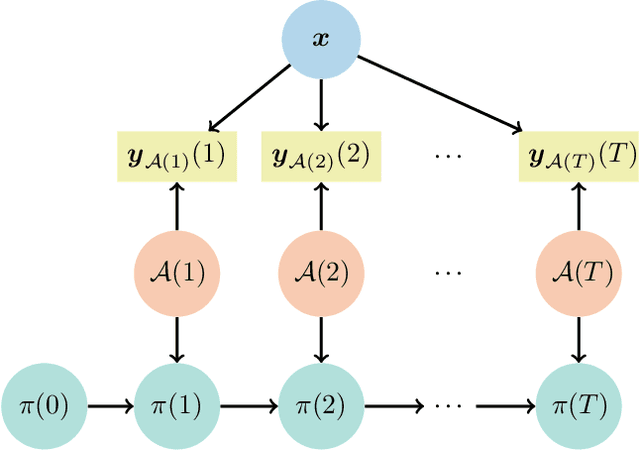
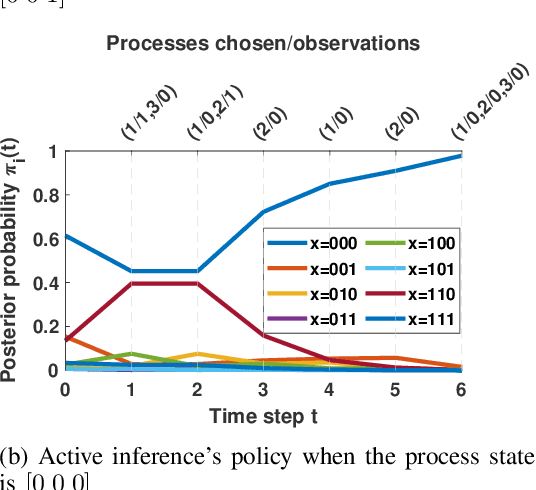
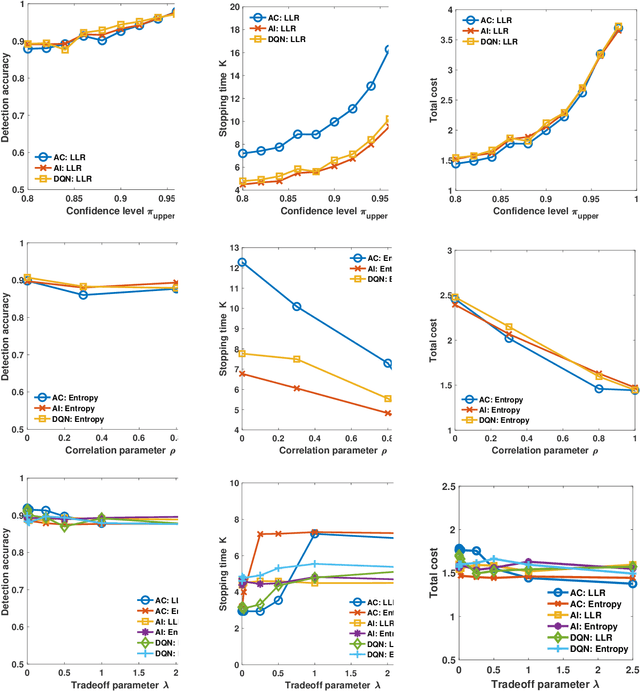
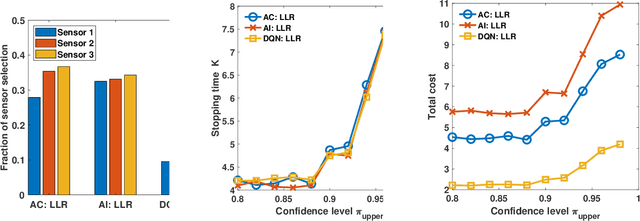
In this paper, we address the problem of detecting anomalies among a given set of binary processes via learning-based controlled sensing. Each process is parameterized by a binary random variable indicating whether the process is anomalous. To identify the anomalies, the decision-making agent is allowed to observe a subset of the processes at each time instant. Also, probing each process has an associated cost. Our objective is to design a sequential selection policy that dynamically determines which processes to observe at each time with the goal to minimize the delay in making the decision and the total sensing cost. We cast this problem as a sequential hypothesis testing problem within the framework of Markov decision processes. This formulation utilizes both a Bayesian log-likelihood ratio-based reward and an entropy-based reward. The problem is then solved using two approaches: 1) a deep reinforcement learning-based approach where we design both deep Q-learning and policy gradient actor-critic algorithms; and 2) a deep active inference-based approach. Using numerical experiments, we demonstrate the efficacy of our algorithms and show that our algorithms adapt to any unknown statistical dependence pattern of the processes.