 Add to Chrome
 Add to Firefox
 Add to Edge
SenseBench: A Benchmark for Remote Sensing Low-Level Visual Perception and Description in Large Vision-Language Models
May 11, 2026
Low-level visual perception underpins reliable remote sensing (RS) image analysis, yet current image quality assessment (IQA) methods output uninterpretable scalar scores rather than characterizing physics-driven RS degradations, deviating markedly from the diagnostic needs of RS experts. While Vision-Language Models (VLMs) present a compelling alternative by delivering language-grounded IQA, their visual priors are heavily biased toward ground-level natural images. Consequently, whether VLMs can overcome this domain gap to perceive and articulate RS artifacts remains insufficiently studied. To bridge this gap, we propose \textbf{SenseBench}, the first dedicated diagnostic benchmark for RS low-level visual perception and description. Driven by a physics-based hierarchical taxonomy that unifies both non-reference and reference-based paradigms, SenseBench features over 10K meticulously curated instances across 6 major and 22 fine-grained RS degradation categories. Specifically, two complementary protocols are designed for evaluation: objective low-level visual \textit{perception} and subjective diagnostic \textit{description}. Comprehensive evaluation of 29 state-of-the-art VLMs reveals not only skewed domain priors and multi-distortion collapse, but also \textit{fluency illusion} and a \textit{perception-description inversion} effect. We hope SenseBench provides a robust evaluation testbed and high-quality diagnostic data to advance the development of VLMs in RS low-level perception. Code and datasets are available \href{https://github.com/Zhong-Chenchen/SenseBench}{\textcolor{blue}{here}}.

COREval: A Comprehensive and Objective Benchmark for Evaluating the Remote Sensing Capabilities of Large Vision-Language Models
Nov 27, 2024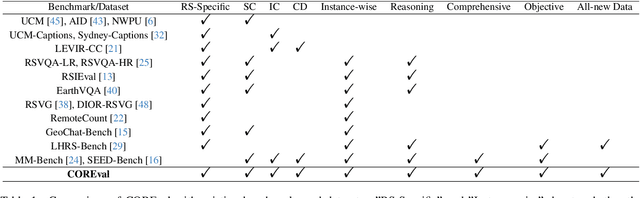
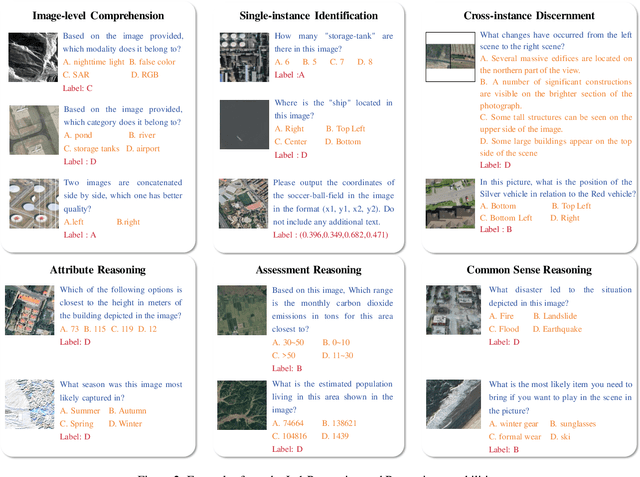
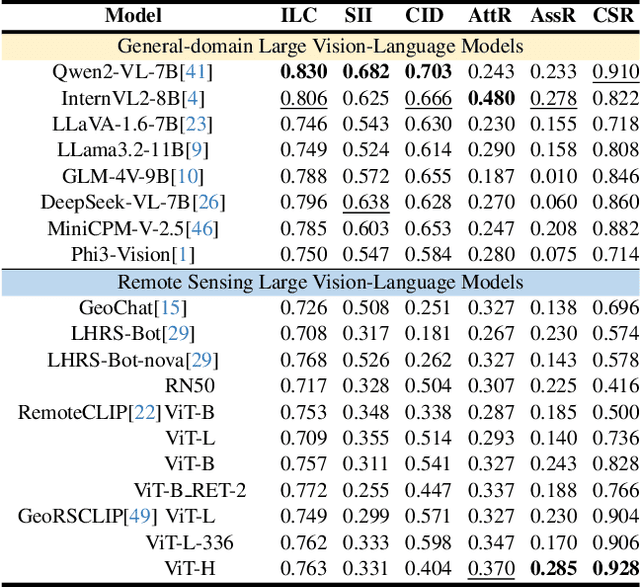
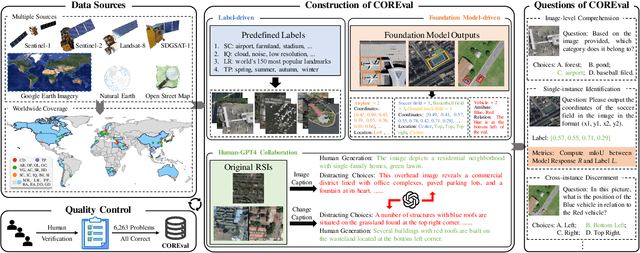
With the rapid development of Large Vision-Language Models (VLMs), both general-domain models and those specifically tailored for remote sensing Earth observation, have demonstrated exceptional perception and reasoning abilities within this specific field. However, the current absence of a comprehensive benchmark for holistically evaluating the remote sensing capabilities of these VLMs represents a significant gap. To bridge this gap, we propose COREval, the first benchmark designed to comprehensively and objectively evaluate the hierarchical remote sensing capabilities of VLMs. Concentrating on 2 primary capability dimensions essential to remote sensing: perception and reasoning, we further categorize 6 secondary dimensions and 22 leaf tasks to ensure a well-rounded assessment coverage for this specific field. COREval guarantees the quality of the total of 6,263 problems through a rigorous process of data collection from 50 globally distributed cities, question construction and quality control, and the format of multiple-choice questions with definitive answers allows for an objective and straightforward evaluation of VLM performance. We conducted a holistic evaluation of 13 prominent open-source VLMs from both the general and remote sensing domains, highlighting current shortcomings in their remote sensing capabilities and providing directions for improvements in their application within this specialized context. We hope that COREval will serve as a valuable resource and offer deeper insights into the challenges and potential of VLMs in the field of remote sensing.