 Add to Chrome
 Add to Firefox
 Add to Edge
DIVE: Dynamic Iterative Visual Evidence Construction for Efficient Vision-Language Models
Aug 05, 2026
Visual inputs in vision-language models (VLMs) are often encoded into substantially longer token sequences than text, making visual tokens a major bottleneck for efficient inference. Abundant recent methods address this bottleneck by scoring token importance and pruning low-scoring tokens in a single pass. However, one-shot scoring is insufficient because a token's prompt-relevant usefulness depends on the evidence already retained. Motivated by this insight, we introduce DIVE (Dynamic Iterative Visual Evidence Construction), a training-free framework that recasts visual-token pruning as dynamic evidence construction. DIVE repeatedly selects the remaining token with the highest residual-conditioned score, updates the visual and prompt residuals to discount the evidence already explained, and re-evaluates the remaining tokens. This select-update-re-evaluate process builds a retained set of complementary, prompt-relevant evidence. Experiments across eight image-understanding benchmarks show that DIVE consistently preserves performance across token budgets. With an 88.9% reduction in visual tokens, DIVE retains 98.2% of the uncompressed model's average performance. Code is available at https://github.com/Zhong-Chenchen/DIVE.git.

SenseBench: A Benchmark for Remote Sensing Low-Level Visual Perception and Description in Large Vision-Language Models
May 11, 2026Low-level visual perception underpins reliable remote sensing (RS) image analysis, yet current image quality assessment (IQA) methods output uninterpretable scalar scores rather than characterizing physics-driven RS degradations, deviating markedly from the diagnostic needs of RS experts. While Vision-Language Models (VLMs) present a compelling alternative by delivering language-grounded IQA, their visual priors are heavily biased toward ground-level natural images. Consequently, whether VLMs can overcome this domain gap to perceive and articulate RS artifacts remains insufficiently studied. To bridge this gap, we propose \textbf{SenseBench}, the first dedicated diagnostic benchmark for RS low-level visual perception and description. Driven by a physics-based hierarchical taxonomy that unifies both non-reference and reference-based paradigms, SenseBench features over 10K meticulously curated instances across 6 major and 22 fine-grained RS degradation categories. Specifically, two complementary protocols are designed for evaluation: objective low-level visual \textit{perception} and subjective diagnostic \textit{description}. Comprehensive evaluation of 29 state-of-the-art VLMs reveals not only skewed domain priors and multi-distortion collapse, but also \textit{fluency illusion} and a \textit{perception-description inversion} effect. We hope SenseBench provides a robust evaluation testbed and high-quality diagnostic data to advance the development of VLMs in RS low-level perception. Code and datasets are available \href{https://github.com/Zhong-Chenchen/SenseBench}{\textcolor{blue}{here}}.
Deep Superpixel-based Network for Blind Image Quality Assessment
Oct 13, 2021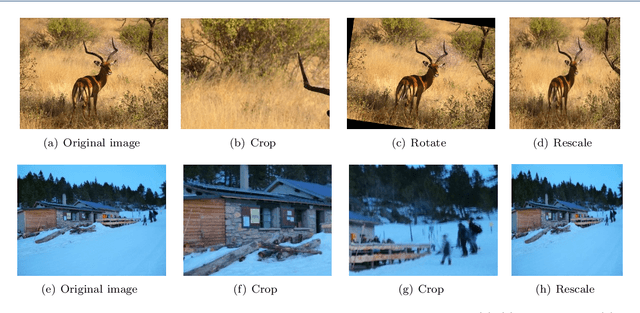

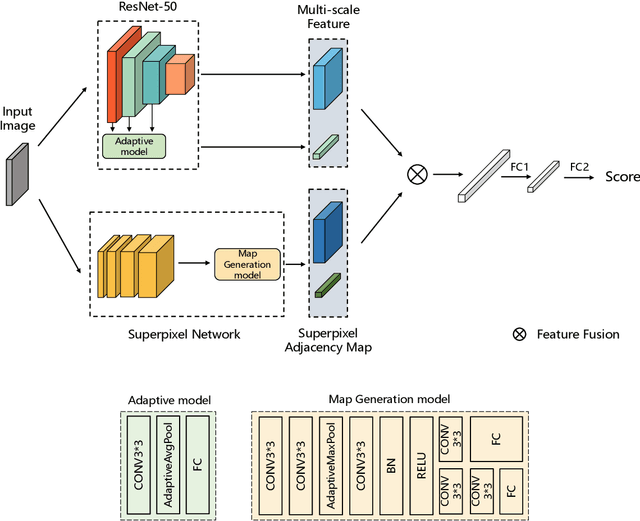
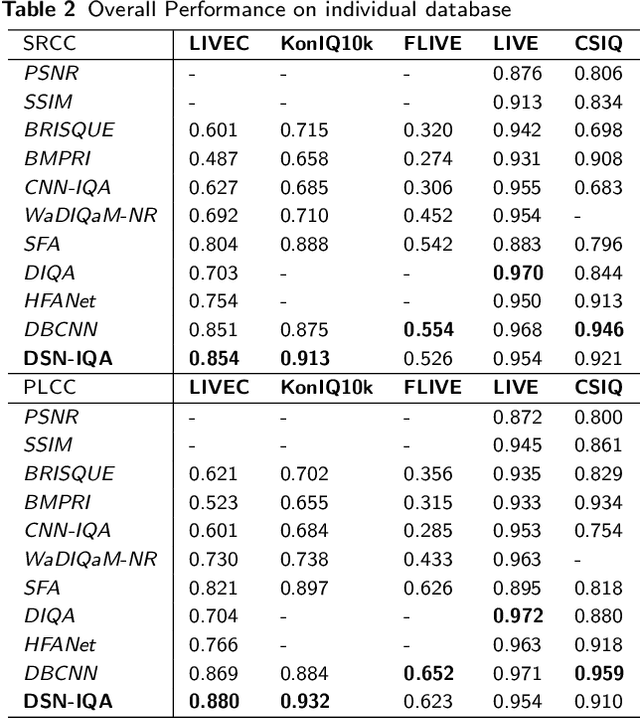
The goal in a blind image quality assessment (BIQA) model is to simulate the process of evaluating images by human eyes and accurately assess the quality of the image. Although many approaches effectively identify degradation, they do not fully consider the semantic content in images resulting in distortion. In order to fill this gap, we propose a deep adaptive superpixel-based network, namely DSN-IQA, to assess the quality of image based on multi-scale and superpixel segmentation. The DSN-IQA can adaptively accept arbitrary scale images as input images, making the assessment process similar to human perception. The network uses two models to extract multi-scale semantic features and generate a superpixel adjacency map. These two elements are united together via feature fusion to accurately predict image quality. Experimental results on different benchmark databases demonstrate that our algorithm is highly competitive with other approaches when assessing challenging authentic image databases. Also, due to adaptive deep superpixel-based network, our model accurately assesses images with complicated distortion, much like the human eye.
No-Reference Color Image Quality Assessment: From Entropy to Perceptual Quality
Dec 27, 2018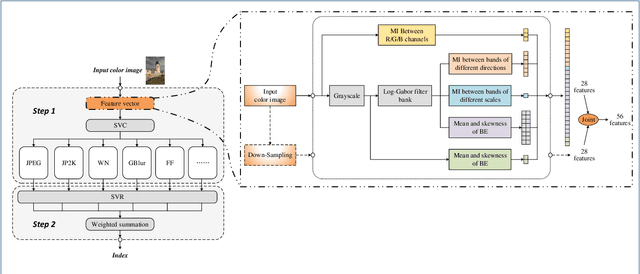

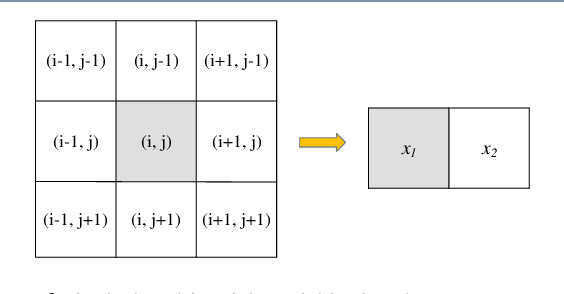
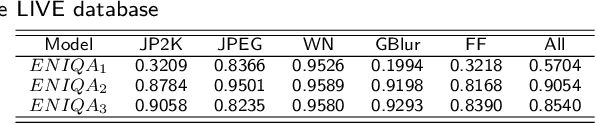
This paper presents a high-performance general-purpose no-reference (NR) image quality assessment (IQA) method based on image entropy. The image features are extracted from two domains. In the spatial domain, the mutual information between the color channels and the two-dimensional entropy are calculated. In the frequency domain, the two-dimensional entropy and the mutual information of the filtered sub-band images are computed as the feature set of the input color image. Then, with all the extracted features, the support vector classifier (SVC) for distortion classification and support vector regression (SVR) are utilized for the quality prediction, to obtain the final quality assessment score. The proposed method, which we call entropy-based no-reference image quality assessment (ENIQA), can assess the quality of different categories of distorted images, and has a low complexity. The proposed ENIQA method was assessed on the LIVE and TID2013 databases and showed a superior performance. The experimental results confirmed that the proposed ENIQA method has a high consistency of objective and subjective assessment on color images, which indicates the good overall performance and generalization ability of ENIQA. The source code is available on github https://github.com/jacob6/ENIQA.