 Add to Chrome
 Add to Firefox
 Add to Edge
Towards Generic Anomaly Detection and Understanding: Large-scale Visual-linguistic Model (GPT-4V) Takes the Lead
Nov 16, 2023
Anomaly detection is a crucial task across different domains and data types. However, existing anomaly detection models are often designed for specific domains and modalities. This study explores the use of GPT-4V(ision), a powerful visual-linguistic model, to address anomaly detection tasks in a generic manner. We investigate the application of GPT-4V in multi-modality, multi-domain anomaly detection tasks, including image, video, point cloud, and time series data, across multiple application areas, such as industrial, medical, logical, video, 3D anomaly detection, and localization tasks. To enhance GPT-4V's performance, we incorporate different kinds of additional cues such as class information, human expertise, and reference images as prompts.Based on our experiments, GPT-4V proves to be highly effective in detecting and explaining global and fine-grained semantic patterns in zero/one-shot anomaly detection. This enables accurate differentiation between normal and abnormal instances. Although we conducted extensive evaluations in this study, there is still room for future evaluation to further exploit GPT-4V's generic anomaly detection capacity from different aspects. These include exploring quantitative metrics, expanding evaluation benchmarks, incorporating multi-round interactions, and incorporating human feedback loops. Nevertheless, GPT-4V exhibits promising performance in generic anomaly detection and understanding, thus opening up a new avenue for anomaly detection.

Towards A Unified Neural Architecture for Visual Recognition and Reasoning
Nov 10, 2023
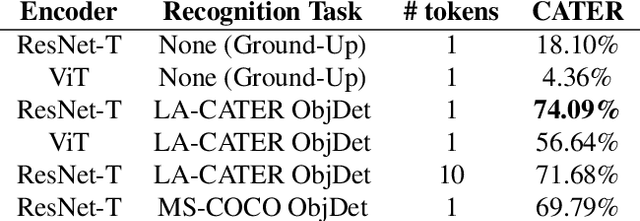
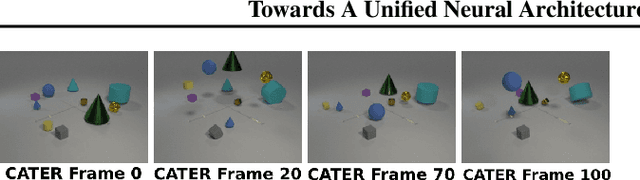
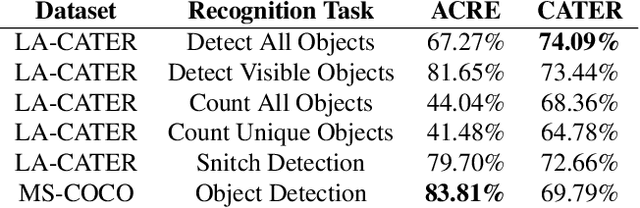
Recognition and reasoning are two pillars of visual understanding. However, these tasks have an imbalance in focus; whereas recent advances in neural networks have shown strong empirical performance in visual recognition, there has been comparably much less success in solving visual reasoning. Intuitively, unifying these two tasks under a singular framework is desirable, as they are mutually dependent and beneficial. Motivated by the recent success of multi-task transformers for visual recognition and language understanding, we propose a unified neural architecture for visual recognition and reasoning with a generic interface (e.g., tokens) for both. Our framework enables the principled investigation of how different visual recognition tasks, datasets, and inductive biases can help enable spatiotemporal reasoning capabilities. Noticeably, we find that object detection, which requires spatial localization of individual objects, is the most beneficial recognition task for reasoning. We further demonstrate via probing that implicit object-centric representations emerge automatically inside our framework. Intriguingly, we discover that certain architectural choices such as the backbone model of the visual encoder have a significant impact on visual reasoning, but little on object detection. Given the results of our experiments, we believe that visual reasoning should be considered as a first-class citizen alongside visual recognition, as they are strongly correlated but benefit from potentially different design choices.
Analyzing Modular Approaches for Visual Question Decomposition
Nov 10, 2023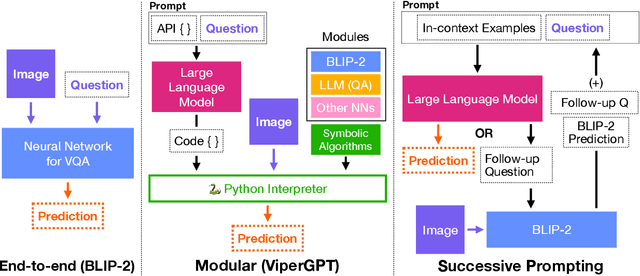
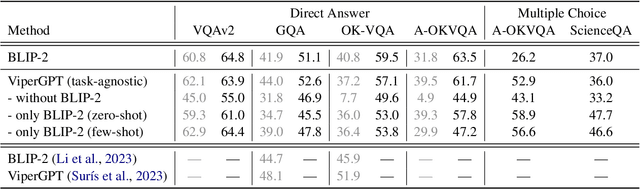

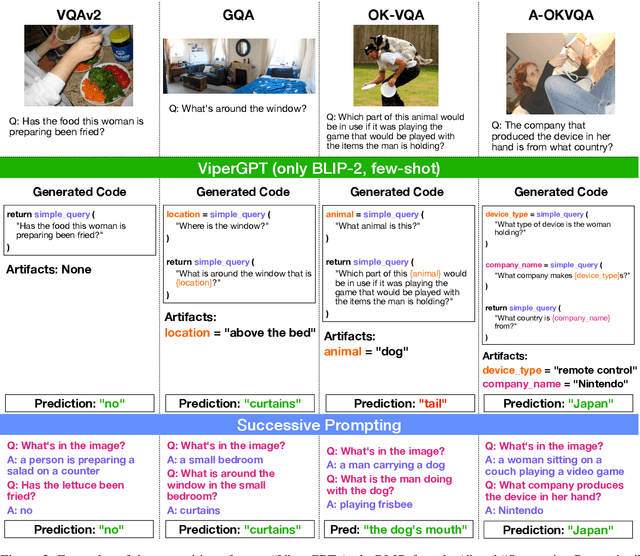
Modular neural networks without additional training have recently been shown to surpass end-to-end neural networks on challenging vision-language tasks. The latest such methods simultaneously introduce LLM-based code generation to build programs and a number of skill-specific, task-oriented modules to execute them. In this paper, we focus on ViperGPT and ask where its additional performance comes from and how much is due to the (state-of-art, end-to-end) BLIP-2 model it subsumes vs. additional symbolic components. To do so, we conduct a controlled study (comparing end-to-end, modular, and prompting-based methods across several VQA benchmarks). We find that ViperGPT's reported gains over BLIP-2 can be attributed to its selection of task-specific modules, and when we run ViperGPT using a more task-agnostic selection of modules, these gains go away. Additionally, ViperGPT retains much of its performance if we make prominent alterations to its selection of modules: e.g. removing or retaining only BLIP-2. Finally, we compare ViperGPT against a prompting-based decomposition strategy and find that, on some benchmarks, modular approaches significantly benefit by representing subtasks with natural language, instead of code.
Emergence of Abstract State Representations in Embodied Sequence Modeling
Nov 07, 2023Decision making via sequence modeling aims to mimic the success of language models, where actions taken by an embodied agent are modeled as tokens to predict. Despite their promising performance, it remains unclear if embodied sequence modeling leads to the emergence of internal representations that represent the environmental state information. A model that lacks abstract state representations would be liable to make decisions based on surface statistics which fail to generalize. We take the BabyAI environment, a grid world in which language-conditioned navigation tasks are performed, and build a sequence modeling Transformer, which takes a language instruction, a sequence of actions, and environmental observations as its inputs. In order to investigate the emergence of abstract state representations, we design a "blindfolded" navigation task, where only the initial environmental layout, the language instruction, and the action sequence to complete the task are available for training. Our probing results show that intermediate environmental layouts can be reasonably reconstructed from the internal activations of a trained model, and that language instructions play a role in the reconstruction accuracy. Our results suggest that many key features of state representations can emerge via embodied sequence modeling, supporting an optimistic outlook for applications of sequence modeling objectives to more complex embodied decision-making domains.
Object-centric Video Representation for Long-term Action Anticipation
Oct 31, 2023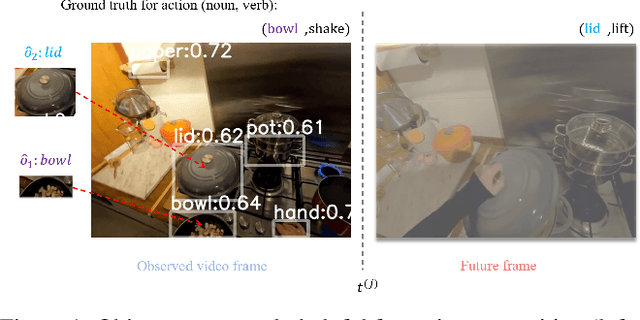
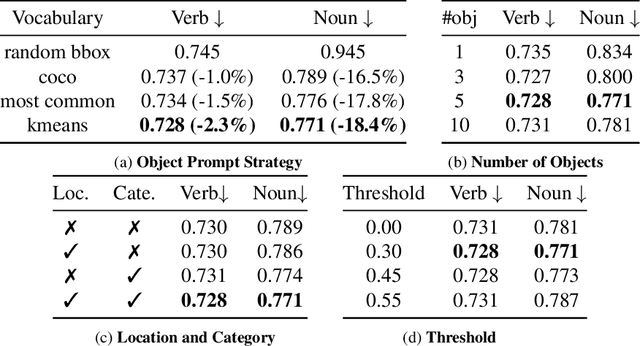
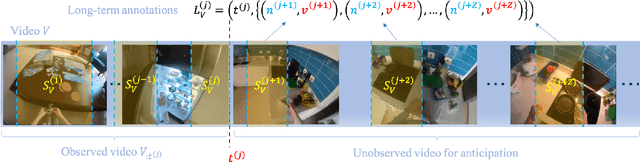
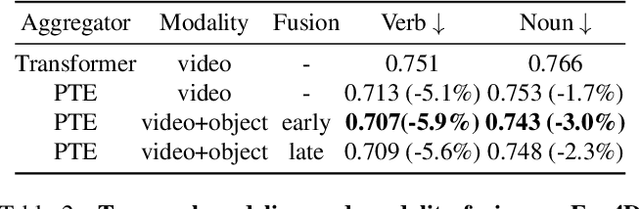
This paper focuses on building object-centric representations for long-term action anticipation in videos. Our key motivation is that objects provide important cues to recognize and predict human-object interactions, especially when the predictions are longer term, as an observed "background" object could be used by the human actor in the future. We observe that existing object-based video recognition frameworks either assume the existence of in-domain supervised object detectors or follow a fully weakly-supervised pipeline to infer object locations from action labels. We propose to build object-centric video representations by leveraging visual-language pretrained models. This is achieved by "object prompts", an approach to extract task-specific object-centric representations from general-purpose pretrained models without finetuning. To recognize and predict human-object interactions, we use a Transformer-based neural architecture which allows the "retrieval" of relevant objects for action anticipation at various time scales. We conduct extensive evaluations on the Ego4D, 50Salads, and EGTEA Gaze+ benchmarks. Both quantitative and qualitative results confirm the effectiveness of our proposed method.
Discrete, compositional, and symbolic representations through attractor dynamics
Oct 03, 2023Compositionality is an important feature of discrete symbolic systems, such as language and programs, as it enables them to have infinite capacity despite a finite symbol set. It serves as a useful abstraction for reasoning in both cognitive science and in AI, yet the interface between continuous and symbolic processing is often imposed by fiat at the algorithmic level, such as by means of quantization or a softmax sampling step. In this work, we explore how discretization could be implemented in a more neurally plausible manner through the modeling of attractor dynamics that partition the continuous representation space into basins that correspond to sequences of symbols. Building on established work in attractor networks and introducing novel training methods, we show that imposing structure in the symbolic space can produce compositionality in the attractor-supported representation space of rich sensory inputs. Lastly, we argue that our model exhibits the process of an information bottleneck that is thought to play a role in conscious experience, decomposing the rich information of a sensory input into stable components encoding symbolic information.
Delta-AI: Local objectives for amortized inference in sparse graphical models
Oct 03, 2023We present a new algorithm for amortized inference in sparse probabilistic graphical models (PGMs), which we call $\Delta$-amortized inference ($\Delta$-AI). Our approach is based on the observation that when the sampling of variables in a PGM is seen as a sequence of actions taken by an agent, sparsity of the PGM enables local credit assignment in the agent's policy learning objective. This yields a local constraint that can be turned into a local loss in the style of generative flow networks (GFlowNets) that enables off-policy training but avoids the need to instantiate all the random variables for each parameter update, thus speeding up training considerably. The $\Delta$-AI objective matches the conditional distribution of a variable given its Markov blanket in a tractable learned sampler, which has the structure of a Bayesian network, with the same conditional distribution under the target PGM. As such, the trained sampler recovers marginals and conditional distributions of interest and enables inference of partial subsets of variables. We illustrate $\Delta$-AI's effectiveness for sampling from synthetic PGMs and training latent variable models with sparse factor structure.
Evaluating the Generation Capabilities of Large Chinese Language Models
Aug 11, 2023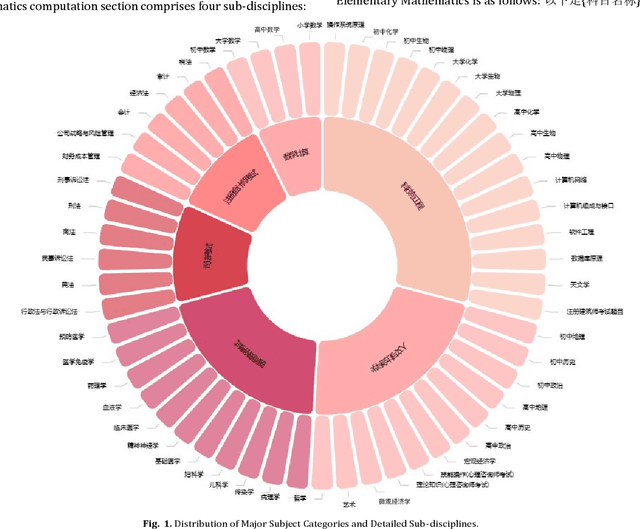
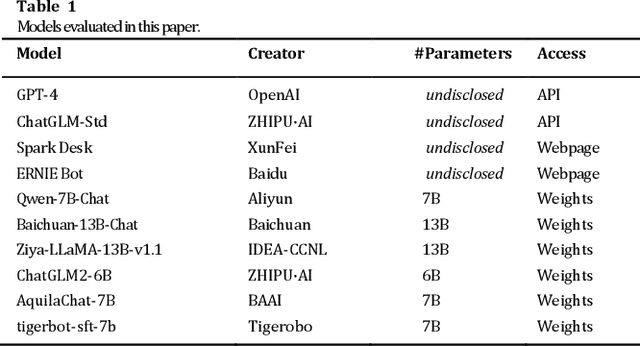
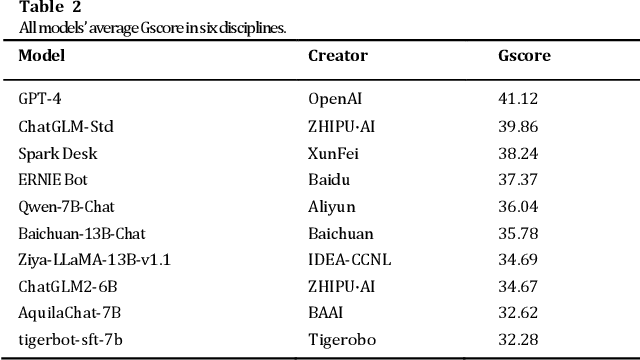
This paper presents CG-Eval, the first comprehensive evaluation of the generation capabilities of large Chinese language models across a wide range of academic disciplines. The models' performance was assessed based on their ability to generate accurate and relevant responses to different types of questions in six disciplines, namely, Science and Engineering, Humanities and Social Sciences, Mathematical Calculations, Medical Practitioner Qualification Examination, Judicial Examination, and Certified Public Accountant Examination. This paper also presents Gscore, a composite index derived from the weighted sum of multiple metrics to measure the quality of model's generation against a reference. The test data and test results can be found at http://cgeval.besteasy.com/.
AntGPT: Can Large Language Models Help Long-term Action Anticipation from Videos?
Jul 31, 2023Can we better anticipate an actor's future actions (e.g. mix eggs) by knowing what commonly happens after his/her current action (e.g. crack eggs)? What if we also know the longer-term goal of the actor (e.g. making egg fried rice)? The long-term action anticipation (LTA) task aims to predict an actor's future behavior from video observations in the form of verb and noun sequences, and it is crucial for human-machine interaction. We propose to formulate the LTA task from two perspectives: a bottom-up approach that predicts the next actions autoregressively by modeling temporal dynamics; and a top-down approach that infers the goal of the actor and plans the needed procedure to accomplish the goal. We hypothesize that large language models (LLMs), which have been pretrained on procedure text data (e.g. recipes, how-tos), have the potential to help LTA from both perspectives. It can help provide the prior knowledge on the possible next actions, and infer the goal given the observed part of a procedure, respectively. To leverage the LLMs, we propose a two-stage framework, AntGPT. It first recognizes the actions already performed in the observed videos and then asks an LLM to predict the future actions via conditioned generation, or to infer the goal and plan the whole procedure by chain-of-thought prompting. Empirical results on the Ego4D LTA v1 and v2 benchmarks, EPIC-Kitchens-55, as well as EGTEA GAZE+ demonstrate the effectiveness of our proposed approach. AntGPT achieves state-of-the-art performance on all above benchmarks, and can successfully infer the goal and thus perform goal-conditioned "counterfactual" prediction via qualitative analysis. Code and model will be released at https://brown-palm.github.io/AntGPT
Does Visual Pretraining Help End-to-End Reasoning?
Jul 17, 2023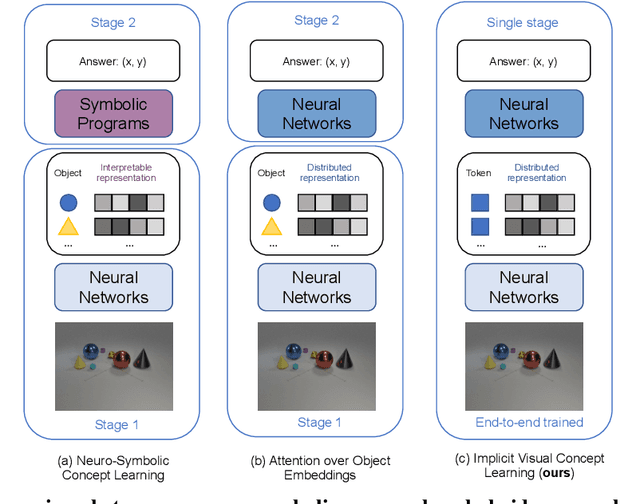

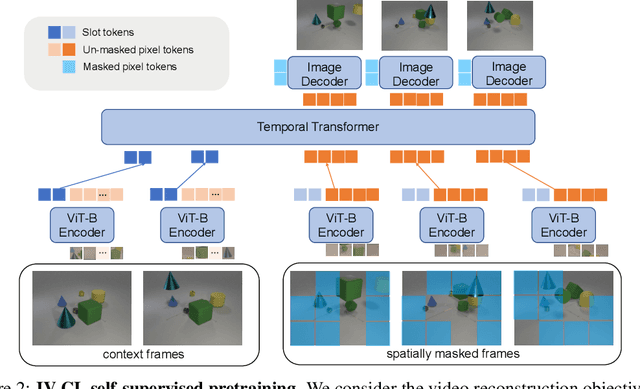

We aim to investigate whether end-to-end learning of visual reasoning can be achieved with general-purpose neural networks, with the help of visual pretraining. A positive result would refute the common belief that explicit visual abstraction (e.g. object detection) is essential for compositional generalization on visual reasoning, and confirm the feasibility of a neural network "generalist" to solve visual recognition and reasoning tasks. We propose a simple and general self-supervised framework which "compresses" each video frame into a small set of tokens with a transformer network, and reconstructs the remaining frames based on the compressed temporal context. To minimize the reconstruction loss, the network must learn a compact representation for each image, as well as capture temporal dynamics and object permanence from temporal context. We perform evaluation on two visual reasoning benchmarks, CATER and ACRE. We observe that pretraining is essential to achieve compositional generalization for end-to-end visual reasoning. Our proposed framework outperforms traditional supervised pretraining, including image classification and explicit object detection, by large margins.