 Add to Chrome
 Add to Firefox
 Add to Edge
Balancing the Reasoning Load: Difficulty-Differentiated Policy Optimization with Length Redistribution for Efficient and Robust Reinforcement Learning
Mar 19, 2026
Large Reasoning Models (LRMs) have shown exceptional reasoning capabilities, but they also suffer from the issue of overthinking, often generating excessively long and redundant answers. For problems that exceed the model's capabilities, LRMs tend to exhibit the overconfidence phenomenon, generating overly short but incorrect answers, which may contribute to suboptimal performance. To address these issues, we propose Difficulty-Differentiated Policy Optimization (DDPO), an efficient reinforcement learning algorithm that optimizes simple and complex tasks separately based on the overconfidence phenomenon. Specifically, it reduces the output length for simple tasks without compromising accuracy, while for complex tasks, it expands the exploration space to improve performance. We further derive the theoretical conditions for maximizing expected accuracy, which require the length distribution to closely approximate the optimal length and be as concentrated as possible. Based on these conditions, we propose using the difficulty-level average as a well-founded reference for length optimization. Extensive experiments on both in-domain and out-of-domain benchmarks validate the superiority and effectiveness of DDPO. Compared to GRPO, DDPO reduces the average answer length by 12% while improving accuracy by 1.85% across multiple benchmarks, achieving a better trade-off between accuracy and length. The code is available at https://github.com/Yinan-Xia/DDPO.

From the Inside Out: Progressive Distribution Refinement for Confidence Calibration
Mar 17, 2026Leveraging the model's internal information as the self-reward signal in Reinforcement Learning (RL) has received extensive attention due to its label-free nature. While prior works have made significant progress in applying the Test-Time Scaling (TTS) strategies to RL, the discrepancy in internal information between test and training remains inadequately addressed. Moreover, Test-Time Training based on voting-based TTS strategies often suffers from reward hacking problems. To address these issues, we propose DistriTTRL, which leverages the distribution prior of the model's confidence during RL to progressively optimize the reward signal, rather than relying solely on single-query rollouts. Additionally, we mitigate the phenomenon of consistent reward hacking caused by the voting-based TTS strategies through diversity-targeted penalties. Benefiting from this training mechanism where model capability and self-reward signals complement each other, and the mitigation of reward hacking, DistriTTRL has achieved significant performance improvements across multiple models and benchmarks.
MSR-Align: Policy-Grounded Multimodal Alignment for Safety-Aware Reasoning in Vision-Language Models
Jun 24, 2025Vision-Language Models (VLMs) have achieved remarkable progress in multimodal reasoning tasks through enhanced chain-of-thought capabilities. However, this advancement also introduces novel safety risks, as these models become increasingly vulnerable to harmful multimodal prompts that can trigger unethical or unsafe behaviors. Existing safety alignment approaches, primarily designed for unimodal language models, fall short in addressing the complex and nuanced threats posed by multimodal inputs. Moreover, current safety datasets lack the fine-grained, policy-grounded reasoning required to robustly align reasoning-capable VLMs. In this work, we introduce {MSR-Align}, a high-quality Multimodal Safety Reasoning dataset tailored to bridge this gap. MSR-Align supports fine-grained, deliberative reasoning over standardized safety policies across both vision and text modalities. Our data generation pipeline emphasizes multimodal diversity, policy-grounded reasoning, and rigorous quality filtering using strong multimodal judges. Extensive experiments demonstrate that fine-tuning VLMs on MSR-Align substantially improves robustness against both textual and vision-language jailbreak attacks, while preserving or enhancing general reasoning performance. MSR-Align provides a scalable and effective foundation for advancing the safety alignment of reasoning-capable VLMs. Our dataset is made publicly available at https://huggingface.co/datasets/Leigest/MSR-Align.
Dream-IF: Dynamic Relative EnhAnceMent for Image Fusion
Mar 13, 2025Image fusion aims to integrate comprehensive information from images acquired through multiple sources. However, images captured by diverse sensors often encounter various degradations that can negatively affect fusion quality. Traditional fusion methods generally treat image enhancement and fusion as separate processes, overlooking the inherent correlation between them; notably, the dominant regions in one modality of a fused image often indicate areas where the other modality might benefit from enhancement. Inspired by this observation, we introduce the concept of dominant regions for image enhancement and present a Dynamic Relative EnhAnceMent framework for Image Fusion (Dream-IF). This framework quantifies the relative dominance of each modality across different layers and leverages this information to facilitate reciprocal cross-modal enhancement. By integrating the relative dominance derived from image fusion, our approach supports not only image restoration but also a broader range of image enhancement applications. Furthermore, we employ prompt-based encoding to capture degradation-specific details, which dynamically steer the restoration process and promote coordinated enhancement in both multi-modal image fusion and image enhancement scenarios. Extensive experimental results demonstrate that Dream-IF consistently outperforms its counterparts.
Test-Time Dynamic Image Fusion
Nov 05, 2024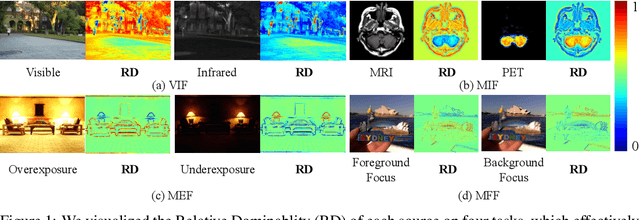
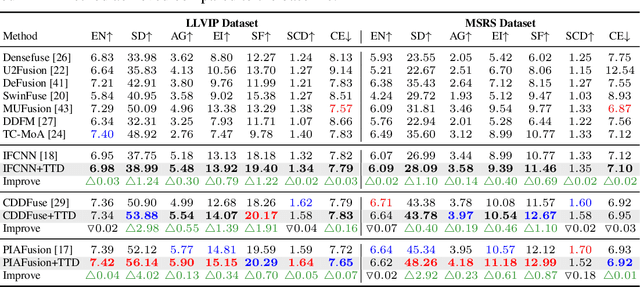
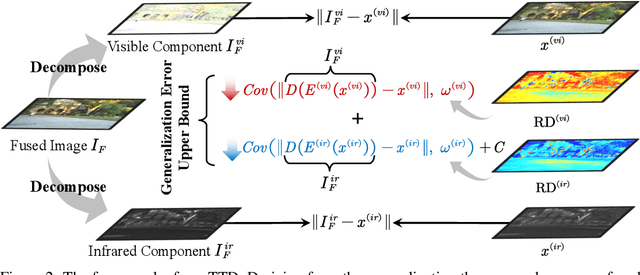
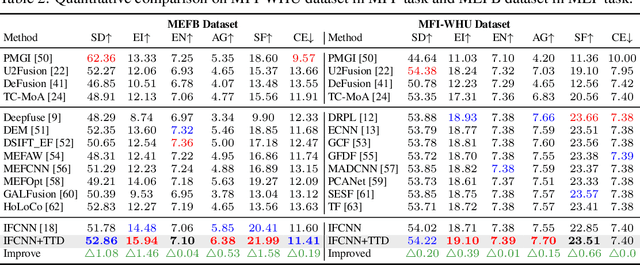
The inherent challenge of image fusion lies in capturing the correlation of multi-source images and comprehensively integrating effective information from different sources. Most existing techniques fail to perform dynamic image fusion while notably lacking theoretical guarantees, leading to potential deployment risks in this field. Is it possible to conduct dynamic image fusion with a clear theoretical justification? In this paper, we give our solution from a generalization perspective. We proceed to reveal the generalized form of image fusion and derive a new test-time dynamic image fusion paradigm. It provably reduces the upper bound of generalization error. Specifically, we decompose the fused image into multiple components corresponding to its source data. The decomposed components represent the effective information from the source data, thus the gap between them reflects the Relative Dominability (RD) of the uni-source data in constructing the fusion image. Theoretically, we prove that the key to reducing generalization error hinges on the negative correlation between the RD-based fusion weight and the uni-source reconstruction loss. Intuitively, RD dynamically highlights the dominant regions of each source and can be naturally converted to the corresponding fusion weight, achieving robust results. Extensive experiments and discussions with in-depth analysis on multiple benchmarks confirm our findings and superiority. Our code is available at https://github.com/Yinan-Xia/TTD.
Predictive Dynamic Fusion
Jun 07, 2024Multimodal fusion is crucial in joint decision-making systems for rendering holistic judgments. Since multimodal data changes in open environments, dynamic fusion has emerged and achieved remarkable progress in numerous applications. However, most existing dynamic multimodal fusion methods lack theoretical guarantees and easily fall into suboptimal problems, yielding unreliability and instability. To address this issue, we propose a Predictive Dynamic Fusion (PDF) framework for multimodal learning. We proceed to reveal the multimodal fusion from a generalization perspective and theoretically derive the predictable Collaborative Belief (Co-Belief) with Mono- and Holo-Confidence, which provably reduces the upper bound of generalization error. Accordingly, we further propose a relative calibration strategy to calibrate the predicted Co-Belief for potential uncertainty. Extensive experiments on multiple benchmarks confirm our superiority. Our code is available at https://github.com/Yinan-Xia/PDF.