 Add to Chrome
 Add to Firefox
 Add to Edge
TEMPO: Scaling Test-time Training for Large Reasoning Models
Apr 21, 2026
Test-time training (TTT) adapts model parameters on unlabeled test instances during inference time, which continuously extends capabilities beyond the reach of offline training. Despite initial gains, existing TTT methods for LRMs plateau quickly and do not benefit from additional test-time compute. Without external calibration, the self-generated reward signal increasingly drifts as the policy model evolves, leading to both performance plateaus and diversity collapse. We propose TEMPO, a TTT framework that interleaves policy refinement on unlabeled questions with periodic critic recalibration on a labeled dataset. By formalizing this alternating procedure through the Expectation-Maximization (EM) algorithm, we reveal that prior methods can be interpreted as incomplete variants that omit the crucial recalibration step. Reintroducing this step tightens the evidence lower bound (ELBO) and enables sustained improvement. Across diverse model families (Qwen3 and OLMO3) and reasoning tasks, TEMPO improves OLMO3-7B on AIME 2024 from 33.0% to 51.1% and Qwen3-14B from 42.3% to 65.8%, while maintaining high diversity.

COME: Test-time adaption by Conservatively Minimizing Entropy
Oct 12, 2024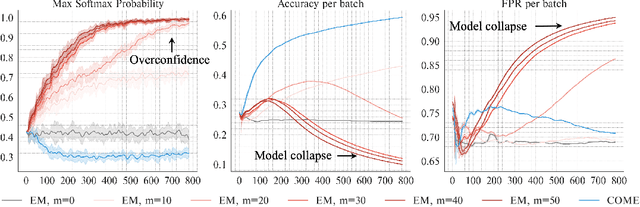
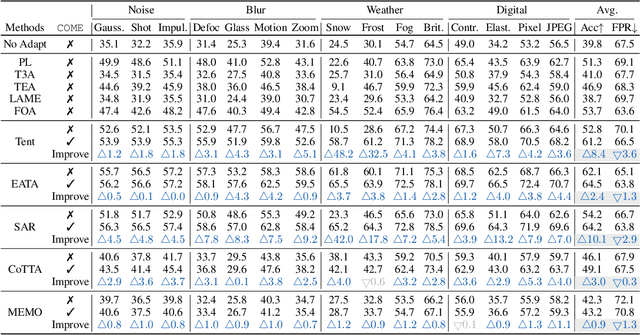
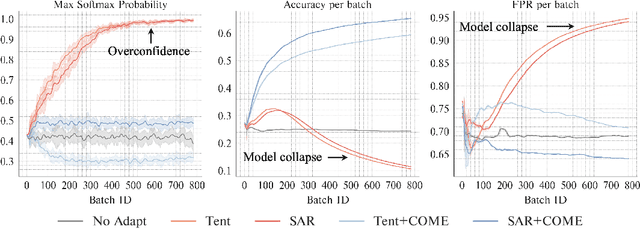
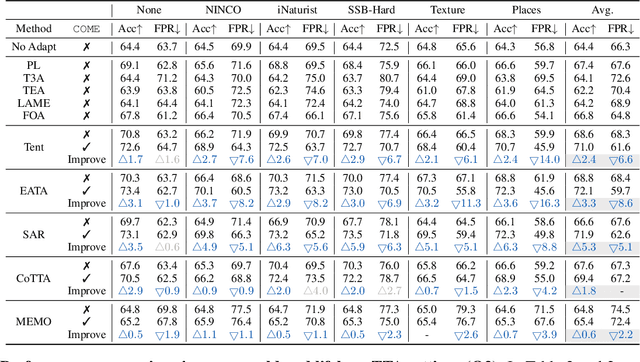
Machine learning models must continuously self-adjust themselves for novel data distribution in the open world. As the predominant principle, entropy minimization (EM) has been proven to be a simple yet effective cornerstone in existing test-time adaption (TTA) methods. While unfortunately its fatal limitation (i.e., overconfidence) tends to result in model collapse. For this issue, we propose to Conservatively Minimize the Entropy (COME), which is a simple drop-in replacement of traditional EM to elegantly address the limitation. In essence, COME explicitly models the uncertainty by characterizing a Dirichlet prior distribution over model predictions during TTA. By doing so, COME naturally regularizes the model to favor conservative confidence on unreliable samples. Theoretically, we provide a preliminary analysis to reveal the ability of COME in enhancing the optimization stability by introducing a data-adaptive lower bound on the entropy. Empirically, our method achieves state-of-the-art performance on commonly used benchmarks, showing significant improvements in terms of classification accuracy and uncertainty estimation under various settings including standard, life-long and open-world TTA, i.e., up to $34.5\%$ improvement on accuracy and $15.1\%$ on false positive rate.