 Add to Chrome
 Add to Firefox
 Add to Edge
Multi-view MERA Subspace Clustering
May 16, 2023
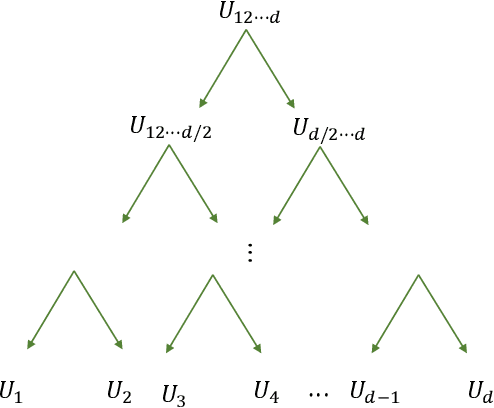
Tensor-based multi-view subspace clustering (MSC) can capture high-order correlation in the self-representation tensor. Current tensor decompositions for MSC suffer from highly unbalanced unfolding matrices or rotation sensitivity, failing to fully explore inter/intra-view information. Using the advanced tensor network, namely, multi-scale entanglement renormalization ansatz (MERA), we propose a low-rank MERA based MSC (MERA-MSC) algorithm, where MERA factorizes a tensor into contractions of one top core factor and the rest orthogonal/semi-orthogonal factors. Benefiting from multiple interactions among orthogonal/semi-orthogonal (low-rank) factors, the low-rank MERA has a strong representation power to capture the complex inter/intra-view information in the self-representation tensor. The alternating direction method of multipliers is adopted to solve the optimization model. Experimental results on five multi-view datasets demonstrate MERA-MSC has superiority against the compared algorithms on six evaluation metrics. Furthermore, we extend MERA-MSC by incorporating anchor learning to develop a scalable low-rank MERA based multi-view clustering method (sMREA-MVC). The effectiveness and efficiency of sMERA-MVC have been validated on three large-scale multi-view datasets. To our knowledge, this is the first work to introduce MERA to the multi-view clustering topic. The codes of MERA-MSC and sMERA-MVC are publicly available at https://github.com/longzhen520/MERA-MSC.

Illumination-insensitive Binary Descriptor for Visual Measurement Based on Local Inter-patch Invariance
May 13, 2023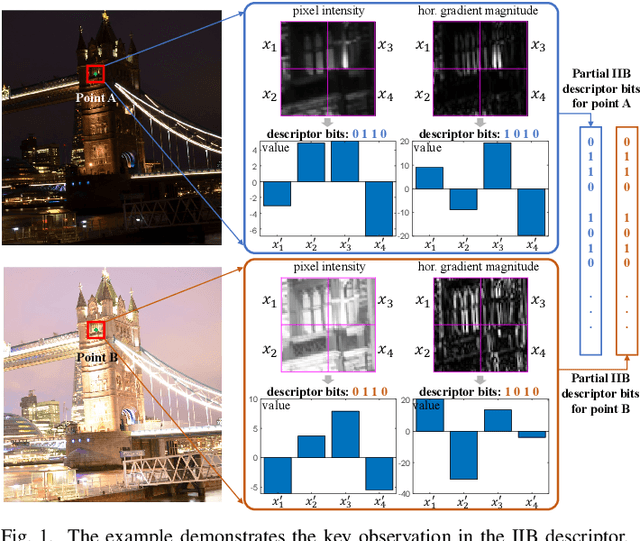


Binary feature descriptors have been widely used in various visual measurement tasks, particularly those with limited computing resources and storage capacities. Existing binary descriptors may not perform well for long-term visual measurement tasks due to their sensitivity to illumination variations. It can be observed that when image illumination changes dramatically, the relative relationship among local patches mostly remains intact. Based on the observation, consequently, this study presents an illumination-insensitive binary (IIB) descriptor by leveraging the local inter-patch invariance exhibited in multiple spatial granularities to deal with unfavorable illumination variations. By taking advantage of integral images for local patch feature computation, a highly efficient IIB descriptor is achieved. It can encode scalable features in multiple spatial granularities, thus facilitating a computationally efficient hierarchical matching from coarse to fine. Moreover, the IIB descriptor can also apply to other types of image data, such as depth maps and semantic segmentation results, when available in some applications. Numerical experiments on both natural and synthetic datasets reveal that the proposed IIB descriptor outperforms state-of-the-art binary descriptors and some testing float descriptors. The proposed IIB descriptor has also been successfully employed in a demo system for long-term visual localization. The code of the IIB descriptor will be publicly available.
* Accepted by IEEE Transactions on Instrumentation and Measurement
Level-line Guided Edge Drawing for Robust Line Segment Detection
May 10, 2023Line segment detection plays a cornerstone role in computer vision tasks. Among numerous detection methods that have been recently proposed, the ones based on edge drawing attract increasing attention owing to their excellent detection efficiency. However, the existing methods are not robust enough due to the inadequate usage of image gradients for edge drawing and line segment fitting. Based on the observation that the line segments should locate on the edge points with both consistent coordinates and level-line information, i.e., the unit vector perpendicular to the gradient orientation, this paper proposes a level-line guided edge drawing for robust line segment detection (GEDRLSD). The level-line information provides potential directions for edge tracking, which could be served as a guideline for accurate edge drawing. Additionally, the level-line information is fused in line segment fitting to improve the robustness. Numerical experiments show the superiority of the proposed GEDRLSD algorithm compared with state-of-the-art methods.
* Accepted by ICASSP 2023
Adaptively Topological Tensor Network for Multi-view Subspace Clustering
May 01, 2023Multi-view subspace clustering methods have employed learned self-representation tensors from different tensor decompositions to exploit low rank information. However, the data structures embedded with self-representation tensors may vary in different multi-view datasets. Therefore, a pre-defined tensor decomposition may not fully exploit low rank information for a certain dataset, resulting in sub-optimal multi-view clustering performance. To alleviate the aforementioned limitations, we propose the adaptively topological tensor network (ATTN) by determining the edge ranks from the structural information of the self-representation tensor, and it can give a better tensor representation with the data-driven strategy. Specifically, in multi-view tensor clustering, we analyze the higher-order correlations among different modes of a self-representation tensor, and prune the links of the weakly correlated ones from a fully connected tensor network. Therefore, the newly obtained tensor networks can efficiently explore the essential clustering information with self-representation with different tensor structures for various datasets. A greedy adaptive rank-increasing strategy is further applied to improve the capture capacity of low rank structure. We apply ATTN on multi-view subspace clustering and utilize the alternating direction method of multipliers to solve it. Experimental results show that multi-view subspace clustering based on ATTN outperforms the counterparts on six multi-view datasets.
A Comprehensive Review of Image Line Segment Detection and Description: Taxonomies, Comparisons, and Challenges
Apr 29, 2023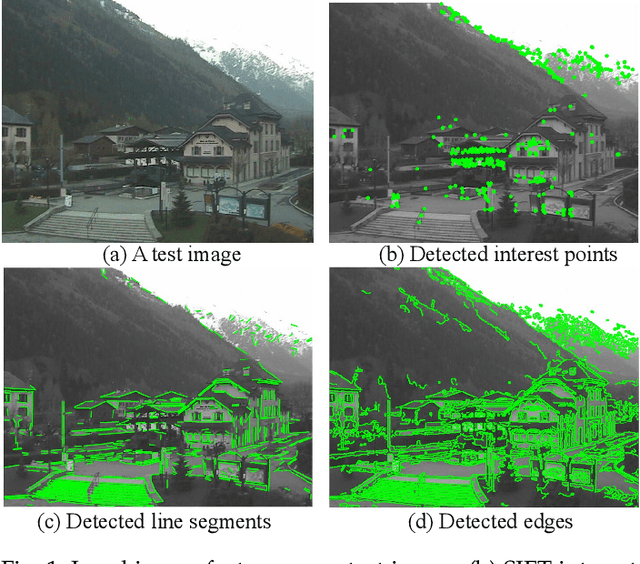
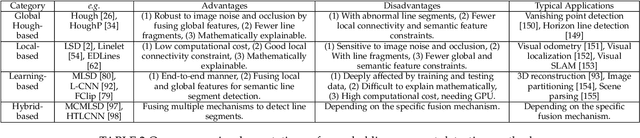
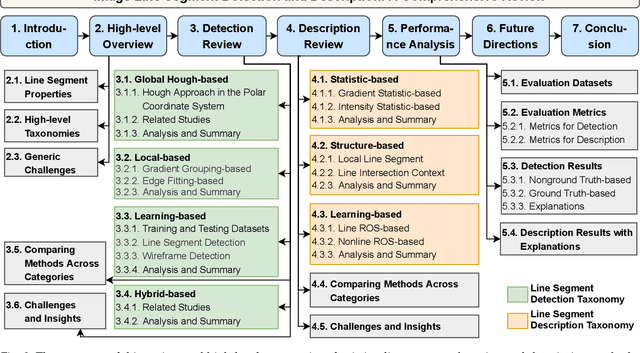
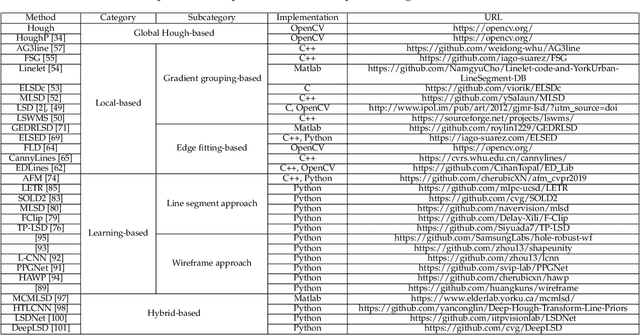
Detection and description of line segments lay the basis for numerous vision tasks. Although many studies have aimed to detect and describe line segments, a comprehensive review is lacking, obstructing their progress. This study fills the gap by comprehensively reviewing related studies on detecting and describing two-dimensional image line segments to provide researchers with an overall picture and deep understanding. Based on their mechanisms, two taxonomies for line segment detection and description are presented to introduce, analyze, and summarize these studies, facilitating researchers to learn about them quickly and extensively. The key issues, core ideas, advantages and disadvantages of existing methods, and their potential applications for each category are analyzed and summarized, including previously unknown findings. The challenges in existing methods and corresponding insights for potentially solving them are also provided to inspire researchers. In addition, some state-of-the-art line segment detection and description algorithms are evaluated without bias, and the evaluation code will be publicly available. The theoretical analysis, coupled with the experimental results, can guide researchers in selecting the best method for their intended vision applications. Finally, this study provides insights for potentially interesting future research directions to attract more attention from researchers to this field.
Low Rank Optimization for Efficient Deep Learning: Making A Balance between Compact Architecture and Fast Training
Mar 22, 2023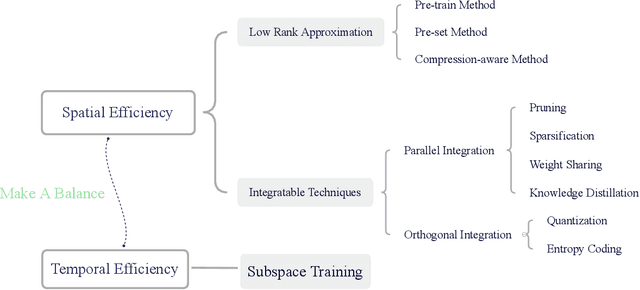
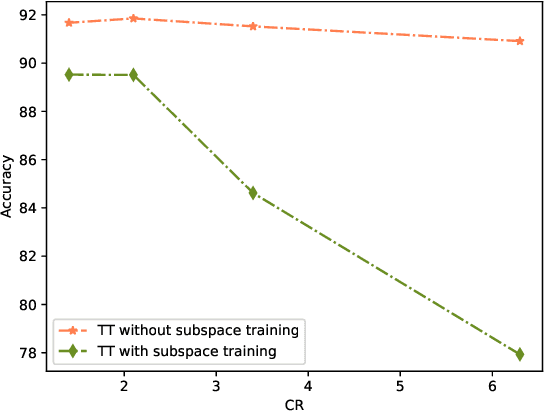
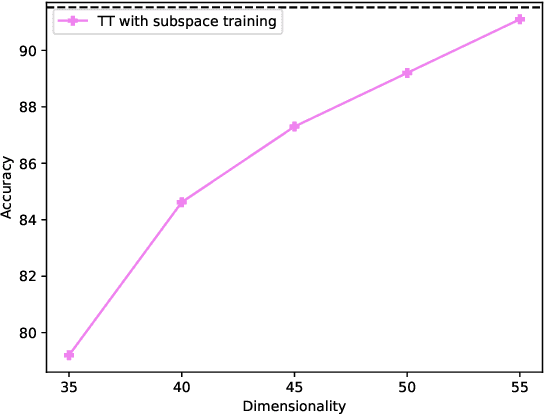
Deep neural networks have achieved great success in many data processing applications. However, the high computational complexity and storage cost makes deep learning hard to be used on resource-constrained devices, and it is not environmental-friendly with much power cost. In this paper, we focus on low-rank optimization for efficient deep learning techniques. In the space domain, deep neural networks are compressed by low rank approximation of the network parameters, which directly reduces the storage requirement with a smaller number of network parameters. In the time domain, the network parameters can be trained in a few subspaces, which enables efficient training for fast convergence. The model compression in the spatial domain is summarized into three categories as pre-train, pre-set, and compression-aware methods, respectively. With a series of integrable techniques discussed, such as sparse pruning, quantization, and entropy coding, we can ensemble them in an integration framework with lower computational complexity and storage. Besides of summary of recent technical advances, we have two findings for motivating future works: one is that the effective rank outperforms other sparse measures for network compression. The other is a spatial and temporal balance for tensorized neural networks.
Tensorized LSSVMs for Multitask Regression
Mar 04, 2023Multitask learning (MTL) can utilize the relatedness between multiple tasks for performance improvement. The advent of multimodal data allows tasks to be referenced by multiple indices. High-order tensors are capable of providing efficient representations for such tasks, while preserving structural task-relations. In this paper, a new MTL method is proposed by leveraging low-rank tensor analysis and constructing tensorized Least Squares Support Vector Machines, namely the tLSSVM-MTL, where multilinear modelling and its nonlinear extensions can be flexibly exerted. We employ a high-order tensor for all the weights with each mode relating to an index and factorize it with CP decomposition, assigning a shared factor for all tasks and retaining task-specific latent factors along each index. Then an alternating algorithm is derived for the nonconvex optimization, where each resulting subproblem is solved by a linear system. Experimental results demonstrate promising performances of our tLSSVM-MTL.
FedTADBench: Federated Time-Series Anomaly Detection Benchmark
Dec 19, 2022


Time series anomaly detection strives to uncover potential abnormal behaviors and patterns from temporal data, and has fundamental significance in diverse application scenarios. Constructing an effective detection model usually requires adequate training data stored in a centralized manner, however, this requirement sometimes could not be satisfied in realistic scenarios. As a prevailing approach to address the above problem, federated learning has demonstrated its power to cooperate with the distributed data available while protecting the privacy of data providers. However, it is still unclear that how existing time series anomaly detection algorithms perform with decentralized data storage and privacy protection through federated learning. To study this, we conduct a federated time series anomaly detection benchmark, named FedTADBench, which involves five representative time series anomaly detection algorithms and four popular federated learning methods. We would like to answer the following questions: (1)How is the performance of time series anomaly detection algorithms when meeting federated learning? (2) Which federated learning method is the most appropriate one for time series anomaly detection? (3) How do federated time series anomaly detection approaches perform on different partitions of data in clients? Numbers of results as well as corresponding analysis are provided from extensive experiments with various settings. The source code of our benchmark is publicly available at https://github.com/fanxingliu2020/FedTADBench.
Deep Negative Correlation Classification
Dec 14, 2022Ensemble learning serves as a straightforward way to improve the performance of almost any machine learning algorithm. Existing deep ensemble methods usually naively train many different models and then aggregate their predictions. This is not optimal in our view from two aspects: i) Naively training multiple models adds much more computational burden, especially in the deep learning era; ii) Purely optimizing each base model without considering their interactions limits the diversity of ensemble and performance gains. We tackle these issues by proposing deep negative correlation classification (DNCC), in which the accuracy and diversity trade-off is systematically controlled by decomposing the loss function seamlessly into individual accuracy and the correlation between individual models and the ensemble. DNCC yields a deep classification ensemble where the individual estimator is both accurate and negatively correlated. Thanks to the optimized diversities, DNCC works well even when utilizing a shared network backbone, which significantly improves its efficiency when compared with most existing ensemble systems. Extensive experiments on multiple benchmark datasets and network structures demonstrate the superiority of the proposed method.
Efficient and Accurate Quantized Image Super-Resolution on Mobile NPUs, Mobile AI & AIM 2022 challenge: Report
Nov 07, 2022

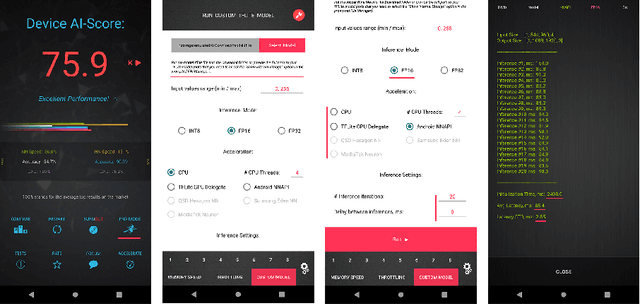
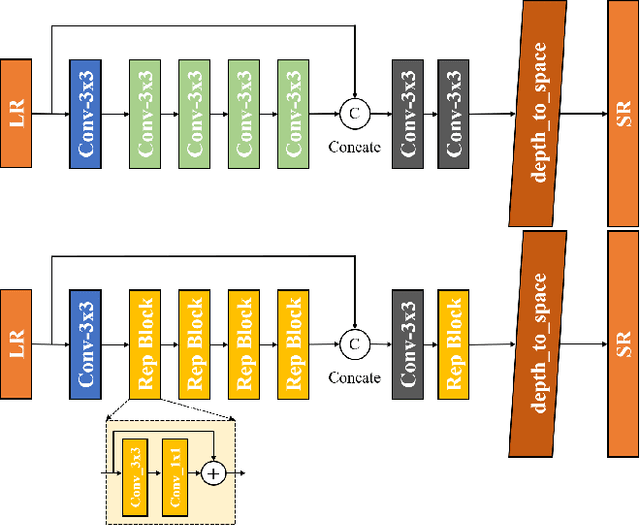
Image super-resolution is a common task on mobile and IoT devices, where one often needs to upscale and enhance low-resolution images and video frames. While numerous solutions have been proposed for this problem in the past, they are usually not compatible with low-power mobile NPUs having many computational and memory constraints. In this Mobile AI challenge, we address this problem and propose the participants to design an efficient quantized image super-resolution solution that can demonstrate a real-time performance on mobile NPUs. The participants were provided with the DIV2K dataset and trained INT8 models to do a high-quality 3X image upscaling. The runtime of all models was evaluated on the Synaptics VS680 Smart Home board with a dedicated edge NPU capable of accelerating quantized neural networks. All proposed solutions are fully compatible with the above NPU, demonstrating an up to 60 FPS rate when reconstructing Full HD resolution images. A detailed description of all models developed in the challenge is provided in this paper.